


Everyone remembers GoldenEye for its bungee jump. It is the stunt that introduced Pierce Brosnan as James Bond: a sheer concrete dam, a silent fall, a rope snapping tight at the last moment. It is routinely cited as one of the great pre-title stunts in the franchise.
But it is not the only major stunt in that opening sequence.
In the wake of renewed attention on extreme, practical stunts — most notably Tom Cruise’s motorbike BASE jump in Mission: Impossible – Dead Reckoning — it is worth noting that James Bond–or at least his stuntmen–had already performed this stunt decades earlier, as the climactic stunt at the end of Goldeneye’s pretitle sequence.
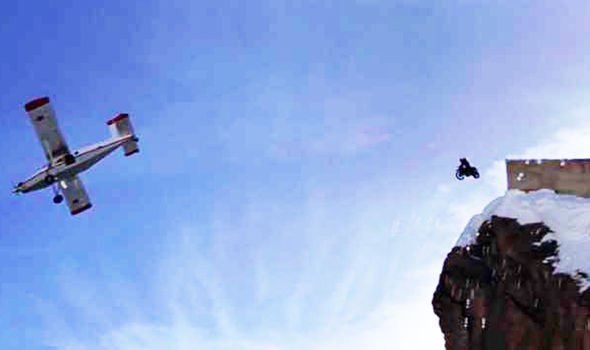
After using a bungee jump to infiltrate the Arkangel chemical weapons facility, Bond evades Russian forces by driving a motorbike off a cliff and BASE jumping after a pilotless aircraft. When the moment is mentioned at all, it is usually reduced to criticism of the finale, in which Bond — in freefall — catches up to a pilotless plane. This moment is often dismissed as an example of mid-1990s CGI excess.
That reaction obscures the reality of the motorbike BASE jump, performed off an actual precipice, and requiring a purpose-built ramp, repeated live attempts, and two different stunt specialists to complete the sequence safely. The stunt has become all but forgotten, partly because of the little promotion it received, an idea, it seems, to surprise the audience like 1977’s skiBASE jump at the end of the pretitle sequence in The Spy Who Loved Me.
Two Stunts, Two Specialists
The stunt was a composite of two distinct physical feats, performed by two specialists with different expertise.
The motorbike-off-the-cliff BASE jump was performed by Jacques “Zoo” Malnuit, who was brought in to take the motorcycle over the edge of Tällistock Mountain in Switzerland and transition immediately into freefall. Long-time Bond stunt veteran, B.J. Worth, who designed and executed the aerial elements of the sequence, performed another freefall in front of the Eiger, to give a different camera perspective to the stunt.
Pierce Brosnan Catches Up To The Plane
The most controversial moment — Bond catching the falling plane — was ultimately completed with visual effects.
In 2020, Brosnan recorded a watch-along commentary track for GoldenEye in which he explained that some of the shots in the sequence were indeed him:
“Now that is me, they had to make a body cast. The prop man came into my dressing room one day, George and Frank said, ‘Right Pierce, here we go, we’re gonna do a body cast. All right, lie like this,’ and they had me lie across the sofa and they took a cast of my chest. I didn’t quite understand what it was for, they said it was something related to this part of the film. Anyways, many months later on the backlot, they had my body cast on a pole and I lay on the body cast and assume the position, as it were, so I could fly through the air and catch the plane.”
The body cast shots were filmed against a rear projection screen of real footage of the mountain with Pierce Brosnan and a plane suspended in front of it.
That decision has come to dominate discussion of the scene, with some even calling it bad CGI. Well, apparently it wasn’t CGI, and personally I always found the criticism unfair. It’s a good effect even today.
Building the Ramp — and Waiting for Winter
Like the similar motorbike BASE jump in Dead Reckoning, GoldenEye’s motorbike jump required a constructed ramp on the mountain precipice. The production built the ramp months in advance, installing it in the autumn and then waiting for winter conditions before filming.
The timing was deliberate. Snow altered the visual continuity of the location and helped integrate the jump into the surrounding landscape. The ramp itself had to be strong enough to withstand months of exposure and precise enough to deliver the bike at a controlled angle and speed.
The logistics did not end once the stunt was captured. Producer Michael G. Wilson recalled that preservation of the pristine natural environment was paramount in filming:
“We had [stuntman] Jacques Malnuit go off on his motorbike and open his parachute. We did that for real. Every time they had just enough petrol in the tank so they’d literally run out of gas when they ran off, for ecological reasons because they didn’t want to damage the environment.”
Repetition, Not Recklessness
The jump was not achieved in a single take. Malnuit reportedly went over the edge multiple times — around seven runs — to capture usable material. Each attempt demanded precision: maintaining speed, committing fully to the launch, separating cleanly from the bike, and deploying the parachute while clearing the rock face.
In this respect, the stunt quietly anticipates the modern methodology popularised decades later by Cruise. It relied on repetition, incremental refinement, and engineering certainty rather than gambling everything on one heroic leap. Cruise performed his jump six times.
The difference is not one of courage or ambition, but of intent. GoldenEye was not trying to prove that its leading man performed the stunt himself. It was trying to stage the cleanest, safest, practical version possible and then integrate it invisibly into the story.
Why the Stunt Was Forgotten
Part of the reason the sequence is often remembered poorly lies not in how it was staged, but in how it was framed. Unlike GoldenEye’s bungee jump — which was heavily promoted, documented, and repeatedly referenced in publicity — the motorbike BASE jump was never foregrounded in behind-the-scenes material. There was no dedicated featurette explaining how it was built, no sustained effort to highlight where it was filmed or how the ramp functioned. Though it does appear at the end of the theatrical trailer.
This lack of promotion may not have been an oversight so much as a deliberate choice. Like the ski-BASE jump in The Spy Who Loved Me, which undoubtedly inspired the BASE jump in GoldenEye, the moment arrives suddenly, staged in wide shot, stripped of musical emphasis, and allowed to speak for itself. It has a similar visual and audio grammar to 1977’s iconic stunt.
In 1977, that approach famously drew cheers from audiences. In 1995, the motorbike BASE jump passed without the same cultural aftershock. It seems EON Productions was relying on surprise, expecting a similar response by audiences almost two decades later.
A Clear Line to Dead Reckoning
Seen now, especially in light of Dead Reckoning, GoldenEye’s motorbike BASE jump reads as an important transitional moment in stunt cinema. It sits between eras: still dependent on wide framing and concealment of the stuntmen, but already attempting something genuinely extreme with motorcycles, cliffs, and freefall.
Cruise’s stunt benefits from modern tools — close-proximity cameras, drones, computer modelling, and an insistence on proof. But the underlying principles are strikingly similar. Both required engineered ramps, repeated live attempts, precise control of separation and trajectory, and an acceptance that the geography itself was the primary antagonist.
If Dead Reckoning represents the most transparent version of this kind of stunt, GoldenEye represents an earlier, more concealed chapter in the same tradition.
Respect, Restored
GoldenEye’s motorbike BASE jump does not deserve to be overshadowed by a bungee cord or dismissed because of a single effects-heavy moment. It deserves recognition as one of the most ambitious physical stunts of the Brosnan era — a sequence built around real risk, real preparation, and real human skill.
James Bond did it first.
Tom Cruise did it again, with improved equipment and the increased stakes of having the film’s star perform the stunt.
Both belong in the same conversation.