


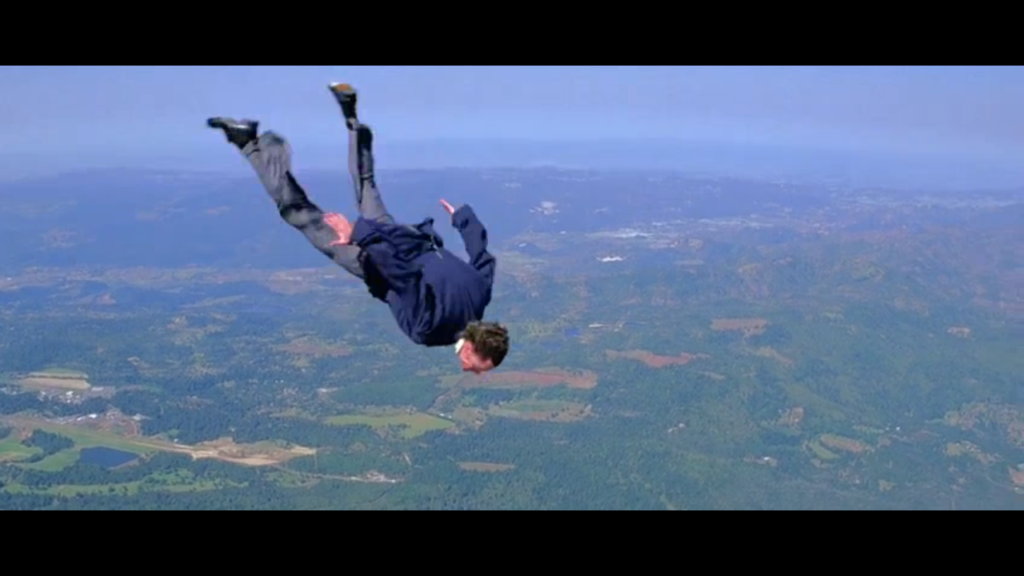
In the heart-stopping opening sequence of 1979’s Moonraker, James Bond is pushed out of a plane without a parachute.
This is long before CGI, long before Marvel did such scenes with computers. Everything is done for real, except the stuntman doubling as Bond is wearing a parachute concealed underneath a special jacket that breaks away when the chute is deployed.
Bond (doubled by Jake Lombard) dives through the air in order to catch up with the only other person wearing a parachute–the villainous pilot Bond fought with onboard before being pushed out of the plane by henchman Jaws (Richard Kiel).
Bond catches the pilot. The two engage in a midair fight, as Bond wrestles the chute from the guy’s back, and then kicks him in the face sending the villain to his death. It was a thrilling scene in 1979 and remains a highlight of the Bond opening action sequences today.
What we’re seeing is a series of firsts in this sequence that redefined skydiving scenes in action movies to this day.
This iconic freefall scene essentially crafted the blueprint that subsequent action films would follow in their own skydiving sequences.
Apart from the special lightweight camera mounted on freefalling cameraman Rande DeLuca’s helmet, this sequence established a now-familiar three-act structure for skydiving scenes that other films like Point Break, Terminal Velocity, and Mission: Impossible–Fallout would follow decades later:
- The Initial Freefall: The protagonist is thrown or jumps from a significant altitude, often unexpectedly or under duress.
- The Mid-Air Confrontation: A struggle or challenge occurs at terminal velocity. This could involve a fight, a chase, or an attempt to secure vital equipment.
- The Desperate Descent: The final, rapid descent towards the ground, where the hero narrowly escapes death and/or the villain meets a gruesome end.
We really want to zero in on the Mid-Air Confrontation.
The part of the fall, where Bond and the pilot are fighting, occurs at terminal velocity – a point where the force of gravity is balanced by the resistance of the air, creating a sensation of floating or hovering.
In this zone, cameramen, and the two stunt people are falling at an even rate and appear to be hovering in midair.
Moonraker’s Template in Later Films
The influence of Moonraker‘s template is evident in numerous later films that feature skydiving sequences. Here are a few notable examples:
- Mission: Impossible – Fallout (2018): The HALO (High Altitude, Low Opening) jump scene in Mission: Impossible – Fallout is a clear descendant of Moonraker. Ethan Hunt and his team perform a complex skydive to infiltrate a target, which involves a mid-air rendezvous, combat, and a race against time to deploy their parachutes before hitting the ground. The sequence adheres to the Moonraker template: the initial freefall from an extreme height, the tense mid-air interaction, and the final, rapid descent with a high risk of failure.
- Drop Zone (1994): This action film starring Wesley Snipes features multiple skydiving sequences, some of which mirror the Moonraker structure. While the film focuses on a group of skydiving criminals, there are scenes involving freefall, struggles in mid-air, and dangerous descents.
- Terminal Velocity (1994): Starring Charlie Sheen, this film is filled with skydiving action. Several scenes follow the template, including moments where characters fight or attempt to gain control of parachutes during freefall, followed by dramatic, near-fatal landings.
The no-parachute sequence in Moonraker took 88 real skydives to complete, and changed skydiving action sequences forever.
Before Moonraker, skydiving sequences were rather tepid, lacking the exciting and suspense that Moonraker introduced. Of course, Bond had already performed a death-defying parachute stunt before, in the previous Bond film, The Spy Who Loved Me, which would go on to inspired many BASEjump action sequences in future films, including Tom Cruise’s bike jump off a precipice in Mission: Impossible–Dead Reckoning.
However, Moonraker’s astounding pre-title sequence represented a seismic shift in how skydiving action sequences were made that last to this day.