


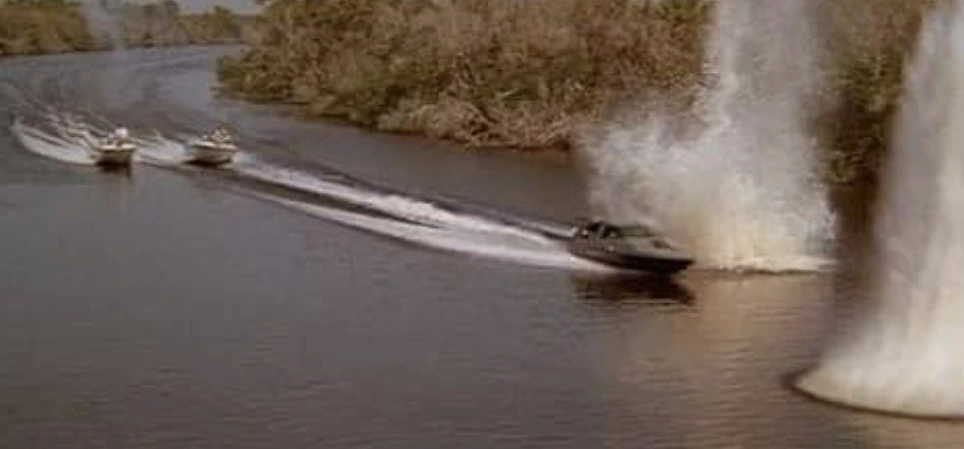
John Richardson hangs beneath a helicopter over Iguaçu Falls when he hears the stitching in his harness begin to go.
Ping. Ping. Ping. Ping.
Below him is a 350-foot drop, a half-ton dummy Glastron speedboat wedged on rocks at the lip of one of the falls. This is the Bond production’s attempt to film a boat going over one of the world’s most spectacular waterfalls as the climax of a speedboat chase. In Moonraker, the falls appear on screen for less than a minute. Getting even that much almost kills Richardson, in a stunt that is more dangerous than the one they want to film.
Iguaçu Falls was the location, stretching 2,700 metres (1.7 miles) making it the widest waterfall system in the world, though consisting of multiple broken cascades rather than a single curtain. Taller than Niagara Falls and second only to Victoria Falls in overall scale, it is an irresistible location for a Bond climax. Moonraker‘s associate producer Bill Cartlidge admitted as much in the documentary Inside Moonraker:
“We went to Brazil in the first place because of this unique location at Iguazu Falls.”
In other words, the location came first. Conceiving an action sequence around the location came later.
Bond films have always been ambitious. Picking a dangerous location to film is exactly the point: placing Bond, his stuntmen, or in this case a member of the special effects crew in genuine peril, is precisely what kept the franchise at the top of the action genre.
From that starting point, EON Productions did what the Bond crew often do: wrote everything else around that signature location. The falls demanded a boat going over the edge. The boat going over the edge demanded a climactic escape for Bond. The escape demanded a hang glider concealed within the hardtop of Bond’s boat. The boat demanded a gadget arsenal. The gadget arsenal dictated the pursuing boats and the order in which each would be destroyed. Reverse engineering a sequence around a location is Bond’s modus operandi.
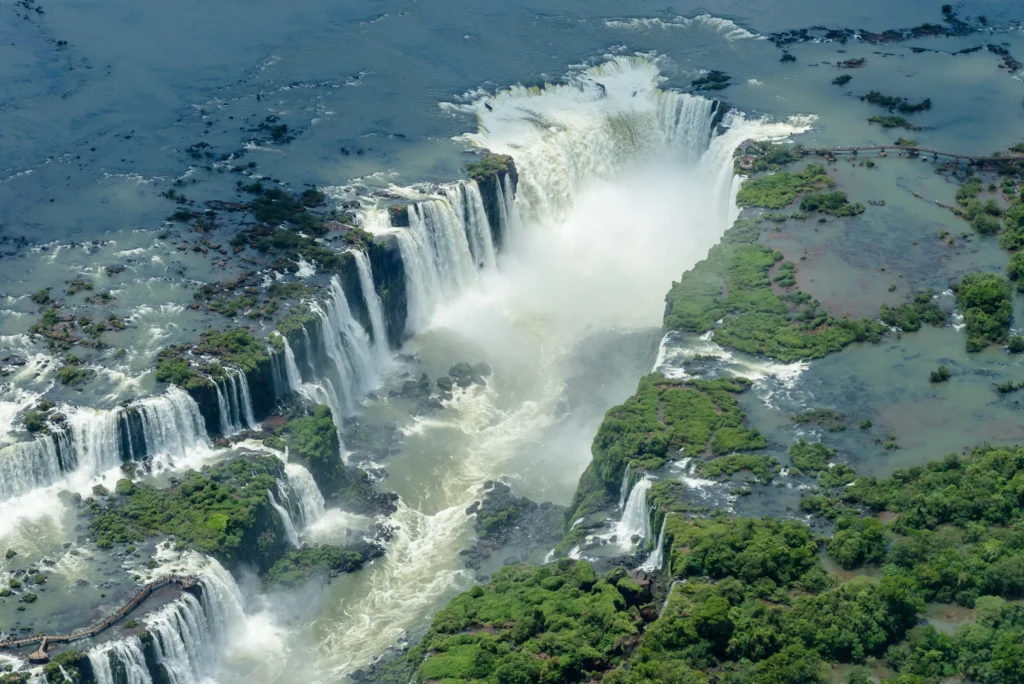

Situated on the Iguazu River at the Triple Frontier where Argentina, Brazil and Paraguay converge, Iguaçu drops, depending on the measurement point, somewhere between two hundred and three hundred and fifty feet. The perfect location for boat nosediving off a waterfall.
Apart from natural danger, the problem was also political geography. The falls border three countries that, in 1978, were barely on speaking terms. Brazil and Paraguay signed the Treaty of Itaipu in 1973, and authorised the construction of the massive Itaipu hydroelectric dam on the Paraná River, which is downstream from the falls.
Argentina believed the dam threatened its own hydropower plans. But Brazil said they would build the dam regardless, and Brazil’s foreign minister threatened war if Argentina tried to stop it. All three countries eventually agreed to the dam, signing the Tripartite Agreement in October 1979. By then, Moonraker had already been filming in the location for months.
Despite the potential for conflict, Bill Cartlidge asked for overflying permission from all three governments. Permission was granted but in the end it wasn’t even needed.
Eon needed a helicopter to capture hang gliding over the falls and at least one speedboat taking a nosedive off the falls, potentially ending up in one of those three countries. It was a jurisdiction nightmare, topped only by the perilous logistics of filming the stunt.
Glastron: The Boat Brand of the Roger Moore Era
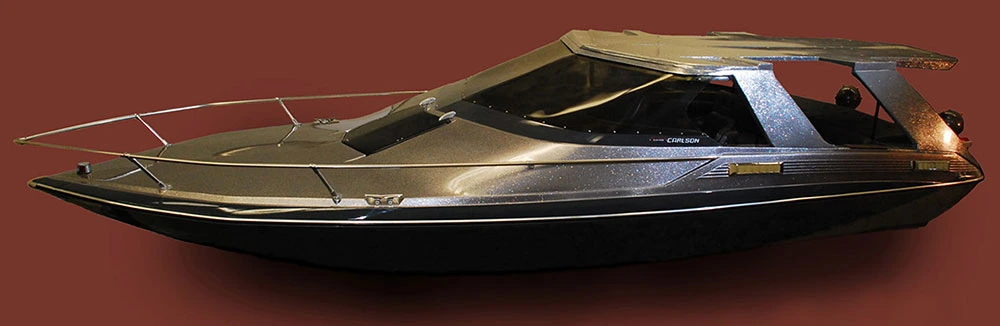

Continuing the relationship begun with Live and Let Die, where Glastron supplied the boats for Bond’s Louisiana chase, EON received a silver CV23HT for Bond and multiple SSV-189s for Drax’s pursuing henchmen.
The CV23HT was the obvious choice for Bond’s hero boat. HT means the boat has a fibreglass hardtop cabin. It is the only Glastron boat with an enclosed roof, a feature that is the only plausible location to conceal a folding delta-wing hang glider.
Only 300 were built from 1978 to 1979, making CV23HT one of the rarest Glastron models. From there, the number painted silver metalflake over gray exclusively for the film were even rarer (either three or four depending on what source you read), while the rest were painted either metalflake blue or metalflake bronze gelcoat. Production records that confirm the exact number were lost in a fire.
Today, one silver metalflake CV23HT is known to survive. Owned by the Ian Fleming Foundation, this surviving boat is often on display at Bond in Motion.
The pursuing SSV-189s were lighter, open-hulled craft and would soon be fitted explosives by Richardson for their high-speed demise. The SSV hull design, unlike the CV23HT, remains on sale to this day. Glastron boats only ever featured in Moore’s Bond films, first in Live and Let Die, followed by Moonraker, and for a final time A View to a Kill in 1985.
The Continent-Hopping Geography of the Chase
The boat chase and Bond’s discovery of a Mayan pyramid complex near the falls that houses Drax’s base is shown in three locations separated by vast geographical distance.
The falls featured in the chase are not meant to be Iguaçu Falls themselves, because they do not flow on from the River Tapirapé, nor is there a Mayan pyramid complex nearby. Drax’s jungle lair — a pyramid glimpsed briefly near the falls — was filmed at the Tikal Mayan ruins in Guatemala — approximately 6,000 miles apart.
The River Tapirapé, named in the film as Bond’s destination in Brazil, is real — a river in Brazil’s Mato Grosso state, a tributary of the Araguaia in the Amazon basin — and 1,400 miles away from Iguaçu Falls. Bond is sent there to locate a rare orchid, the source of the nerve agent with which Drax intends to wipe out humanity. The Tapirapé does not lead to Iguaçu Falls, which drains an entirely separate river system into the Paraná, not the Amazon.
And the river used in filming was not the River Tapirapé either — it was in another country entirely, the St. Lucie River in Florida, United States.
The action sequence was written around these locations. It is the Bond series doing what it has always done — borrowing real and spectacular landmarks and placing them wherever the film requires.
The St. Lucie River in Florida had the requisite tributaries to film a chase filled with boats pursuing Bond and travelling down winding channels to intercept him. Its lush tropical vegetation meant it doubled for the jungle environment around Iguaçu Falls well enough to convince audiences they are watching a single, continuous location.
Q Branch on Water: Turning the Boat Into a Floating War Machine
Bond’s methods of disposing of his assailants come directly from Q Branch, with an arsenal that reworks the tricked-out Little Nellie autogyro from You Only Live Twice for the water. Aerial mines become floating mines. The heat-seeking missile becomes a radio-controlled torpedo. But the true novelty is the folding delta-wing hang glider concealed inside the hardtop cabin roof of the Glastron CV23HT.
There is a real structure to Bond action sequences. They’re carefully choreographed around location and gadgets. The boat is not merely a vehicle. It is a delivery system for escalating surprises: first evasion, then counterattack, then the destruction of assailants one by one, with each becoming bigger and more explosive than the last. Then there is the surprise of either transformation, the use of a signature gadget, and/or one final big stunt that forms the climax of the chase — in this case Bond escaping through transformation, by hang glider, as his boat goes over the falls.
Those gadgets not only form the structure of the chase but are reminiscent of previous chases such as the Aston Martin DB5 chase in Goldfinger and the aforementioned autogyro aerial battle in You Only Live Twice. They are distinct enough — one is on land, another is in the sky, and this one is on the water — but they’re familiar enough to be distinctly “Bondian”: what makes the Bond formula distinct from other action-adventure films.
At the Edge: The Stunt-Behind-the-Stunt
Enter John Richardson
Bond veteran, John Richardson, recruited as special effects supervisor on what would be his first EON Bond film, was, as he explained in the February 1988 edition of Cinefex, “basically in charge of the location shooting in South America and Florida.”
Richardson flew out to the falls with second unit director Ernest Day just before Christmas 1978 — months after the special effects crew had recced the area when the water levels were considerably lower.
The original plan had been to use an air cannon to propel a full-size Glastron dummy over the lip of the falls. The idea was scrapped, but not before the team built a steel rod into the boat to accompany the air cannon. Now it weighed considerably more — a ton — according to Cinefex.
The boat dummy, Richardson recalled in his book Making Movie Magic, “had to be positioned in the middle of the fast-moving water a hundred feet or two away from the edge of the waterfall in order we could film the climactic scene. I should add it’s a 350ft drop, so there was no room for error.”
“I felt then that the chances of actually getting a boat over the falls were fairly remote,” he told Cinefex, “because there were many rocks just below the surface of the water. The water was flowing very fast at that point, and the boats would almost certainly impale themselves.”
He reported back to producer Albert “Cubby” Broccoli and co-producer Michael G. Wilson with characteristic directness, giving them a fifty-fifty at best for propelling the boat off the falls.
He and Day then visited the Florida Everglades location on the same trip, flying back to London from New York on Concorde — three hours and fifteen minutes at Mach 2.1 — with a clear picture of what both jobs would require.
The Boat Stuck Twenty Feet From the Drop
Richardson returned to Iguazu after Christmas with his full crew. Among them was a young Chris Corbould, on one of his first pictures, who would go on to become one of the most decorated special effects supervisors in the industry — and special effects supervisor on later Bond films.
Also with Richardson were two riggers and an army squad assigned to assist from a local base. The conditions they found were worse than the first visit. Water levels were higher. The current was choppier.
But into the water Richardson went.
“One of my guys, Johnny Morris, and I tied ourselves off on a rock and then took turns to belay each other – walking and swimming from rock to rock. Occasionally we would disappear under the water because we could never really tell how deep it was and every so often there’d be a deep hole we would fall into.”
The plan was for two crewmen tethered to ropes to belay into position by a central rock, and then pull the boat dummy out on the same ropes that tethered them.
Then, they would release it into the current on camera — providing the back-projection plates the unit needed of the boat going over.
The army squad assigned to assist watched from the bank and refused to follow. Richardson told Cartlidge and Broccoli afterwards that he didn’t want them again; both agreed immediately.
It took almost seven hours to belay to the central rock, pulling the boat behind them. When the cameras finally rolled and the boat was released into the current — it wedged on a rock right at the edge of the falls.
The boat was jammed on a rock twenty feet from the edge, directly blocking the shot the unit had spent seven hours positioning itself to get. The fast-moving water so close to the edge made freeing the boat even more life-threatening — one slip and the current would carry the men down twenty feet before the deadly 350 foot drop over the falls. There was no practical way to reach it from the bank. Defeated, they climbed up through the jungle full of “spiders’ webs with the biggest bloody spiders you’ve seen in your life.”
The crew retreated to the hotel bar to assess how to fix the problem — and Richardson “found himself saying” that he could hang from a helicopter, grab the prow railing of the boat, and the helicopter would fly up and away — dragging the boat clear of the rock with Richardson as the link between aircraft and hull — performing what may be the most dangerous stunt a non-stuntman crew member has performed on a Bond film.
Dangling From a Helicopter in True Bond Style
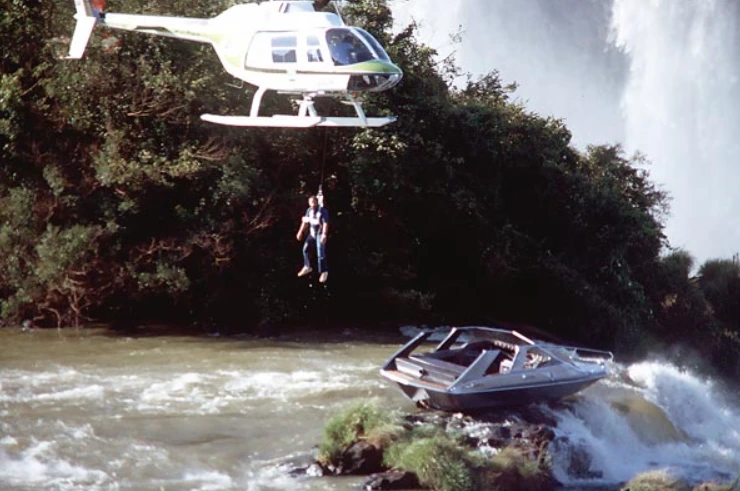

The next morning, Richardson was winched down from the helicopter, first into the water, then into the bush. It dropped him, as he recalled in Cinefex, “everywhere but in the boat.” He came down at last on a rock next to the hull.
The pilot had explained the risk before Richardson’s descent.
The winch, the pilot said, would only hold three hundred kilos.
On the first attempt he could not shift the boat at all. He headed back to base. On the second, he suggested that the pilot lower him down onto the prow of the boar directly.
To add additional support beyond the winch’s load-bearing limit, Richardson had suggested tying himself both to the cargo-lifting hook attached under the helicopter and to the winch before lowering him onto the prow. But it wasn’t enough. And Richardson’s idea to hold the railing while the pilot pulled up would cause too much strain — and put too much weight — on the harness.
Richardson managed to edge the boat a few inches along the rock — and then, over the rotor noise, he heard something.
Ping. Ping. Ping. Ping.
“I thought, ‘What on earth is that?'” he wrote in Making Movie Magic. “I could hear it quite loudly over the noise of the helicopter, and I suddenly realised it was the stitching on the harness I was wearing — breaking.”
He let go of the boat and swung over the edge of the falls.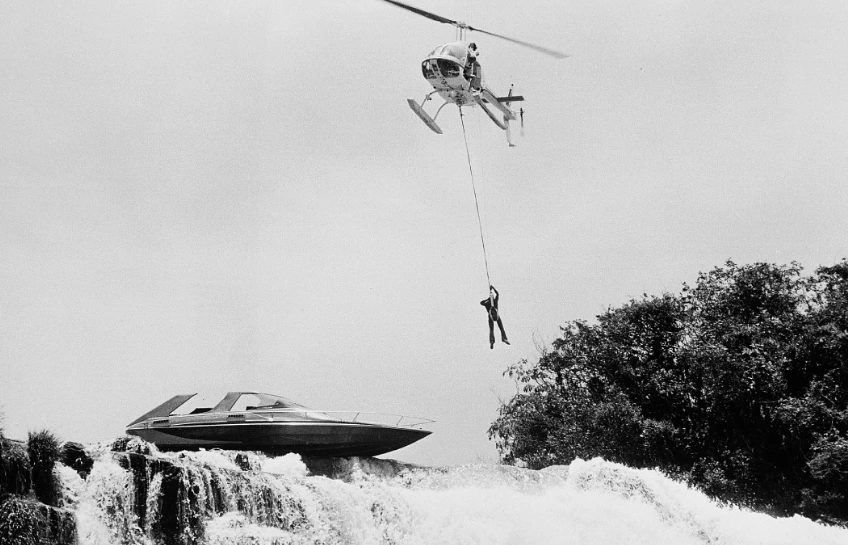

Which introduced the next problem: the rope to the hook and the cable to the winch had spun together and could no longer be wound in. And in a daring stunt worthy of a Bond film, Richardson climbed the rope to reach the helicopter skid, while dangled near the lip of one of the world’s largest waterfalls.
When Richardson’s fellow crewmember, Johnny Morris, signalled the pilot that Richardson was safe, the pilot misread the sign as they should go. Immediately, he tilted over the falls with Richardson hanging on for dear life.
He wrote later, with some understatement: “Who did I think I was — Superman?”
More like James Bond — and his stunt would be echoed in Licence to Kill, when Bond is winched beneath a helicopter to snare Franz Sanchez’s plane. The mechanics are strikingly similar: a man hanging below a helicopter, trying to attach himself to a moving or unstable target while the aircraft does the pulling. For Your Eyes Only, the immediate follow-up to Moonraker, and GoldenEye would later repeat the image of Richardson clinging to a helicopter skid, but Licence to Kill comes closest to Richardson’s real-life stunt.
Whether Richardson’s ordeal directly inspired those later images is impossible to know. But the resemblance is hard to ignore. Before Bond dangled from helicopters on screen, one of the men making Bond had already done it for real.
Operation Blow Up the Boat Fails—and then came the Rain
After the helicopter attempts were exhausted, the crew returned to the hotel bar and arrived at a new plan. A helicopter would fly over the jammed boat and drop a mixture of kerosene and petrol onto it. Richardson would rig an improvised incendiary device timed to ignite the fuel. The boat would burn free of the rock or be carried over by the current as the structure gave way. The helicopter would be clear before ignition.
They did not get to try it. That night it rained somewhere two hundred miles upstream.
“During the night the water came down and washed the boat over,” Richardson recalled. “Solved our problem for us.”
The following morning, the helicopter itself was destroyed.
Taking off for another group on an unrelated job, it crashed on the pad and was badly damaged. Richardson noted the timing in Making Movie Magic with quiet relief: imagine, he wrote, if that had happened three days earlier, when they were attempting the petrol-dump plan.
The Hang Glider Stunt Fails Too
The boat was only half the problem. The other half was Bond’s escape.
The other task at Iguaçu — getting a practical shot of the hang glider escape — produced its own chapter of difficulty. Pilot John Long had been engaged to fly a delta-wing glider over the falls to provide footage of Bond’s escape. Richardson described the challenge in Inside Moonraker:
“You know, hang gliding in the South Downs in England is a completely different deal to try to do it in the tropics over the top of a waterfall with the updrafts and the downdrafts and the water spray and everything else.”
Long made several aborted circuits before committing to a proper run. He lost lift. He lost control. The glider came down into the trees and the crew rushed into the jungle to retrieve him.
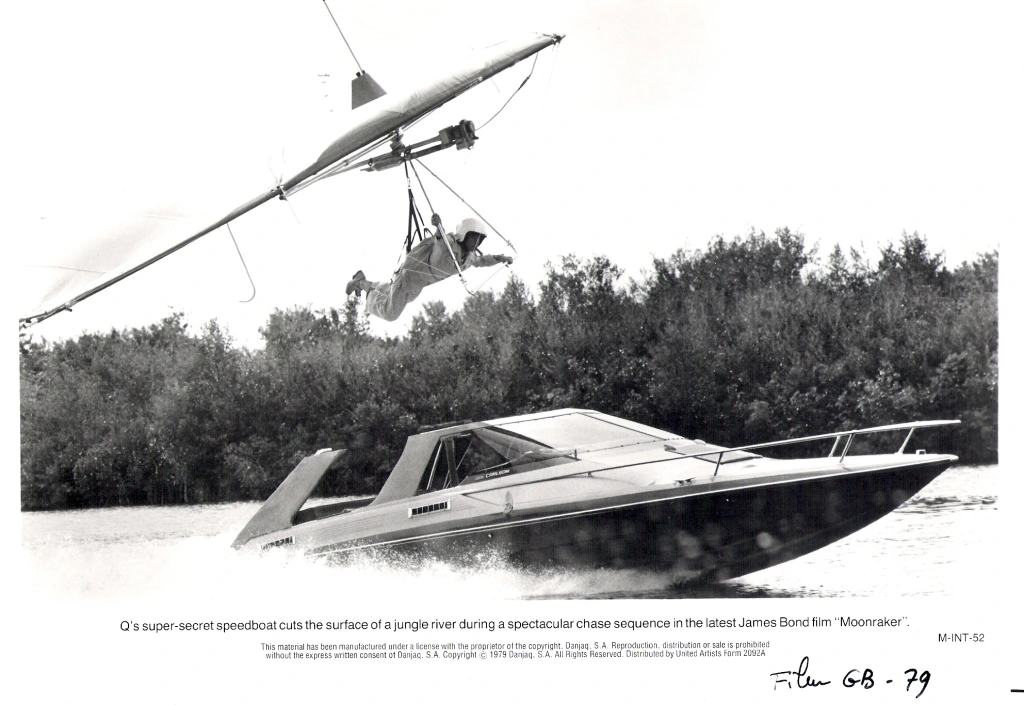

The practical hang glider shot over the falls was abandoned. But Long would make the trip to Florida, where he flew above St. Lucie River and behind the speeding Glastron hard top. These shots were combined with rear-projection plates and close-ups of Moore putting on his helmet and unzipping the ceiling to reach the hang glider, creating the convincing illusion that the glider separates from the top of the boat.
Richardson and his crew spent approximately a week at Iguaçu.
Derek Meddings’ Miniatures Save the Day
The falls sequence was ultimately completed with miniatures built by visual effects supervisor Derek Meddings at Pinewood. In the finished film it is Jaws and his boat that go over the edge — not Bond’s. The plunge, recorded as two hundred feet in Cinefex and three hundred and fifty in Richardson’s book, provided entirely by Meddings’ models.
Looking back at photographs of Richardson dangling from the helicopter, you’ll note that it’s Bond’s Glastron caught on the rock, not Jaw’s boat. This means there was a plan to film Bond’s boat plummeting off the falls.
Richardson’s location work had produced back-projection plates and several near-fatalities. But in the end, with Derek Meddings’ help, the boat going over the falls was achieved — without a stuntman, without a real speedboat, and without the need for overflying filming permission.
“It was a shame that Derek and I never worked together on a full-time basis,” Richardson wrote in Making Movie Magic, “because I think we could have made a pretty formidable team.”
Port St. Lucie, Florida: Filming the River Chase

With the falls operation resolved — partly through providence, partly through Meddings’ miniature work at Pinewood — Richardson moved the effects crew to Port St. Lucie, a small town in the Florida Everglades.
Here, over three to four weeks on the St. Lucie River, the preceding portion of the chase was choreographed: Bond’s Glastron CV23HT pursued by Jaws and Drax’s henchmen in their SSV-189s, with Richardson deploying an arsenal of practical pyrotechnic effects that made this sequence one of the most technically demanding boat chases in the series.
The boat operation in Florida had its own culture. The stunt drivers — led by Mike Turk, who had assembled and coordinated the team of water specialists working the sequence — were collectively nicknamed “Turk’s Navy” by Richardson’s effects crew. Richardson called them “the best boat people in the business.”
A sign on a fence near the location, dated 7 February 1979 read: “Special Effects Unlimited — Boat Driving Tuition,” followed by a mock course schedule listing Turk and colleagues by name alongside humorous and dangerous course descriptions. It was the kind of gallows wit that tends to develop on location units that spend weeks doing genuinely dangerous things at speed.
Lewis Gilbert, directing the picture, came out to Port St. Lucie with Roger Moore for a couple of days to shoot the close-up material — the cockpit reactions, Bond’s hands on the gadgets panel, Moore’s face as the gadgets deploy and the explosions bracket his hull. The second unit work was Richardson’s domain; the actor arrived for the specific shots that required him.
The boats were travelling at fifty miles per hour. The charges had to be timed to the passing of each hull.
“All of the pyrotechnic work was, to say the least, a little tricky,” Richardson recalled in Cinefex. “Explosions in water are always one of the most dangerous situations for us. We have to be very careful in order to avoid accidents because charges can drift and boats don’t necessarily follow the right line. We had to make sure that the boats were as close as they could be to the explosions, but not too close.”
In Making Movie Magic, Richardson added:
” … [A]though we wanted to set the bangs as close to the boats as possible, the timing was critical. A fraction of a second out and the boat, and passengers, might be seriously injured.”
The Mine Ejector
The enemy boat that hits Bond’s deployed mines was the biggest explosion in the sequence.
For this destruction, Richardson applied his signature approach to pyrotechnics: not one large blast but a series of smaller charges accomplishing different things simultaneously. Some were placed inside the boat; others were fixed approximately four feet beneath the hull, timed to fire upward and physically lift the craft clear of the water as it detonated. The result on screen — a waterspout with the boat riding it, followed by a fireball fifty feet off the water as the boat itself explodes — is a precisely layered sequence that Richardson had engineered charge by charge.
“We also had self-timed charges in the boat,” he explained in Cinefex.
For shots of the destroyed boats, Richardson constructed a special towing mount that held each speedboat nose-up in a planing position, simulating high-speed travel for the cameras even when the vessel was being towed at controlled speeds past the lens. The illusion of velocity was complete.
The Torpedo — and the Last 007 Theme
Bond deploys the torpedo — not a prop but a functional practical device. Richardson had built a radio-controlled, self-propelled torpedo guided by one of his crew, fired from Bond’s boat to pursue the SSV-189 behind him. The boat attempts to evade. It cannot.
For the explosion, Richardson broke what appears on screen as a single blast into three distinct parts.
“The first explosion occurs in a very close shot and two crew members fly out,” he explained in Cinefex.
One of them was Richardson. An air ram in the back of the stricken boat launched Richardson and a colleague into the water on the first charge — real bodies exiting a real explosion in a close shot, with the wider destruction following in subsequent cuts.
“It’s always nice to see real people flying out of an explosion like that. It was a small, controlled explosion, and it wasn’t really that dangerous.”
He paused before adding:
“The dangerous thing was the crocodiles in the water. It was a case of hearing somebody say ‘Cut!’ and then getting up and running on top of the water back to the boat as fast as you could.”
Jaws Jumps His Boat — a Nod to Live and Let Die
Bond changes course along a new river channel, only to be surprised by Jaws jumping his boat out of the riverbank vegetation — a direct nod to the ramp launches of Live and Let Die six years earlier. The specific mechanics of the Jaws jump are not documented in any surviving production account, but the approach is consistent with Live and Let Die‘s jumps using a concealed ramp.
For coverage across the entire Florida sequence, Richardson operated on the principle that complex, unrepeatable practical effects demanded maximum camera presence.
“Most of the work we do involves two cameras,” he explained in Cinefex, “but there are times when I have to beg, borrow or steal every camera I can get my hands on and have everyone who is capable of pointing one covering the scene. If you can muster three or four — especially on the big set pieces — you’ll be okay.”
The entire Florida operation required three to four weeks on the water.
Diagnosed with Crabs?
Not everything at Port St. Lucie was pyrotechnic. Towards the end of the shoot, Richardson found something small crawling on his private parts. He caught it and placed it in a film tub. He spent the following hours in considerable anxiety, went through an ordeal with two doctors, and was treated for what appeared — to the doctors, and to Richardson — to be a case of crabs.
Three months later, back in England, the truth emerged. Mike Turk’s boat crew had harvested half a dozen baby crabs from the dock and planted them in his hotel room. The doctors, presented with something small and crustacean, had reached the wrong conclusion. Richardson, for his part, had spent three months believing he had crabs. Later, Turk, got more mileage out of the joke when, as Richardson’s best man, he relayed the entire joke to Richardson’s wedding guests, including his parents.
The Missing Link Between Live and Let Die and The World Is Not Enough
The Amazon boat chase builds on previous boat chases, copying elements and expanding the boat chase into new directions. It’s all part of the characteristic Bond formula, establishing something familiar, something that feels uniquely Bondian, while pushing boundaries in stunt work and practical effects.
The Moonraker Amazon chase is the spiritual sequel to Live and Let Die’s Louisiana boat chase. Both sequences depend on Glastron speedboats, real water, destructive escalation, and the comic spectacle of Roger Moore’s Bond turning a chase into a stunt carnival. But where Live and Let Die is built around practical speed and impact — boats jumping roads, smashing through obstacles, and skidding across Louisiana geography — Moonraker pushes the template into Q Branch fantasy. The boat becomes a gadget platform. The chase becomes a transformation sequence. The aquatic stunt-piece becomes unmistakably Bondian.
From Russia With Love introduced audiences to multi-boat pursuits, and revolutionized how speed was captured on water, ending in a fabulous pyrotechnic catastrophe on water. Live and Let Die‘s boat chase took familiar beats, including the multi-boat chase, the explosive destruction of pursuing craft using multi-stage pyrotechnics, the fundamental format of a high-speed river chase built around practical stunt work, and the fiery ending — but adding significant risk and ambition with what boats could do — such as driving them on land, across levees and performing a 120-foot boat jump, which remains the longest boat jump to this day, according to the Guinness Book of Records. In addition, it incorporated a police car chase, timed to the aquatic action, with both land and water criss-crossing at certain points for laughs and danger.
Moonraker also borrows more directly from From Russia With Love than first appears. SPECTRE’s boats in the earlier film are not merely pursuing Bond; their crews fire grenade launchers, turning the chase into an armed waterborne assault. Moonraker reworks that idea with Drax’s henchmen, whose pursuing boats are not simply obstacles but weapons platforms. The difference is that Bond’s boat is now armed too, shifting the balance from escape to counterattack.
When the boat chase was re-introduced in Moonraker, audiences were treated to two: the Bondola and this Amazon boat chase. The Bondola played up the comedic elements found in the Live and Let Die boat chase to the extreme, most notably the reactions of disbelieving land-based locals but becoming totally reliant on slapstick.
The Amazon boat chase, however, leans more into spectacle, taking the idea of racing through bayous to the Amazon — or more accurately Florida, where it was filmed. But here, we begin to see spectacle taking centre stage. The action sequence is far shorter, supporting the long-held view that the Live and Let Die boat chase outstays its welcome. Nonetheless, we get jumping boats, winding river chases — now punctuated by explosions and gadget-laden watercraft inspired by Q Branch’s tricked-out cars and aircraft, like the autogyro Little Nellie in You Only Live Twice. It was inevitable that gadgets would proliferate from cars to aircraft to watercraft — even if we ignore that the villains had already done this with Emile Largo’s Disco Volante, a yacht that could turn into a fast-moving hydrofoil, while its jettisoned cocoon turned into a gun-mounted platform to fight the incoming US Coast Guard.
Convergence is often a missed criterion in evolving Bond action sequences — the convergence of previous ideas into new vehicles and stunts. So, the Amazon boat chase has a direct lineage not only with previous boat chases, but also other gadget-laden vehicles dating back to the Aston Martin DB5 in Goldfinger. And this idea — this gadget-laden boat — would go on to inspire the Q Boat in The World Is Not Enough. From Little Nellie it inherited the gadget-platform concept: a vehicle whose Q Branch arsenal provides the dramatic structure of the chase, each gadget deployed as a distinct beat with its own practical effect.
These elements from Live and Let Die and this Moonraker boat chase — boats travelling on water and land, laden with gadgets, used for humorous effect with bystanders — would converge once again in the pre-title sequence for The World Is Not Enough (1999). Bond’s Q Boat on the Thames carries two torpedoes rather than one, deploys gadgets against the Cigar Girl’s Sunseeker in a sequence that runs fourteen minutes and required thirty-five boats and six weeks of filming, and at one point drives like a hovercraft through a riverside restaurant — echoing the Bondola’s St Mark’s Square crossing and Live and Let Die‘s land-travelling boats. What would return was the length of the chase, but without the slow pacing. Over decades, you can see how each sequence builds, evolves, and is improved in special effects, spectacle, and pacing.
What the Amazon chase also demonstrates — and what Cartlidge’s remark about Iguaçu most plainly confirms — is the Bond production’s instinct for finding a location first and writing the stunt to reach it. The two-hundred-foot falls dictated the hang glider escape. The hang glider escape dictated the hardtop boat. The hardtop boat dictated the gadget arsenal. The gadget arsenal dictated the sequence of pursuers and the beats of their destruction.
Richardson and his crew spent a week at the edge of those falls, roped together twenty feet from the drop, dangling from helicopters with harness stitching giving way, retrieving a hang glider pilot from the jungle. In the end, they couldn’t even film the hang glider flying over the falls. But the sequence had been written, and luckily they had the best miniature special effects guy in the business to finish it off for them — Derek Meddings. And the falls appear on screen for less than a minute.


- California’s AG Loses to Paramount: Inside the Paramount / Warner Bros. Discovery Merger — And Why Ellison May Still Leave California - September 26, 2026
- Napoleon Solo Sold for £1: The Year Ian Fleming Stopped Owning Ian Fleming - July 25, 2026
- The Untold Story of The Persuaders!: Cars, Glamour, Conflict and James Bond - July 20, 2026