

A Venetian Gondola that transforms into a speed boat then a hovercraft — nicknamed ‘the Bondola’ — earned its title as Bond’s most ridiculed gadget ever. But building it and filming it through tourist-clogged canals and Venetian walkways made the shoot hostile, and nearly sank its star. The Bondola, played exclusively for laughs, took the franchise from occasional goofy humour to relentless slapstick, which haunted the Bond franchise like a bad hangover for the better part of a decade.
After showcasing Bond’s best gadget — a Lotus Esprit S1 that can transform into a submersible in The Spy Who Loved Me (1977) — Moonraker decided to follow it up with Bond’s worst — a Venetian gondola that could transform into a speed boat and then a hovercraft.
The Lotus Esprit submarine car — a sleek, gadget-laden sports car that drove off a pier, sprouted fins and torpedoes, and glided through the Bahamas as a fully functional submersible — had set a benchmark for the Bond gadget vehicle. It achieved the same iconic status as the tricked-out Aston Martin DB5. And practically — even in the fantasy world of James Bond — one could, if they suspended enough disbelief, believe that a spy would need a car that could turn into a submersible. But a Venetian gondola turned speed boat and hovercraft — not on your life.

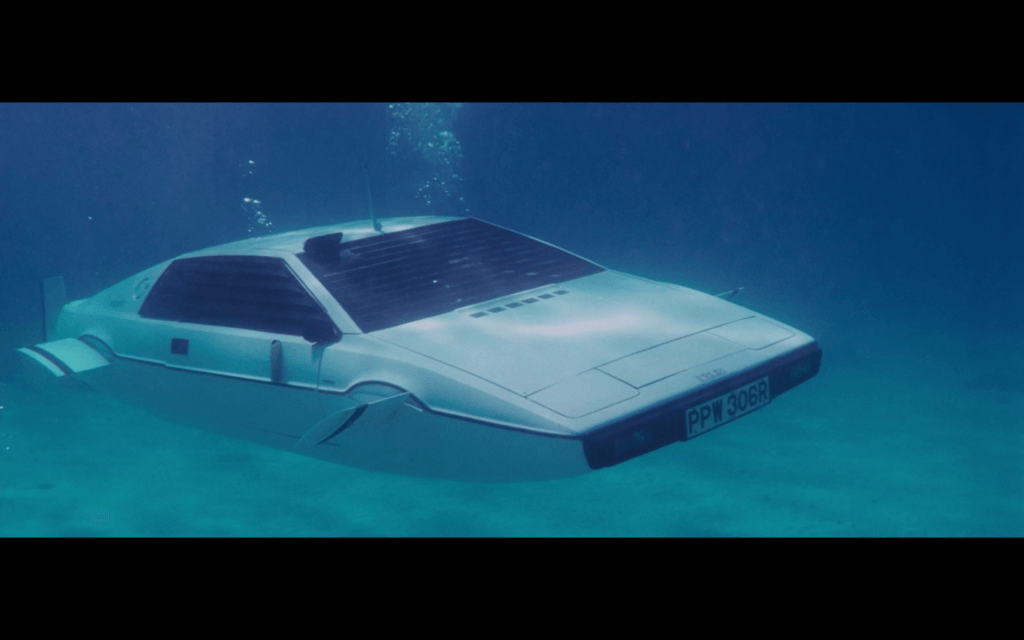
The Aston Martin DB5 and Lotus Esprit S1 weaponized elegance. The Bondola weaponized absurdity.
Of course, on paper, trying to top a sleek-looking Lotus Esprit submarine is impossible. So returning director, Lewis Gilbert, decided to not even try. Instead, Moonraker, which is somewhat of a companion piece to The Spy Who Loved Me and part of Gilbert’s fantasy, pure cinema Bond trilogy, which began twelve years earlier with You Only Live Twice (1967), decided to subvert expectations and poke fun at Bond’s vehicular gadget with the Bondola. We go from the most practical, coolest gadget to the most impractical, uncoolest gadget across two, back-to-back movies.
On a closer look, the Bondola is a direct response to the Lotus Esprit submarine: not just subversion but an inversion. Bond’s Lotus Esprit enters the water and transforms into a submarine, while the Bondola transforms into a hovercraft and exits the water onto dry land. It seems deliberate — the opposite of the car-sub but in the worst possible way.
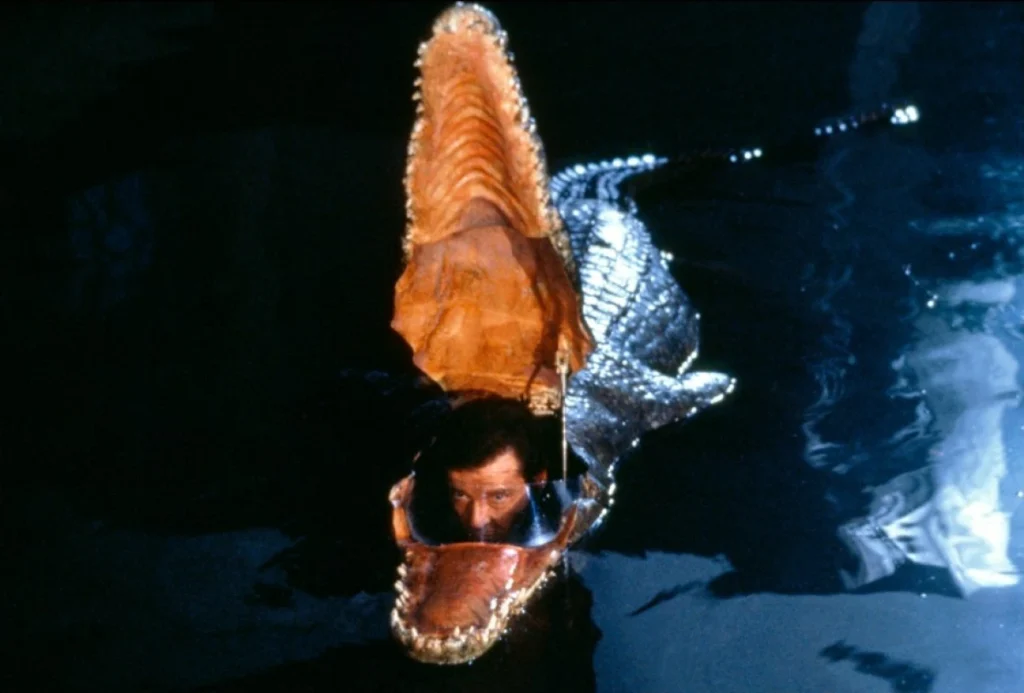
But you can’t write a Bond history without referencing the Bondola — and it does impact the franchise in ways that perhaps in hindsight were not the best — I’m looking at you John Glen, and your preponderance to lean into slapstick in one of my favorite Moore flicks, Octopussy, with a fake alligator sub, a slapstick Tuk Tuk chase involving tennis rackets and reactions from Indian bystanders as if they’re attending a tennis match; a reliance on slapstick that bleeds into A View To A Kill in even worse ways.
Slapstick moments appear throughout the Bond films, but in Moonraker, specifically when Bond unleashes the Bondola’s hidden gadgets, slapstick takes the wheel.
But now, lets get serious. Because even devising a slapstick chase, requires serious work to devise — and the Bondola had its own challenges to overcome.

Pre-Production: From Motorbike to Gondola
Moonraker presented the production with a location challenge unlike anything the franchise had previously attempted. Venice — built across 118 islands and connected by 400 bridges — is one of the most logistically hostile film locations on earth. There are no roads. Every piece of equipment had to be transported by barge.
Associate Producer William Cartlidge, a nautical scholar, used his knowledge of the Dover Tide Tables to calculate the Venetian tides, because, as he later recalled, clearance had to be exact:
“It was necessary because going under these bridges with our barges the clearance under them would sometimes be less than a foot. So if you tried to move the unit at the wrong time of the day you are in trouble.”
The Venice location budget ran to $2 million — an entry listed in the production accounts as “special location facilities.” After being picked at by UA execs, Andy Albeck and Steven Bach, over the cost, Cartlidge was rather more candid about what it actually covered:
“Fuck it — it’s for bribes!’ Well they nearly fell off the bloody chairs. ‘SHIT! BRIBES? It’s illegal!’ I said, ‘First of all it may be illegal in America but it ain’t illegal in the UK and this is an Anglo-French co-production.”
The sequence itself began with a very different idea. Screenwriter Christopher Wood, finding that a gondola chase in Venice would be “too predictable,” originally conceived something far more kinetic. As Wood recalled in the EON Productions documentary Inside Moonraker:
“I thought Bond getting on a motorbike and screaming around there because he could have used the waters as well: humped-back bridges, motorbike sprinting off and landing on gondolas and then off onto the other side.”
A March 1978 draft, analysed in Clément Fuetry’s Scripting 007, shows Bond’s gondolier being killed by a machine gun rather than a throwing knife. More strikingly, the sequence’s climax involved Bond escaping first on motorbike through Venice and then on a jetpack — launched from a boathouse, pursued by a helicopter, crashing through the glass roof of a luxury restaurant and landing between two tables. Bond’s line upon landing: “I’m afraid I haven’t made a reservation.” Broccoli, according to Wood, was obsessed with jetpacks. Nonetheless, the idea was scrapped.

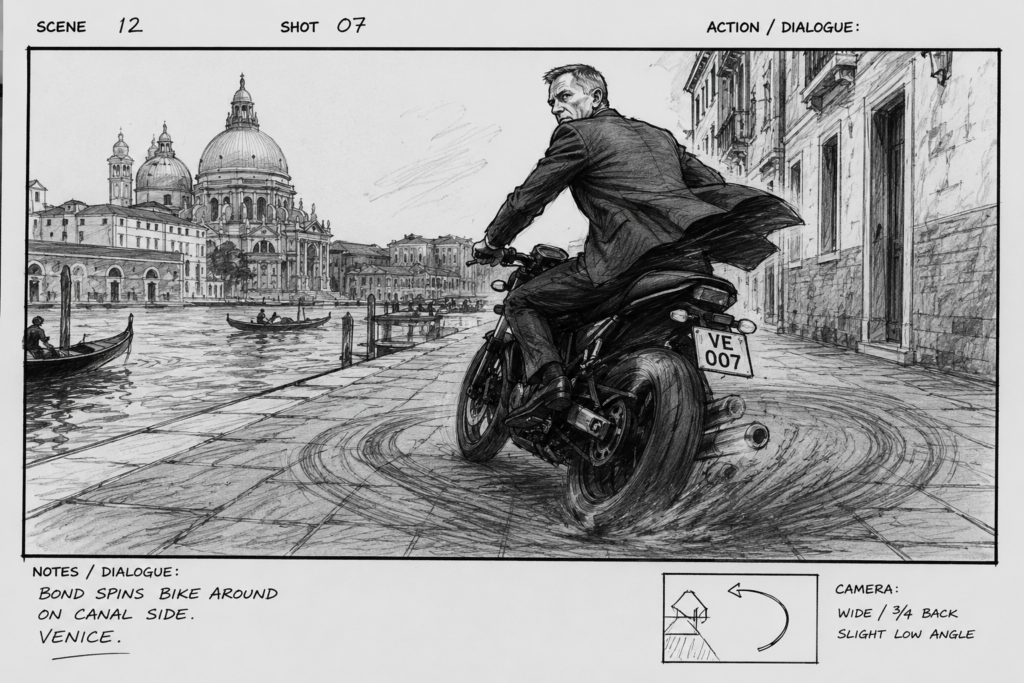
It was producer Cubby Broccoli who vetoed the motorbike —on the grounds of image. Motorcycles, Broccoli felt, were too low-end a vehicle for James Bond. That idea would be rectified by his daughter, Barbara Broccoli and stepson Michael G. Wilson when they took over producing reins with Goldeneye.
The gondola idea emerged as the replacement, and with it came the creative problem of how to make a boat chase in one of the world’s most photographed waterways feel anything other than routine.
The shift from the early script to the finished film also shaped the sequence’s opening. A man rises like Dracula from a coffin strapped to the roof of a passing funeral barge and kills Bond’s gondolier Franco with a throwing knife. Bond grabs the dead man’s knife and returns it. The coffin lid closes. The funeral boat glides on. It is slapstick from its first moment and never abates as a lovers boat is sawn in half while they kiss, an old man throws away his cigarette — presumably giving up smoking — after seeing the coffin floating in the canal, till the moment the gondola turns into a hovercraft and travels past a double-taking pigeon in St Marks Square!
Moonraker leans into the comedy genre more than other Bond film — and for many it works, never taking itself seriously. At the time, Moonraker earned the highest box office for a Bond film, just two films after it had reached its low-point with Moore’s second outing as 007 in The Man With The Golden Gun. These various comedy moments — such as the Bondola sequence — helps prepare the audience for the film’s outrageous climax in outer space. Moonraker realizes how preposterous is space-based plot to kill humanity is, and so almost everything else had to be framed in slapstick.

Engineering the Bondola: The Ford Granada on the Grand Canal
The central engineering challenge of the gondola sequence was one the production discovered the hard way. As documented in Inside Moonraker, the crew’s first instinct was to take a real gondola and fit it with a motor. The result was immediate and definitive: gondolas are not designed for speed. Once the vessel exceeded 15 mph, it sank.
The production was forced to start again. Cartlidge recalled the solution:
“The gondola, which was a splendid idea and sort of rang a change on the normal boat chase thing. What we did in the first instance was get a gondola and we had to get a clapped out one and virtually rebuild it because nobody would sell us their prize gondola.”
Ultimately four gondolas were purpose-built and customised for the sequence, capable of travelling at 60 mph through the narrow Venetian canals — four times the speed at which the original had sunk.
The hovercraft transformation added a further layer of mechanical complexity. Former car designer Peter Bohanna — drafted into the Bond productions to conceptualise and build prop vehicles — was responsible for the Bondola’s construction.
As documented in Bond Cars: The Definitive History, the gondola-hovercraft concealed a Ford Granada powertrain beneath its traditional wooden hull. The transformation mechanism worked by inflating a rubber “skirt” (the inflatable membrane around the base of a hovercraft holding a cushion of air) around the hull’s base, lifting the vessel clear of the water and allowing it to be driven on land.
In principle, it was a clean and logical piece of engineering. In practice, as Roger Moore would discover, it was anything but.
Filming the Sequence
The main unit departed for Venice in late September 1978. Lewis Gilbert directed the Venice sequences, including the St Marks Square crossing made by the Bondola, with second unit work (i.e. the action work in the canals) overseen by John Glen — who had been brought in after original second unit director Ernest Day was forced to step down when his wife fell ill. Glen had previously done the Venice reconnaissance with Gilbert, so he was already familiar with the location when he
took over.
The sequence also pauses filming entirely at one point. The death of Pope John Paul I on September 28, 1978 — just days into the Venice shoot — brought the city’s bells into continuous tribute. The sound made location recording impossible, and the production suspended work until the tolling ceased.
What the finished sequence presents as a continuous chase through the Venetian canal system is, in reality, a geographical fiction. The production filmed across multiple disconnected neighbourhoods — primarily Dorsoduro in the south of the city and Cannaregio in the north — and stitched them together in the edit to suggest a single unbroken pursuit. Anyone who knows Venice well will recognise that Bond moves from one side of the city to the other between cuts, covering distances that would take considerably longer than the sequence implies. It is a classic piece of location filmmaking — the city as a collection of visual assets rather than a coherent geography.
The Canal Chase — A mishmash of unrelated locations stitched into one continuous chase
The chase proper was filmed primarily in Dorsoduro, with the Fondamenta Briati, Rio del Carmini and Rio de S. Margherita used repeatedly for trick shots as the four customised gondolas — capable of 60 mph — threaded through the narrow waterways. For context, the official speed restriction in Venice’s canals is 5 knots — approximately 6 mph. The production was moving at ten times the legal limit. As Moore described in Bond on Bond, the conditions were in one sense straightforward: the canals were so narrow and the action so fast that crowds had nowhere to watch from except a few bridges, and by the time anyone realised what was passing, it was already gone.
The chase also passes the Squero di San Trovaso — one of Venice’s last working gondola shipyards, also in Dorsoduro — giving the sequence an inadvertent irony: Bond’s motorised impostor of a gondola roaring past the very yard where real ones are built and repaired.
Behind the wheel of the Bondola throughout the canal chase was Irish stuntman Martin Grace — Roger Moore’s principal stunt double across six Bond films — with Claude Carliez, the French stunt arranger on the production, playing the gondolier Franco on screen. Carliez had the distinction of being both the man responsible for coordinating the French stunt performers and the man killed in the sequence’s opening shot. The pursuing speedboat — registration V99060 — was piloted by stuntman Claude Pillas while Michel Berreur fires a machine gun.

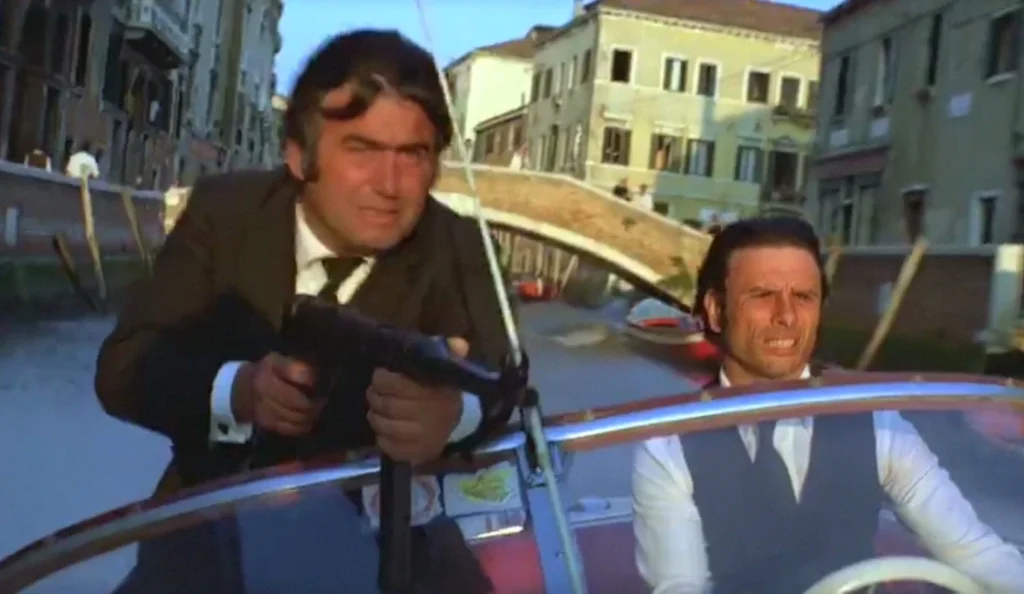
Unlike the Glastron SSV-189s used in the Amazon river chase, the pursuing speedboat in the Venice canal chase was not a production boat at all. Known as “Mia,” it was custom-built specifically for the film — manufacturer unknown. The reason is almost certainly practical: the narrow, twisting waterways of Venice demanded a hull designed for tight turns and confined spaces rather than the open-water performance the Glastron range was built for. Where the Florida (doubling as the Amazon) chase called for boats capable of fifty miles an hour on straight river channels, the Venice pursuit required something that could navigate low bridges, stone walls and canal junctions at controlled speeds while remaining visually threatening. A custom commission could be engineered to those specific constraints in a way an off-the-shelf production boat could not.
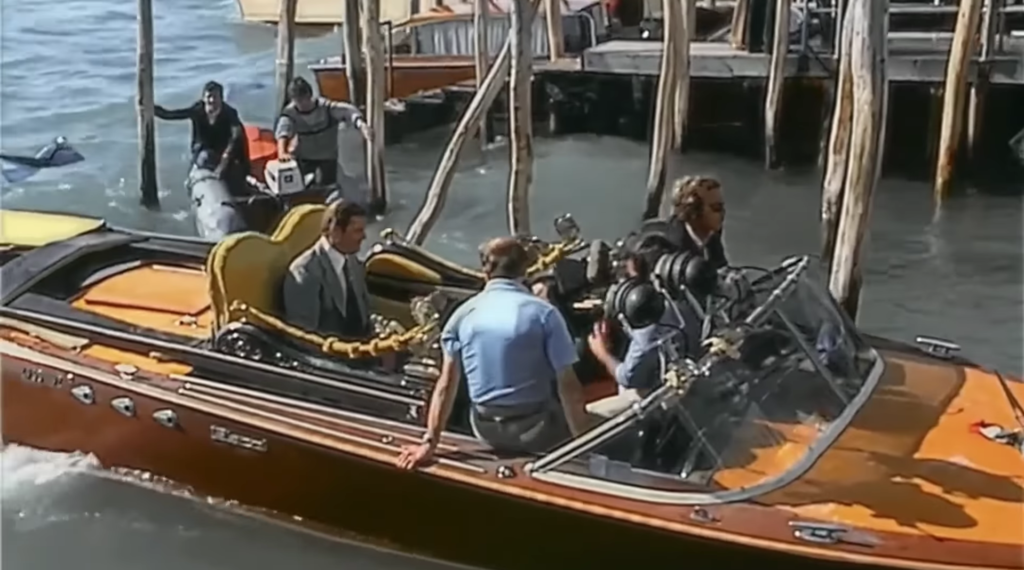
There is also a custom-built speed boat made to look like a Venetian gondola to film close-ups of Moore racing through canals. A pilot was behind the wheel in the cockpit (as seen in the photograph below), while a cameraman sat or stood in the passenger seat to film Moore. These shots, combined with wide shots of Martin Grace doubling as Bond while powering the fast-moving Bondola, legitimized Moore as being the real driver of the rickety, impractical contraption.

The Gondola Split — A Practical Trick Using Weights
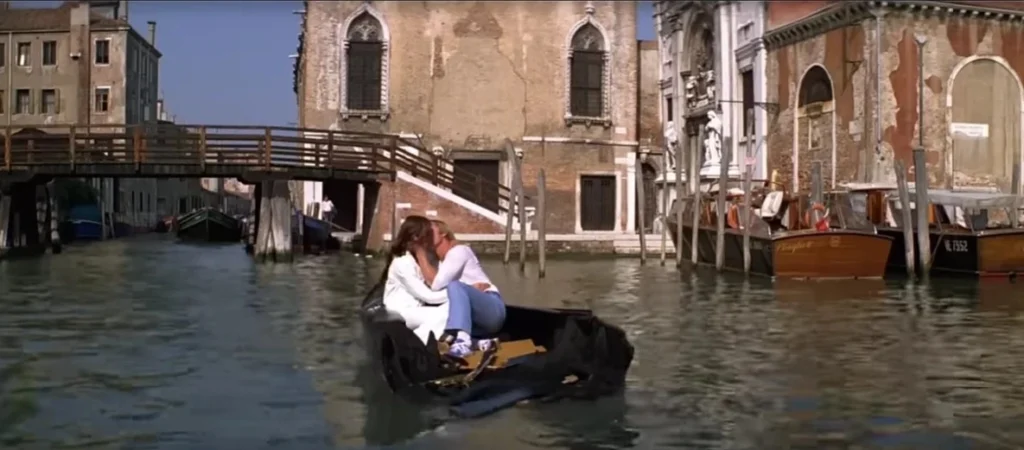
Here the sequence makes its most audacious geographical leap. The edit cuts from Dorsoduro in the south to Cannaregio in the north — opposite sides of the city — convincing the audience that it’s an adjacent location. The gondola carrying the kissing couple emerges from Rio di Santa Caterina as Bond and the pursuing speedboat come in from the north on the canal. The production installed temporary traffic lights on the canal wall specifically for this shot, controlling boat movement through the junction during filming. As the speedboat passes over the kissing couple’s gondola and shears it in two, the front half drifts away across the canal towards Rio della Sensa, the couple still blissfully unaware. Their gondolier, rather less fortunately, goes down with the other half. The gag nods directly to the river chase in The Man with the Golden Gun (1974), in which a boat is similarly sheared in half.
The stunt was performed by Daniel Breton as the male half of the kissing couple and Dorothy Ford as the female half — Ford also serving as stunt double for Lois Chiles elsewhere in the film. To ensure the floating half of the gondola didn’t simply sink the moment it was sheared, the production weighted it to keep it stable on the water — allowing the couple to continue their oblivious embrace, while their gondolier went down with the other half of the boat. The speed boat hits the other half of the boat, and you can clearly see where the gondola was part-sawn so it cleanly broke in two as the speedboat collided with it.

The Hovercraft Transformation — Canal Grande, St Mark’s Basin
The chase climaxes at the Canal Grande quays leading to St Mark’s Basin, with the Basilica di Santa Maria della Salute visible in the background. Here the gondola was required to exit the canal, rise out of the water as a hovercraft, and mount the waterfront steps onto the Piazzetta. There were 40,000 tourists watching.
Two gondolas were used for the sequence: the first for the transformation shot itself, the second — built on the Ford Granada chassis — for the land-based driving across the square.
The transformation was filmed in five attempts. The problem was that the hovercraft’s inflation mechanism activated unevenly — one side inflating faster than the other, tipping the vessel sideways and depositing Moore into the Grand Canal.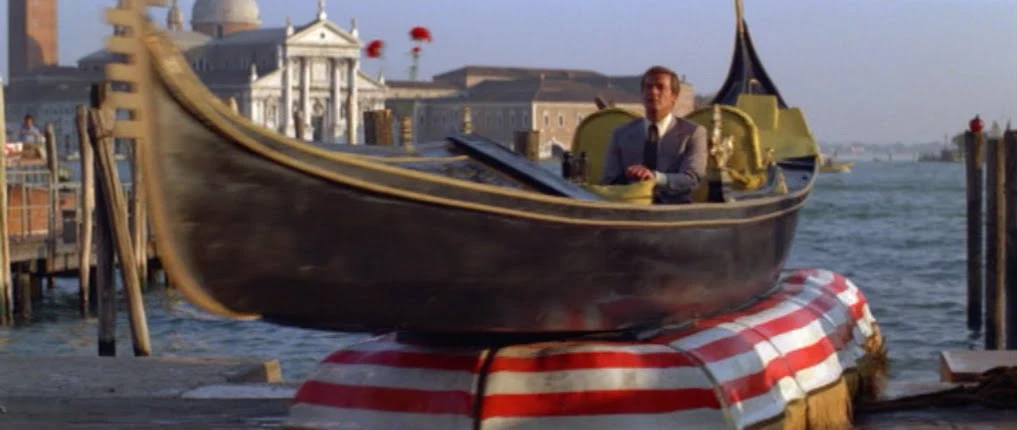

As Moore described it in Inside Moonraker:
“I’m sitting there in a nice grey silk suit, push the button, and the thing starts to rise up out of the water, and WHOOP! — it throws me into the lagoon. There are 40,000 tourists watching. They think that’s rather fun. I don’t think it’s very much fun at all.”
The tourists, armed with Nikon cameras, documented each failure with enthusiasm. Each take required Moore to be dried off, re-suited, re-made-up and returned to the gondola. He had arrived for the day with five silk suits. After four failures, everything depended on the fifth take — and the fifth suit. It worked. “Luckily I had five suits,” Moore recalled — though characteristically muddling the count in the telling. “One more take and we wouldn’t have been able to do it.”
St Mark’s Square — Piazza San Marco, alongside the Doge’s Palace
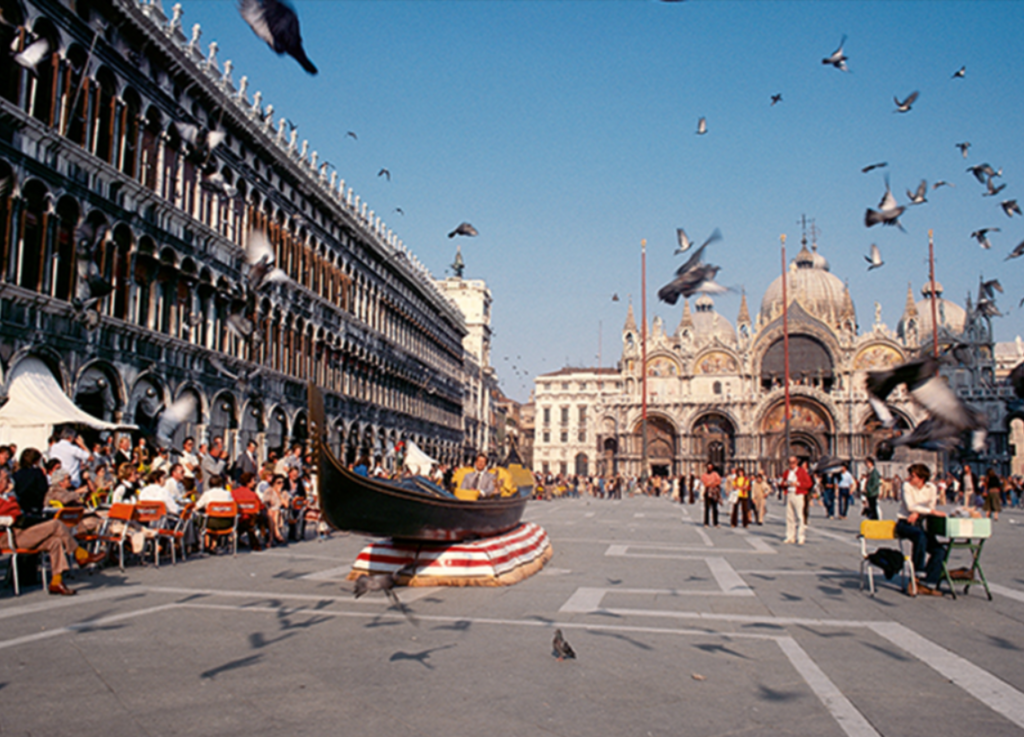

Once on land, the sequence abandons any remaining pretence of action filmmaking and becomes pure comedy. Bond drives the Bondola up from the canal onto the Piazzetta and across the vast open square — all at the wheel of what is, however you dress it up, a motorised gondola on wheels, threading through tens of thousands of bewildered tourists.
The police initially offered to control the crowd. Gilbert recalled in Inside Moonraker what happened next: “The police said, ‘Don’t worry we’ll keep the crowd back.’ Well what they did — they formed them in two lines like the Coronation and Roger had to drive across the square. It was just ludicrous.” Gilbert’s solution was to remove the police entirely and let the tourists react naturally. “Of course, they all reacted as they would react,” he said. “They all thought, ‘What the hell is going on.'”
Moore was less sanguine. “I was absolutely petrified,” he recalled. “As I’m driving, these people don’t know I’m going to hit somebody. I don’t have that much control of it.” Cartlidge confirmed the vehicle’s handling: “You had to be a bit tricky with that because it was a very unwieldy vehicle.”
In reality, Moore’s account in Bond on Bond reveals rather more chaos than the finished film suggests. He had requested some kind of horn to warn tourists that a motorised gondola was approaching: “They found some sort of claxon, and I literally beep-beeped my way around unsuspecting tourists, across to a sharp right turn down a narrow road. It was so narrow the F/X boys put Vaseline down the side of the gondola so I could slip down more easily.” None of it — the claxon, the sharp right turn, the Vaseline — appears in the finished film. What the audience sees is Bond gliding serenely through the crowd as if by magic. The chaos of the actual filming is completely invisible in the finished sequence.
The result is a scene constructed almost entirely from reaction shots — scored, appropriately, to Johann Strauss’s Tritsch-Tratsch Polka, which Gilbert selected to underline the sequence’s complete abandonment of anything resembling tension. A waiter, distracted by the passing Bondola, pours beer down the back of a seated customer without noticing. A dog regards the contraption with an expression of pure aristocratic disdain. A pigeon performs a double take.
The crowd itself was also populated with production insiders. Albert R. Broccoli appears among the tourists, wearing an untucked light blue shirt. Dana Broccoli and Michael G. Wilson are also present. Lewis Gilbert himself — the director of the sequence — can be spotted as one of the men at St Mark’s Square. It is, in its way, the production’s own double take: the people who made the most ridiculous sequence in the franchise’s history, watching it unfold around them.
The pigeon is the sequence’s most technically demanding gag and its most infamous. To achieve it without CGI, the production team glued a live pigeon to a wooden board and waited for the bird to turn its head. The footage was then played forward and rewound to create the impression of a double take. It apparently took a considerable amount of time to get the bird to cooperate — all for a moment that lasts less than two seconds on screen and has been cited ever since as the precise moment Moonraker lost the plot entirely.
The final reaction shot is a piece of deliberate franchise mythology. The man sitting at an outdoor café table, staring at the passing Bondola and directing his gaze back to his wine bottle as if questioning his own sobriety, is Victor Tourjansky — an Italian assistant director working on the production who had been cast in the same role, uncredited, in The Spy Who Loved Me two years earlier. In that film, Tourjansky sat on a Sardinian beach and watched in identical bewilderment as the Lotus Esprit emerged from the sea. As associate producer Cartlidge recalled in the documentary Inside The Spy Who Loved Me, the cameo began as “a ghastly in-joke of Lewis Gilbert and myself.” It proved too good to abandon. Tourjansky would appear once more, wine glass in hand, in For Your Eyes Only (1981), watching from a ski lodge balcony as Bond skis through pursued by thugs on a motorbike. Across three consecutive films, he became the Moore era’s most reliable straight man — the ordinary man confronted by the extraordinary, choosing to blame the bottle.
The Bondola After Bond
Peter Bohanna kept a Moonraker gondola prototype after filming wrapped, storing it at his local pub, the Leatherne Bottel in Goring-on-Thames. According to his son Pierre — himself now a leading film prop-maker, responsible among other things for the Harry Potter wand — the gondola was later borrowed by Val Doonican’s television show, which planned to film the Irish singer warbling up the Thames with two backing singers and a gondolier. The gondola sank. The sequence never made it to television. The Bondola, it seems, was no more seaworthy in retirement than it had been in production.
Bond Legacy: The Slapstick Hangover
Humour has always been part of the Bond formula. Even in the Connery era, the films traded on wit and occasional self-awareness. But it was Diamonds Are Forever (1971) that first allowed slapstick to fully infiltrate an action sequence, most notably in the moon buggy chase through the Nevada desert — broad, cartoonish, and played entirely for laughs. The trend deepened into Moore’s early films. Live and Let Die gave us Sheriff J.W. Pepper blundering through the Louisiana bayou. The Man with the Golden Gun brought him back, and added a speedboat shearing through a newly-wed couple’s wedding cake. These were slapstick moments, but they were used sparingly, and crucially, the stuntwork surrounding them still carried a genuine sense of danger. The 120-foot boat jump in Live and Let Die is funny in its audacity, but it is also genuinely terrifying. The two registers — comedy and danger — coexisted.
The Bondola sequence removed danger from the equation entirely. There is no moment in the Venice gondola chase that carries physical threat or genuine jeopardy. Every beat is a gag, from the Dracula-rising assassin to the tipping hovercraft to the double-taking pigeon. It is the first Bond action sequence to operate purely as comedy — and unfortunately, it proved contagious.
The hangover carried directly into the films John Glen directed across the rest of Moore’s tenure. In Octopussy (1983), the Tuk-tuk chase through India features Bond’s ally Vijay fending off attackers with a tennis racket while the Indian public watches and reacts as though they are at a tennis match. In A View to a Kill (1985), a fire engine chase through San Francisco plays like a Keystone Kops sequence, with hapless policemen in pursuit. Later in the same film, Bond commandeers a taxi from its driver — drunk and still drinking — and the car is subsequently knocked in half by a passing vehicle, with Bond driving his half to a bridge overlooking the Seine. The slapstick logic is identical to the Bondola’s: Bond in an absurd vehicle, chaos unfolding around him, composure unruffled.
The infection even spread beyond Moore. In Timothy Dalton’s first film, The Living Daylights (1987), a tyre-less car cuts a perfect circle in ice around a police vehicle — a gag so broad it would not have looked out of place in Moonraker. Dalton’s harder edge eventually purged much of this tone, but it lingered.
It lingered, too, into the Brosnan era — and here the Bondola’s influence takes an interesting turn. The pre-title sequence of The World Is Not Enough (1999) features Bond piloting the gadget-laden Q Boat down the Thames, at one point driving it like a hovercraft as it careers through a riverside restaurant and back onto the water. Public reaction shots are integral to the sequence, just as they are in Moonraker. But the tone is dialled sharply down. The Q Boat sequence is exciting and often genuinely dangerous-feeling — the slapstick register is gone, replaced by high-speed practical stunt work. It is, in a sense, the Bondola redeemed: the same concept — a gadget-laden amphibious craft causing havoc in a public space — executed with the sense of danger the Bondola abandoned.
The Bondola sequence is widely considered one of the weakest in the Bond canon. The double-taking pigeon is not merely a bad joke in isolation — it is the moment the franchise signalled, unambiguously, that it was no longer concerned with even the appearance of plausibility. And yet Moore’s preternatural calm behind the wheel — sitting bolt upright in his grey silk suit, navigating a motorised gondola through tens of thousands of tourists across one of the world’s great public squares — makes it work within the context of the film. The sequence succeeds as comedy even as it fails as action.
While the Bondola sequence contributes in a positive manner to the Q Boat sequence on the Thames in The World Is Not Enough, the second boat chase in Moonraker, set on the river leading to Iguaçu Falls in the Amazon, does so in another way. Its gadgets — torpedoes and mines — would exert their own influence, most directly on the Q Boat pre-title sequence in The World Is Not Enough (1999), in which Bond pilots a torpedo-equipped jet-powered boat against a female assassin, known only as the Cigar Girl, in her Sunseeker boat. The lineage from the Moonraker Amazon chase to the Q Boat is a story for the next article. But both are downstream of the Bondola — the ridiculous, sinking, tourist-scattering, pigeon-startling gondola that was christened the Bondola.
The Bondola survived Moonraker. But so did the slapstick that would define the rest of the Moore era.


- California’s AG Loses to Paramount: Inside the Paramount / Warner Bros. Discovery Merger — And Why Ellison May Still Leave California - September 26, 2026
- Napoleon Solo Sold for £1: The Year Ian Fleming Stopped Owning Ian Fleming - July 25, 2026
- The Untold Story of The Persuaders!: Cars, Glamour, Conflict and James Bond - July 20, 2026