


In the closing act of Moonraker (1979), James Bond and Dr Holly Goodhead disable the radar-jamming system that kept Hugo Drax’s space station hidden in orbit. Within moments the station shows up on American and Soviet radar screens. Washington responds by launching a shuttle from Vandenberg in California with a platoon of laser-armed marines, sent to intercept and storm the station.


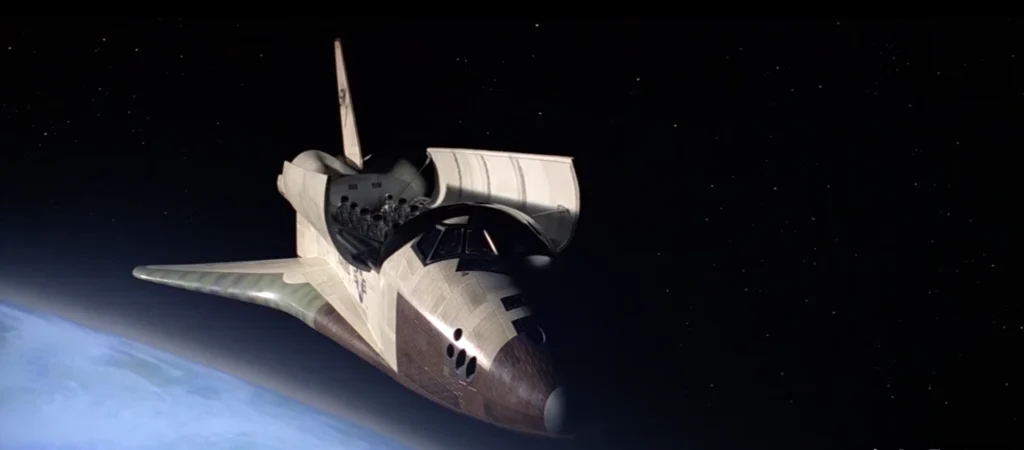



The moment seems pure fiction. A US Space Shuttle, not yet in service, set to intercept an enemy space station, carrying a platoon of US marines armed with laser guns. The laser guns weren’t real, nor was the idea of an armed platoon in outer space, but the Vandenberg Shuttle launch site at Space Launch Complex 6, situated along the rugged terrain on the southern expanse of Vandenberg Air Force Base, did exist.
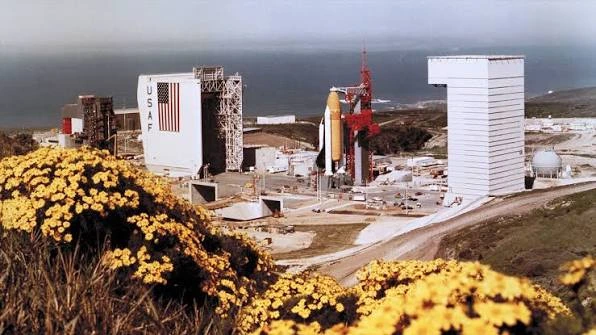

Abbreviated SLC-6 and pronounced in typical military phonetic slang as “Slick 6”, the military launch site was planned for shooting shuttles into polar orbits from the West Coast, a trajectory essential for carrying secret surveillance satellites into space. It was the Space Shuttle program’s military arm, just without weapons.
Moonraker shows the launch in a blink and you’ll miss it scene, a recreation of the real site: a Derek Meddings miniature of the Vandenberg launch site that lasts less than 15 seconds on screen. One of Drax’s personnel makes the launch site explicit after viewing his radar screen: “Vandenberg. Continental USA.” First, they believe the launch was scheduled, but then they discover the real reason: the radar jamming system has failed, thanks to Bond and Goodhead.
In 1979, while Moonraker was in cinemas, the United States Air Force was spending billions to make Vandenberg the military home of the Space Shuttle.
But it never happened. The militarized Space Shuttle program was scrapped between 1986 and 1989, and Slick 6 was recommissioned for launching rockets.
Bond producer Cubby Broccoli liked to describe Moonraker as “science fact, not science fiction.” Not just a riff on Star Wars.
Eon Productions had been given special access to NASA research, specifically to its Space Shuttle project and to early design plans for possible future space stations. What Eon took from NASA’s space station ideas is unknown; the design and scope mostly sprang from the imagination of production designer Ken Adam, while other elements were drawn from NASA research included the space backpacks (shades of NASA’s Manned Manoeuvring Unit or MMU) used to propel astronauts during the space battle and, of course, the Space Shuttle itself.

The shuttle design is fairly accurate to the real craft. Renaming it Moonraker ties its design and construction for NASA to the villain, Hugo Drax, and his company, Drax Industries. In reality, the shuttles were made by Rockwell International, a large aerospace and defence contractor, with the orbiters assembled and engineered at its Californian sites in Palmdale and Downey respectively, making for a striking parallel to Drax Industries in the film.
Eon and NASA both hoped the film’s release would roughly coincide with the first Shuttle launch. It didn’t happen that way. Columbia ran into technical problems and didn’t fly until 12 April 1981, so Moonraker put an orbiter in space nearly two years before NASA did.
Space Launch Complex 6
Kennedy Space Center in Florida was the centre of NASA’s shuttle operations, sending orbiters east over the Atlantic. What Florida couldn’t do safely was reach polar orbit, a north-south path that carries a satellite over both poles. As the satellite loops from pole to pole, the Earth turns beneath it, so over time it passes above every part of the planet.
This polar trajectory was important to the military.
Electro-optical spy satellites, which photograph the ground digitally rather than on film, needed polar orbits to watch any adversary, anywhere. A polar launch from Florida would have flown overpopulated land. Vandenberg, on the California coast, could launch due south over the Pacific Ocean.
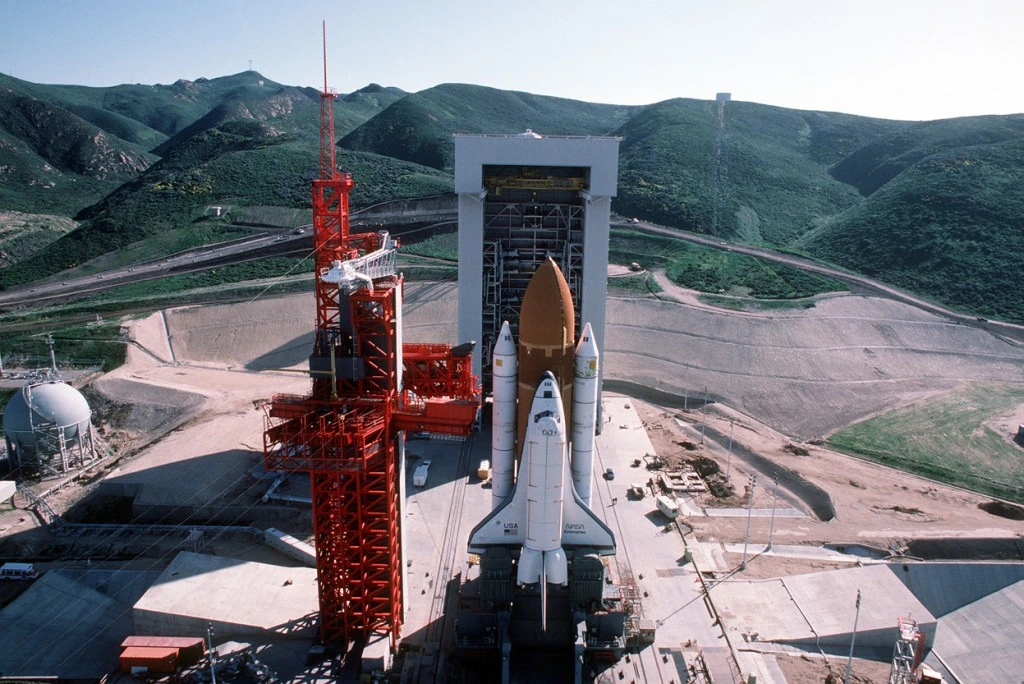
The Air Force’s answer was Slick 6. Slick 6 already had a history of military dreams in space. It was first built in the 1960s for the Manned Orbiting Laboratory (MOL), an Air Force spy station meant to send astronauts into orbit in a Gemini capsule on top of a Titan rocket. Construction began in 1966, but MOL was cancelled on 10 June 1969 before it ever flew, and the unfinished pad was mothballed. Between 1979 and 1986 it was rebuilt at enormous cost for the Shuttle. Slick 6 was built for two crewed military space programs and never launched a single person on either. Orbiters would have been carried from North Vandenberg to the pad on a special 76-wheel transporter. From Slick 6, the Shuttle would carry military and intelligence payloads into polar orbit, a capability Florida couldn’t offer.
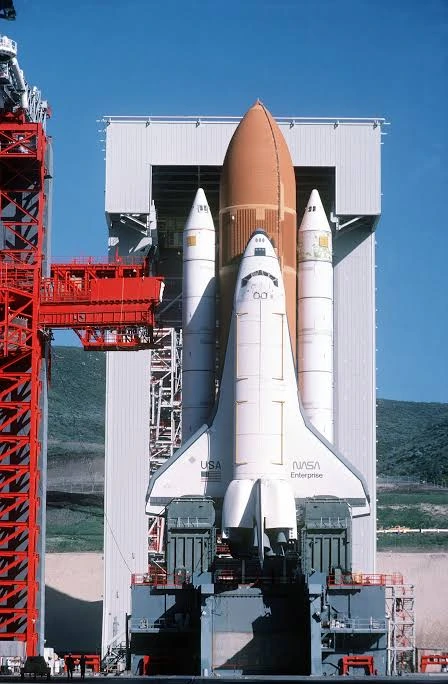
Photographs exist of the shuttle Enterprise, named in homage to Captain Kirk’s starship, standing on the Slick 6 pad. In 1985 it was brought to Vandenberg and stacked on the pad for fit checks, to make sure the facilities worked with a real orbiter. But Enterprise was a test vehicle that could never fly in space. Another orbiter was scheduled to launch from the pad, before the flight was canned.
Seven years after Moonraker, the United States was weeks or months away from launching a military Shuttle from Vandenberg. There were no marines and no laser rifles, but the basic idea was the film’s.
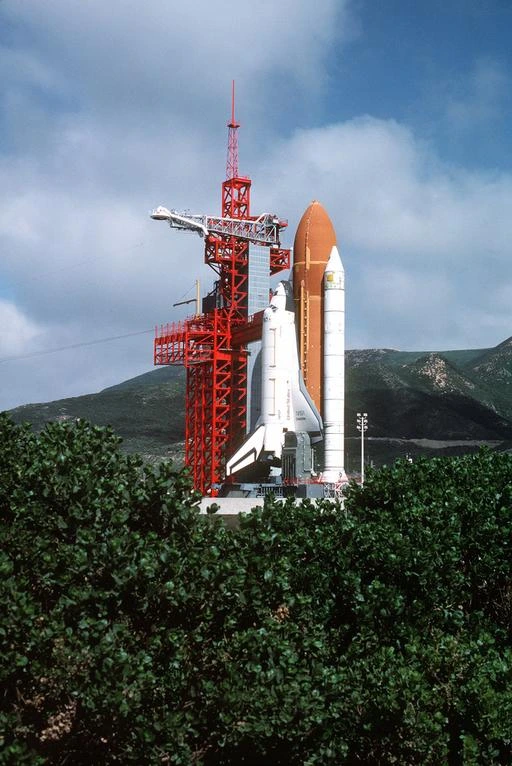

The first Vandenberg mission, STS-62-A, was scheduled for July 1986 using the orbiter Discovery, with a reconnaissance satellite called Teal Ruby. It would have been the first crewed launch from Vandenberg and the first crewed mission into polar orbit. Bob Crippen would be the shuttle commander, after flying four shuttle missions from Florida (three on Challenger and one on Columbia).
Crippen had history with Slick 6. In 1966 the Air Force picked Crippen as one of its MOL astronauts, which made Slick 6 his home. When MOL was cancelled in 1969, he transferred to NASA instead, before being assigned to command the Vandenberg mission. But he never got to launch from Slick 6, leaving the same pilot grounded at the same pad for the second time, seventeen years later. The crew would have included Air Force personnel and Edward “Pete” Aldridge, Under Secretary of the Air Force, as payload specialist. Two years later, as Air Force Secretary, Aldridge helped dismantle the program.
How Slick 6 Died
On 28 January 1986, Challenger broke apart 73 seconds after lifting off from Florida. It was the beginning of the end for the Shuttle program. All shuttles were grounded immediately.
Challenger is usually given as the reason Vandenberg never launched a Shuttle, but the full story is less tidy.
A June 1986 Senate report concluded that the primary reason was the need to test and modify the pad itself. The pad had b een constructed with singular rockets in mind, not shuttles with booster rockets. Unmodified, the launch could seriously damage an orbiter under certain circumstances. Engineers had found that SLC-6 would produce more contaminated wastewater than expected and needed more sound suppression. There were also fears that gaseous hydrogen could collect at the pad. Ignite that, even with a cigarette lighter, and there’s an instant inferno.
Those problems alone might have pushed a first launch back to 1989.
The decline came in stages:
- 31 July 1986: SLC-6 placed in “operational caretaker status.”
- 31 January 1987: the 6595th Shuttle Test Group at Vandenberg inactivated.
- 20 February 1987: the site reduced to “minimum caretaker status.”
- 13 May 1988: Air Force Secretary Aldridge, the man who was to have flown from the pad, directed that Shuttle assets at Vandenberg be transferred elsewhere, mostly to Kennedy Space Center, by the end of the fiscal year.
- 20 September 1989: the work finished ten days early and SLC-6 was mothballed.
- 26 December 1989: the Air Force formally closed the Shuttle programme at Vandenberg.
The Pentagon’s link to the Shuttle didn’t end entirely. Classified military payloads flew aboard Shuttles from Florida between 1982 and 1992, but none of those missions reached polar orbit. And that was the whole reason Slick Six had been built. In July 1990 work began converting the complex for unmanned Titan IV rockets. No Shuttle ever left the pad.
The View from Moscow
On the other side of the Iron Curtain, the American Shuttle looked far more sinister.
In 1976, two Soviet mathematicians, Dmitry Okhotsimsky and Yuri Sikharulidze, produced an assessment of the American programme. The Soviets didn’t believe the US purpose for the Shuttle. Washington claimed the Shuttle would make launching satellites cheaper. Soviet researchers were convinced it would cost more. If the Shuttle made no economic sense, they reasoned, it had to be for something else. The study concluded that the Shuttle could “dive” on Moscow in a surprise attack and release a nuclear weapon capable of destroying the city and the Soviet leadership.
The central concern was a manoeuvre unique to a winged spacecraft. Yuri Semenov, a senior designer at NPO Energia, later recalled officials warning that an American Shuttle, even on its first orbit, could make a sideways manoeuvre, and end up over Moscow with a potentially dangerous payload. A ballistic missile warhead follows a predictable path. A Shuttle could glide, steer and change course on its way down, and position itself to drop a warhead.
As Semenov put it, “Parity is needed, we needed the same type of rocket-space system.”
Buran: The Shuttle Ordered by the Soviet Military

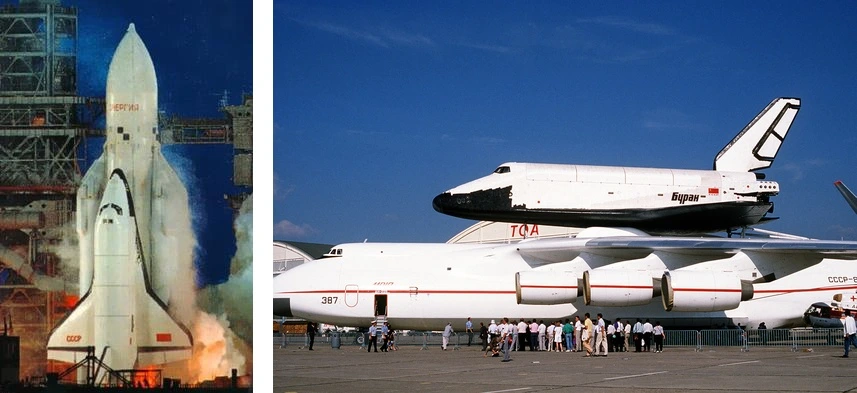
The Soviet answer was Buran, a spacecraft so close in shape to the American orbiter that it is widely believed to have relied on stolen plans.
Semenov was blunt about who wanted it:
“It is no secret to anyone in our sector… that the Energia-Buran system was ordered from us by the military.”
The military plans went beyond matching the Americans. In 1976 the Soviet leadership ordered a confidential study into creating weapons for fighting in space, and the work was given to NPO Energia. Designers planned two armed spacecraft built on the same basic platform (power, propulsion and control systems) but with different weapons: Skif, carrying a laser, and Kaskad, carrying missiles. Their systems borrowed heavily from Buran. One Russian source on the program goes further and claims nuclear bombs were meant to sit in Buran’s own payload bay, though that claim is hard to corroborate.
The programme came closest to real hardware on 15 May 1987, when Energia launched Skif-DM, an 80-tonne prototype battle station also known as Polyus. A propulsion failure sent it into the Pacific instead of orbit. Ironically, the American space weapons it was meant to answer barely existed. The Kremlin’s fears had largely invented them.
Buran itself flew only once. On 15 November 1988 it completed two orbits fully automatically, with no crew aboard, and landed itself at Baikonur. It never flew again. Starved of money as the Soviet Union collapsed, the program was formally ended in 1993, eighteen years before the American Shuttle retired in 2011. In May 2002 the neglected roof of its hangar at Baikonur collapsed during repair work. It destroyed the only Buran orbiter that had ever flown and killed the workers on the roof, eight according to most accounts.
Science Fact After All
The dates make one thing clear: Moonraker didn’t create the Soviet fear. The Okhotsimsky and Sikharulidze study, and the 1976 decision to explore weapons in space, came three years before Roger Moore went into orbit. Bond didn’t plant the idea in the Kremlin.
What he did was put it on screen. In 1979 the world watched a Shuttle launch from Vandenberg as a military vehicle, carrying armed men to a hostile station in orbit. That was close to the future the US Air Force was building at Slick Six, and it was the scenario Soviet planners had already convinced themselves was coming, the one that led them to build Buran and a laser battle station. Cubby Broccoli’s boast about “science fact, not science fiction” was meant as publicity. It was closer to the truth than he could have known. On both sides of the Cold War, the idea of a militarised shuttle was taken seriously, and both versions ended up, like Drax’s station, as wreckage of an imagined future: a mothballed pad in California and a crushed orbiter in Kazakhstan.
The Road Not Taken
Moonraker isn’t the only screen story to imagine where Slick Six might have led.
In For All Mankind, the Apple TV+ alternate history in which the space race never ended, Vandenberg becomes a working shuttle site. In season two, set in 1983, NASA flight director Margo Madison asks the Air Force’s General Nelson Bradford to let a shuttle land at Edwards so NASA can free up polar launches from Vandenberg, the exact job Slick Six was built for. The show then goes further than the Air Force ever did. NASA’s new shuttle Pathfinder is rushed into service as a warship, armed with Phoenix missiles and sent to face down an armed Soviet Buran.
It’s similar to the scenario Okhotsimsky and Sikharulidze feared in 1976, played out on television more than forty years later. Moonraker got there first, in 1979.
A Real Moonraker Finally Leaves Vandenberg
Forty-seven years after the film, a real Moonraker launched from Vandenberg.
At 4:02 a.m. on 30 March 2026, a SpaceX Falcon 9 lifted off from Space Launch Complex 4 East on the Transporter-16 rideshare mission. Among its 119 payloads was Moonraker, built by Pacific Defense.
It wasn’t a space shuttle, and it didn’t launch from Slick Six. But it was military. Moonraker is a radio-frequency payload designed for space situational awareness and electromagnetic spectrum operations: in plain terms, it watches and listens to what’s happening in orbit. It was developed under contract to the Air Force Research Laboratory’s Space Control Technology Branch, and Pacific Defense says it gives the Department of War a capability to outpace emerging threats. The company hasn’t said where the name comes from, but a moonraker is a sail, not a spacecraft. It was Ian Fleming who put the word on a rocket. And Pacific Defense is likely making a nod to the Bond film.
Slick Six Gets a New Owner
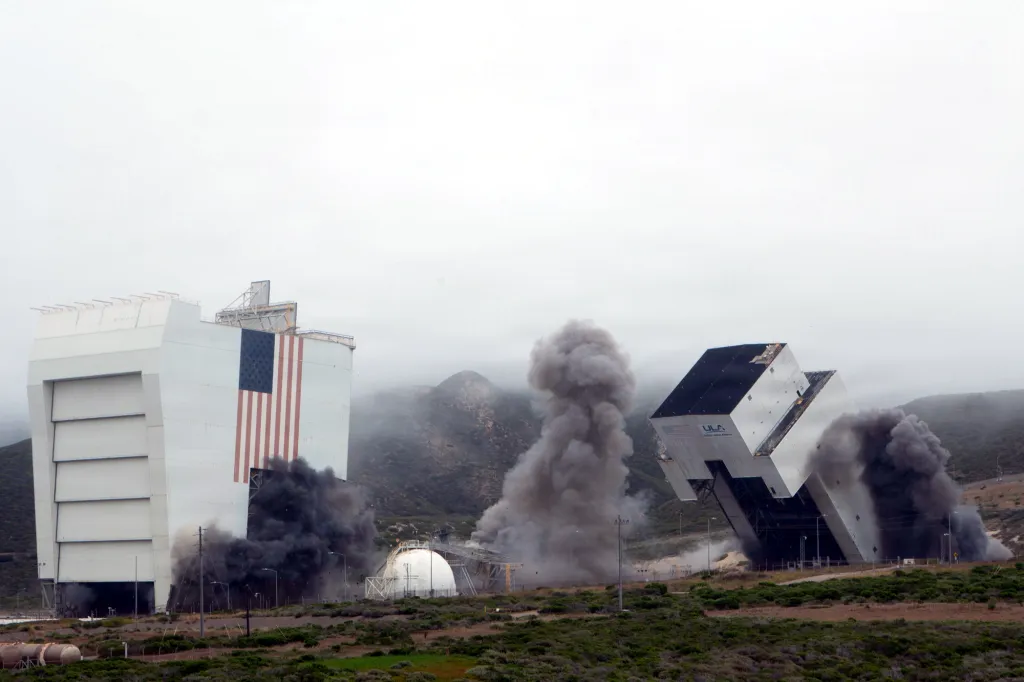

Slick Six itself is coming back to life. On 24 April 2023, the US Space Force announced it was leasing SLC-6 to SpaceX for Falcon 9 and Falcon Heavy launches and landings. Other companies had wanted the pad for its size, most notably Blue Origin, for its New Glenn rocket. In October 2025, the Department of the Air Force gave SpaceX final approval to redevelop the complex, raising its annual launch limit across its two Vandenberg pads from 50 to 100.
So the pad built for a military space station, then rebuilt for a military space shuttle, never launched either. Its future belongs to a private space company, the very thing Hugo Drax ran in Moonraker. The film imagined a private industrialist launching shuttles from California. It just got the pad wrong.


- Vandenberg’s Slick 6: Moonraker Foreshadows A Planned US Militarised Space Shuttle Program That Never Flew - November 29, 2026
- Robert Pattinson Is 007: “Welcome to His Majesty’s Secret Service” - November 16, 2026
- Tom Brittney: Is This Bond’s Mystery Fourth Man? - November 2, 2026