


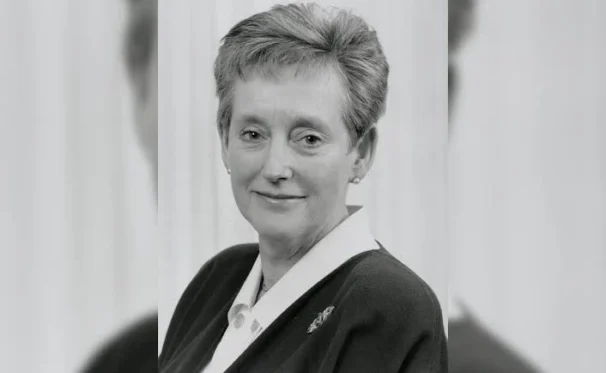
Judi Dench played James Bond’s boss, M, in eight Bond films from GoldenEye (1995) to SPECTRE (2015). Casting a woman as Bond’s boss was a risky move in 1995. She would be the first female boss for 007, a man not exactly known for taking orders from a woman.
She made quite an entrance, first telling her second-in-command, Bill Tanner, that if she “wanted sarcasm, she’d talk to her children”, and then chastising Bond as “a sexist, misogynist dinosaur. A relic of the Cold War.” But she owned the role, and both boss and Bond developed mutual respect over successive adventures — their interactions a series highlight that, for many, helped position Dench as the best M in the Bond series.
The risky move was not just in making M a woman but having 007 take orders from one. And while Dench carried the role herself, the casting decision didn’t come from nowhere. It came from real life — mirroring the real-life appointment of Stella Rimington as Director General of MI5 in 1992.

The Woman Who Made It Thinkable
Rimington was the first woman to hold the post, and the first DG whose name was publicly announced on appointment. Three years later, the Bond producers cast a woman as M for the first time. The connection, confirmed by the producers themselves, was direct: Rimington’s appointment made the idea not just plausible but resonant.
She died on 3 August 2025, aged 90. Her family said she was surrounded by her beloved family and dogs, and had “determinedly held on to the life she loved until her last breath.”
MI5’s current Director General, Ken McCallum, described her as “the first avowed female head of any intelligence agency in the world” who “broke through long-standing barriers and was a visible example of the importance of diversity in leadership.”
That was the public statement. The private reality of how she got there was considerably less ceremonial — and one based on merit.

A Typist in New Delhi
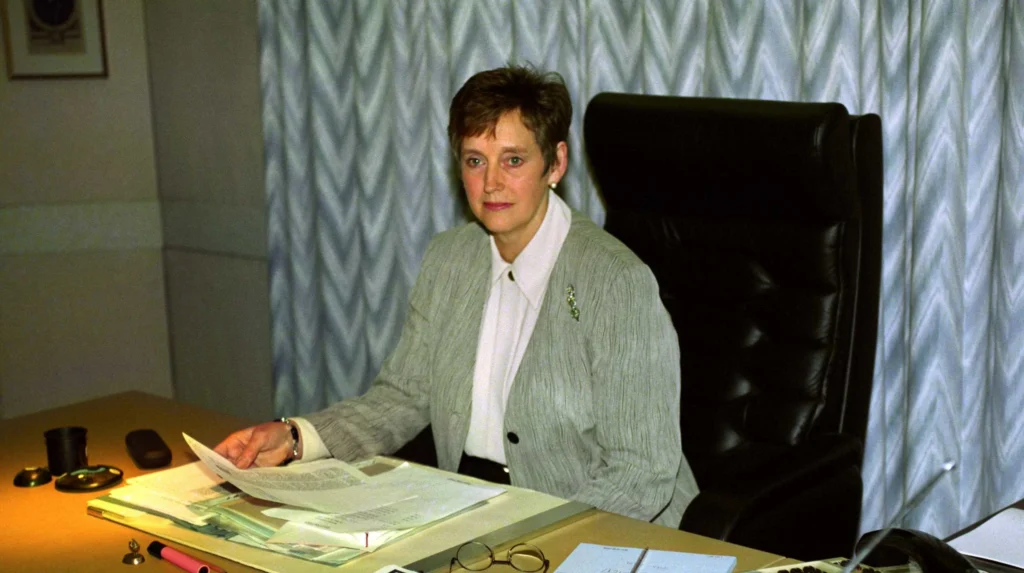
Rimington did not set out to be a spy. Born in South London in 1935, she studied English at Edinburgh University, trained as an archivist, and in the mid-1960s found herself in New Delhi as the wife of a British diplomat. It was not, by her own account, a fulfilling existence — tea parties and amateur dramatics while her husband worked.
In 1967, a man at the High Commission tapped her on the shoulder. He needed clerical help with office work. She agreed, and discovered he was MI5’s representative in India. She spent nearly two years working in the MI5 New Delhi office, returned to London in 1969, and applied for a permanent position. She was hired. The great game, as she’d imagined it reading Kipling, turned out to be rather more administrative than advertised. She began, as generations of women in intelligence had before her, at a typewriter.
What she did over the following 27 years was something else entirely.
Rising Through the Ranks
Between 1969 and 1990, Rimington worked in all three branches of the Security Service: counter-espionage, counter-subversion, and counter-terrorism. She became the first woman promoted to the rank of Director of a Service branch — a distinction that sounds procedural until you consider what MI5 was actually doing during those years: monitoring Soviet espionage networks, infiltrating Provisional IRA cells, tracking Eastern Bloc agents operating on British soil.
The personal cost was real. She has spoken about watching her children raised by a nanny while she worked. She recalled one night when her baby was rushed to hospital with convulsions. She was en route to a safe house to meet an Eastern European spy who was considering defection. If she didn’t arrive, the asset wouldn’t get access. She went to the meeting first.
In 1989, she gave evidence in court against the Czechoslovak spy Václav Jelínek — operating under the alias Erwin van Haarlem — testifying under her own alias, Miss J. In 1990, she was promoted to Deputy Director General, overseeing MI5’s move to its current headquarters at Thames House. In December 1991, she flew to Moscow to conduct the first friendly contact between British intelligence and the KGB. When she landed back in London, she was told she had been appointed Director General.
Director General
Her appointment was announced by the Home Secretary on 16 December 1991. The British press responded by launching a determined campaign to photograph her covertly. The New Statesman and The Independent both obtained and published surveillance images of her — an irony apparently lost on their editors. Rimington was dubbed the “housewife spy.” The coverage was, by any measure, an exercise in institutional panic about a woman at the top of a world that had never had one.
She responded by doing the job. Under her leadership, MI5 took primary responsibility for countering Provisional IRA terrorism on mainland Britain — a major operational shift announced in May 1992, which transferred lead authority from police Special Branches to the Security Service. Nearly half the agency’s resources were redirected to Irish-related terrorism. Over an 18-month period ending in mid-1994, more than 20 PIRA members were arrested and charged on the mainland.
In July 1993, she oversaw something arguably more significant for the long term: MI5 published a 36-page booklet, The Security Service, publicly revealing details of the agency’s activities and duties for the first time in its history — including photographs of Rimington herself as Director General. For an organisation that had spent decades denying its own existence, it was a seismic step. Rimington had long advocated for transparency. She pushed it through anyway.
She stood down in 1996 and was made a Dame Commander of the Order of the Bath in the same year.
On Screen
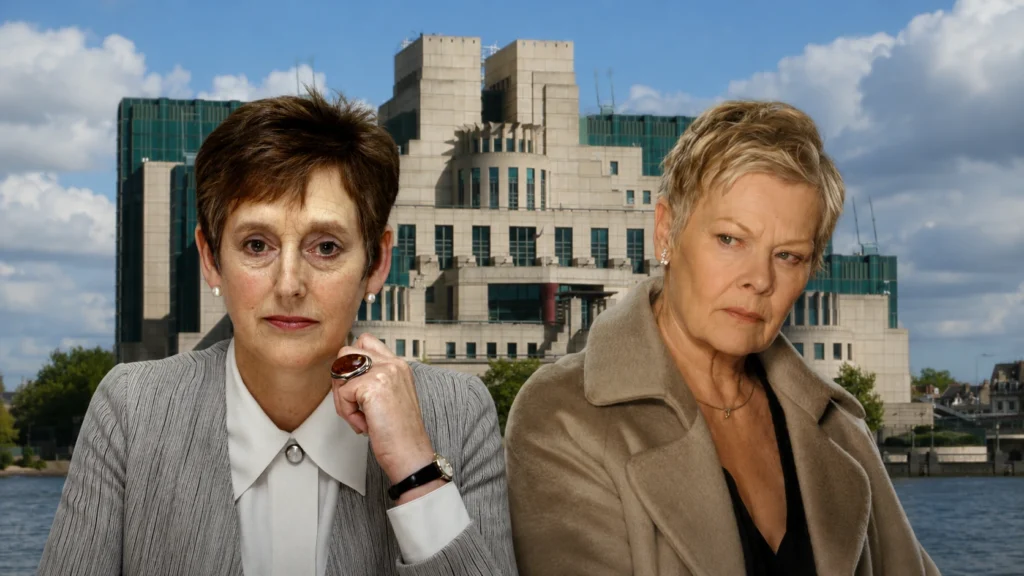

GoldenEye opened in cinemas in November 1995, three years after Rimington’s appointment and one year before she retired. The new M — cold, precise, entirely unbothered by Bond’s opinion of her — looked out at audiences who had just spent three years watching a woman run Britain’s intelligence services. The connection was legible.
The similarities between Dench’s M and Rimington went beyond the institutional. Both women wore similar clothing to what photographers had captured Rimington wearing in public. Both wore a short pixie cut — though it should be noted that Dench already wore her hair that way before taking the role; it was her own.
The more striking resemblance was in manner. When Rimington’s eldest daughter saw GoldenEye in 1995, her reaction was immediate:
“Gosh, she even holds her hands like you do.”
The producers confirmed the inspiration directly. 007.com’s official GoldenEye at 30 feature states that the Dench characterisation was “inspired by the 1992 appointment of Stella Rimington.” The “reportedly” that usually qualifies this claim in other publications can be dropped. It’s on record.
Dench herself, however, has always denied it. At a 2017 event at The China Exchange in London, she firmly stated that her interpretation of M was not based on Rimington — while confirming she had met real MI6 officers at a lunch at the Vauxhall building before taking the role. The triangle is interesting: the producers say yes, the mannerisms say yes, the actress says no. Make of that what you will.
MI5 is concerned with threats on home soil. The M of the Bond films runs MI6, which handles foreign intelligence — closer in function to the CIA than the FBI. Rimington led the domestic agency; Bond’s M leads the foreign one. The distinction matters factually, but it didn’t matter culturally. What Rimington represented — a woman at the top of Britain’s secret world — was the thing that mattered. The specific acronym was secondary.
Open Secret and the Liz Carlyle Novels
Five years after leaving MI5, Rimington published Open Secret, her memoir of 27 years in the Service. The government was not pleased. Publishing a first-hand account of life inside British intelligence was — and remains — an act that requires official clearance and generates institutional anxiety regardless of what’s in it. Open Secret generated both.
It was not, by most accounts, a tell-all in the tabloid sense. What it did was continue the work Rimington had begun as Director General: making the Security Service legible to the public it served. She had always believed transparency was not incompatible with security. The book was the argument in print.
In 2004, aged 69, she turned to fiction. At Risk introduced Liz Carlyle, an MI5 intelligence officer in her thirties working in counter-terrorism and navigating the institutional obstacles of a male-dominated agency. The autobiographical undertow was not subtle. Liz Carlyle was Rimington in her earlier years — ambitious, analytically sharp, doing the work inside a structure that had been built without her in mind.
The Carlyle series ran to ten novels, praised by security professionals for their procedural authenticity. A Falklands War veteran and former military intelligence officer described At Risk‘s depiction of jihadist terrorism as “believable and frightening,” adding that the hairs on the back of his neck stood up on at least two occasions.
Readers noted what the novels offered that Bond never did: a ground-level portrait of how intelligence work actually functions — the waiting, the assessment, the managed uncertainty, the absence of clean resolution.
Rimington later began a second series featuring CIA officer Manon Tyler. The Devil’s Bargain (2022), the first Tyler novel, was published when she was 87. Her final book, The Hidden Hand, appeared in 2025. She was writing, and publishing, until the very end.
Real Life Catches Up
In June 2025, six weeks before Rimington’s death, the British government announced that Blaise Metreweli would become the first female chief of MI6 — the actual agency that James Bond works for, the one Dench’s M ran on screen for seventeen years. Metreweli, then serving as MI6’s Director General of Technology and Innovation took office on 1 October 2025.
The coverage noted the obvious: real life had finally caught up with the fiction. Rimington had broken the barrier at MI5 in 1992. Eliza Manningham-Buller followed her at MI5 between 2002 and 2007. Anne Keast-Butler became the first female head of GCHQ in 2023. Metreweli completed the sequence. Every major British intelligence agency is now headed, or has been headed, by a woman.
Dench’s M preceded the real-world female chiefs of MI6 and GCHQ — but she only existed because Rimington had already broken the first barrier.
A Note on Dench’s M and SPECTRE
Many were confused when Dench reappeared as M in Daniel Craig’s run as Bond. After all, Casino Royale, a hard reboot of the character, took Bond into an alternate universe, so to speak, where M’s secretary Mis Moneypenny and Q were also rebooted with different actors, a different backstory, and in Q’s case, from a new, younger generation.
Dench, in fact, plays two different characters in Brosnan and Craig’s films. The GoldenEye screenplay and late novelization by John Gardner, refers to her by name: Barbara Mawdsley, with a history in numbers. As M self-describes herself to Bond: “A bean counter more interested in my numbers than your instincts”.
Casino Royale didn’t give much away in determining that Dench was playing a different person. But by the time we get to SkyFall, we learn she used to Head MI6’s Hong Kong station, overseeing the transition of the city from the UK back to China.
In an early treatment of SkyFall called Once Upon A Spy we learn M’s name: Olivia Mansfield.
Either way, Dench’s M had more to do in those stories, which was in part, an honour bestowed to her presence and ability as an actor — including becoming the first M to die on screen, leading to the first success of a villain in a Bond film. Raoul Silva’s (Javier Bardem) plan was to kill her out of revenge for giving him up to the Chinese back in her Hong Kong days.
SkyFall was Dench’s final active run as M. Her appearance in SPECTRE (2015) is a brief recorded message — a posthumous cameo rather than an active role. For those keeping count: eight films.
It’s a fitting end for a character drawn from a woman who spent her career operating in the shadows.
Stella Rimington, DCB — 13 May 1935 to 3 August 2025.


- Why Robert Pattinson’s Batman Should Be DCU’s Caped Crusader - October 12, 2026
- California’s AG Loses to Paramount: Inside the Paramount / Warner Bros. Discovery Merger — And Why Ellison May Still Leave California - September 26, 2026
- Napoleon Solo Sold for £1: The Year Ian Fleming Stopped Owning Ian Fleming - July 25, 2026