Weaponized Elegance: Engineering the Goldfinger Aston Martin DB5
“Beautiful on the outside, vicious on the inside — that was already becoming part of the formula.” — Ken Adam, production designer, Goldfinger
It was the car that changed James Bond and action cinema forever. Dubbed “the most famous car in the world,” the Aston Martin DB5 — with its sophisticated styling and concealed arsenal — became the template for almost every Bond vehicle that followed, from cars and boats to even a gadget-laden autogyro. It also inspired generations of tricked-out vehicles across film and television, including the on-screen Batmobile, which would soon borrow extensively from its gadget-laden design.
More importantly, the Aston Martin DB5 was the first car to be turned into a functional war machine on screen — and that, in itself, spawned a fleet of inspired cars across comics and film, from Batman and the rest of DC to Mission: Impossible and Marvel and beyond.
The Aston Martin DB5 was unveiled in September 1963 at the Earl’s Court Motor Show — almost exactly a year before Goldfinger premiered in September 1964. Still, the car’s exposure in Bond’s third film moved it from Aston Martin’s flagship grand tourer into legend.
It was Bond who made the Aston Martin DB5 the “most famous car in the world.”
Yet Bond’s association with Aston Martin did not originate with the film. It began with Ian Fleming.
In Goldfinger, published in 1959, Bond replaces his long-favored Bentley with an Aston Martin DB Mark III drawn from the Service motor pool for a specific assignment. The choice was contemporary. By the late 1950s Aston Martin’s profile had risen sharply through international racing success and the development of the DB series. The Mk III was a modern British grand tourer when Fleming was writing the novel in 1958–59 — credible, fast, and newly visible.
Fleming equipped the car with restrained, functional modifications: reinforced body panels and bumpers, a hidden Colt .45 beneath the driver’s seat, and a tracking device known as the “Homer.” There were switches to alter the type and colour of Bond’s front and rear lights if he was following or being followed at night. The emphasis was not fantasy but utility. The Aston Martin in the novel is equipment — modern, British, efficient — but not ostentatious. Its gadgetry is discreet.
That literary template would prove decisive. When EON adapted Goldfinger for the screen, the presence of an Aston Martin in the novel provided the foundation. But the film would escalate the idea dramatically.
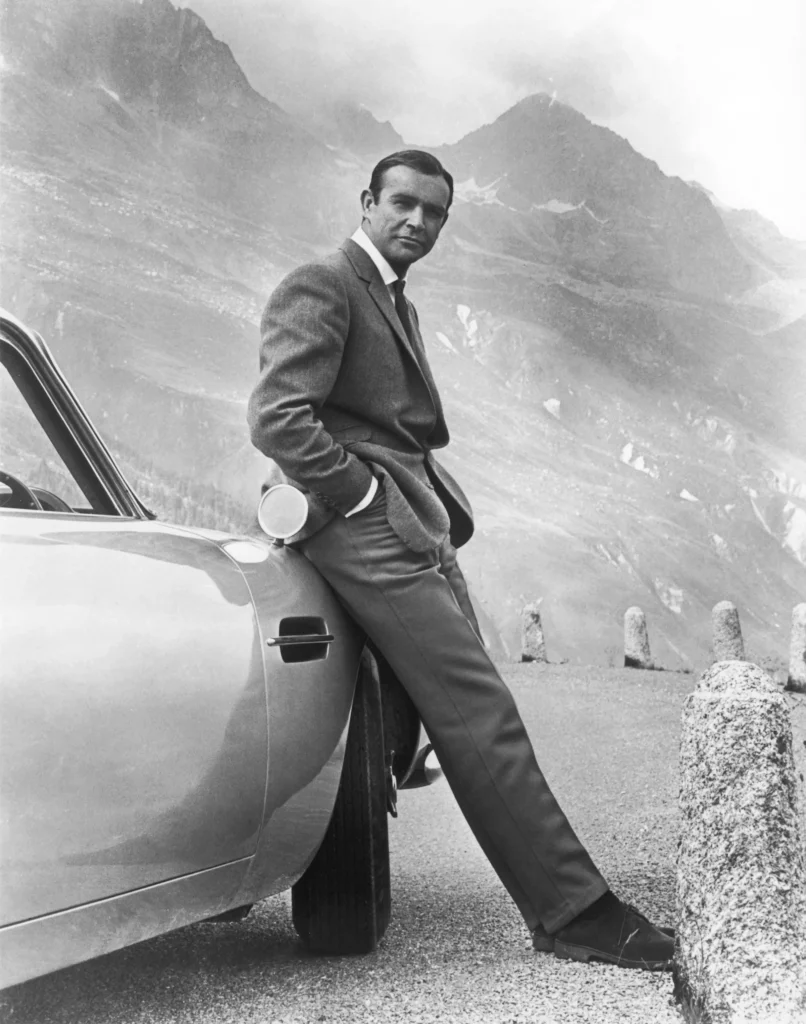
The Aston Martin DB5 embodied Sean Connery’s Bond, a definition that can be encapsulated in two words: weaponized elegance. Connery’s Bond is the original cinematic template — impeccably refined, but purpose-built for violence. His Savile Row tailoring, tuxedos, and Rolex project wealth and sophistication, but beneath that polish lies lethal capability. The DB5 does the same, presenting itself as a gentleman’s grand tourer while concealing its capacity for violence — its gadgets — beneath its skin. Both operate on the same principle: luxury as camouflage. The DB5 looks like a gentleman’s car and kills like a soldier’s weapon. That’s Connery’s Bond in metal and paint.
As production designer Ken Adam put it: “Beautiful on the outside, vicious on the inside — that was already becoming part of the formula.”
That literary template would prove decisive. But the route from Fleming’s restrained Aston Martin DB Mark III to the weaponized DB5 of Goldfinger was not direct. It passed through several script drafts, where Bond’s car shifted models, accumulated gadgets, and gradually changed from useful Service equipment into a cinematic showpiece.
From DB Mark III to Bentley to DB5: How Bond’s Gadget Car Evolved Over Script Treatments & Drafts
Equipping Bond’s car with gadgets was a collaborative process — one that evolved across the screenplay treatments, drafts, production design, and special effects work before it became the DB5 seen in Goldfinger.
(The script analysis traced here draws on Scripting 007, in which author Clément Feutry presents detailed accounts of the Maibaum treatments and the Dehn draft from documents in his own collection, cobbled together from winning bids at auction houses.)
Before Aston Martin agreed to supply two DB5s to EON Productions, screenwriter Richard Maibaum had already incorporated Fleming’s Aston Martin DB Mark III — often loosely referred to as a DB3 — into his early treatments. In Maibaum’s May 19, 1963 treatment, Bond goes to the Service garage and selects a grey Aston Martin DB3 equipped with practical Service modifications: heavy-duty bumpers, a telephone, headlights and rear lights that could change colour, a long-barrelled Colt .45 hidden in a compartment, and a receiver to track a beacon.
By Maibaum’s July 8, 1963 treatment, Bond had been returned to his beloved Bentley, though the same gadgets remained. The car was still equipped with essentially the same Service modifications drawn from Fleming’s Aston Martin: defensive bumpers, a telephone, concealed weaponry, lighting tricks, and a receiver for the tracking beacon. In Maibaum’s later draft, Bond again collects a gadgetized Bentley, now painted traditional racing green, from the Service dispatcher. Bond uses the Bentley to ram Tilly Masterton off the road in the Swiss scene, and she hitches a ride with him, making some quip about Bond ramming her off the road in order to pick her up. There is no night time gadget deployment chase, but Tilly is still killed by Oddjob’s bowler hat, but in this treatment, after Bond stops her from killing Goldfinger with her sniper rifle.
The DB5 arrived later. After Berkley Mather made uncredited revisions and screenwriter Paul Dehn was brought in to polish Maibaum’s work, Dehn’s December 23, 1963 draft introduced Bond’s Aston Martin DB5 for the first time. But the scene had not yet become the full Q Branch demonstration seen in the finished film. Q gives Bond a single tracking beacon and presents him with the Aston Martin DB5, saying: “The car has some other interesting modifications. Here’s an amusing little wheeze…” The script then cuts away before Q explains those modifications. At this stage, the audience was still intended to discover much of the car’s arsenal later, in the field.
Those gadgets reveal themselves during the Swiss scenes, though in forms that differ sharply from the finished film. The tire slasher is already present, described as a “knife flicking from Aston’s hub cap” to puncture Tilly Masterton’s tire. Bond also collects night binoculars and a grenade hidden in a shaker. The rear bulletproof plate is present, though instead of being activated by a button hidden beneath Bond’s central armrest, it is triggered by turning a window handle. The smoke screen is present too, but activated by the cigarette lighter. The major unused gadget is a flamethrower hidden behind the headlights, which Bond uses against Goldfinger’s guards.
The ejector seat is also already in place, though not yet in its final form. Rather than being triggered by the little red button in the gear stick, it is activated by pulling the handbrake. It works in two stages: hydraulic rods first raise the seat to roof level, then the seat ejects. The machine guns are not yet there. Instead, during the mirror scene near the end of the chase, Bond throws a grenade from the glove compartment.
The December 1963 draft does not prove that Dehn originated the DB5’s gadgets. If anything, the overlap between the draft’s rough gadget ideas and Adam and special effects supervisor John Stears’ later accounts suggests a production process already in motion, with script, design, and effects work feeding one another.
Adam and Stears both later described the gadgets as their conception.
This is backed up by Ken Adam’s early production drawings, reproduced in Scripting 007, which show the flamethrower mounted behind the grille— a different position and function it occupies in Dehn’s December draft. So, we see that dialogue between Adam and various screenwriters. Adam likely decided both the gadget and their placement, as he has said as much, and the difference between Dehn’s screenplay and Adam’s drawings, is in Adam moving the location of gadgets like the flamethrower. These early drawings also included a searchlight mounted on top of the windscreen and his front and rear overriders that he loved so much. The overriders were built into the car, but never used. The drawing also shows an early example of the rear bullet proof shield, which here raises like a car trunk on hinges, while the final design rises vertically out of the car’s trunk.
The gadgets weren’t written into existence by the screenplay. They were designed first, and the screenplay caught up.
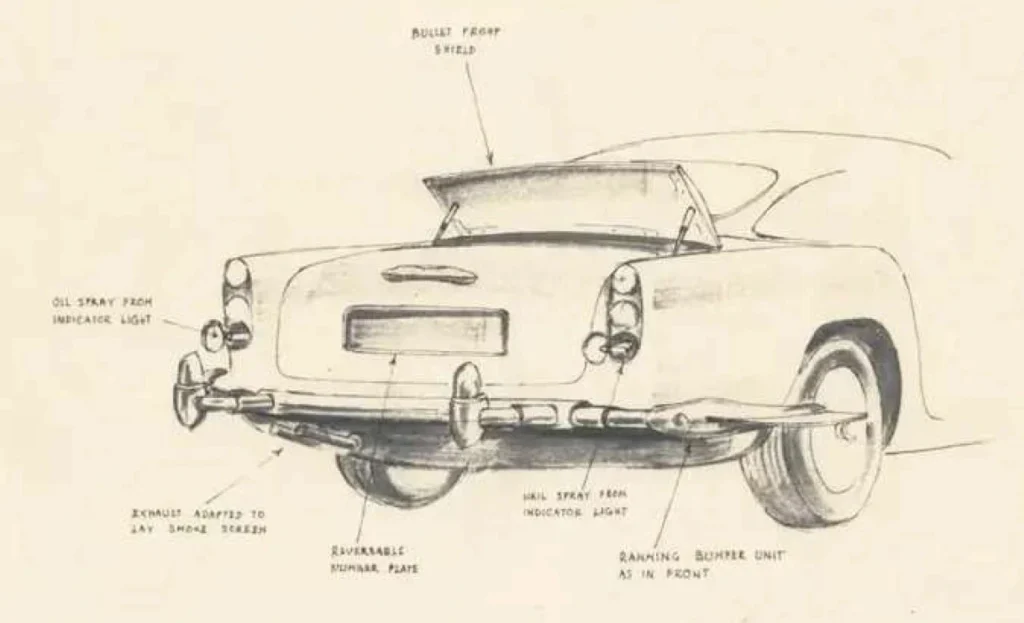
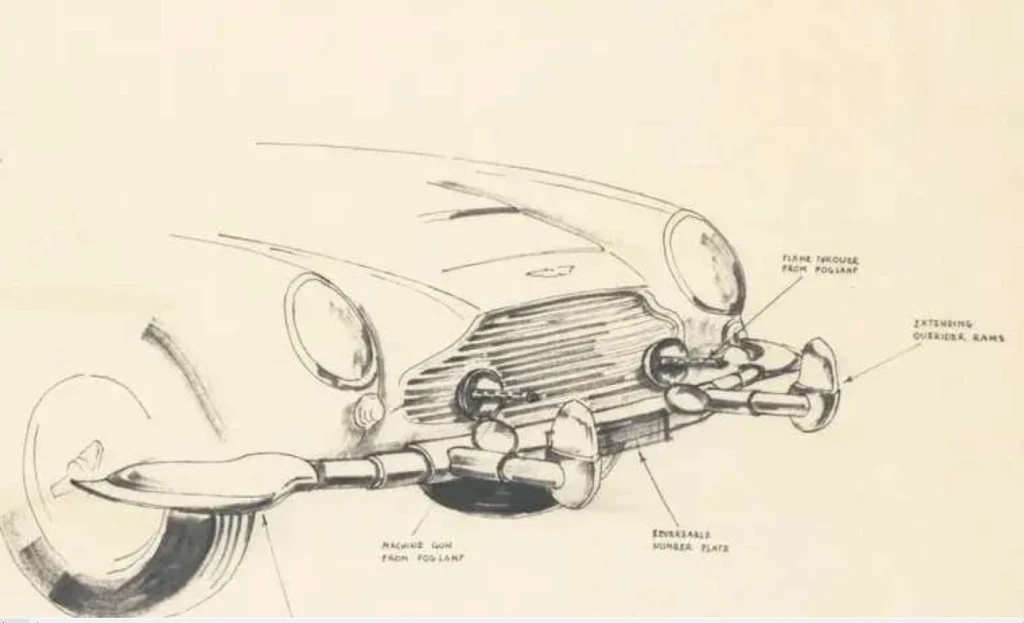
What the drafts show is not a clean line of authorship, but a moving exchange between screenplay, design, and engineering as the DB5’s arsenal took shape. By the time the final film was shot, those ideas had been refined into something far more elegant: the wheel “flicking knife” became the tyre slasher; the handbrake-operated ejector seat became the red-button payoff in the gear stick; the cigarette-lighter smoke screen became part of a wider control system; the flamethrower vanished; and machine guns emerged from behind the front headlights.
The DB5’s gadgets were refined over collaboration — a detail we get into next — emerging from a process of refinement into a coherent idea: a luxury grand tourer whose violence was hidden inside its elegance.
Once the DB5 was locked into the film, the problem became physical: could Aston Martin’s new grand tourer actually contain the arsenal the production now imagined for it?
From Skepticism to Screen Legend
The difference in cars between drafts shows that securing the Aston Martin DB5 came quite late in pre-production. EON had to secure the cars. That was not straightforward. Aston Martin had a new flagship model, and the idea of handing it to a film crew intending to cut into it, fill it with gadgets, and drive it through action sequences was not immediately appealing.
Even the choice of Aston Martin comes with competing memories. Fleming had already put Bond in an Aston Martin DB Mark III, but Ken Adam later remembered the production arriving at the decision through discussion. Adam, producers Albert “Cubby” Broccoli and Harry Saltzman, and director Guy Hamilton had debated the options together.
“I remember Cubby, Harry, Guy and myself debating what car we would give Bond,” Adam told author Christopher Frayling in his book, Ken Adam and The Art of Production Design, “because there were the E-type Jaguars, the Aston Martins and the Italian Ferraris and Alfa Romeos. We decided the Aston Martin, which was by far the most expensive British sports car, would be the right prop for Bond.”
Memory is sometimes clouded decades on — the script drafts contradict this rather neat description of events, since at one point the Aston Martin MK III was replaced by Bentley before deciding on the DB5. Fleming’s novel had been followed closely until a more imaginative and cinematic vision was imbued into the DB5.
Adam and Stears went together to meet David Brown — Aston Martin’s owner — at the Newport Pagnell plant — but it was Saltzman who made the initial approach. Aston Martin’s General Manager Steve Heggie said in the book, The Most Famous Car in the World that he showed no interest:
“We had many such requests in those days from film producers and in general it cost Aston Martin more than it was worth.”
Saltzman persisted and Aston Martin reluctantly relented. Adam and Stears followed up in person. As Stears recalled in Inside Goldfinger:
“When we came to do Goldfinger, there was a debate on what car to use…. The management at Aston Martin were very skeptical about us and they said, ‘What do you want to do with the car?’ I told them briefly this. ‘But you won’t do it. You won’t get any more equipment in this car. It’s absolutely loaded as it is.’ [I said] ‘So, just give me a break. Let me do it. I can prove to you I can do it.'”
Adam and Stears visited Newport Pagnell in late 1963. Within days, Dehn’s December 23rd draft had Bond collecting a DB5 for the first time. The car didn’t enter the screenplay just as a creative preference — it entered because the production had finally secured one.
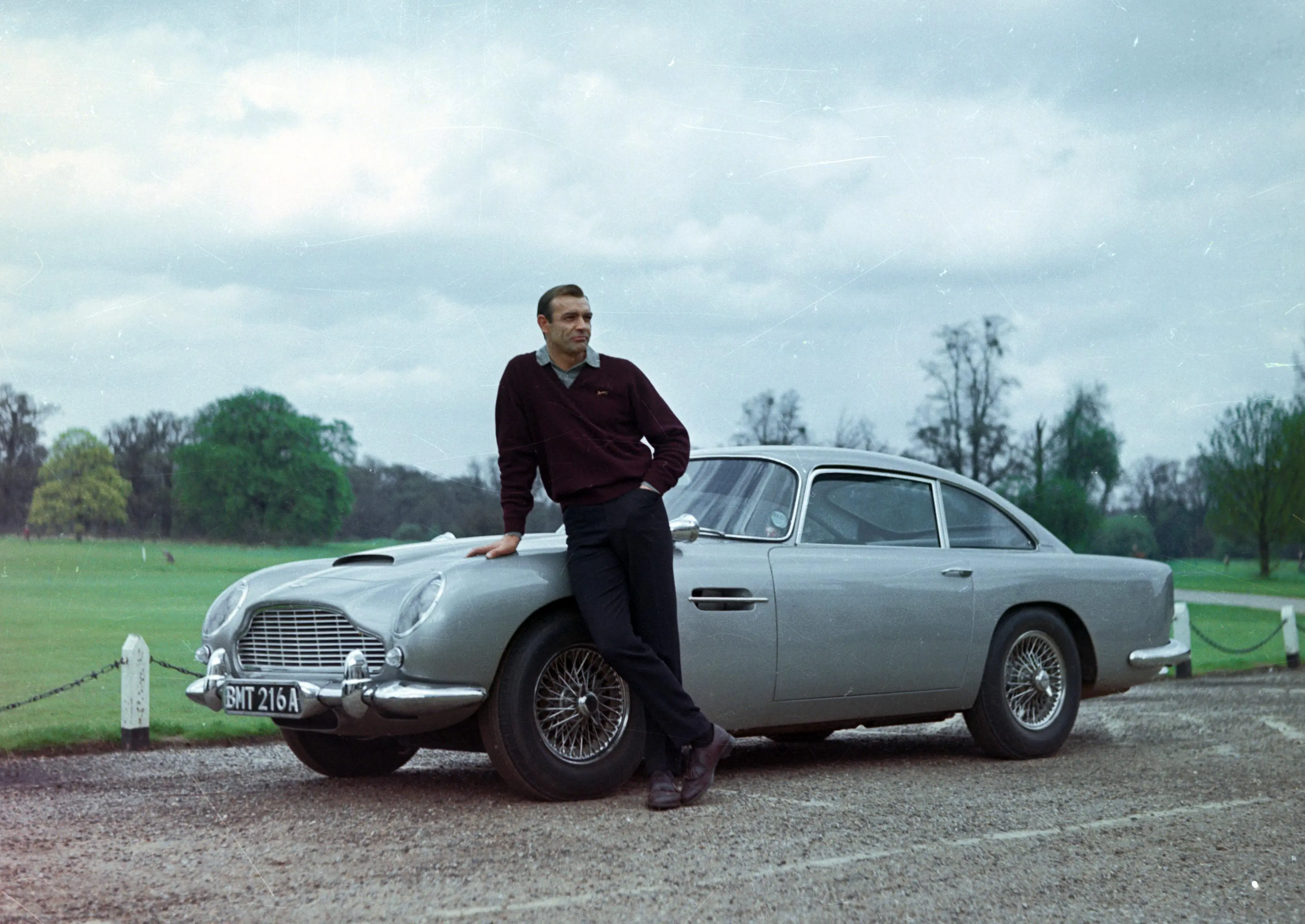
Aston Martin supplied two cars — one “hero” car for close-ups and interior work, and one for action sequences. One was prototype chassis DP/216/1, registration BMT 216A, originally painted Dubonnet red. The DB5’s now-iconic Silver Birch finish was not its original colour — a deliberate choice that would become inseparable from Bond. And it wasn’t even a new car. It had already done time as a factory test vehicle before EON got their hands on it.
The commercial outcome of that reluctant loan would prove staggering. After Goldfinger, Aston Martin’s sales went up by about 47 per cent. During the shoot itself, special effects technician Bert Luxford and Stears visited the factory for lunch with the Managing Director, who produced a scrapbook four inches thick. “This is all the free advertising,” he said. “About £3 million worth.” The film hadn’t even been released. Aston Martin would later strip the gimmick car of its gadgetry and re-sell it — an irony Luxford noted with characteristic dryness:
“I think the only remaining part of the film version car is the number plate, which is a shame.”
Building the Weapon
With Aston Martin’s agreement secured, the evolving gadget-car concept had to become a working screen machine. Some ideas had already appeared in rough form in the drafts; others would be refined through Adam’s sketches, Hamilton’s suggestions, and Stears’ practical effects work. The challenge was not simply to invent gadgets, but to make them feel as though they belonged inside one elegant car.
Adam was a sports car enthusiast who drove an E-type Jaguar. In those days it had no front bumper, and it was continuously being damaged by other cars. So he gave the DB5 extendable front and rear bumpers — overriders — for ramming enemy vehicles. They were installed but never featured in the final film.
“I got my own back with the DB5,” Adam recalled. “It got rid of all my frustrations.”
The machine guns, the wheel scythe (tire slashers), the passenger ejector seat — in their final screen form, the DB5’s arsenal became, in part, a catalogue of everyday motoring grievances weaponized. Hamilton contributed the revolving number plates, born of his own parking ticket frustrations. Between them, they had turned personal irritation into one of cinema’s most iconic cars.
Adam’s concepts and the evolving script requirements were then translated into working drawings by Bond designer Peter Lamont, who drafted a series of full-scale plans in record time — finishing on a snowy Christmas Eve in 1963. The car was delivered to Pinewood Studios in January 1964.
From Christmas Eve drawings to a finished, fully weaponised car: six weeks.
Too Many Gadgets For One Car
The task of turning that fast-moving bundle of script ideas, sketches, and mechanical ambitions into a working car fell to Stears and his core team: Jimmy Ackland-Snow, Frank George, and Luxford. Adam was generous about Stears’ contribution:
“I was very fortunate to have Johnny Stears working with me because he was a brilliant engineer who, once I made a sketch, made it all happen.”
When Stears first told the team what he intended to put inside the car, their response was unambiguous:
“When I first mentioned to the lads my intentions, well their language was rather choice to say the least,” Stears recalled. “Let’s just say they thought I was off my rocker.”
It was, as Luxford later put it, “a job and a half.” Stears’ background was in model-making, not engineering — which made the rest of the team essential. Luxford himself was in charge of the over-riders, machine guns, and rear bulletproof screen. The division of labour was clear, the timeline brutal, and the constraints merciless:
“There was nothing electronic in those days — it was all mechanical. We had hydraulic tanks in the boot running all the gimmicks. If you’ve ever been in an Aston, you’ll know there isn’t much room anyway, so for us to pack all of these things in there was no mean feat.”
The finished car was valued at £25,000 — one of a kind, and irreplaceable. Saltzman called it his “$45,000 bag of tricks.” The crew treated it rather less reverentially. Technician Joe Fitt recalled crewmembers borrowing it for lunch:
“I thought Harry was gonna have a coronary. Here was a £25,000 car, one of a kind, and a crewmember had borrowed it.”
The space constraint had a practical consequence that audiences never see: not all gadgets were in the car simultaneously. As Luxford explained:
“The rear lights that dropped down and the oil slick that came out of it was done for real with a big container in the back of the car. But we also had this lifting bulletproof shield. To get the tank in there, the bulletproof shield had to be taken out then put back after that shot for the bullet effects. So we were always on the go on that car. Never a dull moment.”
This was the film world’s licence to cheat — and it extended further than the boot. As Bond special effects veteran Chris Corbould later observed when building the 25 continuation DB5s for Aston Martin in 2020:
“We have licence in the film world to ‘cheat’ different aspects under controlled conditions. For instance, we might have four different cars to accommodate four different gadgets.”
The original production did exactly that. The hero gadget car was supplemented by a second DB5 used purely for driving sequences — with gadgets fitted only later, for filming and promotional use. As Adam confirmed:
“We needed a second car for that because the mechanics had to be hidden inside it to make the gadgets work.”
The relationship between Adam’s imagination and Luxford’s engineering was the engine behind the whole enterprise. Adam’s world was fantasy; Luxford’s was real. As Luxford later reflected:
“Adam’s visualization of the car was anything but practical. Perhaps his lack of engineering background was a bonus? Had he been an engineer, would his design have been as outrageously amazing? Here the engineer and film designer complimented each other, for each drove the other to new, un-thought-of limits, and each was certainly ahead of their time.”
Some Gadgets Didn’t Make the Cut
Across the drafts, drawings, and production discussions, the DB5 accumulated more gadgets than the final film could use. Some came from the screenplay. Some came from Adam’s sketches. Some were altered or abandoned once Stears’ team confronted the physical limits of the car.
The flamethrower behind the headlights appears in Dehn’s December draft and also survives in Adam’s early drawings, but it disappeared from the finished film. An overrider that extended like a boxing glove was also considered. The original plan was for the car to drop a cluster of three-pronged nails in the path of pursuers — abandoned not for engineering reasons, but because the producers feared it was too easy for the public to copy. The oil slick replaced it.
As Adam later noted, the key ingredients of the final DB5 — the ejector seat, the wheel scythe, the revolving number plates, and the homing device — were all present before filming began, even if their form and function continued to be refined.
Before filming could begin, there was one further problem. The DB5 had to be returned to the factory at Newport Pagnell because the clutch had burnt out. It was a small clutch for such a large car, and it would prove a recurring issue. The car came back to Pinewood ready for the first night of filming — and promptly suffered a second catastrophe.
The script called for Bob Simmons to approach a large mirror reflecting the headlights back at him, mistake them for an oncoming car, and crash into a foam brick wall. Adam had built the wall from foam — but twenty feet behind it lay an actual concrete wall. He warned Simmons to start braking early. Simmons broke too late. The car hit the concrete wall at the end, and the team worked all night and part of the next day replacing the damaged parts. Luxford, who remembered real buildings and scaffolding behind the wall rather than a concrete barrier, recalled the damage with equal dismay:
“After our three months of hard work! It was an accident, and wasn’t his fault, I realize that. But for it to happen on the first night was criminal. The car had to go back to the factory again.”
Q Branch
The final film made one crucial change to the December draft: instead of saving the DB5’s secrets for the chase, Broccoli wanted them sold to the audience in advance. According to Scripting 007, Broccoli told Guy Hamilton that the scene and the film would be more interesting if spectators saw Q present the gadgets before Bond used them.
With the car built and armed, it was time to show it to the world — starting with Bond himself.
Adam dressed the Q Branch set as deliberately as he dressed the car. In the background, a tear gas-emitting parking meter, a hand grenade hidden in a thermos, a bulletproof rain slicker — ordinary items rendered deadly, surrounding the most extraordinary object in the room. A Mini van. An Anglepoise lamp. All classics of British design, placed there intentionally. “It was also an expression of the period,” Adam explained. “I introduced typical items of that period into the dressing of Q’s workshop.”
The Aston Martin, with its hand-stitched leather upholstery in the tradition of gentlemanly British design, sat at the centre of it all. Q Branch wasn’t just a laboratory. It was a portrait of Britain — elegant, eccentric, and concealing something dangerous beneath a civilised surface. Exactly like the car.
Desmond Llewelyn’s Q is the scene’s secret weapon. In rehearsals, director Hamilton had given him a single note: “No, no, you hate this man. He destroys everything you give him.” From that direction, Llewelyn built one of cinema’s great comic relationships — an almost-dislike that masked genuine professional pride.
As Luxford later wrote:
“I did love Desmond because he was us — the back-room technicians and engineers. He glamorized our role but did it in such an admirable and semi-serious way as to perfectly reflect our feelings.”
Q Branch wasn’t just a scene. It was a portrait of the people who had spent three months cramming hydraulic tanks and compressed air cylinders into a boot that had no room for them.
The gadgets themselves were a wink at the times. 1964 was the first year that front-seat safety belts were required in American cars. Films like Dr. Strangelove and Fail Safe were openly fearful of the menace of deadly technology. The DB5’s gadgets embraced that fear and inverted it — putting the audience in control rather than at its mercy. The DB5’s lethal accoutrements also made fun of the “push-button conveniences” on contemporary cars which rarely seemed to work — the Edsel’s “Teletouch” steering wheel-mounted transmission, or the Ford Skyliner’s hardtop which, at the touch of a button, folded back into the trunk, nearly eliminating any storage space. Bond’s buttons all worked. Every time.
Gadgets were teased in Dehn’s December draft. In the finished film, they were staged as a presentation. Only the revolving number plates are demonstrated mechanically in Q Branch, and they remain the only gadget Bond never uses in the field, at least on camera. Every other major gadget shown in that room would be used before the credits rolled — perfectly setting up audience anticipation.
Q had taken the most expensive British sports car on the market — a car that had been in production for barely a year — and turned it into a war machine. And curiously, that weaponization made the DB5 more aspirational, not less. A luxury grand tourer was already desirable. A luxury grand tourer with machine guns concealed behind its indicator lights, a tyre scythe hidden in its wheel hubs, and an ejector seat triggered by a button in the gear stick — that was irresistible. The car’s violence didn’t contradict its elegance. It completed it.
Q was a salesman, though his irritation with Bond obscures the fact entirely. Q Branch is a car showroom. The briefing is a demonstration. And the audience, like any customer in a showroom who has just been shown a feature they didn’t know they needed, walked out wanting one. The proof is in the numbers — Aston Martin’s sales rose 47 per cent after the film’s release. The most effective car advertisement ever made was delivered by a man who couldn’t stand the person he was selling to. The Q Branch scene would become a staple of the Bond series — the template for how every subsequent Bond vehicle would be introduced, demonstrated, and sold to audiences for the next sixty years.
One Car, Two Chases
For almost an hour, Bond’s Aston Martin DB5 becomes the prime feature of Goldfinger. We see it waiting to be loaded into a cargo plane — flown across the English Channel like the possession of a man who travels in a particular style. Then we see it doing what Aston Martin built it for: a grand tourer on the great roads of Europe, winding through the Swiss Alps as Bond tracks Goldfinger’s Rolls-Royce with unhurried elegance before peeling off in playful pursuit of a beautiful blonde. And then, at night, when Bond and Tilly Masterton must escape Goldfinger’s thugs, the car performs in more deadly fashion as Bond deploys each deadly gadget one by one.
The Daytime Alpine Chase
Although it appears first in the film, the daytime Alpine chase was the last sequence of principal photography to be shot — filmed in July 1964 on the Furka Pass, a high mountain road winding through the Urseren Valley near Andermatt in central Switzerland, some 50 miles south of Zurich. The nighttime chase at Black Park, which follows a few minutes later, had already been completed months earlier, in March. The Switzerland shoot lasted seven days and was completed on July 11, 1964 — the final day of filming on Goldfinger.
It was also, in an unprecedented move, a press event. Journalists and photographers were invited onto the set for the entire shoot. “Almost every day was a press conference,” recalled Peter Waelty, co-author of The Goldfinger Files, a book dedicated to the Alpine sequence. The strategy worked — the images generated by the Swiss shoot fed directly into the film’s marketing machine. Sean Connery, meanwhile, was reportedly hitting the hay at three in the morning after drunken nights in Andermatt, up for make-up at seven and on set by eight.
Tyre Slashers
Bond tracks Goldfinger using the “Homer” through the Swiss Alps. When Tilly Masterton tries to shoot Goldfinger but, inadvertently almost hits Bond, he gives chase. It’s a playful pursuit — as if Bond instinctly knows she isn’t a threat. Nonetheless he deploys wheel-mounted scythes against her. The tyre slashers were not mentioned in Q Branch — a move to deliberately surprise audiences. As Stears explained, the effect was achieved practically:
“The actual tyre-slashing apparatus we didn’t do on the car as such. All that touching was done actually in the studios. I built a rig on rails, built the side of the car in fibreglass — both the Aston Martin and the Mustang.”
Inspired by the scythed chariots in Ben-Hur, the blades extend and puncture Tilly’s tyres — and tear up the side of her car — with almost casual precision. The DB5 has kept a secret even from Q’s own briefing.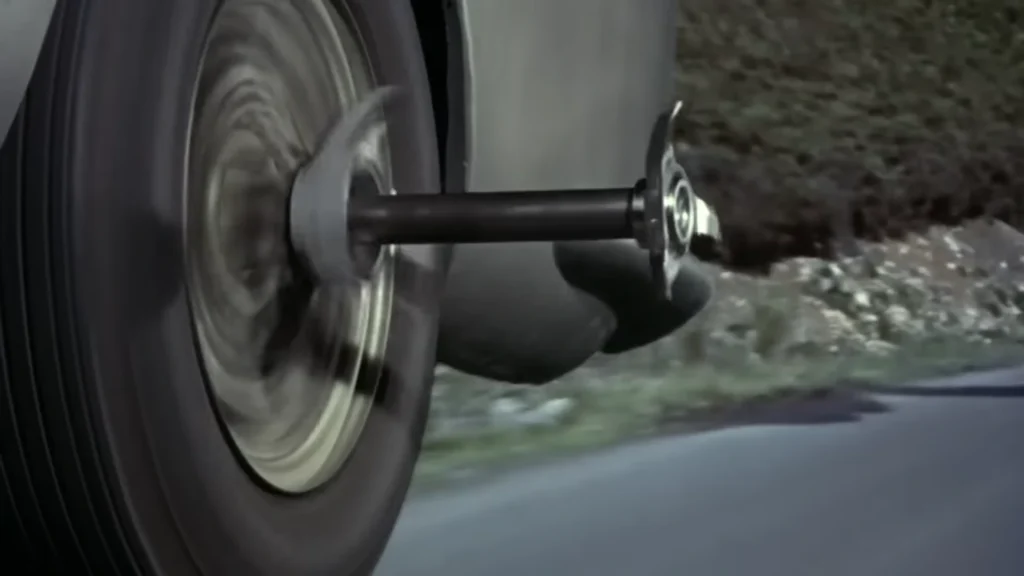
The Nighttime Chase
Shooting the DB5 scenes began on 9 March 1964, with the nighttime chase split across two locations. The forest pursuit — in which Bond deploys the smoke screen, oil slick, and bulletproof shield — was filmed in Black Park, a 500-acre woodland neighbouring Pinewood Studios, dressed to pass as the forests surrounding Goldfinger’s facility in Switzerland. The sequence then moves to the Pinewood backlot itself: the narrow alleys between the studio buildings standing in for Goldfinger’s factory complex, where Bond deploys the ejector seat and machine guns before crashing into a wall at the rear of Sound Stages A and E. That road — where the chase ends — has since been renamed Goldfinger Avenue.
The sequence showcases the rest of the car’s arsenal against three pursuing Mercedes — a 220 S and two 180 saloons packed with Goldfinger’s men. Sean Connery, however, was absent. Still committed to Alfred Hitchcock’s Marnie, the driving was handled by stunt double Bob Simmons — the same man who had first appeared as Bond in Dr. No‘s gun-barrel shot.
Smoke Screen
Stears squeezed inside the boot to activate the smoke screen while moving. On cue, a canister released a dense cloud behind the DB5. The visual gag works instantly, and the first Mercedes crashes into a tree, temporarily disabling its occupants. Humor was essential to the sequence. Without it, the chase risks becoming a procedural demonstration of gadgets. Instead, the devices themselves become part of the entertainment — before the car’s true lethality reveals itself.
Oil Slick
The next gadget deployed is the oil slick — the device that replaced the original nail cluster, itself scrapped because the producers feared audiences would copy it too easily. Once again, it is an entirely practical effect. The red taillights lower and a cylinder hidden in the boot pumps oil through the two openings onto the road behind the DB5. The pursuing Mercedes skids off the road, down an embankment, and explodes. With each gadget deployed, the tension escalates. Humor gives way to the car’s deadliness.
The crash and explosion were achieved with an unmanned stunt car rigged with pyrotechnics — the henchmen only present in the interior close-ups filmed separately. Look carefully at the car as it burns and the back seat is visibly empty. The mechanics of how the sequence was constructed are hiding in plain sight.
And the next gadget would indirectly lead to the deadliest moment in the chase — the murder of Tilly Masterton.
Bulletproof Shield
Visibility on the unlit forest roads is minimal, and Bond slams on his brakes before driving over an embankment. He and Tilly are trapped. The remaining two carloads of thugs corner them. Bond raises the bulletproof shield to protect Tilly while using his front door as cover during the ensuing gun battle. But the shield can only protect her inside the car — and she needs to make it to the nearby bracken for safety. When Bond tells her to run, Oddjob kills her with his bowler hat.
As Luxford recalled, the DB5’s slim-line boot could not accommodate both the bulletproof shield and the oil slick cylinders simultaneously. The tank had to come out before the shield could go back in. Every gadget in the sequence required a separate setup. The car was never fully weaponised in a single take.
Bond is now captured, and Oddjob grunts for him to get back into the car — with a thug sitting in the most lethal position in the vehicle: the front passenger seat.
Ejector Seat
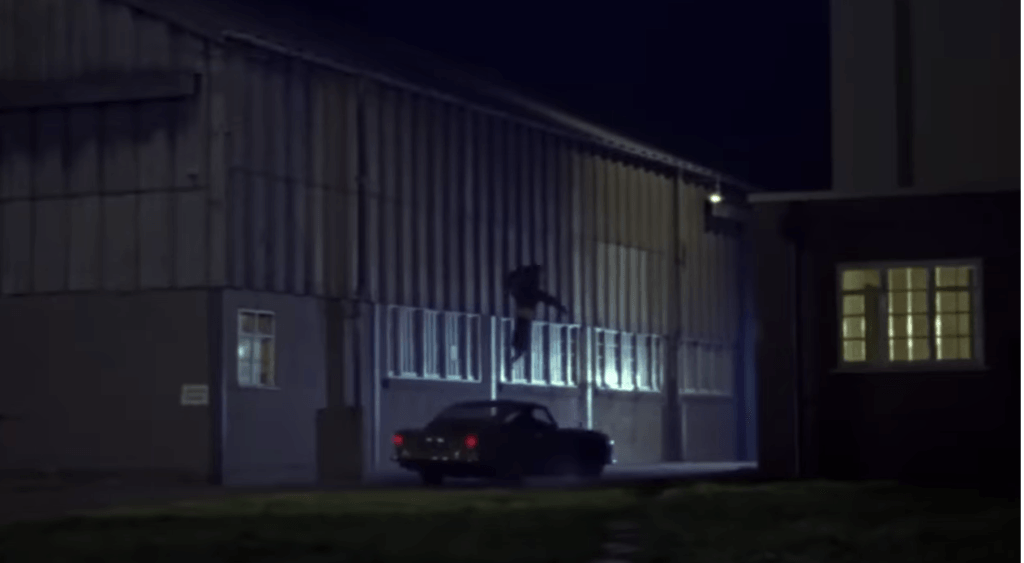
With Bond driving at gunpoint, the audience knows that moment has arrived. But director Guy Hamilton makes them wait a little longer, building toward it with a perfect blend of suspense and humor.
Bond’s DB5 is hemmed in by the two remaining Mercedes — one in front and one behind. When they reach the entrance to Goldfinger’s facility, an elderly woman emerges to raise the barrier. Seeing the three-car procession, she curtseys, believing Bond must be royalty.
The humorous moment immediately pivots into suspense as Bond breaks formation with his armed passenger threatening to kill him. Bond flips the little red switch hidden in the gear stick. The roof panel flies open and compressed air launches the thug upward through the opening. Through smooth editing, the interior shot transitions seamlessly to a wide shot of the “man” being launched from the vehicle and crashing beside the road.
The ejector seat was built by Jimmy Ackland-Snow and triggered by highly compressed air — based, as Adam confirmed, on the ejector seat of a fighter plane. It was fired by remote control, without anyone in the car. The whole sequence was over in about four seconds — the top of the roof flew off, and the seat went, as Luxford put it, “whoosh.” A mannequin was used, not a real body. As Luxford noted: “nobody could have survived that.”
Getting the hole in the roof had been its own ordeal. As Stears recalled:
“I marked it out, and taped off the roof of this beautiful car. I looked at it, went away and had a cup of coffee, came back, and got the drill, and drilled the hole. It was terrifying.”
While the ejector seat was only installed when required for filming, it became the defining moment of the sequence. But Hamilton still had one final surprise. As Bond races back toward the entrance, the seemingly harmless old lady reappears wielding a machine gun. The weapon is clearly too powerful for her, but she still sprays the DB5’s windscreen with bullets. On repeat viewings, it is arguably the moment audiences anticipate most.
Certainly, one filmmaker admired it. After Goldfinger‘s release, Hamilton recalled Alfred Hitchcock telling him over lunch: “I wish I had thought of that one.”
Machine Guns
After the old lady sprays bullets across Bond’s windscreen, he is chased through Goldfinger’s Swiss facility — the location provided by the back lot at Pinewood studios.
After evading the cars, crisscrossing through lanes in the facility, Bond is now driving toward what he believes is an oncoming car — headlights approaching fast through the darkness. He opens the armrest and fires the machine guns at the threat ahead. The guns emerge from behind the front indicator lights and fire — but the car keeps coming. Bond can’t understand it. The car keeps coming because it isn’t a car. It’s his own headlights, reflected back at him in a giant mirror. He fires again. Still it comes. And then he drives straight into the wall behind it.
The close-up shots of the machine guns emerging and firing were achieved on a soundstage using gas-operated weapons built specifically for filming, before being cut into the location footage — the same practical approach used for the tyre slashers.
Crashing into a Foam Wall Damages The Car
The chase ends with Bond crashing into the wall. It was a sequence the production knew intimately — because it had already happened by accident on the very first night of filming. The script called for Bob Simmons to approach the mirror, mistake the reflected headlights for an oncoming car, and crash into a foam brick wall.
Adam had built the wall from foam — but twenty feet behind it lay an actual concrete wall. He warned Simmons to start braking early. Simmons broke too late. The car hit the concrete wall, and the team worked all night and part of the next day replacing the damaged parts. Luxford, who remembered real buildings and scaffolding behind the wall rather than a concrete barrier, recalled the damage with equal dismay:
“After our three months of hard work! It was an accident, and wasn’t his fault, I realize that. But for it to happen on the first night was criminal. The car had to go back to the factory again.”
This time, the crash was intentional. The sequence was filmed on the road at the rear of Pinewood Studios Sound Stages A and E — a stretch of tarmac that has since been renamed Goldfinger Avenue in the film’s honour. The crash itself was filmed twice: the first take, in which the car drives clean through the fake wall, can be seen in the film’s original trailer. The second take, in which the car stops at the wall as scripted, is the one that made the final cut.
As Luxford reflected, none of the individual gadgets were truly new. Tyre slashers had appeared in Ben-Hur. Ejector seats existed in aeroplanes. Machine guns and oil slicks had been used in cars during the American Prohibition period.
“The genius,” Luxford wrote, “was in bringing it all together in one machine.”
What Adam and Stears did was take those real-world ideas and put them into the car itself — machine guns, oil slicks, concealed behind the car’s own lights and panels. That synthesis — every weapon, every trick, every surprise, hidden beneath the skin of one of the most beautiful cars ever built — was what made the DB5 unlike anything cinema had seen before. It was the first car laden with a secret arsenal. It remains arguably the most famous. And certainly the most stylish.
Aspirational Object: The First Tricked-Out Car in Cinema
The aspirational power of the DB5 was not despite its concealed violence but because of it. Men left cinemas wanting to be Bond — and the car was central to that fantasy. Not just a beautiful car. A beautiful car with a secret. How that secret was sold to audiences, and how EON would use the same mechanism to sell every Bond car that followed, is a story for another article.
It is perhaps no coincidence that the silver grey of the DB5 finds its echo in the pale silver suit Bond changes into aboard Goldfinger’s plane — the precise moment the car has been destroyed and Bond becomes his prisoner. Whether this was deliberate coordination between the costume and production design departments is impossible to say with certainty. Ken Adam’s Silver Birch palette for the car was established early, and it would be surprising if nobody noticed the parallel. But the thematic resonance is perfect regardless of intent. Bond wears the car’s colour after the car is gone. The DB5 has been stripped away — his armour destroyed — and he replaces it with his own. He’s been disarmed. But he still looks the part.
The suit as armour. The car as suit. It is a connection that would echo forward twenty-five years to Tim Burton’s Batman, when production designer Anton Furst explicitly described the Batmobile as “an extension of his armour — a suit on wheels.” He was designing for a different hero in a different city. But the idea had been there all along, hiding in Silver Birch on the roads outside Pinewood. Connery bought his own DB5 after Goldfinger. The car wasn’t just a prop to him. It was an extension of who he was on screen — and perhaps off it too. The Batmobile owes a debt to the Aston Martin DB5, and they would borrow from each other over the decades — another cinematic history that deserves its own article.
The DB5 arrived at the precise moment cars meant more to Western culture than at any point before or since. In 1963, one in seven American jobs was directly connected to the automobile industry. The car had become the most visible external symbol of personality for the middle classes on both sides of the Atlantic — status symbol, calling card, reputation-maker. It was no accident that Goldfinger was the film EON deliberately engineered to crack the American market — bigger budget, broader canvas, more spectacle. And at the centre of that spectacle was a car. A British sportscar, no less, displayed at the 1964 New York World’s Fair alongside the film’s two publicity DB5s — the most visible possible statement to American audiences about what this car represented. Whether Goldfinger cracked the American market for Aston Martin specifically is impossible to quantify precisely — the 47 per cent sales increase Adam cited doesn’t break down by territory. But the intent was clear, and the New York World’s Fair deployment leaves little doubt about where Aston Martin and EON believed the opportunity lay.
For American audiences primed to read a man’s character through what he drove, the DB5 communicated everything about Bond in a single shot. And yet it was emphatically not a car for everyone. Aston Martin built only 1,023 of them between 1963 and 1965. At £4,248 — more than the average British annual wage, more expensive than a Cadillac limousine — it was beyond almost anyone who saw it. Bond’s car, and what he did with it on screen, made it feel like it belonged to everyone anyway. This made it an aspirational object — the inspiration for every tricked-out car that followed, from Bond’s own long lineage of gadget vehicles to the Batmobile and Tom Cruise’s arsenal-laden cars in Mission: Impossible and beyond.
Luxury as camouflage.
Weaponized elegance.
And the moment James Bond became a brand.

- Why Robert Pattinson’s Batman Should Be DCU’s Caped Crusader - October 12, 2026
- California’s AG Loses to Paramount: Inside the Paramount / Warner Bros. Discovery Merger — And Why Ellison May Still Leave California - September 26, 2026
- Napoleon Solo Sold for £1: The Year Ian Fleming Stopped Owning Ian Fleming - July 25, 2026