Making Miniatures Look Massive: Looking Back At EEG’s Special Photographic Effects On ‘Blade Runner’
A combination of lighting and atmospheric effects, the right film stock, and a proprietary motion-controlled camera system called the “Ice-Box” gave Blade Runner’s miniatures an unprecedented realism and turned them into the sprawling, dystopian megacity of Los Angeles 2019.
In 1982, Ridley Scott, the visionary director behind Alien, reinvented science fiction for a second time with Blade Runner, a futuristic noir about a cop hunting violent, genetically engineered androids called replicants. The film is set entirely within the confines of Los Angeles 2019, a futuristic, dystopian city with towering buildings blanketed by perpetual night and rain. “The City”, as it was called during production, bears little resemblance to LA, or indeed any other city today. Nonetheless, there is no denying the mesmerizing degree of realism created by the film’s production design and special effects.
Scott, one of the best visual directors in the business, benefited from the work of a number of talented artists in The City’s conception. Visual futurist Syd Mead designed the buildings and the city’s vehicles.However, the extraordinary realism of this future megalopolis was achieved by Entertainment Effects Group (EEG), a special effects company formed by Douglas Trumbull and Richard Yuricich, that no longer exists today but leaves a legacy in special photographic effects.
Both men–along with their colleague, David Dryer–served as the three Special Photographic Effects Supervisors on Blade Runner. It was their team of over 50 people specializing in matte paintings, miniatures, optical compositing, and front projection that made the hyper-detailed megacity of Los Angeles 2019, with its towering pyramids, industrial outskirts, advertising billboards, and flying vehicles. While all eyes are on those fantastic miniatures made under the supervision of chief modelmaker Mark Stetson, they would not have that grandeur or realism without the thousands of lights that lit up the buildings and flying vehicles. Nor would the miniatures look full-scale without the special atmospheric effects that simulated the hazardous pollution a dystopian megacity was sure to produce.
As we’ll see, atmospheric effects, and, in particular, lights are a signature feature of EEG’s work, a combination that came together in Close Encounters and was expanded considerably in Blade Runner.
EEG’s Mastery of Miniatures and Optical Effects
If you watch films from the 1960s to the 1980s featuring flying miniatures with lights, then you’re likely viewing some of Douglas Trumbull’s best work. Before he formed EEG with Yuricich in 1975, he devised the “slit-scan” effects: the oscillating lights and shapes that formed the “Stargate” sequence at the end of 2001: A Space Odyssey. With EEG, Trumbull oversaw the special photographic effects on Star Trek: The Motion Picture and Close Encounters of the Third Kind. The combination of lights and miniatures on the otherworldly UFOs in Close Encounters, particularly, is why Ridley Scott hired EEG over competitors like John Dykstra’s Apogee Group and ILM.
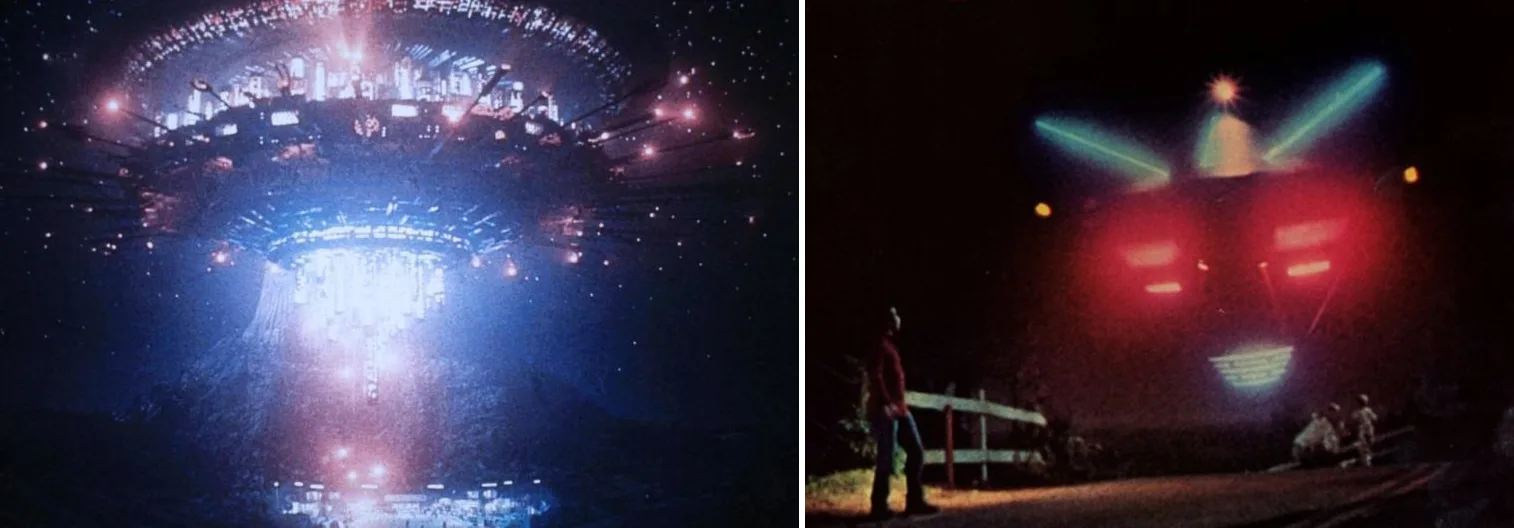
With Blade Runner, Trumbull wanted “to attain the gritty, highly realistic, almost documentary-like quality of Alien.” The documentary effect Trumbull and his team gave “The City” helped make Blade Runner the prototype of futuristic sci-fi films set in large, population-dense, dystopian megacities.
All the action took place on the streets, inside the buildings, and above, in the airways of “The City”. Trumbull gave full-scale sets the illusion of size by extending them into the distance with miniatures, matte paintings, lighting, and atmospheric effects. While Batman relied more on massive sets to suggest scale, Blade Runner focused mostly on miniatures to achieve the same effect, which EEG achieved through a process developed, for the most part, on Close Encounters.
EEG’s Special Effects Process
The art of making miniatures look like towering behemoths in a futuristic city-scape came down to EEG’s use of three technologies:
- The selection of film stock
- Douglas Trumbull’s unique motion-controlled camera system
- Smoke effects
65 mm Film Stock
EEG’s process was to shoot, dupe (duplicate), and composite (marry together) the effects onto 65 mm film. Trumbull selected 65 mm (the negative is 65 mm while the print is 70 mm) over 35 mm or VistaVision because the effects looked richer and more realistic on this film stock. There are no grainy images, which is a common problem in effects shots from this era, and thus, the use of 65 mm is a principal reason why Blade Runner’s effects still hold up today.
Put simply, a larger negative produces a sharper image and clear final composite.
This film stock was perfect for the miniatures, but it was also used for live-action sequences that required the addition of special effects in post-production. Once finished, the 65 mm shots were reduced to 35 mm anamorphic (widescreen) negatives for theatrical release.
The “Ice Box”: Trumbull’s Motion Control Camera System
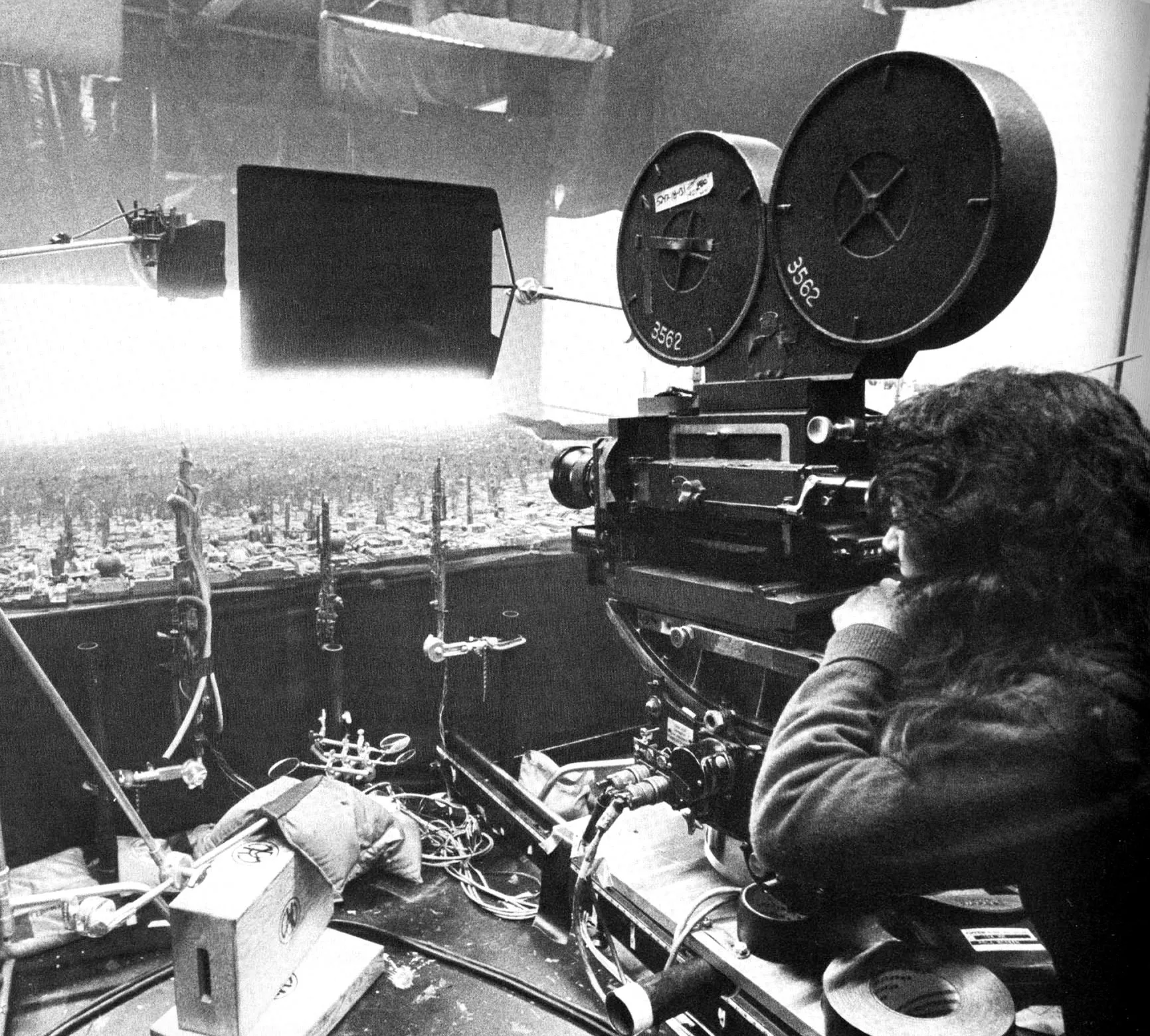
For filming the special effects, Trumbull preferred motion control over blue screen, because he felt blue screen was adequate for hard-edged matte work but did not give him the clarity of image he wanted. Instead, he used frontlight/backlight to pull mattes. Trumbull controlled filming through his specially designed motion-control system, affectionately known as the “Ice Box” (because of its bulky appearance), which he developed on Close Encounters, and also used on Star Trek: The Motion Picture.
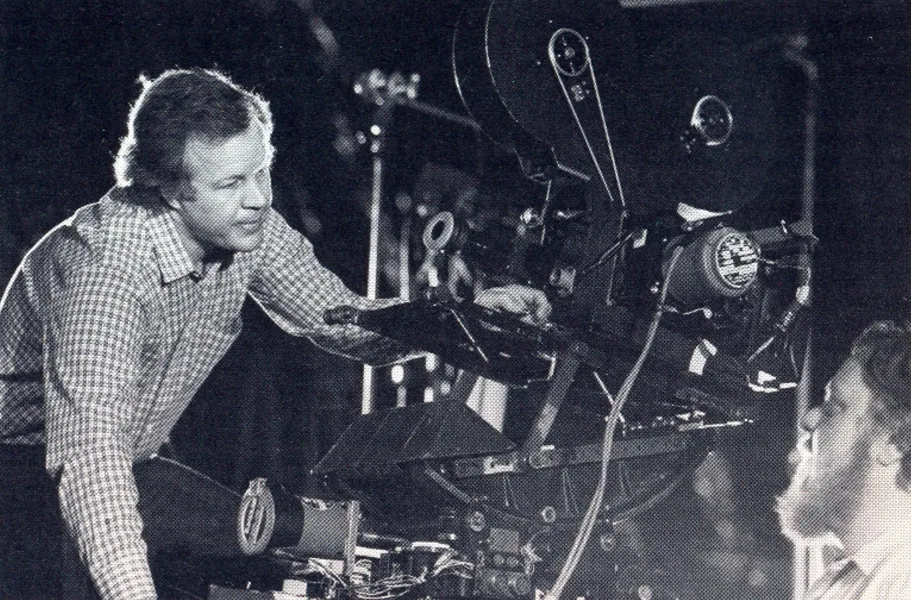
The Ice Box was quite a system in its day, with at least 8 channels of control for camera movements, and lighting.
It could precisely and automatically pan, tilt, track, boom, and follow-focus a camera. Through computer precision, EEG could exactly repeat the same camera movement over the miniatures in multiple takes. This meant EEG could composite a new effect onto the same strip of film with each new take, thus replacing the need for blue screen.
“If you are going back on an additional pass to double expose over the original negative–which we did a lot–you can program new information into any channel that is not being used to control the move and create, for example, a light that rotates at a certain speed,” David Dryer told American Cinematographer.
According to Trumbull, the Ice Box helped “save” the miniatures. It was used to photograph all the city models and incorporate different elements like the police spinners and other flying vehicles onto the film.
Smoke Effects
However, Scott’s predilection for the camera to glide for long takes over sections of the city required additional smoke effects to produce an accurate illusion of size and grandeur.
A closer look at the final film shows a petrochemical haze over the miniatures. A thick cloak of smog was created by shooting the miniatures in EEG’s “Smoke Room”, which was filled with vaporized mineral oil.
On this self-enclosed stage, EEG technicians dressed in protective clothing placed tabletop miniatures, model vehicles, and other reduced-scale objects in the haze.
Specially designed infrared sensors measured and precisely controlled the density of the vapor. This quite complex trick gave depth and aerial perspective to the models and helped to blur the backgrounds, which were typically in forced-perspective and matte paintings.
Building and Filming Blade Runner’s Miniatures
Tasked with creating these miniatures were EEG’s chief modelmaker, Mark Stetson, and his crew of 23 miniature makers. Their work began in August 1980, to get the models ready for filming. In all, 15-20 buildings were built. When special effects filming commenced, they were rearranged for different shots, suggesting more buildings in the cityscape than there were.
The model work can be divided into The City’s four main features: the industrial Hades landscape, the Tyrell Corporation pyramids, the skyscrapers with their giant advertising billboards and blimp, and the Spinner and other flying vehicles that crisscross through the airways of this megalopolis.
The Hades Landscape
https://youtu.be/nFVcdKa0M9E
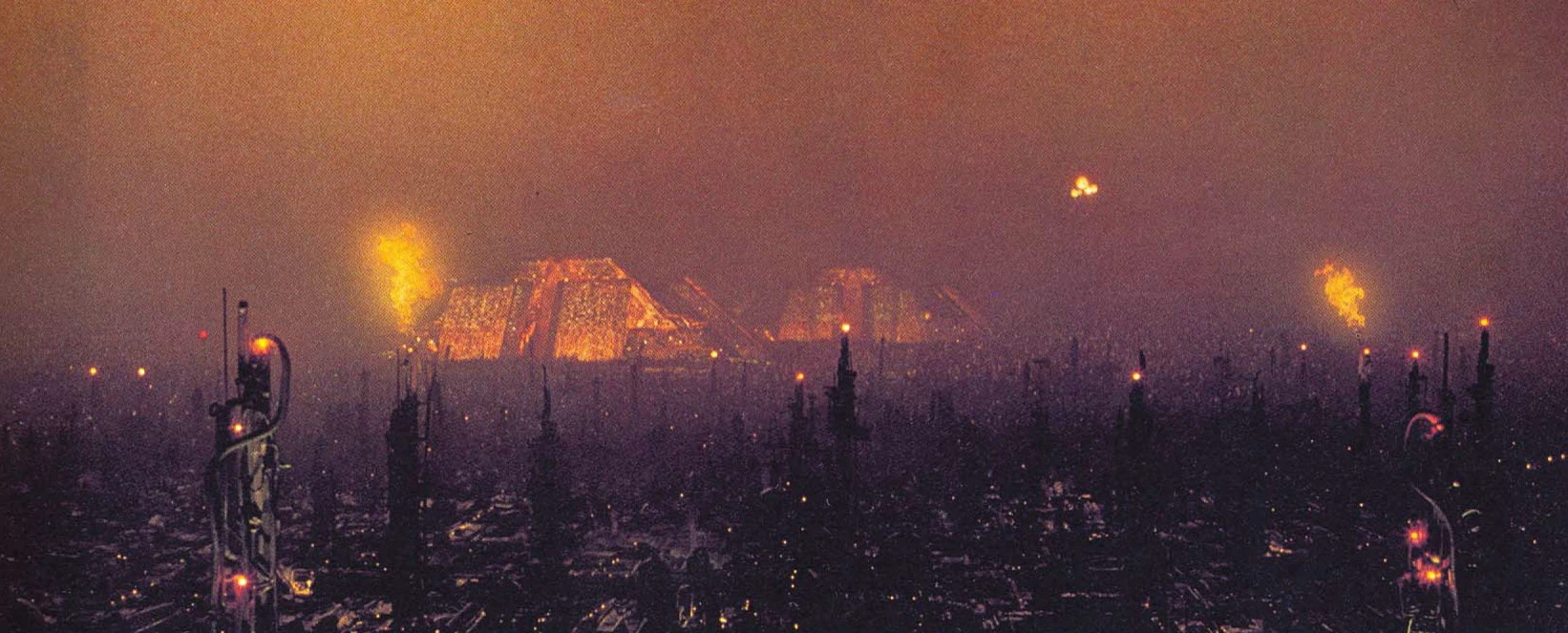
Blade Runner begins with the camera moving slowly across the industrial outskirts of Los Angeles 2019. Nicknamed Ridley’s Inferno and the Hades landscape, the meaning is pretty self-explanatory. The audience is entering hell.
This sets the dystopian tone of the city and also establishes Scott and Trumbull’s mandate to make these miniatures dirty and rusted, with the feeling of long-term use.
To create the effect required a combination of:
- miniatures
- front projected flame effects, and
- multiple motion-controlled camera passes to “matte-in” (layering one element onto another) these effects in the same frame of film.
In the film, the Hades landscape stretches for miles, but in reality, the miniature set, which was built on a plexiglass/cast-foam base, was only 18 feet long and 13 feet deep. It was constructed on three separate tables measuring six feet by 13 feet each, which could be either joined or filmed separately depending on the shot.
The vast majority of the towers, tubes, and pipes were acid-etched brass silhouette cut-outs made with a photolithography process.
These two-dimensional silhouette cut-outs were hot-glued to the table in long rows and placed in forced perspective. Forced perspective creates an optical illusion of distance and size of miniatures by placing them closer or further away from the camera lens.
On the Hades set, larger silhouette cut-outs were placed in rows closer to the camera and then graduated back into the distance. The rows of silhouette cut-outs were made increasingly smaller the further they were from the camera. The rows of larger to smaller cut-outs helped create a vast illusion of depth in the frame.
But this still wasn’t enough to satisfactorily create this illusion of depth.
So a ground plane of individual three-dimensional towers ranging from 18 inches to 13 feet was made and placed in the foreground. Many of the structures on the model, including the foreground buildings, were based on photographs of refining plants in California.
Certain towers from these refineries were reproduced in miniature and made to look ten times their original size. Extrusions or pipes were added to many models to give them a retrofit look that was an important part of The City’s overall design. To complete the realism, the structures were roughly painted and even applied with instant coffee to add a worn, aging effect.
Next, flames were filmed and added to the top of these cracking plants through front projection, an effects technique in which an image or background is projected from the front onto a highly reflective surface.
Flame footage was shot in the EEG parking lot and in a desert just outside L.A.
“We had huge burners of propane gas and we would let off these belches of propane gas and shoot them at probably 72 to 96 frames per second,” said Trumbull.
This flame footage was then front-projected by a synchronized 35mm film projector onto white foam cards slotted onto the industrial towers in the Hades miniature set.
“We’d go back and expose those fire explosions in registration to the entire Hades set,” Dryer said in Future Noir: The Making of Blade Runner. “All you’d see on the negative was the fire. This was later optically added with what’s called a cover matter to give the flames some density so that you wouldn’t see too many of the other light sources through the flames.”
The final touch was to give the impression of thousands of city lights in the distance, beyond the Hades landscape.
The idea came to chief modeler Mark Stetson during a late-night flight when he saw Los Angeles lit up through the plane’s window. The effect was simple enough to create, but the scope was tremendous.
By building the Hades set on a raised platform, seven miles of fiber-optic strands and 2000 light points could be threaded through the bottom of the model to light it up. Varied colored lights were used to simulate the diversity of lights in the night-scapes of real cities.
First, photofloods shone through the model’s plexiglass base, which created a strong light source. Then, tiny “grain of wheat” lightbulbs were placed at specific points in the model. Finally, the fine fiber-optic strands were inserted into buildings or other parts of the model where light points were required, such as the red lights seen on refinery towers. Tips of fiber-optic strands were painted either red, yellow or orange to provide varied colored lights.
At the other end, the fiber-optic strands were bundled together into one of 20 small boxes, each equipped with a bulb. Turning each of these bulbs on would turn on the fiber-optic strands they controlled in the Hades model.
These lights were controlled by Trumbull’s computer-controlled “Icebox” system.
Trumbull explained the process of shooting the Hades landscape as follows:
“[We switched on the lights and the Ice Box was programmed to move the camera over the Hades model in a certain way for one shot.] Then you could switch off the lights and bring the camera back to its original start position. Then we’d insert the small white cards into the Hades landscape onto which we would project the fireball footage. The Icebox would then rewind the film that had just been shot and make a second pass exactly like the first one, recording the fireballs onto the same piece of film which had just exposed the Hades lights. In this way, we were able to build up layer after layer of various effects on the same piece of negative. All in all, the Icebox was a real workhorse.”
Tyrell Pyramids
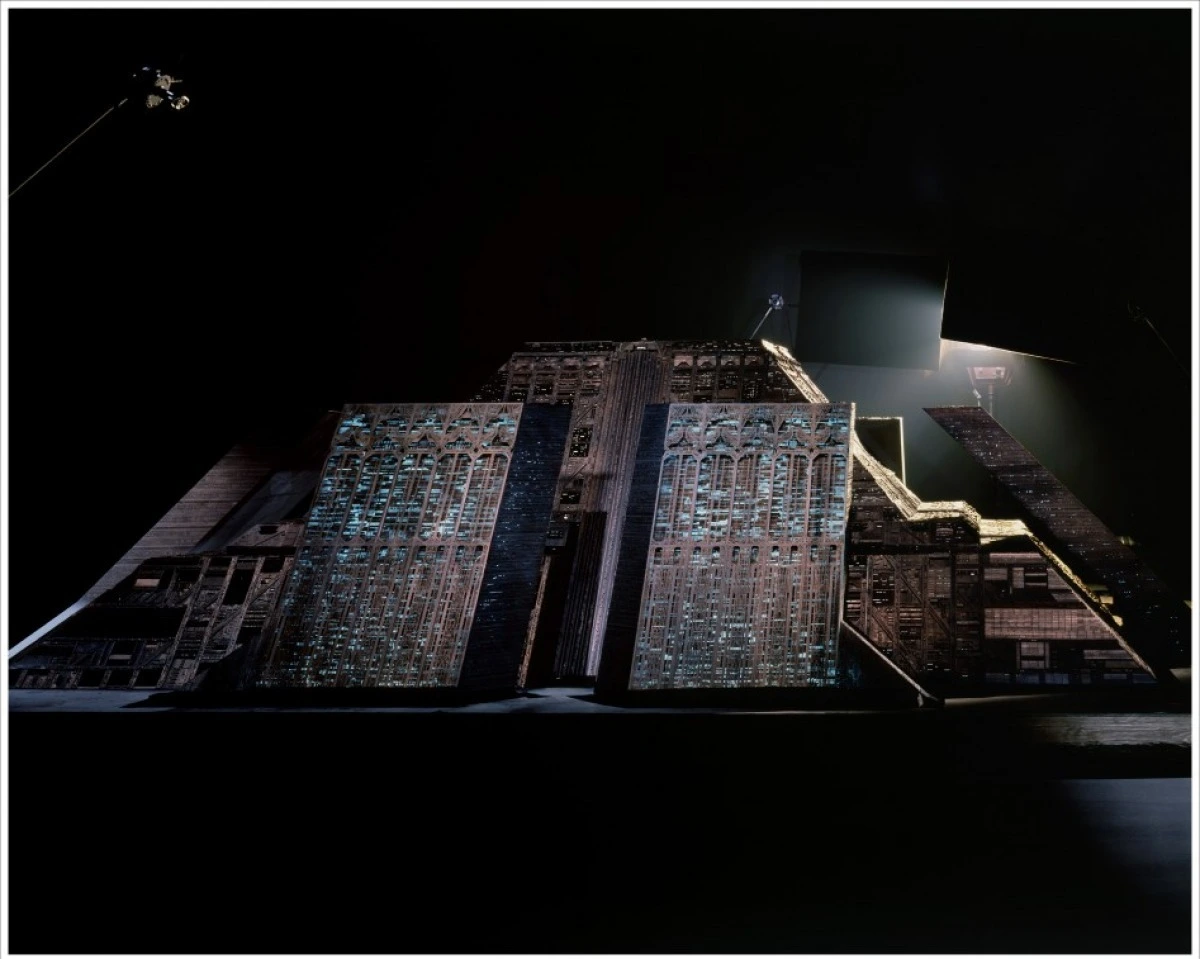
The dominant structures in Los Angeles 2019 are the twin Tyrell pyramids. Only one pyramid was actually made, and then moved around, photographed, and composited to look like two pyramids. But there was also a “Pyramid-insert model” constructed for close-ups.
Main Model
“Since the actual size of the Tyrell Pyramid was supposed to be well over a mile high–anywhere from 600 to 900 stories tall, depending on who you talked to–we guesstimated our scale on the single Pyramid model at about 1/750; one foot of model equaled 750 feet in reality,” Stetson said in the book, Future Noir: The Making of Blade Runner.
Building the Miniature:
A foam-core mockup of the Tyrell Pyramid was built first. This served as a prototype for the model, which was constructed from a variety of materials:
- The core pyramidal structure was a clear plastic shell.
- Styrene and flat-panel plastic patterns were cut and applied to the shell’s surface.
- Finally, the application of plastic strip stock gave fine surface detail to the flat-panel patterns.
Stetson told VFX Voice:
“We laid down one quarter-inch plastic angle stock on its edges to create a stair-step surface. On what would become the vertical faces of the steps we added tiny plastic strips of raised detail to indicate window casements, which eased the process of scraping off the window openings later.”
Once completed, rubber molds were poured. Then pyramid panels were cut from Plexiglas, which exactly matched the plastic pattern panels described by Stetson above.
Technicians spray-painted the inner surface of the molds with automotive primer, then a coat of opaquing fluid. Clear polyester casting resin was then poured into the mold and ‘squish-molded’ with the newly cut Plexiglas panels. This process created the pyramid’s clear plastic shell.
Paint was then applied to the model and hand-scraped from raised window areas, which helped give the effect of hundreds of windows and lights on the structure.
Lighting the Model:
The final effect was helped by lighting the structure from within with a 10K bare bulb on EEG’s smoke stage.
Large fans kept the whole structure cool from the light.
The buttresses’ shape and design required a different lighting solution of U-shaped fluorescent bulbs. Despite heavy filter correction,” added Stetson, “the buttress lighting was notably cooler in color than the main pyramid. We decided that was just part of the look of the building.”
Optical Effect Makes Two Pyramids From One Model:
Only one pyramid was constructed. Optical sleight of hand was used to make the model look like twin pyramids in the final film. When the audience first glimpses the pyramid at the beginning, the structure looms on the horizon as the camera pushes through the Hades landscape. This is actually an Ektachrome photograph of the model. (Ektachrome is a Kodak range of transparency, still, and motion picture films that were available in many formats, including 35 mm and sheet sizes up to 11×14 inch size.)
As the camera moves progressively out of the refinery landscape and closer to the pyramid, there is a transition from the Ektachrome photograph of the pyramid to the actual scale model itself.
The sequence concludes with a shot of eight narrow windows (two rows of four windows) on the pyramid. The camera zeroes in on one window revealing an interrogation room with ceiling fans, and a man standing at the window. This interrogation room, glimpsed from outside the pyramid is actually a scale-model, of the actual set where Holden is shot at and nearly killed by the replicant, Leon. As the camera focuses on the miniature ceiling fans, the film cuts to the actual full-scale set where Leon’s V-K test takes place.
The “Pyramid-insert Model”
The Interrogation room was part of the “Pyramid-insert Model”, a four-foot-high by five-foot-wide miniature which housed detailed parts of the pyramid for close-ups. Included was a detailed face of the pyramid, and a flat top section, which was the miniaturized roof of the Tyrell Pyramid. In addition, this model included motorized three-inch high elevator cars, which ran up and down separate tracks (filmed in motion control) on the outside, Tyrell’s office and bedroom in miniature, and, of course, the above-stated scaled-down Interrogation Room.
This miniature Interrogation Room featured electrically-powered miniature rotating ceiling fans, scaled-down furniture, and a one-inch-high human miniature of Holden. The cut from this miniature to the full-size Interrogation Room set on the Burbank Studios lot is seamless. Even today, you’d be hard-pressed to distinguish the miniature from the full-size set.
Skyscrapers And Advertising Miniatures
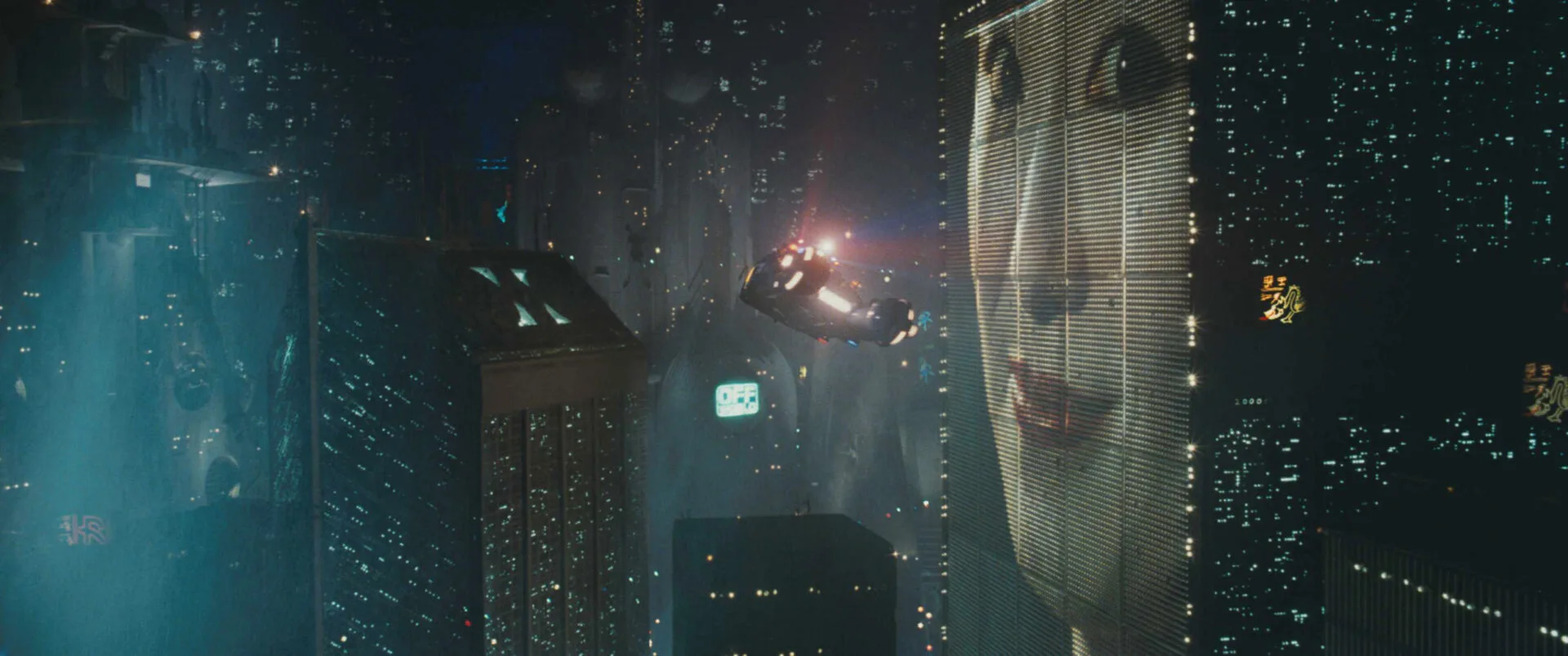
The beginning of the film slowly takes us into the central part of “The City”. The first image of the city center is dominated by a gargantuan-sized electronic advertising billboard featuring a traditional geisha girl. Screen left, and behind the billboard, we see first glimpses of titanic-sized skyscrapers. As the film progresses, more of The City is revealed. It is a labyrinthine technological dystopia, sometimes bright with neon signage and lights, but always shrouded in darkness.
The advertising is as much a feature of The City as the buildings themselves, an idea based on Ridley Scott’s assumption that in 2019 we’d be “assaulted by media.”
This cityscape is a mixture of real-life sets, matte painting backdrops, and miniatures. Sets built at Burbank Studios were extended into a towering metropolis by the matte paintings and miniatures as seen in the movie still below.
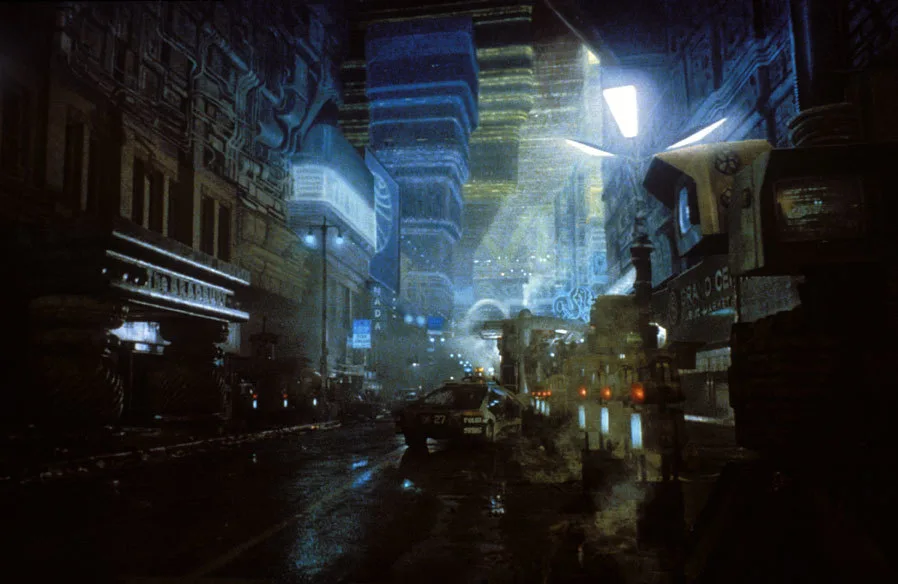
The metropolis is an eclectic mixture of styles, some familiar and some not. There were also some cheeky Easter Eggs to past sci-fi films hidden in the metropolis. There’s a building that looks similar to the Millennium Falcon, based on Bill George’s 5-foot replica, and Jon Roennau’s 4-foot replica of the Dark Star ship from the John Carpenter film is also hidden among the structures.
They’re nice homages, but, nonetheless, the majority of the designs came directly from futurist–and the film’s production designer–Syd Mead, who designed, as Stetson told VFX Voice, “soaring megastructures planted among the decaying remains of the old city below.”
So the emphasis in the miniature build shifted to huge towers and high-altitude aerial views.”
The cumbersome size and weight of the “Ice Box” motion-control camera system proved problematic in getting the high-angle shots of these towering skyscrapers. The solution–which gave a nice aesthetic on-screen– was to tilt the buildings so the camera could film them at low angles.
The cityscape above often features flying cars, or spinners (which we’ll discuss in more detail shortly). While these miniatures were composited into shots of the cityscape, sometimes they were just simple light effects created by EEG’s chief animation and graphics supplier, John Walsh.
The advertising billboards were based on Ridley Scott’s assumption that in 2019 we’d be “assaulted by media”. With David Dryer, the director “hypothesized” that sides of these skyscrapers would be covered with electronic billboards lit-up only at night. During the day, a glimpse of windows on the buildings could be made through the screens.
The electronic images on these giant video screen walls were created on 35 mm at Maxella. Dryer explained how he shot the adverts in Future Noir:
“I filmed [two oriental women] giving the camera alluring looks, or blowing smoke and popping pills and other things that were not particularly healthy. We then created fifteen faux commercials from fifteen to forty-five seconds long, which could either be used by the live-action unit as background videos or by EEG to project onto the various miniaturized advertising screens. For the screens themselves, we took a silver-painted, plastic mold-form material that looked like a series of tiny nubby lightbulbs and projected our commercials onto that. We actually blanked out some of these little nubs with black paint to make it appear as if some of the bulbs had burned out.”
Mark Stetson interjected. Amused, he recounted that for that particular screen featuring the geisha girl, he used the screen from a game called “Doodle Ball” which he purchased from Toys R Us. It was applied to the side of the model building; the screen’s dimensions were about 15 by 24 inches.
“The reason we chose Doodle Ball,” Stetson elaborated, “was because it was composed of this vacuum-formed material that had a thin styrene sheet with a series of regular little domes on it. We bought a ton of those games and threw away everything but the trays; it was cheaper to do that than vacuform our own.”
In total, EEG made or acquired ten “commercial screens” in a number of sizes (ranging from 8 inches by 10 inches to 6-feet-high by 4-foot-wide). 35 mm projectors beamed the advertising footage directed by Dryer onto these screens on the models and in-camera.
Integrating the Advertising Screens with the City
The screens themselves, however, were only one element in a larger compositional puzzle. Once Dryer’s footage was beamed onto the model screens in-camera, those advertising miniatures had to be integrated with the surrounding cityscape — a composite that could involve as many as 35 to 40 individual elements in a single shot, not counting the positive and negative mattes required for each one.
The process was cumulative. A background matte painting, executed by Matthew Yuricich, established the mid-distance skyline — skyscrapers fading into the perpetual haze of Los Angeles 2019. Closer to camera, the skyscraper miniatures themselves were filmed in the Smoke Room, where the vaporized mineral oil gave the towers their aerial perspective and prevented the hard edge that would otherwise reveal the model’s proximity to the lens. The advertising screens, already filmed separately with their projected footage baked in, were then optically composited into the overall shot as a distinct layer. Interactive lighting — programmed through the Ice Box’s computer channels — ensured that the glow from a screen would spill onto the adjacent building face, so that the light source behaved as it would in reality. The result was a cityscape in which no single element dominated. The matte painting receded into the background, the miniatures gave the foreground mass and weight, and the advertising screens animated the whole composition, suggesting a city that was perpetually switched on.
The Spinners
Equally iconic among EEG’s miniature work were the Spinners — the flying police vehicles that crisscross the Los Angeles skyline throughout the film. Syd Mead, who designed them during pre-production in 1980, called them “aerodynes” rather than Spinners; the brand name came from Philip K. Dick’s source novel. Mead’s concept, inspired by the vertical takeoff capabilities of the Harrier Jump Jet, imagined a vehicle that directed air downward to create lift — a form that never changed shape regardless of whether it was stationary or in flight. His sketches evolved over four months and were approved with almost no revisions.
The full-scale versions were built by legendary custom car builder Gene Winfield, who constructed them on Volkswagen Beetle chassis — chosen because the air-cooled rear engine could idle for hours without overheating, and the rear placement allowed Mead’s low, menacing front silhouette to be faithfully reproduced. Winfield worked directly from Mead’s color renderings and from scale blueprints produced by a team of studio artists, with Mead and Ridley Scott visiting his shop during construction to check progress.
The miniatures were a different matter entirely, and a considerably more complex engineering problem. Modelmaker Bill George built the initial Spinner master pattern by hand, from which rubber molds were produced. Castings were laid up in plastic with fine surface detailing added by hand, and each vehicle was fitted with a vacuum-formed canopy. The models were built in four distinct scales — ranging from one inch to fifty inches — because different shots demanded different sizes. For a wide aerial pass through the city, the smaller eighteen-inch model was preferable; the Ice Box’s wide-angle lens could resolve it cleanly enough, and the larger model was simply too awkward to rig. For close-up work, or shots where the Spinner had to feel massive against the surrounding architecture, the four-and-a-half-foot version came out.
The engineering inside the larger models was considerable. Each had to accommodate cabling, stepper motors for motion control, internal lighting, and nitrogen plumbing to produce the exhaust effect. The police light bar was a late addition — Ridley Scott asked for gumball-style police lights mounted on the roof well into the development of the models, requiring Stetson’s team to retrofit an already complex piece of engineering. The lights themselves became one of the Spinner’s most distinctive visual signatures on screen.
Getting the Spinners to appear as though they genuinely belonged in the sky above the city required the full arsenal of EEG’s compositing techniques. The vehicles were almost always shot in the Smoke Room, where the mineral oil haze softened their outlines and gave them the same atmospheric quality as the buildings below them. As the Spinner receded from camera, Dryer’s team systematically reduced the matte density — deliberately contaminating the vehicle’s edges with the background haze — so that it appeared to dissolve into the smog rather than floating above it like a stuck postage stamp.
The Spinner interiors presented a separate problem entirely. The live-action cockpit scenes were shot without backgrounds; Dryer’s team later drew a matte line by rotoscoping the window, removed the actual window from the vehicle, mounted it on C-stands in the exact position it had occupied relative to the lens in the original shot, rear-projected the composited flying footage behind it, and then threw rain and smoke across the glass to match the conditions visible outside. Interactive lighting was added to match the brightness of the miniature cityscape falling across the actors’ faces. The window element was then matted back into the original live-action shot, completing the illusion that Harrison Ford was genuinely flying above Los Angeles 2019.
The Enduring Standard
What EEG achieved on Blade Runner was not merely a collection of impressive individual effects, but the establishment of a complete philosophy for how a fictional world could be made to feel real. Every element — the 65mm negative that eliminated grain buildup across five generations of optical work, the Ice Box’s repeatable motion control that allowed layer after layer to be built on the same strip of film, the Smoke Room’s mineral oil haze that gave everything the same atmospheric quality, the interactive lighting that made each element respond to every other — was designed not to impress in isolation but to be invisible in combination.
The shots that Dryer described as his greatest success were the ones where audiences assumed they were looking at live-action photography. The cityscape of Los Angeles 2019 worked because no viewer could identify precisely where the matte painting ended and the miniature began, where the miniature gave way to the optical composite, or where the composite dissolved into the live-action set. The city felt total. More than forty years later, Blade Runner‘s effects have not dated in the way that so much of the CGI that replaced these techniques subsequently has — and the reason is the same one that made the work difficult in the first place.
EEG built everything at miniature scale, at full resolution, in camera, on film. But the light fell on real surfaces. The smoke moved through real air. The city, improbable as it was, existed. It felt real. It felt massive. It felt lived in.

- Why Robert Pattinson’s Batman Should Be DCU’s Caped Crusader - October 12, 2026
- California’s AG Loses to Paramount: Inside the Paramount / Warner Bros. Discovery Merger — And Why Ellison May Still Leave California - September 26, 2026
- Napoleon Solo Sold for £1: The Year Ian Fleming Stopped Owning Ian Fleming - July 25, 2026