Burton’s Batmobile: Inside the Creation of Batman’s Iconic Supercar
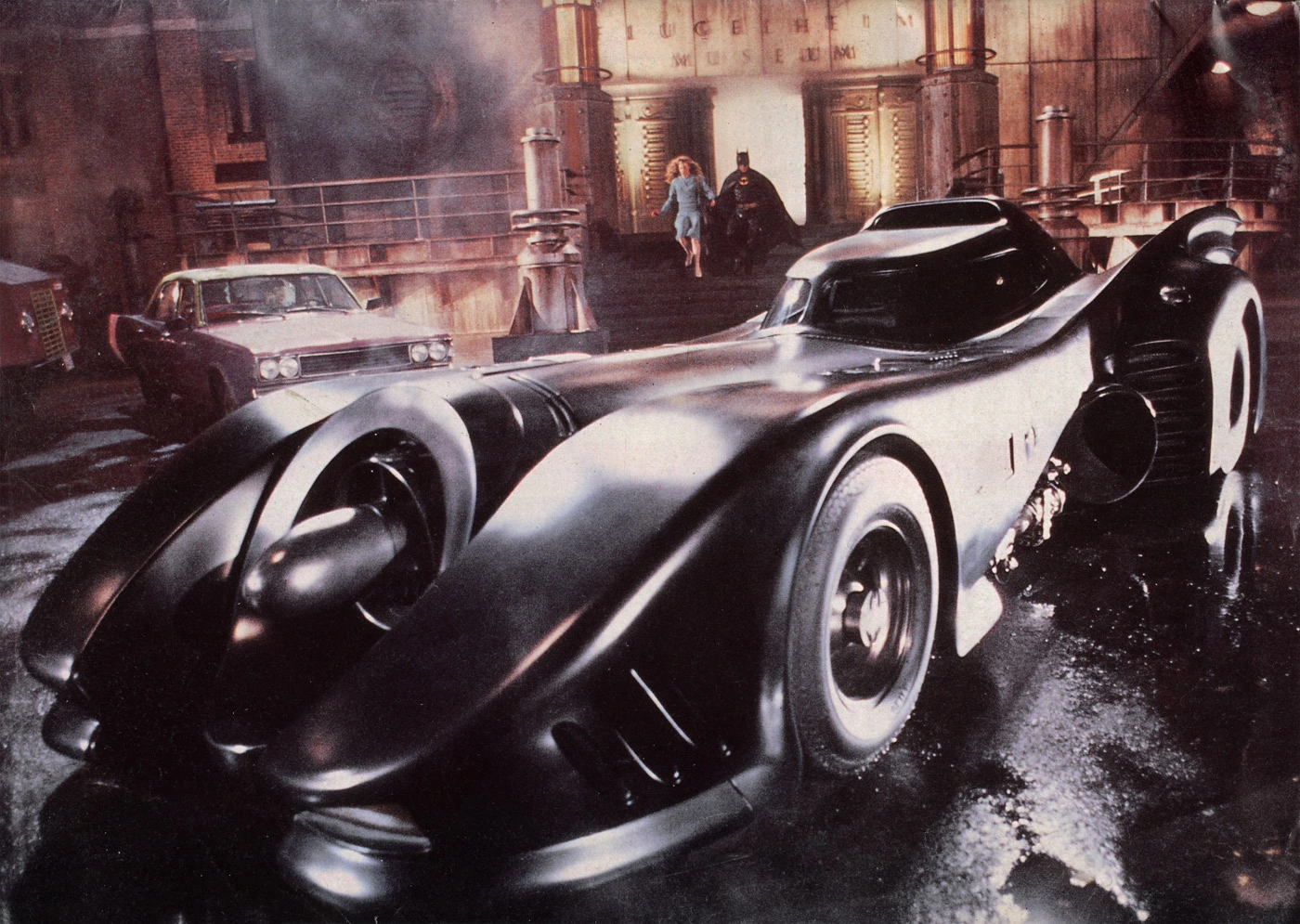
When the Burton Batmobile reappeared in 2023’s The Flash, it didn’t race through Gotham or fire its afterburners. It just sat in the Bat Cave — a museum piece. The irony is that a car this iconic deserved better. Because in 1989, the Burton Batmobile didn’t just appear on screen. It redefined what a superhero’s car could be — a benchmark every Batmobile since has been measured against.
That car was Anton Furst’s doing. The production designer did something no one had done before: turned the Batmobile into a war machine. Not a gadget-filled sports car. Not a sleek concept car. But a high-performance, armor-plated supercar reimagined as a predatory machine packed with an arsenal fit for a tank. Stalking the streets of a dark retrofuturistic Gotham, it made quite a statement: this was no longer the campy Caped Crusader of the 1960s Adam West TV series. Batman had finally returned to his roots as a dangerous vigilante, and Furst’s Batmobile was the clearest proof of it.
The menacing design finally suited a comic book hero bearing the title the Dark Knight. It was expressionist, retrofuturistic, and genuinely intimidating — and it set the template for every Batmobile that followed. So how did Burton and Furst conceive it?
Branding the Batmobile to Burton’s Batman
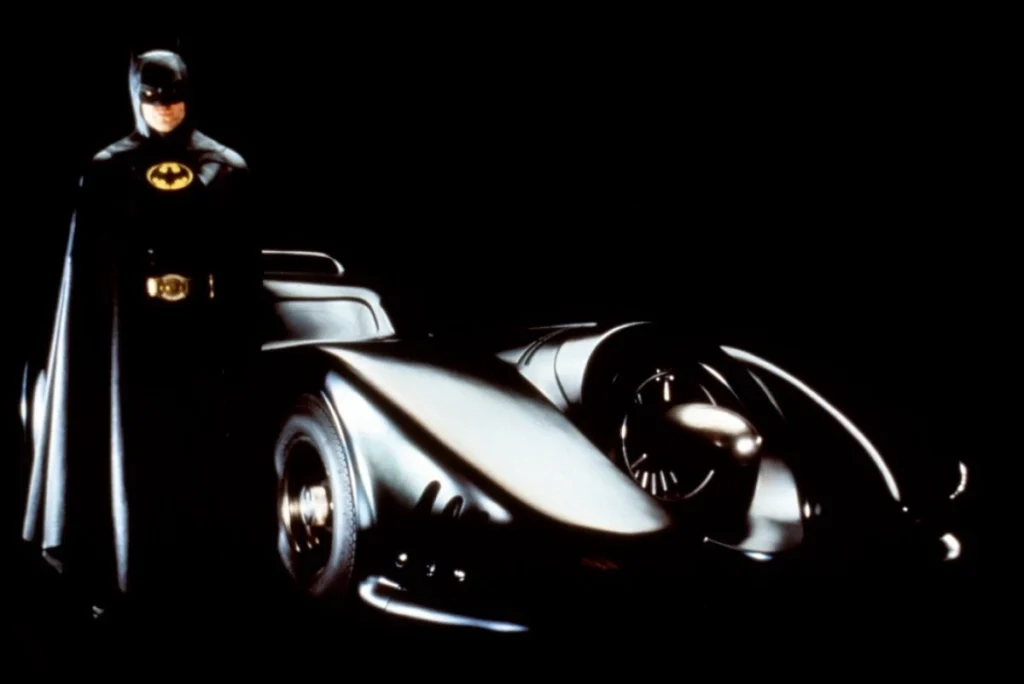
Described variously as the Burton or Keaton Batmobile, the aim was to create something “retrofuturistic” — something that was an extension of Batman himself. A “suit on wheels” that felt right at home in the dystopian German Expressionist Gotham City designed by Furst.
Burton wasn’t interested in making the TV show. As he put it:
“I was much more interested in making the darker version, more of what the roots of the comic book was. Just go back to the psychology of what the guy is trying to do. He’s trying to scare people. He’s trying to make a mythic, almost supernatural persona because he is a real person and he’s trying to intimidate and frighten. So, therefore, the intention of the Batmobile was to look as imposing as possible.”
Michael Keaton’s Batman is not a superhero like the rest of the Justice League. He needs to use intimidation and theatrics to strike fear into Gotham’s villains. This is embodied in the cape and cowl he wears, and the fake wings and grappling hook he uses to fool Gotham’s citizens into believing he is an otherworldly creature that might be half-bat and half-man. Those same theatrics would be built into the design of the Batmobile.
On a superficial level, a car is part of a person’s image. In film, the connection between the hero and the car he drives is even more overt. As Batman producer Michael Uslan put it:
“To get an audience to suspend its disbelief and buy into the fact that there could be a guy seriously getting dressed as a bat — that took a lot in order to accomplish. And part of that is the effectiveness of the Batmobile.”
The 1966 Lincoln Futura-inspired Batmobile of the Adam West series belonged to a different era entirely — pastel, pop art, and knowingly absurd. Burton’s Batmobile would need to do the opposite: anchor Batman in a world where dressing as a bat made a terrifying kind of sense. Furst understood that the car wasn’t just a vehicle; it was a symbol.
But before getting into how the Batmobile was designed, it’s worth clearing up the biggest misconception about it. Furst didn’t design the car himself. He oversaw its design, set the brief, and shaped its direction at every turn — but it was concept artist Julian Caldow who actually put pencil to paper and conceived its look. Somehow, Caldow gets lost in the production history. As a self-described fan of the “broad stroke” in designs, Furst often gave “broad strokes” about details in interviews, as you’d expect from a man more concerned with design than interviews. But it would be a mistake to let that obscure Caldow’s contribution. The Batmobile you know is his drawing.
“Form First, Then Make It Work”
Furst’s main contribution was to turn the Batmobile into a war machine and push for a “retrofuturistic” design.
Like Burton, Furst understood the power of an image — and the power of the car’s image to help create the mythos around “The Bat,” a predatory, supernatural element that struck terror into Gotham’s villains.
“What I thought is it is like an extension of his armor,” Batman production designer Anton Furst told the Southern California Institute of Architecture in 1990. “It’s an extension of him…I thought you’ve got to have this knight-in-armor feel with the sort of visor look, and anything to make it an aggressive war machine.”
“We wanted intimidation in the car,” Furst told Motor Trends magazine in 1989, “but we didn’t want to put it in a time period.”
The design path of the Burton Batmobile would follow a similar path to designing Gotham City–a dystopian mishmash of different architectural styles from different eras to create a retrofuturistic design. A city out of time. The Burton Batmobile would ultimately combine elements of different cars and aircraft from different decades to create something uniquely timeless.
Furst was also the first designer to turn the Batmobile into a war machine. This car, packed with its lethal arsenal and protected by armor plating, influenced the approach to every Batmobile to come on film and television.
But it didn’t begin this way.
Designing the Batmobile
Concept Artist Julian Caldow
Armed with his desire for a predatory, armored war machine that was an extension of Batman’s suit, Furst turned to concept artist Julian Caldow to design Batman’s supercar.
In 2020, Caldow told Bricks Fanatics that Furst allowed him to research different designs, then would look at his designs and ideas and encourage him to go in a particular direction. Caldow’s first designs were too similar to the Lincoln Futura-inspired Batmobile of the Adam West TV series.
Furst steered him away, encouraging Caldow to see the Batmobile as more of a symbol of Batman–an extension of him.
Caldow looked at car designs by artists like Syd Mead, but it was his research into Utah Salt Flat racers that caught Furst’s attention.
“I was trying to draw a dark sports car and I think he was thinking more along the tank lines and the speed record stuff,” said Caldow. “I remember showing him the speed record stuff and it was like, ‘Now this is where it should be going.’”
Utah Salt Flat Racers, a Volkswagen Beetle, and the X-15
This is where the origin of the Batmobile’s design gets a little murky. Furst mentions the Utah Salt Flat racers of the 1930s and the Stingrays of the 1950s as an influence. But Caldow remembers it differently–the specific racers he names are the Green Monster and the Thrust2, which are decades later in the 1960s and 1980s.
Both share a huge intake with a protruding spike, which became a dominant feature of the Burton Batmobile. And you the Thrust2 slopes down at the front maps directly onto the Burton Batmobile nose.
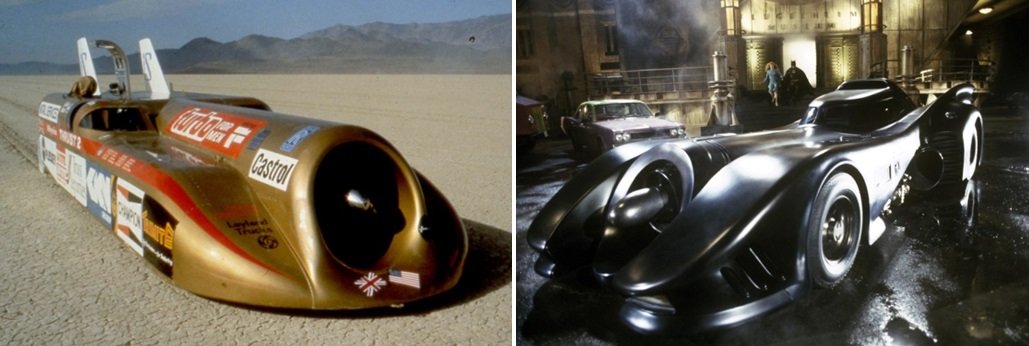
That’s why the nose is so long, why the canopy feels like a cockpit, and why the car reads like a machine built around a turbine rather than a crankshaft.
Nonetheless, design characteristics from Sir Malcolm Campbell’s Blue Bird series can be seen in the Batmobile–particularly his 1933 Campbell Napier Railton Bluebird–legitimizing Furst’s claim.
The long, needle-like central fuselage and open wheel pushed to extreme ends of the car body, like Sir Malcom Campbell’s Blue Bird and other 1930s speed racers like Mormon Meteor III, early So-Cal streamliners, or the Thunderbolt.
These cars had the romantic futurism–early “retrofuturistic” vibe Furst wanted. The Thrust 2 itself is also inspired by those 1930s racers.
In other words, the open wheels pushed to extreme ends of the elongated body come originally from 1930s salt flat racers and the central jet-powered intake comes via the Thrust2.
That’s why the nose is so long, why the canopy feels like a cockpit, and why the car reads like a machine built around a turbine rather than a crankshaft.
The Burton Batmobile basically has a rocket running through its center — intake at the front, afterburner at the rear. The canopy over the cockpit was inspired by the X-15, the aircraft Neil Armstrong flew as part of a team setting hypersonic and altitude records. And the back of the Batmobile draws from an unexpected source: the rear of a Volkswagen Beetle.
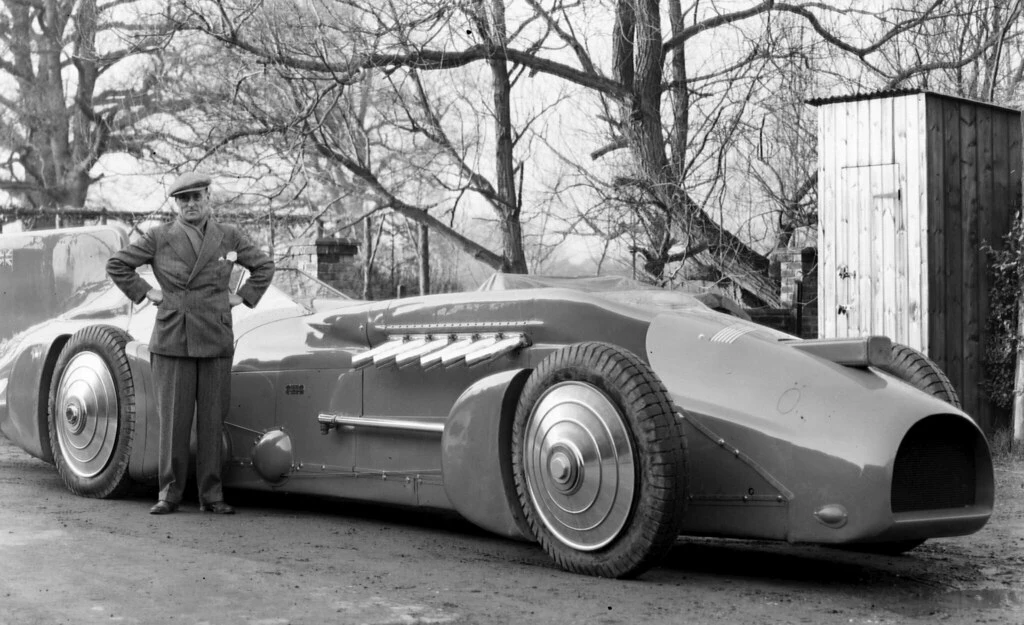
Caldow never mentions any art deco or steampunk influence, though both words are often used to describe the finished car. While steampunk is retrofuturistic, its world runs on steam — which rules out the jet-powered Batmobile. The Burton Batmobile does, however, share the curvaceous lines of art deco cars. The fenders over the back wheels echo the swooping fenders of 1930s art deco vehicles. These curves, combined with the Formula 1 look of a McLaren, give the Burton Batmobile its retrofuturistic feel.
Furst’s design is unlikely to be topped. Like his design for Gotham City, the Batmobile is neither modern nor old. The design is timeless — which is exactly what Furst wanted.
Building the Batmobile
The Clay Maquette and the Chassis
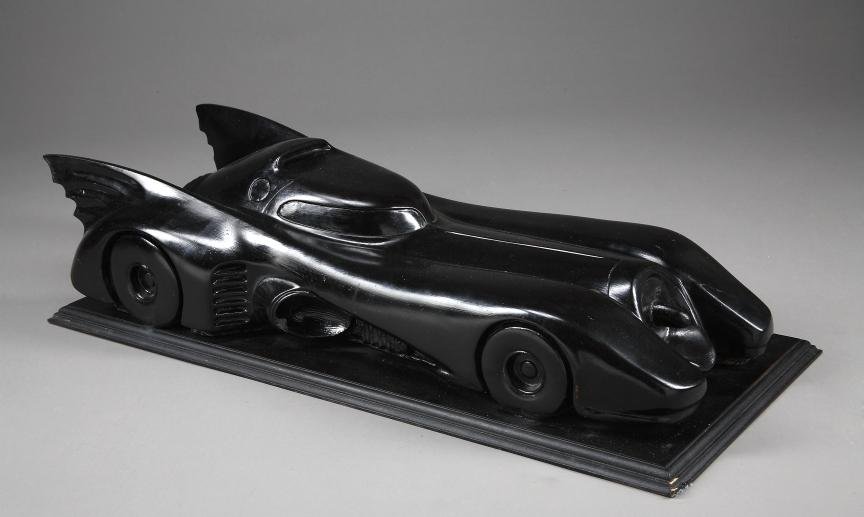
Getting from Caldow’s designs to a full-size functioning car required a bridge between art and engineering. Art Director Terry Ackland-Snow described the process: “We made a little clay maquette to see that we got that right — we got the basis of it right. Then we did it full-size.”
The result wasn’t quite complete. As Burton pointed out during an early review: “It’s really great. The only trouble is — how do they get in it?” There was no door. The solution came from Ackland-Snow’s experience inside a Harrier Jump Jet, where the entire canopy slides forward. That became the Batmobile’s entry mechanism.
For the chassis, the special effects team sourced two donor cars — a Chevrolet Impala and, as SFX technician Andy Smith recalled, “the ugliest pink Oldsmobile Cutlass convertible you’ve ever seen in your life.” The choice was deliberate: both had box chassis that could be cut and extended at the prop shaft, and neither cost much money. The Impala engine was retained for its sound. As production designer Nigel Phelps put it, “One of the psychological things with it was that John put in a Chevy Impala engine so it sounded great.”
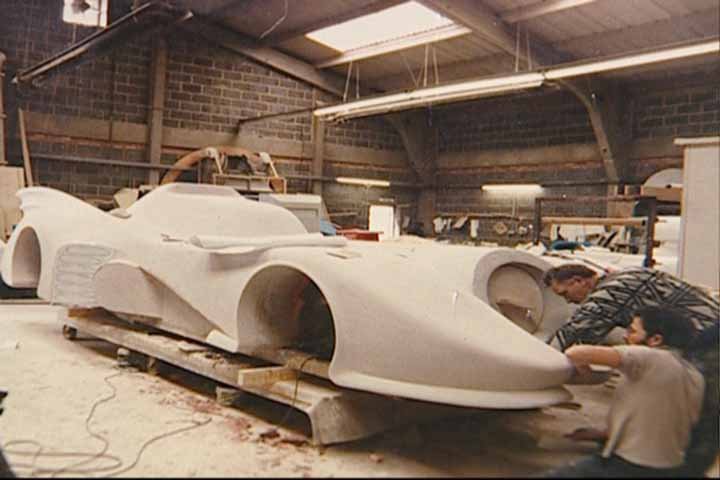
The body was sculpted in polystyrene to nail the shape, then rendered in fiberglass. Engineer John Evans recalled that the precision was remarkable: “We had our chassis built and we put it on and it fitted like a glove the first time.” There was only about six inches of clearance between the ground and the bottom of the car.
Parts From a London Bus, a Ferrari, and a Vulcan Bomber
Like the Lotus Esprit submarine car, the Burton Batmobile was assembled from an eclectic mix of real-world components, each sourced with characteristic resourcefulness. Ackland-Snow came across the solution for the headlights when he noticed his wife’s Honda Civic parked outside: “If you turn them upside down we can put them there. And it worked.” Burton later asked for yellow ones — they simply painted them.
The rear lights came from a Ferrari. Stuck in a traffic jam behind one, Ackland-Snow spotted the round red lights: “I contacted Ferrari. ‘How many do you want?’ ‘Make it eight.'” The fuel cap was spotted on the side of a London Routemaster bus. A man who supplied aviation scrap provided the intake fan — taken from an emergency generator on the wing of a Vulcan bomber. The tail pipe came from a Bristol Viper jet.
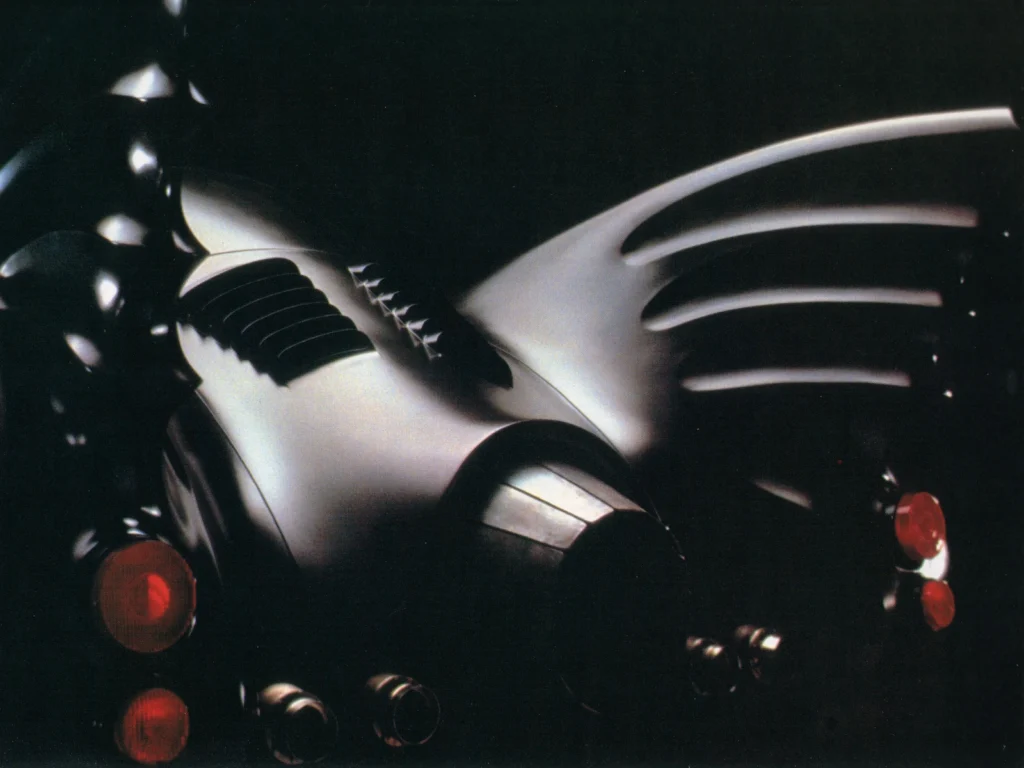
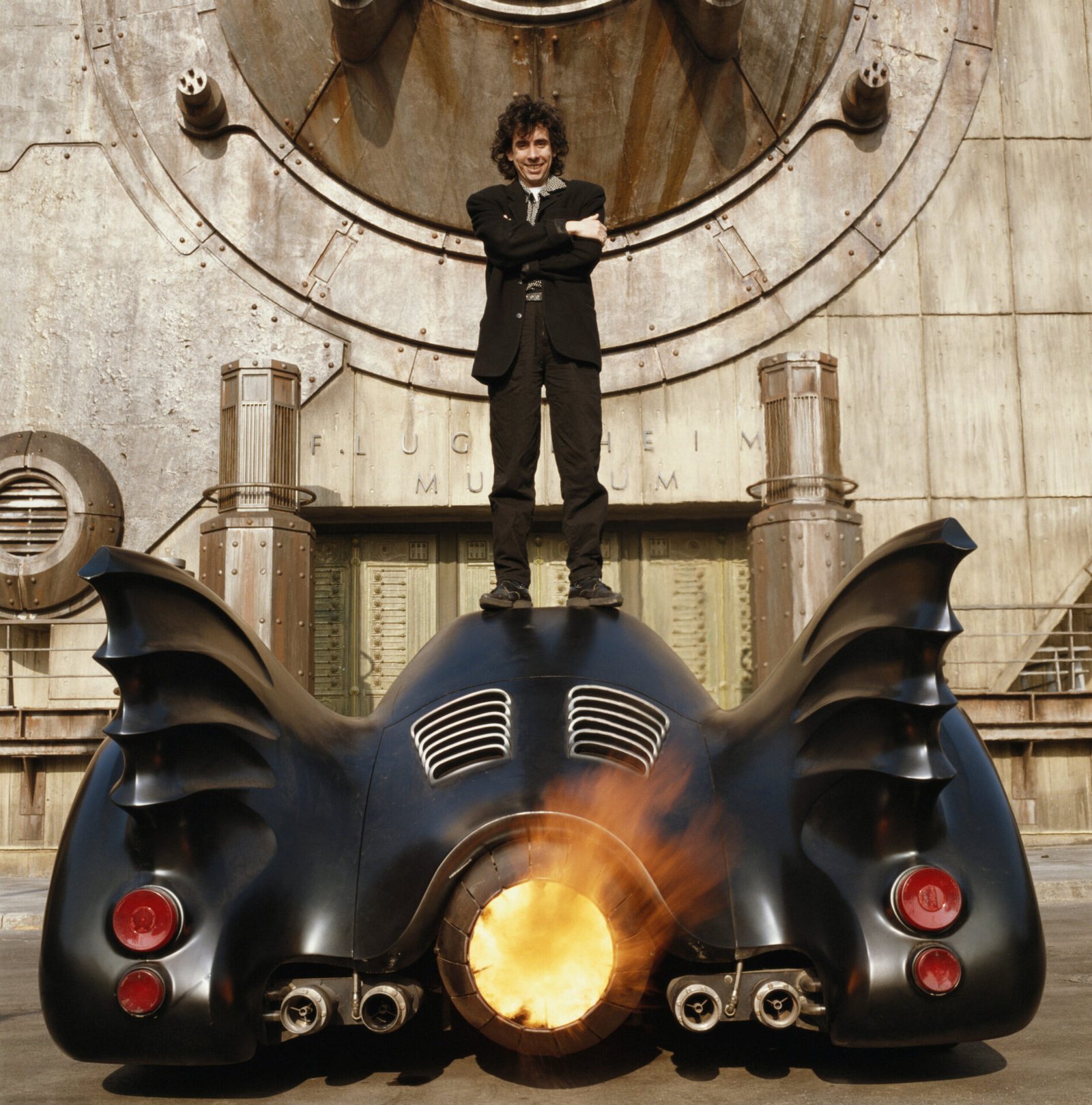
The turbine nose, which makes the car look like a rolling weapon, was dressed with real aerospace parts — Rolls-Royce jet intake components and Harrier jump-jet turbine blades — to sell authenticity. The turbine itself was cosmetic, built over the spliced Impala chassis.
The Gadgets
Furst’s idea of the Batmobile as a “knight in armor” — an extension of the Dark Knight himself — drove the decision that its tricks should feel mechanical, not whimsical like the 1966 car. But that didn’t stop the design team drawing inspiration from the earlier Batmobile’s gadgets. The twin parachutes became grappling hooks. The 1966 afterburner was updated into a jet engine.
Before any of it could be built, however, the production had to fight to keep Caldow’s design intact. General Motors offered six million dollars to build the cars — on the condition that they could discard Caldow’s drawings and use their own design. Producer Jon Peters refused. Ford also bid for the job but wanted six months to deliver. Evans and his team built it in three and a half.
Grappling Hooks. Batman uses a grappling hook to create the mythos of being a flying apparition, and this idea was extended into the car. The grappling cable fired from the forward hubcaps — powered by compressed air and rams — could launch up to twenty feet. In the film, Batman uses it to make a high-speed turn at the corner of Arnee’s Bar on Broad Avenue, the chasing cars unable to follow and piling up behind him. It was the same mechanical principle as the twin parachutes in the 1966 Batmobile: dramatic deceleration and a hairpin change of direction, just executed with considerably more menace.
Browning Machine Guns. Two 9mm Browning machine guns extended from either side of the car on air rams and fired dummy bullets. Evans described the engineering: “All of the controls for the guns were actually inside the car. We had speed regulators on them so that they could go at whatever speed the director wanted at the time.” Finding room for everything was the real challenge. “The most difficult thing about all of this was just finding room for all the air cylinders and reservoirs and everything. The inside of the Batmobile was very small and it was quite a tight fit just to get everything we needed in there.”
The Afterburner. The rear afterburner was the gadget that worried Evans most. To look convincing on film it needed real flame — and real flame meant real danger. The team insulated the back of the car and ringed it with CO2 extinguishers on a panic button accessible from both inside and outside the vehicle, so that a driver trapped inside could trigger them independently. The flames were generated with a mixture of gas, petrol, and paraffin. There was one hard limit baked into the engineering: the afterburner could only run for fifteen seconds at a time before it burned through its fuel supply. Every shot of the Batmobile’s jet blast was planned around that constraint.
Filming the Batmobile
The Batmobile proved almost too powerful for the studio lot. As Burton recalled: “It could actually go faster than the amount of room we had. Just by the time we got up to speed you’re off the studio lot.” Ackland-Snow, who drove it himself, got it up to 75 mph before thinking “the car was going to take off.” At left-hand drive and with a bonnet that seemed to go on forever, it was a singular experience.
Second unit director Peter MacDonald was immediately struck by what he saw:
“The Batmobile, I thought, was incredible. Far better than anything that came later because it had a real honest look. It looked like it was tough. The first time I saw the Batmobile coming around the corner it was going sideways and I thought, ‘This is it.'”
It requires skill to drive it around the Pinewood Studios set.
Depending on the level of danger in a particular shot, the car was driven either by Bob Marlais — a member of the Evans effects crew — or a stuntman. “Bob drove it when there were gadgets involved or there was a timing problem for special effects,” Evans explained, “but if it got too dangerous, a stuntman took over.” Every scene in Batman was filmed with one of three full-sized working cars. Not a single miniature was used.
The Axis Chemicals Sequence
The Batmobile’s most technically ambitious sequence in Batman is the destruction of Axis Chemicals — and like the Lotus Esprit submarine sequence before it, it was achieved by stitching together three completely separate locations that audiences never notice are distinct places.
The interior of the factory — the set through which the Batmobile charges under fire, dropping grenades as it goes — was filmed inside the Acton Lane Power Station, a decommissioned coal-fired plant near Wembley in West London, built in 1899 and closed in 1983. When the Batman crew arrived, they found most of the Aliens set still intact inside. James Cameron had filmed much of his 1986 sequel there, and the production had simply walked away and left the futuristic industrial dressing in place. At several points in the finished film, elements of the Aliens Atmosphere Processing Plant are easy to make out — most recognizably the stairways that Ripley negotiates while searching for Newt, which Jack Napier uses in his escape at the beginning of the film. The cast and crew complained bitterly about conditions inside the building, including asbestos issues that were only partially dealt with before cameras rolled.
The exterior of Axis Chemicals — the building Batman drives away from as it burns — was filmed at an entirely different location: Little Barford Power Station in Cambridgeshire. The actual explosion of the exterior, however, was neither Acton Lane nor Little Barford. That was a miniature, built by Derek Meddings’ studio from illustrations by Nigel Phelps. A miniature Batmobile was also constructed for the explosion shot — the same approach Meddings had used on the Lotus Esprit submarine sequence in The Spy Who Loved Me a decade earlier.
For the interior explosion sequence — the Batmobile driving through a burning factory — the real car was used on the real set, doing approximately 30 miles per hour with controlled fires blazing on either side. During one take that made it into the final film, one of the explosions was triggered early. The driver narrowly escaped. The car can be heard audibly accelerating in that particular shot as the driver instinctively floored it through the blast.
The Chemical Factory Chase
The car’s impact on set led directly to one of the film’s most memorable sequences. MacDonald recalled: “I remember when we did the chemical factory and it was just supposed to be a little tiny car chase, but once I saw that Batmobile, I said to Tim, ‘We gotta…’ We did a whole sequence instead of just a couple of shots.” What began as two or three setups expanded to fifteen or twenty, all of which made it into the final film.
The chemical factory sequence presented its own challenges. Evans described a car doing 30 miles per hour with explosions going off either side of it. The Batmobile’s low clearance — just six inches from the ground — and the driver’s cramped position meant that elegant exits remained a challenge throughout production. On one occasion, the problem of Michael Keaton’s bat ears wasn’t discovered until after construction: “We hadn’t accommodated the four inches of his bat ears. So that was quite funny.” The solution was a new hood with slightly shorter ears.
The car’s handling was another matter. As MacDonald dryly noted, it “really wasn’t that roadworthy” — the driver correcting a slide at the last moment in what could have been a serious incident. But on screen, the result was exactly what Burton wanted:
“The design that we finally ended up with — which I loved — was just sort of unexpected. It had made us kind of laugh because it was tough but it was kind of perverse. It had a weird quality to it that I can’t quite put my finger on. But it still had a bat kind of motif to it, but something else. It was just an aggressive thing. And also just the right paint job and texture and gun-metal quality to it to give it that sort of scary, aggressive persona.” — Tim Burton
The Batmobile in Batman Returns
For Batman Returns in 1992, the Batmobile returned with the same design — Caldow’s original blueprint was left entirely untouched. But it had a new trick up its sleeve.
Anton Furst had died in November 1991, before filming began. His replacement as production designer was Bo Welch, a Burton loyalist who had worked with the director on Beetlejuice and Edward Scissorhands and understood his visual language instinctively. Where Furst had built his Gotham from German Expressionism and brutalist architecture, Welch pushed the city into darker, more fascist territory — a place that was, in his words, “huge, dehumanizing and falling in on itself.” The Batmobile, however, was not his to reimagine. That had already been done.
The Batmissile
The one addition Welch did make to the Batmobile was the Batmissile mode — the idea that the car could shed its outer skin and reduce itself to the bare central fuselage to squeeze through a gap too narrow for the full vehicle. It was the logical conclusion of everything Caldow had drawn three years earlier. Strip the body away and what remains is exactly the rocket-spine that had always been at the car’s core — the Thrust2 influence made literal.
The Batmissile was designed by conceptual illustrator Jacques Rey in association with Tim Flattery. Rey built a maquette that was handed to 4-Ward Productions — the visual effects company founded by brothers Robert and Dennis Skotak, veterans of Aliens and The Abyss — to base the final models on. In the division of labour between the brothers, Robert oversaw the art direction and construction of the miniatures while Dennis composed the photography. Between them, 4-Ward created all the shots of the Batmobile transforming into the Batmissile, as well as the opening credits sewer sequence and the Batskiboat action scenes.
For the full-size Batmissile, Warner Bros. turned to Jay Ohrberg — the same car builder who had supplied Batmobiles for Six Flags parks across the country. “They brought two original cars and we made a mold,” Ohrberg recalled. He built the Batmissile — which he described as looking “like a big roller blade” — from designs provided by Warner Bros. The original plan was to build it as an outer shell with a working motorcycle inside to drive it. That idea was scrapped. Instead, the team rigged the full-size vehicle to run along a set of rails pulled by a cable — which is exactly how the narrow alleyway shots were achieved. Due to its limitations, the full-size Batmissile was only used for those few shots. Everything else — the transformation sequence itself — was handled entirely by the Skotak miniatures.
The Batmissile Transformation
The transformation was achieved with two quarter-scale miniatures, each approximately five feet long, built from fiberglass bodies over aluminum frameworks with the wheels mounted to the underframe. Both were constructed from molds taken directly from the Batmobile — meaning the team had to pull specific pieces from those molds depending on which stage of the transformation a given shot required.
The first miniature was the Batmobile. On this model, the central canopy section peels away and the cockpit closes inward, narrowing the profile of the car. The front fenders then rise — but don’t blow off. The mechanics were practical: metal pull cables running on rails beneath the model physically hauled the fenders upward on cue.
The second miniature was the Batmissile itself — already reduced to its core shape — rigged with compressed air. On this model, the fenders front and back blow completely clear of the body, the compressed air firing them away in a single violent burst. Cut together, the two models create the illusion of one seamless, continuous transformation.
As the Propstore presenter explains in the video below — and who has the actual screen-used miniature in hand — the team likely built only one hero Batmissile model, with separate hand props used to capture specific stages of the wheel transformation. The model rolls freely on its aluminum underframe and may have been pulled on a cable during filming to simulate forward motion.
The contrast with Batman is instructive. In the first film, every shot was achieved with full-size working cars and not a single miniature was used. In Batman Returns, the transformation demanded the opposite approach — quarter-scale fiberglass models, compressed air rigs, and pull cables. The Skotak brothers brought the same methodical miniature craft they had applied to Aliens and The Abyss to a sequence lasting barely thirty seconds on screen. The miniature tells its own story — and it’s in the video above.
The Penguin Takes the Wheel
The Batmissile transformation wasn’t the only sequence that required a purpose-built car. The Penguin’s remote hijacking of the Batmobile — in which he sends it on a rampage through Gotham’s streets with Batman trapped and powerless inside — demanded an entirely separate vehicle. A dedicated Batmobile was constructed specifically for the sequence, powered by a rear-mounted electric motor and a bank of 48-volt lead acid batteries, capable of speeds of 25 to 30 mph. The real trick was hidden in plain sight: a concealed compartment behind the cockpit contained a second set of controls — a steering wheel, side view ports, and a forward viewport — for a stunt driver to operate the car unseen. Michael Keaton was in the front. The stunt driver was running the car from behind him. The “remote control” was practical filmmaking.
The sequence in which the Batmobile ploughs through Gotham’s police cars was equally engineered. Rather than launching the cars via ramps, the production rigged them with cables and a mechanical lifting arm extended from the side of a nearby building. The cars were moving and rising before the Batmobile even made contact — the impact was as much illusion as collision. It was a deliberate inversion of everything the Batmobile stood for: an instrument of control and intimidation weaponized against its own driver. Take away his car and Batman is exposed. Vulnerable. Human.
After Batman Returns, the Batmobile’s association with Burton’s expressionist Gotham ended. The Batmobiles that followed — for Val Kilmer in Batman Forever and George Clooney in Batman & Robin — tried to evolve and improve on Caldow and Furst’s template and were judged inferior for it. Christopher Nolan wisely chose to go in a completely fresh direction with the Tumbler in Batman Begins, which earned its own considerable reputation through originality rather than competition. Robert Pattinson’s muscle car Batmobile in The Batman did the same — rooting the car in a different era and a different psychology entirely.
Burton’s Batmobile endures because it was never just a car. It was a piece of production design that told you everything you needed to know about this Batman before he said a word — brutal, timeless, and unmistakably dangerous. For the same reason that “Wet Nellie” will always be Roger Moore’s car, the Burton Batmobile will always be Keaton’s.

- California’s AG Loses to Paramount: Inside the Paramount / Warner Bros. Discovery Merger — And Why Ellison May Still Leave California - September 26, 2026
- Napoleon Solo Sold for £1: The Year Ian Fleming Stopped Owning Ian Fleming - July 25, 2026
- The Untold Story of The Persuaders!: Cars, Glamour, Conflict and James Bond - July 20, 2026