


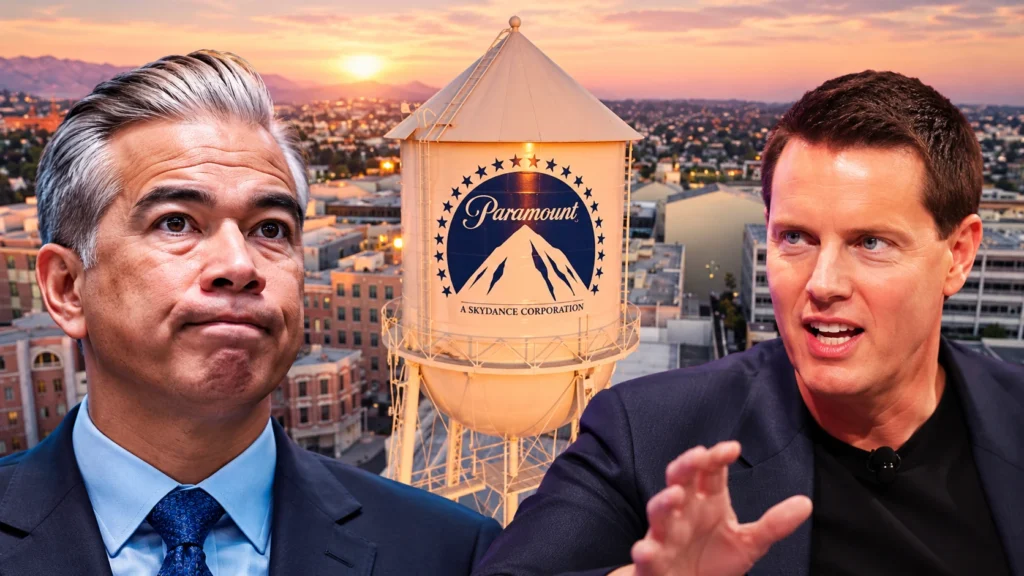
On the afternoon of Wednesday, 5 August, David Ellison called his twelve-person Executive Leadership Team to a lunch meeting on the Paramount lot. He opened the meeting with confidence, assuring his team they would win the antitrust case California and eleven other states had brought against Paramount’s $110 billion acquisition of Warner Bros. Discovery. His real preference, he insisted, was to keep the merged company, and its roughly 30,000 Southern California jobs, exactly where it was.
Then, according to accounts from that meeting, Ellison confirmed the rumour no one in the room believed or wanted to believe: if the case wasn’t settled by 1 October, Paramount would leave California, regardless of how the lawsuit ended. That was the date a “ticking fee” embedded in the merger contract would start to accrue, a penalty for every day the deal stayed unclosed. California’s attorney general, Rob Bonta, had exposed Ellison to it by suing. The threat to leave was the only weapon Ellison had left. It was a stalemate.
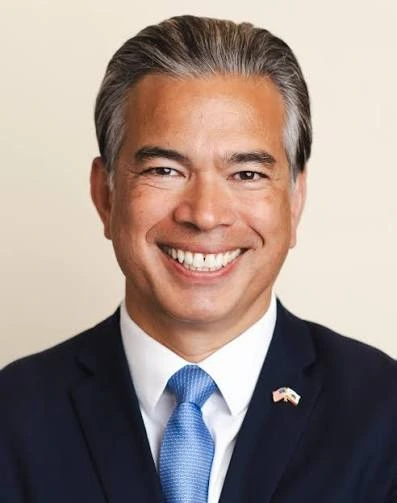

Tennessee, Texas and Georgia were on the table, all with Republican governors. Ellison cast the twelve states’ lawsuit as politics dressed up as antitrust law, and he answered in kind: sued by Democrats, he would move Paramount from a blue state to a red one. Several members of his own leadership team, by one account, left the room upset.
But Ellison’s eventual victory, and the largely toothless terms Bonta settled for, raise an obvious question: did the Ellisons lay a trap, and did Bonta walk straight into it?
The lawsuit itself dates back to mid-July, when Bonta and eleven fellow Democratic attorneys general sued to block the merger. They argued in a lengthy complaint that merging two out of Hollywood’s five major distributors would “extinguish competition.”
Antitrust or Politics?
Ellison’s relocation threat compounded the theatre that had developed around the proposed merger for weeks. Tennessee’s deputy governor had already sent Paramount an unsolicited courtship letter weeks before California even filed suit. Texas was also running its own campaign for Paramount in parallel. Public records obtained by The Hollywood Reporter show Ellison meeting Texas Lieutenant Governor Dan Patrick in August, while the Texas Media Production Alliance had been coordinating a formal pitch since July. When word of the August meeting with his Executive Leadership Team got out, the drama intensified. Ellison used a New York Times op-ed to argue the whole case was political cover for concerns over his stewardship of CNN. Bonta, in kind, used Deadline to call the merger a straightforward antitrust matter and, on social media, dismissed the relocation threat itself as “another attempt to blackmail the state into letting an illegal deal through.”
Pressed on the threat at a public panel, Bonta was unbothered:
“If they make that choice to leave, that is their choice and their choice alone. They own it. It lies at their feet.”
Ellison’s political framing in his op-ed is supported at face value by the map: twelve Democratic attorneys general suing him, and three states with Republican governors courting Paramount’s business. But the politics didn’t run only one way, and on closer inspection the blue states’ concern was more legitimate than Ellison admitted.
Ellison is no Hollywood outsider.

Skydance has been a production fixture of Hollywood since its founding in April 2006, producing some major hits from Mission: Impossible – Ghost Protocol onwards to the final two Kelvin-timeline Star Trek films. From the autumn of 2009, Skydance was locked into a co-financing and distribution deal with Paramount Pictures.
But an insider can still have politics, and Ellison’s showed up exactly where the states said they would: in news. Within months of taking control of Paramount, he bought Bari Weiss‘s The Free Press for $150 million, installed Weiss as editor-in-chief of CBS News, and brought in executives with what Variety called “unfashionable” viewpoints by Hollywood standards.


A similar pattern also emerges in Paramount’s entertainment arm. Taylor Sheridan, the man behind Yellowstone and Landman, makes shows often branded as red-state television, however much he denies it.
Yet according to the Wall Street Journal, Ellison pushed Sheridan to create a series tied to America’s 250th anniversary, which Sheridan refused as too overtly political. That dispute, alongside budget fights and the dismissal of an executive who had shepherded his projects, helped drive Sheridan to a billion-dollar deal with NBCUniversal, which takes effect once his Paramount contract runs out in 2028. Ellison’s clearest intervention in a show’s politics was a push to the right, and it cost him his most bankable showrunner.
Star Trek is sometimes cited as evidence the other way, but it proves little. Its television wing was drawing “woke” criticism long before Ellison, dating back to Star Trek: Discovery in 2017, and Starfleet Academy was commissioned and shot before he took control. Its cancellation in March needed no political explanation: after two seasons, it had a 51 per cent audience score on Rotten Tomatoes (against 87 per cent from critics) and had never appeared in Nielsen’s weekly top ten.
So the question in this section’s title has an uncomfortable answer: both.
The legal case was built on antitrust law, but the fear behind it was political, and Ellison’s own record gave it substance. The prospect of a CNN turned from blue to red wasn’t a Bonta talking point. It was an extrapolation from what Ellison had already done at CBS News. The merger would put two of America’s major television news operations under one owner, which is why four of the twelve states would later hold out for the divestiture of both. It was also a fear the lawsuit was poorly built to address.
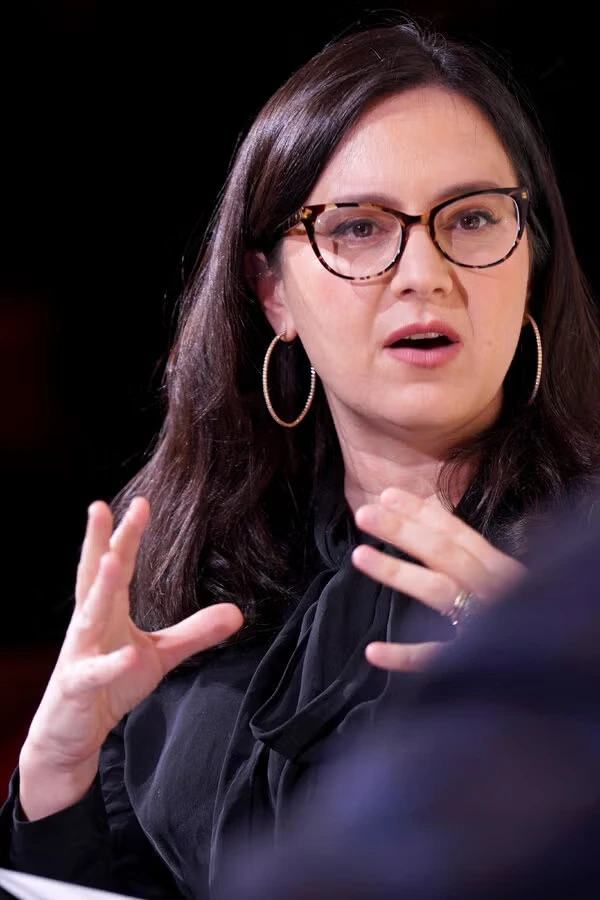

California’s own lead attorney would later concede that the nature of the antitrust claims limited how far the case could deal with concerns about political bias in the media.
That limit wasn’t a loophole Bonta chose. Antitrust law polices competition, not viewpoints, and the First Amendment largely bars governments from regulating news outlets for their politics. It is a protection that cuts both ways: a legal tool that let a state intervene to stop CNN turning right could just as easily be turned on a network accused of leaning left.
The antitrust case, meanwhile, stands on its own.
Look at what the merger gives Ellison regardless of his politics, and you might agree with Bonta anyway, though then Disney CEO Bob Iger’s acquisitions weren’t all waved through without a fight either. Pixar, Marvel and Lucasfilm drew little scrutiny. But Disney’s 2019 purchase of 21st Century Fox only closed after the DOJ brought an antitrust suit over part of it, resolved by forcing Disney to sell Fox’s 22 regional sports networks to preserve competition in cable sports pricing. The DOJ’s antitrust chief on that case, Makan Delrahim, is now Paramount’s Chief Legal Officer.
So there were real antitrust concerns over Disney’s acquisition of another studio, and the scale of the Paramount-Warner Bros. Discovery merger raises the same kind of concern. What’s different this time is who raised it and what came of it. Fox’s case was a federal DOJ action that forced Disney to divest assets. Paramount’s case was a state-led fight over a deal the DOJ itself had waved through, and it ended in commitments rather than a sale.
Nonetheless, like Disney’s acquisition of Fox, the merger between Paramount and Warner Bros. Discovery houses a formidable back catalogue, franchise list and sports portfolio under one roof.
What Ellison Actually Built
The obvious comparison to a Paramount / Warner Bros. Discovery merger is Disney. Over two decades, Bob Iger acquired Pixar, Marvel, Lucasfilm, and most of 21st Century Fox, adding substantial franchises to its catalogue, and turning the Mouse House into one of the industry’s most diversified major conglomerates, spanning film, television, streaming and theme parks in a portfolio no rival studio has matched.
The Paramount/Warner Bros. Discovery merger is a real contender to that dominance.
But, the comparison cuts three ways depending on what you measure. At the US box office specifically, the combined Paramount / Warner Bros. Discovery behemoth overtakes Disney outright to become the country’s single largest theatrical distributor.
On streaming, the two are neck and neck: Paramount+, HBO Max, and Discovery+ combined sit within 200,000 subscribers of Disney’s entire Disney+/Hulu/ESPN+ total (As last reported, since Disney no longer publishes subscriber figures). Sports rights are opaque compared with theatrical and streaming. The industry has fragmented broadcast packages so thoroughly across CBS, Fox, NBC, ESPN and Amazon that neither side can claim supremacy. Both companies hold substantial, overlapping pieces of the same leagues.
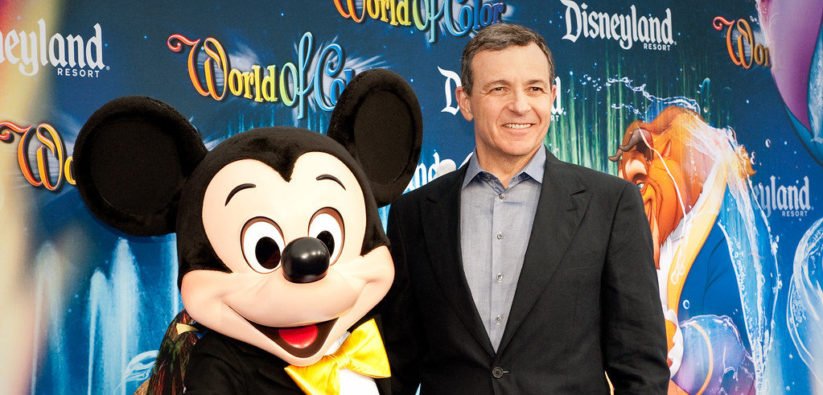

Where Disney still wins decisively is through its prime differentiator: Disney’s Parks & Experiences division. Disney’s total company revenue for fiscal 2025 ran to $95.71 billion, against the combined Paramount-WBD’s own projected $69 billion — a gap of roughly $27 billion Disney owes almost entirely to Disney’s Parks & Experiences division, which includes the theme parks, the cruise ships, and the consumer products. The division generated $10 billion in operating income on its own last year, which outperformed what most media companies manage across their entire operation. Ellison built a rival capable of beating Disney at the box office and matching it on streaming. He didn’t build anything capable of touching the part of Disney’s business that actually prints the most money.
Ellison is young. At 43, with his father’s fortune behind him, he has decades to keep acquiring, longer than most of his rivals. If the goal is to run the largest media conglomerate on the planet, he isn’t there yet. That title doesn’t belong to Disney today. Netflix holds the largest market cap of any of them, and Comcast, NBCUniversal’s parent, is the largest media conglomerate by revenue at $121–124 billion, against Disney’s $95.71 billion.
What Losing Paramount Would Mean For the Californian Economy
Once leaked, the numbers behind Ellison’s relocation threat were substantial enough to underline the considerable loss this move would incur for California. An Los Angeles County Economic Development Corporation study, obtained by Politico in mid-September, and according to Puck, commissioned by Paramount itself, put the cost of a full Paramount exit at somewhere between 29,000 and 58,000 California jobs and $10.6 billion to $21.2 billion a year in lost economic output.
Even the minimum, a slower-withdrawal scenario, would cost 2,750 to 5,550 job-years and $1.01 billion to $2.03 billion in output between October 2026 and September 2031. The state would also lose the property and personal income tax tied to those jobs and buildings. The report was, in other words, as much a part of the pressure campaign as a measurement of it.
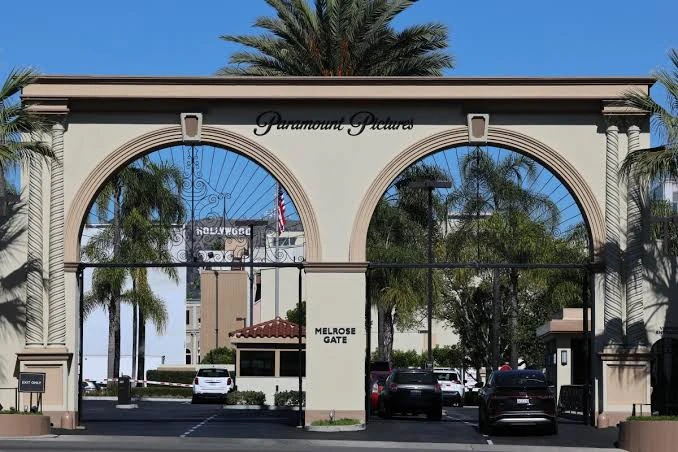

Ellison reportedly put the saving from leaving at around $500 million a year in taxes and other costs, before counting whatever the Melrose lot would fetch at sale. The tax half of that claim was mostly theatre. Virtually every state Paramount considered moving to has shifted to “market-based sourcing,” which taxes companies based on where their customers live not where their offices are situated. California would keep taxing Paramount on its California subscribers and moviegoers wherever the headquarters went.
The cost half was real: the upkeep and property tax on the Melrose lot, California’s steep workers’ compensation premiums, and the general overhead of operating in one of the country’s most expensive states. And the pressure to cut will only grow. To fund what The Hollywood Reporter calls the “largest leveraged buyout in history”, the combined company is taking on more than $80 billion of debt, with Morgan Stanley estimating around $6.4 billion in interest payments in 2027 alone. Nobody at Paramount was arguing that the intellectual property needed to leave California. Only the buildings did, and unlike the tax argument, that one held up.
This wasn’t just posturing, either. By mid-September, Paramount representatives were touring a vacant multi-acre site outside downtown Nashville and had contacted at least two developers about building new offices there. They were seeking roughly 400,000 square feet the company could occupy within two to three years. That was the leadership and headquarters part of the plan, moving first and as fast as office space allows, with the fuller shift of production jobs following on the five-year timeline Ellison had given his own executives. Even Paramount’s Chief Legal Officer, Makan Delrahim, hedged the company’s stated loyalty at a Sacramento summit that August.
Ellison’s “intent is to be committed to California,” he said, but ultimately a company has to “go to the place where you’re wanted.”
What Bonta Actually Got
Bonta reached a settlement framework with Paramount over the weekend of 19 and 20 September. It was announced on the Monday and still awaits a federal judge’s approval. Four states (Massachusetts, New York, Connecticut and Minnesota) held out for more. Connecticut’s attorney general, William Tong, was explicit about what his state wanted:
“Connecticut wanted and demanded full divestiture of CNN and CBS News. We wanted to save ethical and independent journalism and news.”
What they got instead was a compromise: an independent editorial board, to be staffed within 180 days by five journalists with at least a decade’s experience each. Whether it amounts to much is another question. The board is appointed by Paramount’s own board of directors, which prompted immediate criticism that it has no real independence, since the people overseeing Ellison’s newsrooms would be handpicked by Ellison. Having secured that and nothing stronger, the four gave up. California had been acting as lead counsel, funding the case, staffing discovery and running strategy while the other eleven states rode along as co-plaintiffs. Once California stepped back, none of the four had the budget to keep fighting Paramount’s legal team alone. A parallel lawsuit from the Writers Guild of America was settled the same day, with Paramount agreeing to five years without writer layoffs at CBS News and a $17.5 million contribution to the guild’s health fund.
The full terms bind the merged company to a mix of old pledges and new obligations. Ellison had already committed, on the public record, to thirty theatrical releases a year, rising to thirty-two after two years, and to a 45-day exclusive theatrical window. Bonta’s team didn’t invent either number; they attached consequences to them. The release pledge was a smaller stretch than it sounds. Per an LA County economic report, Warner Bros. distributed 11 wide releases in 2025 and Paramount put out 10 features, a combined 21 that already roughly meets the settlement’s 20-wide-release minimum. The real stretch is the 30-film total, about nine more films a year, in an industry already moving back towards theatrical releases as studios abandon COVID-era streaming-first strategies.
What’s actually new is what happens if Paramount misses. It pays a $30 million penalty per shortfall film, payable to Hollywood guild health and retirement funds, and repeated failures escalate to a forced sale of Paramount’s stake in Miramax. Miramax is a relatively small production and distribution company whose only release this year is Scary Movie. The settlement never contemplates a forced sale of the blue-chip assets, New Line Cinema or DC Studios among them.


On top of that, Bonta secured several further commitments. Paramount must spend at least $300 million more a year on US production, or $1.5 billion over five years. It must fund a $25 million independent-film acquisition fund, which works out at $5 million a year, roughly the cost of one modest indie. A five-year firewall keeps Paramount’s and Warner’s cable-carriage negotiations separate, backed by a list of channels to be divested if it’s breached, running from the BET networks to Comedy Central and VH1, though not CNN. There is also a $47.5 million workforce fund, and a commitment not to sell or close either the Paramount lot on Melrose or the Warner Bros. lot in Burbank for five years.
Few of these commitments are California-specific. The $300 million production pledge is scoped to “the United States,” so Paramount could satisfy it entirely by spending more in Georgia or Texas and nothing extra in California. The lot commitment is the exception, and even it has a gap: Paramount is barred from selling or closing the Melrose and Burbank lots, but nothing requires it to keep them staffed at anything like current levels. And the whole agreement comes with a force majeure clause, giving Paramount an out on its obligations if events beyond its control intervene, such as a Hollywood strike or another pandemic.
Bonta’s own conduct in the run-up to the deal invites a harsher reading of how it ended. As late as August, in an interview with The Hollywood Reporter, he dismissed the relocation threat as a “Hail Mary” and said “it seems like they’re grasping at straws.” For months he had insisted publicly that he would accept only structural remedies, meaning divestitures, and dismissed behavioural pledges like film quotas as weak and unenforceable.
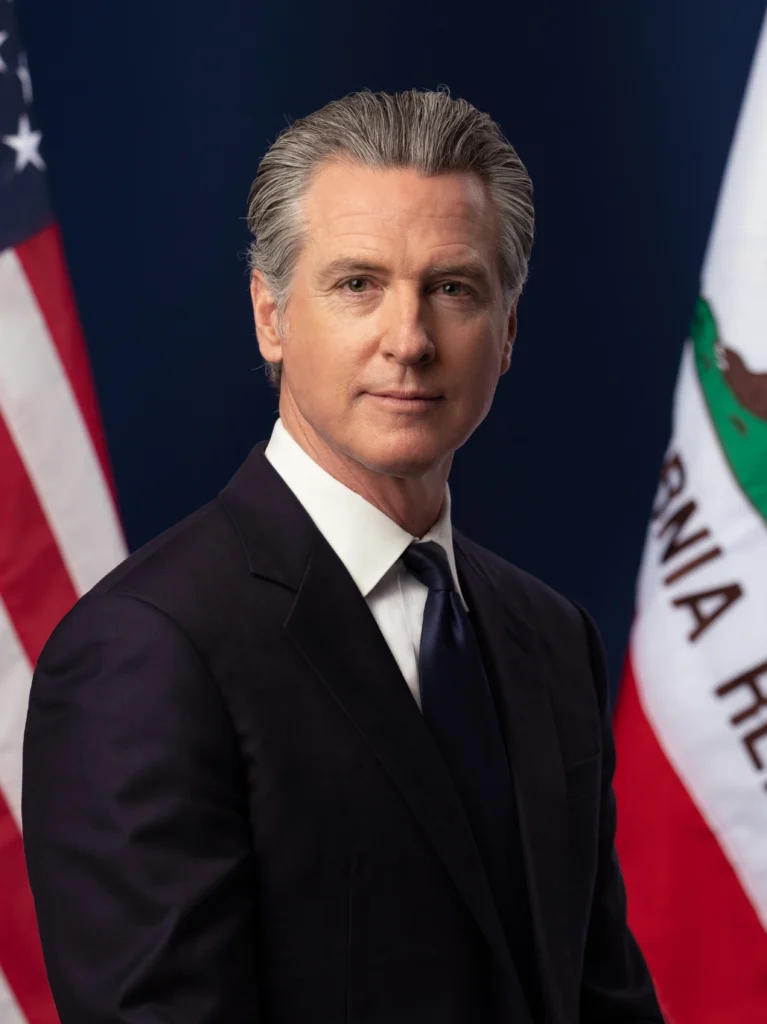

Governor Gavin Newsom had inserted himself into the talks, telling reporters he took Ellison’s threat “seriously” and was “very mindful of what this means to the state — our reputation.” None of that proves the settlement was the wrong call. A coalition of states losing a fully litigated trial over a deal the DOJ had already cleared would have been a far worse outcome than an imperfect settlement.
But it does mean Bonta folded looking a great deal weaker than the “grasping at straws” line he had used against Ellison weeks earlier.
California’s own explanation, later offered by its lead attorney Paula Blizzard, was that cinema owners, the very constituency the case was meant to protect, had come round to supporting the merger. The country’s three largest cinema chains had backed the deal earlier in the year, a move they would likely not have made for Netflix, which had once looked set to buy Warner Bros.
“Those are the voices that carry weight because those are the people we’re trying to protect,” Blizzard said.
The relocation threat, she insisted, was another matter:
“Some voices carry less weight. Those are the ones who are threatening and blackmailing us that they’d pull out of California that doesn’t affect the antitrust case.”
Ellison’s own account of who mattered was rather different. His statement announcing the settlement thanked Bonta, his fellow attorneys general and the Writers Guild, and “Governor Newsom for his support throughout this process.” This was the same governor who, weeks earlier, had said he took the threat “seriously.”
Ellison called the settlement “complete clearance for this merger.”
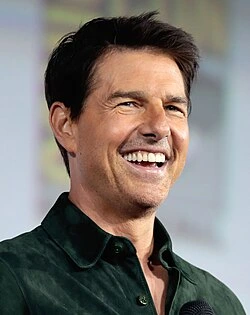

Months earlier, Paramount’s biggest star had put the company line more simply. In the hype video that opened Paramount’s CinemaCon presentation, Tom Cruise declared from atop the lot’s water tower:
“The future is Paramount. And the future looks pretty great from here.”
The Five-Year Clock
Ellison, once he’d got what he wanted, dropped the relocation talk as quickly as he’d raised it:
“Let me be clear: the newly merged company will be headquartered in Los Angeles. We aren’t going anywhere. Our history is here and this is where our future is being built.”
By the time he said it, the tax argument had already collapsed, and the operating costs Ellison had cited as the reason to leave were on a clock that happens to match his own. The consent decree’s commitments run until 31 December 2031, just over five years from the deal’s expected closing. That is almost exactly the timeline Ellison had given his executives for shifting jobs out of state, regardless of any lawsuit. Office space in Nashville could be ready in two to three years; the lots can’t be sold before 2032. What the settlement secured, at best, was five years in which Paramount was unlikely to sell the lots anyway. Once that window closes, nothing stops Ellison finishing what he told his executives in August.

It wouldn’t be the first time an Ellison-run company left California. Larry Ellison moved Oracle’s headquarters from Redwood City to Austin, Texas, in December 2020. Less than four years later, he declared Nashville, the city Paramount had been scouting, the company’s “world headquarters.”
Not everyone in the industry read that history as a warning. Three days before the settlement was announced, Puck co-founder Matthew Belloni, a former editorial director of The Hollywood Reporter, wrote that Ellison’s “game isn’t moving or not moving his company, but convincing Bonta… that the threat is credible.” That matches what happened. But Belloni also argued that leaving would be too costly and too socially damaging to be real; he would “never look at [Ellison] the same way,” he wrote. He pointed to Oracle, which he said still keeps a significant presence in California “even after Larry opened his spite stores in Texas and then Tennessee.”
That understates what has happened since. Before its 2020 move, Oracle’s Redwood City campus alone employed more than 6,500 people, 13.5 per cent of the city’s jobs. For years afterwards, Oracle kept more office workers in California than in Texas; the headquarters change was, for a long stretch, mostly a filing. But since Larry Ellison named Nashville the world headquarters, the cuts have turned concrete: more than 1,100 California positions eliminated between October 2025 and April 2026, across Redwood City, Santa Clara, Pleasanton and Santa Monica. The company has partly tied those cuts to redirecting spending into AI data centres, but they are cuts all the same. “Significant presence” was accurate the day Belloni wrote it. It says nothing about the Ellison’s habit of leaving states they’ve fallen out with, and that habit IS the story.. Oracle could do without Silicon Valley, and gradually it has. David Ellison may yet prove that Paramount’s future looks just as good from somewhere else.
Whatever Ellison told Los Angeles on 21 September, its a promise worth very little. This time there’s already a date on the calendar, one Bonta negotiated, and one that happens to fit the exact timeframe Ellison gave his own executive team to relocate out of California back in August. Hollywood will be watching that date with great unease.


- Why Robert Pattinson’s Batman Should Be DCU’s Caped Crusader - October 12, 2026
- California’s AG Loses to Paramount: Inside the Paramount / Warner Bros. Discovery Merger — And Why Ellison May Still Leave California - September 26, 2026
- Napoleon Solo Sold for £1: The Year Ian Fleming Stopped Owning Ian Fleming - July 25, 2026