StageCraft: How ILM Built the Virtual Stage That Changed Production, Its Limits, and the Stages That Followed
ILM’s StageCraft is the realisation of a vision George Lucas had been articulating for years — a stage of the future in which the walls of a studio change to suit the story. It took a lighting problem on a Star Wars film, a cinematographer’s hunch, and a decade of development to get there. Learn how StageCraft developed, how it works, what it can do — and where its limits lie.
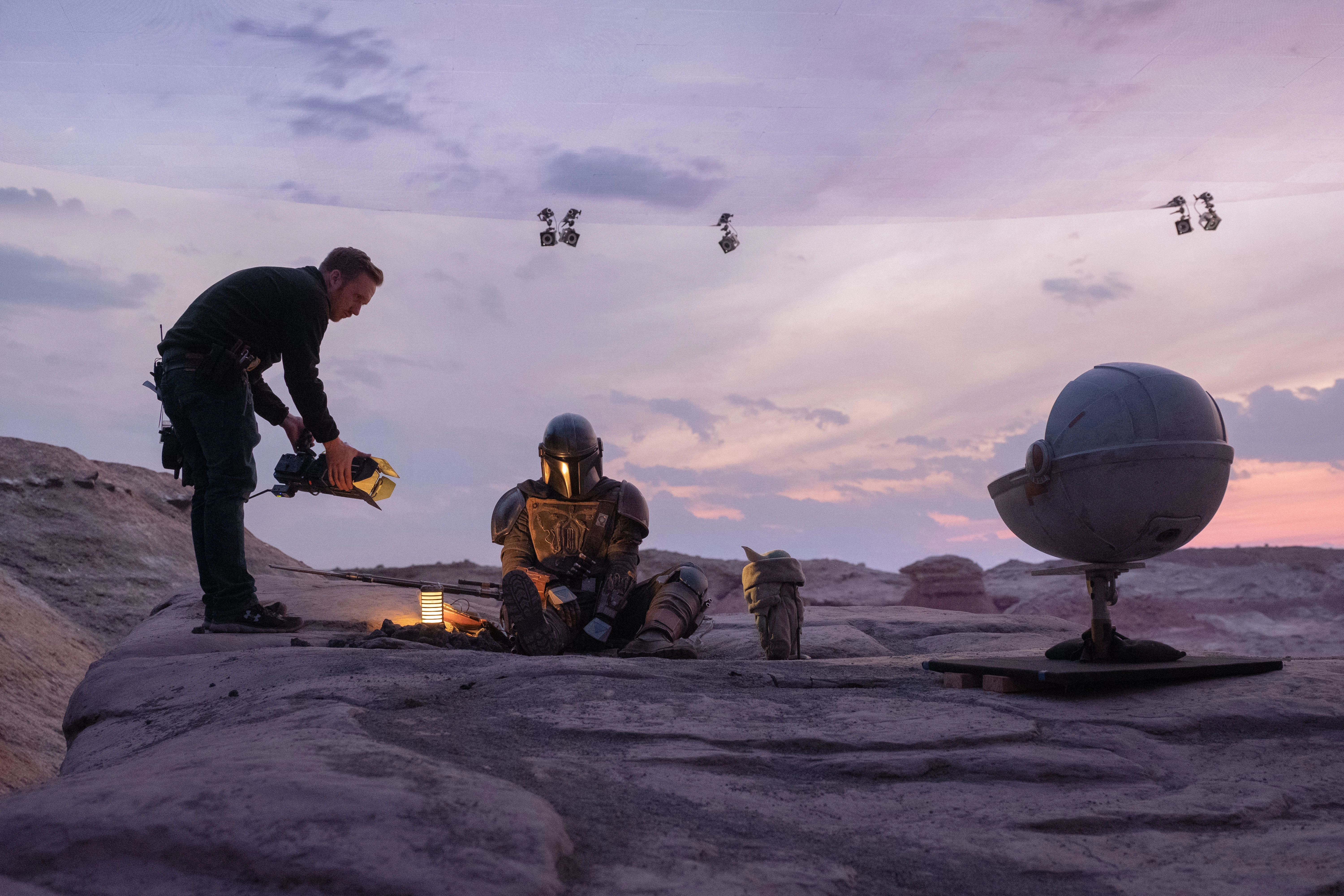
After pushing film-making into the new frontier of real-time virtual film production with The Lion King and The Jungle Book, director Jon Favreau advanced it further with Industrial Light & Magic on The Mandalorian. For Star Wars’ first live-action tv series, ILM built the world’s first dedicated, fully immersive virtual stage called StageCraft at Manhattan Beach Studios in L.A.
Audiences expect exotic and fantastical locations of the various planets characters visit in a Star Wars production. But traveling to the deserts of Tunisia, the ice-fields of Norway, or a redwood forest in California isn’t possible with the budgetary and time-constraints of TV production. However, StageCraft made the creation of photorealistic, digital environments inside a virtual stage possible. Over 50% of The Mandalorian was shot in this one, virtual location reducing location shoots and chroma key (blue and greenscreen) compositing.
The virtual stage is a fully-immersive semicircular LED screen and ceiling with a performance area, where practical sets were extended seamlessly into the yonder by the digital backdrops played on the screen. The 3D imagery is rendered by Epic Games’ real-time game software, Unreal Engine, which allows ILM’s artists to craft fantastic landscapes of various planets in one virtual location with a degree of realism that rivals any real location.
Where StageCraft Really Began
The lede version of StageCraft’s origin — that Jon Favreau invented virtual production — is incomplete. The more accurate story begins in 2015, on the set of Rogue One.
Cinematographer Greig Fraser was trying to solve a specific lighting problem: how to correctly light the inside of an X-Wing cockpit during a barrel roll in space. One half of the pilot’s face should be lit by sunlight; the other in shadow. With conventional methods, replicating that physics on a studio stage required an elaborate rig of mirrors, lights, and crew. Fraser’s solution was to make the world around the actor do the work. He consulted ILM’s visual effects supervisor John Knoll, and the two began building an LED wall that could play a dynamic, pre-visualised background — one that emitted light, not just reflected it.
“That started the conversation,” Fraser later recalled.
ILM’s Rob Bredow and Fraser ran tests to see whether LEDs could become the walls of a studio itself. Knoll connected the idea to something George Lucas had long discussed: a “stage of the future” in which the walls of a studio change to suit the background. The Rogue One prototype was the practical meeting point for a lighting problem and a decade-old vision.
ILM picked up the concept and began developing an entire set made of LEDs — a two-story-high curved video wall with a ceiling of the same screens, capable of projecting backgrounds and tracking camera movement. Fraser and Favreau, who had been developing parallel virtual production techniques on The Lion King, would bring it together for The Mandalorian. Favreau’s involvement gave ILM the filmmaker to test-run their technology with someone equipped to use it.
The Limitations of Rear Projection and Chroma Key
In interviews before The Mandalorian‘s premiere, Favreau quickly glossed over the limitations of greenscreen and the need for StageCraft, never referring to the virtual stage by name. Today, virtual production is rapidly solving creative, technical, and logistical issues of chroma key and rear projection.
Rear projection, which has been around since the dawn of motion pictures, requires actors to perform in front of a screen with pre-recorded footage projected on it from behind. But the downside is you can’t move the camera to capture a different angle because the projected footage can’t move with the camera. The camera must remain stationary throughout the shot to prevent a loss in perspective.
The advent of chroma key (blue or greenscreen) replaced rear projection in most respects. Background and other elements are composited in post-production, which allows the crew to use multi-camera set-ups to capture and create complex sequences. And while bluescreen and greenscreen, in particular, provide greater freedom and creates astounding results, it too, can be problematic.
The successful use of blue and greenscreen requires the expert handling of lighting to reduce blue and green spill (or reflection) on the actors, wardrobe, sets, and props, and then the seamless compositing of effects and backdrops in post-production to create a realistic final scene. Removing a solid color–or “keying”–can look great, but it’s a major headache. It’s not only difficult and specialized work, its time consuming and costs a fair bit to achieve.
Problems with “keying” include the disappearance of foreground details on subjects, costumes, or props (especially fine details like fur on the edge of a subject), which need to be added back in post-production, and the perspective of the background doesn’t change, which has to be created in the final composite.
Keying is sometimes used in conjunction with rear projection to reduce these limitations. Rear projection can help eliminate the loss of fine foreground details, but the background will still not move, or shift perspective with a change in camera movement or angle. Perspective shifting (or the parallax effect) is natural when shooting subjects in front of real backgrounds on location, and, therefore, is an important element in creating convincing realistic shots set in artificial landscapes.
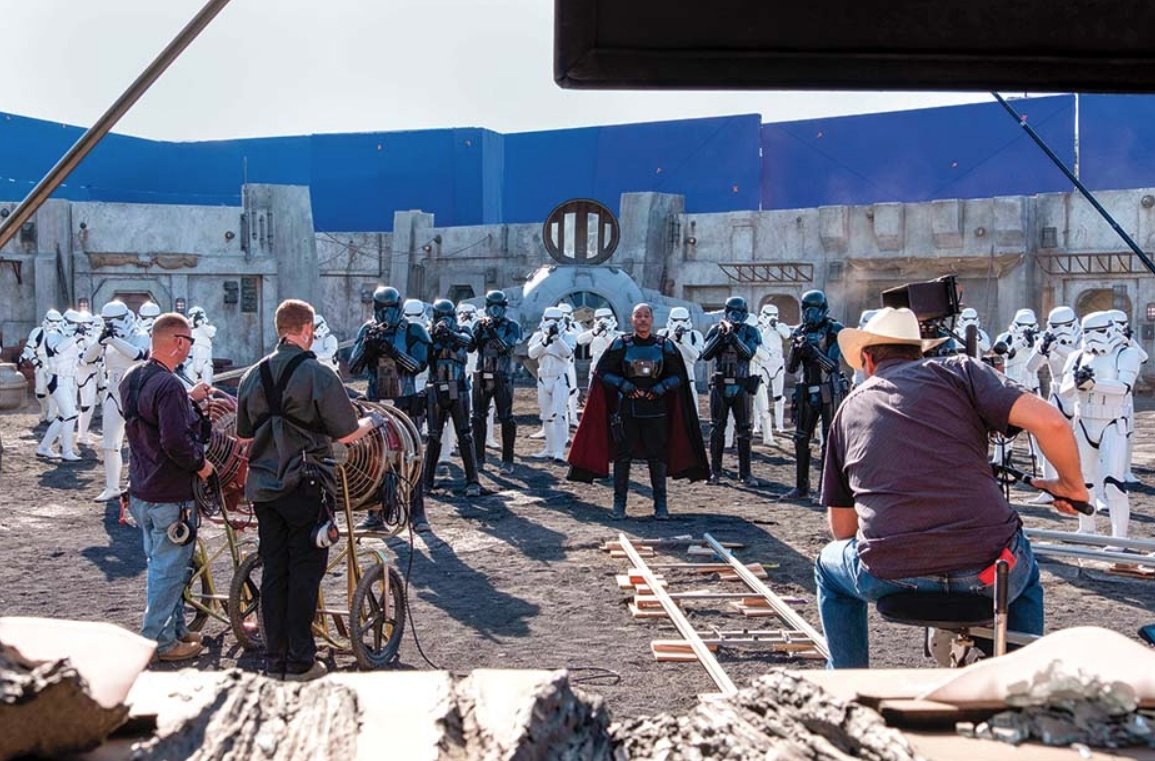
CG Environments Run Real-Time On LED Walls
The Mandalorian solved all these problems by replacing greenscreen with the virtual sets provided by StageCraft. The Volume, as it is known, is a semicircular LED video wall and ceiling with a performance area, where practical sets are extended seamlessly into the digital environments played on the screen behind them. The original Season 1 installation at Manhattan Beach — first operational in October 2019 — comprised 1,326 individual LED screens of a 2.84mm pixel pitch, 20 feet high, covering a 270-degree semicircular background with a 75-foot-diameter performance area. At the rear, in the remaining 90-degrees of open area essentially behind the camera, were two 18′-high-by-20′-wide flat panels of 132 more LED screens mounted to traveler track and chain motors.
That original stage was the first of what is now a global network of permanent volumes. A second Manhattan Beach stage came online in January 2021; Pinewood Studios in London followed in February 2021. Each successive installation is larger, higher-resolution, and technically more capable than what preceded it — the Manhattan Beach stages both run at 75 ft. wide and 23 ft. tall, with the original stage having been upgraded beyond its Season 1 specifications. ILM has also built bespoke pop-up volumes for individual productions. The 1,326-screen configuration is where StageCraft started, but it is ever changing, expanding or tailor-made (bespoke) for a specific production.
While the LED wall is a sophisticated canvas, Unreal Engine is the operating system that runs sophisticated digital environments on the screens. Together, the LED wall and Unreal Engine create a fully immersive environment for cast and crew. The combination brings lighting, visual effects, and environments on-set in real-time, and all is recorded in-camera, thereby reducing costly and time-consuming location shooting and post-production.
The key benefit of LED is in the name. LED stands for light-emitting diodes, which means it provides general illumination suitable for providing visibility for signage outdoors especially in sunlight. Cinematographer Greg Fraser saw the possibilities of LED while filming Rogue One — and what he understood, which others didn’t yet, is that an LED wall doesn’t just display a background. It is a light source. That distinction is what makes StageCraft fundamentally different from a projection system.
The Camera Tracking System: The Real Breakthrough
Virtual backgrounds on a screen are not new. What makes StageCraft work — and what the original promotional coverage largely overlooked — is the camera tracking system underneath it all.
The critical element is what is known as the frustum: the cone-shaped field of view from the camera’s lens position that feeds data directly to Unreal Engine in real-time. As the camera moves, its position is tracked by infrared rigs, and the engine updates the background perspective accordingly — simulating the parallax effect that occurs naturally when filming on real locations. The background shifts correctly as the camera moves or changes angle. Without this, actors would be standing in front of a flat screen. With it, they appear to inhabit a three-dimensional world.
This is why greenscreen struggles with perspective: the composited background is applied uniformly across the frame in post, without accounting for the camera’s actual spatial position. StageCraft solves this in real-time, on set, with the camera seeing exactly what a camera at that position would see in a real environment.
Brain Bar
An unprecedented benefit of StageCraft is the merging of the visual effects workflow with principal photography in real-time. A normal visual effects workflow runs concurrently (but separately) alongside principal photography and extends into post-production. While the visual effects crew can perform billions of computations per second, one single frame of digital visual-effects work can require 12 hours or more to complete.
StageCraft removed this headache by allowing visual effects to be composited in-camera. The effects crew was moved out of some dark room into the virtual stage with the camera crew, gaffer, DOP, and the actors. Now called the Virtual Production Crew (or “Brain Bar”), each member of the effects crew has an assigned task. One might adjust 3D Models (a rock or a spaceship) in the panels, another will tweak live animation like a burning fire, while another will color correct. All changes could be made in real-time as the DOP and director called for it. And the ability to change effects and backdrops on set allowed each actor to perform or interact with an effect they could see, rather than a blank greenscreen. StageCraft is a win-win for both cast and crew.
This feature alone is revolutionizing visual-effects work, for it not only reduces time and cost in production but eliminates problems inherent to chroma key. Unlike blue- and greenscreen, StageCraft’s LED wall provided the correct highlights, and light reflections on characters and objects (i.e. eliminated spill).
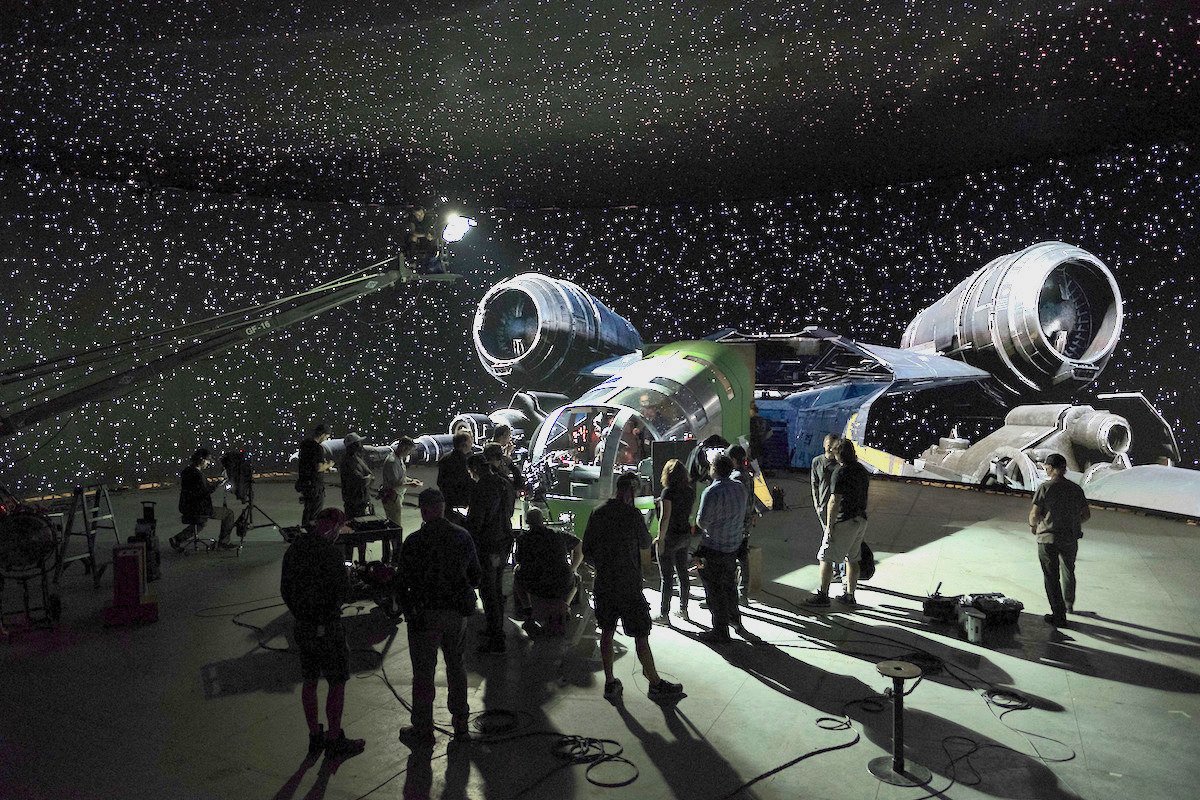
While StageCraft eliminates the need for many effects in post-production, additional elements can be added between the actors and the background. A small part of the LED screen can be switched to a green screen. CG elements can then be inserted in post-production and combined with the background, or you can replace the green screen with high-quality background than captured on set.
Solving the Moire Effect
The biggest issue with filming screens is the Moire Effect, which produces strange wavy patterns across the footage. ILM solved this problem with a combination of right LED screen size, adequate camera sensor and correct lenses.
The Mandalorian‘s DP, Greg Fraser, addressed this by experimenting with a prototype 35-foot-wide capture volume, covered with 2.8 millimeter LED panels, which improved on the nine millimeter pixel resolution Fraser used on Rogue One. This background was captured with an ARRI ALEXA LF; the camera’s Ultra Vista lenses had a fast fall-off which shot anamorphic and largely fixed the moire problem.
There is, however, a residual limitation that the moire solution creates. To reduce moire patterns, the background was often shot slightly soft — diffused to prevent the digital wall from showing through. But that defocus cannot be reversed: if the wall was too close and therefore out of focus, there is no way to make the imagery come back into focus. The only option is to replace the digital LED footage with sharp material in post-production.
As ILM’s Richard Bluff noted:
“There is no magic trick that helps that focus problem. It just came down to the choices that Greig Fraser and Barry Baz Idoine made with the lens packages.”
Creating and Manipulating Environments in Unreal Engine
While the LED screen is the canvas in which these changes can be made, Epic Games’ Unreal Engine, is the software that operated this miraculous virtual stage. ILM partnered with the game engine’s developer, Epic Games, to transform Unreal Engine from a game engine into a film production tool that used real-time display on LED screen walls.
Unreal Engine effectively replaces sets with photorealistic, virtual 3-D environments, and gives the crew unprecedented freedom through making quick changes during shooting. Changes can be made to lighting, background elements, color, and environment.
Using Unreal Engine, filmmakers can create a background that moves with the camera’s point of view — the footage moves with the camera in real time to simulate parallax effect, where the background shifts perspective as the camera moves or changes angle. This effect occurs naturally when filming on location in a real environment. This is the frustum in action.
The LED screens also provide lighting, and for the most part, no additional light sources are needed. The result is natural light and reflections of the environment. On The Mandalorian, the VFX crew only had to even out slight color differences between the real part of the set and LED screen footage when both appeared in the same shot.
From One Stage to a Global Network
The Mandalorian Season 1 was StageCraft’s proof of concept. The industry moved quickly. Within a year, productions outside Lucasfilm were already using the technology, and ILM was building stages on three continents.
The first non-Lucasfilm production was George Clooney’s The Midnight Sky for Netflix in 2020 — a pop-up Volume configured specifically for the film. It demonstrated that StageCraft was not a proprietary Star Wars tool but a hireable service. ILM formalised this with the announcement of three new permanent stages in September 2020: a second Volume at Manhattan Beach, a third at Pinewood Studios in London (operational February 2021), and a bespoke large-scale installation at Fox Studios Australia for Marvel’s Thor: Love and Thunder. A Vancouver stage followed in late 2021. ILM also confirmed it would continue building temporary pop-up volumes for individual productions anywhere in the world.
The Lucasfilm slate adopted the technology across its entire Disney+ output. The Book of Boba Fett (2021) used it extensively. Obi-Wan Kenobi (2022) leaned on the Pinewood stage for its shoot. Andor (2022) notably rejected it — a decision covered in the companion article. Ahsoka (2023) used it throughout Season 1. Star Wars: Skeleton Crew (2024) continued the pattern.
Beyond Star Wars, the technology spread in two directions simultaneously. Inside Disney and Marvel, directors who had learned the system directing episodes of The Mandalorian brought it to their own features: Taika Waititi to Thor: Love and Thunder, Peyton Reed to Ant-Man and the Wasp: Quantumania. Steven Spielberg used the Manhattan Beach stage for a tornado sequence in The Fabelmans (2022) — one of the more unexpected applications, used surgically for a single practical-effects sequence rather than as a primary production method.
Outside Disney entirely, Warner Bros. built its own equivalent — V Stage at Leavesden — which House of the Dragon used from 2022 onward for dragon-riding sequences and atmospheric scenes. DC’s Black Adam used ILM’s stage the same year. Outside superhero and fantasy properties, the technology found its way into network comedy: How I Met Your Father (2022) and the pirate comedy Our Flag Means Death (2022) both used Volumes for environments their budgets couldn’t otherwise produce. By 2023, Percy Jackson and the Olympians was using it for Disney+; by 2024 the BBC’s Doctor Who reboot and Netflix’s Avatar: The Last Airbender had both adopted it.
By Epic Games’ own count, the industry went from three LED stages worldwide in 2019 to roughly 300 by 2022. StageCraft did not create the virtual production industry, but The Mandalorian proved the concept at a scale and quality that made the industry move. The technology that Greig Fraser prototyped in an X-Wing cockpit in 2015 had become, within six years, the dominant production paradigm for prestige genre television.
The Industry Builds Its Own
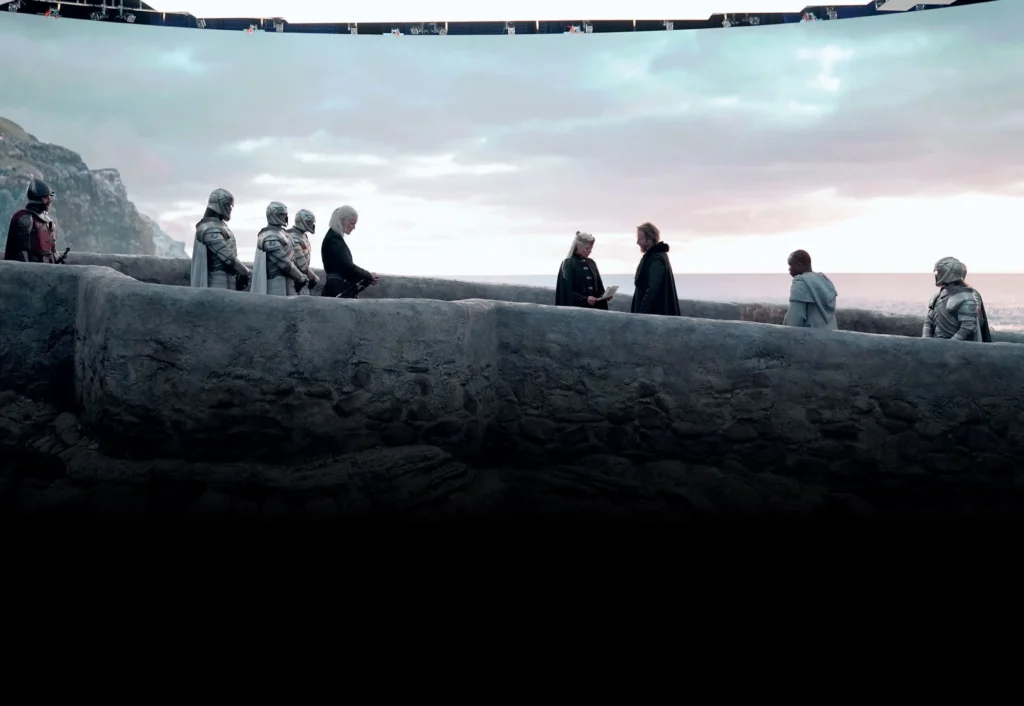
When The Mandalorian proved the concept, the studios didn’t wait for ILM to build stages for them. They built their own — under different names, with different partners, but running the same fundamental physics.
Warner Bros. was the first major studio to establish a permanent in-house equivalent. V Stage opened at Warner Bros. Studios Leavesden in the UK in June 2021, becoming one of the largest virtual production facilities in Europe at 24,000 square feet, with a 7,100-square-foot wraparound LED environment and a dynamic ceiling of independently tilting panels. House of the Dragon was its inaugural production. Warner Bros. had essentially made the same calculation ILM made in 2019: owning the infrastructure was more efficient than licensing it for every production. V Stage used the same underlying technology — Unreal Engine for real-time rendering, OptiTrack or equivalent for camera tracking, ROE Visual or similar LED panels — just without the ILM branding or the StageCraft pipeline.
Pixomondo, a VFX house with a long-running Star Trek relationship, took an analogous route in Toronto. The company built a 70-by-30-foot horseshoe-shaped volume at its Toronto facility, using ROE Visual Black Pearl 2.8mm LED panels and Brompton processing feeding Unreal Engine in real time. Star Trek: Discovery became the first Trek production to shoot on an LED volume from Season 4 onward, with Star Trek: Strange New Worlds designed entirely around the technology from its inception — the first major franchise series built ground-up for a non-ILM volume. Sony subsequently acquired Pixomondo in 2022, giving the studio ownership of three large-scale LED stages across Canada, including what was at the time the largest LED stage in Vancouver, used for Netflix’s Avatar: The Last Airbender.
NEP Virtual Studios entered the market through its Lux Machina arm — one of the original technology partners on The Mandalorian Season 1 — and through its Prysm Stages brand, opening a permanent facility at Trilith Studios in Atlanta with Francis Ford Coppola’s Megalopolis as its first production. NEP’s Lux Machina credits include Bullet Train and Shazam: Fury of the Gods, demonstrating the technology’s reach beyond prestige fantasy into mainstream action.
The pattern across all of these is consistent: a studio or VFX house with existing relationships to a major franchise or broadcaster recognised that owning permanent LED infrastructure was more cost-effective than repeated ILM hire, built their own volume, and brought in Unreal Engine plus a camera tracking solution to replicate the core StageCraft workflow. By 2022, Epic Games was tracking roughly 300 LED stages worldwide — up from three in 2019. ILM had not licensed or franchised StageCraft. The industry had simply reverse-engineered the concept from publicly available components, with the open availability of Unreal Engine as the enabling factor.
StageCraft remained the premium offering — ILM’s proprietary Helios rendering engine, developed specifically for the system from 2021 onward, gave it performance advantages over standard Unreal Engine deployments, and the accumulated production knowledge from The Mandalorian through Ahsoka represented institutional expertise no competitor could replicate quickly. But the technology itself had become a commodity. The question was no longer whether a production could access an LED volume. It was whether the people using it understood what it was for.
What the Volume Does Well — and Where It Stops
StageCraft excels in controlled interior environments, hard surfaces, and contained sets where the camera remains within the Volume’s geometry. It is particularly effective in scenes requiring extended soft-light conditions — dawn, dusk, overcast sky — where shooting on location would give a crew only minutes before the light changes. It eliminates spill, delivers interactive lighting directly onto performers and practical sets, and collapses the gap between pre-production, production, and post into a single continuous workflow.
Its limitations are equally specific. Bright outdoor sunlight cannot be convincingly simulated — the LED panels emit soft, even light, and the directionality of hard sun produces reflections on the walls themselves that break the illusion. Organic environments (trees, grass, water, earth) are substantially harder to render convincingly than the hard surfaces and metal that dominate the Star Wars vocabulary. Sequences requiring genuine geographic scope — the sense that a world extends beyond the camera’s eye-line in every direction — are beyond what any LED volume can currently provide.
The LED-as-light-source principle that is StageCraft’s greatest strength also produces a specific and unforeseen problem in bright-environment sequences. Because the wall is the primary light source, the colours of the virtual environment are cast directly onto the physical set in front of it. In early Mandalorian desert sequences, vivid-coloured props in the virtual background produced coloured light that fell onto the physical sand, requiring correction in post. Richard Bluff described it plainly: brightly coloured virtual props created “a red and yellow light source directly lighting up the sand in front of it.” The very thing that eliminates spill in most circumstances creates it in others.
Fast movement presents a structural problem that no amount of software iteration has fully solved. The frustum updates the virtual environment in response to camera movement in near-real-time — but near-real-time is not instantaneous. At normal filming speeds the latency is imperceptible. At the speeds required for a convincing vehicle chase, it becomes visible: the environment doesn’t update fast enough, and the background lags fractionally behind the camera. The practical consequence is that speeder bikes and high-speed vehicle sequences cannot be shot inside the Volume without the background betraying the illusion. Productions addressed this by reverting to conventional bluescreen for those sequences — and a Season 1 behind-the-scenes photograph, copyright Walt Disney Pictures, shows exactly how: the StageCraft LED panels at Manhattan Beach are covered entirely in draped blue chroma key fabric, with a sand practical set built in front of them and the virtual production crew and monitors visible in the foreground. The curved geometry of the backdrop — which would serve no purpose on a purpose-built flat bluescreen stage — confirms the LED wall is underneath. The Brain Bar crew are present because they remained the production unit for this stage regardless of what was on the walls, running real-time Unreal Engine previsualization that would inform the final composite even with the panels dark. StageCraft’s infrastructure was repurposed for conventional chroma key work when the technology’s own limits made that necessary.
These are not flaws waiting to be engineered away. They are the physics of the system. Understanding them is the difference between using StageCraft as the tool it is and using it as the default it was never designed to be. The productions that grasped that distinction early produced results that hold up. Those that didn’t are another story — and one worth telling separately.

- Why Robert Pattinson’s Batman Should Be DCU’s Caped Crusader - October 12, 2026
- California’s AG Loses to Paramount: Inside the Paramount / Warner Bros. Discovery Merger — And Why Ellison May Still Leave California - September 26, 2026
- Napoleon Solo Sold for £1: The Year Ian Fleming Stopped Owning Ian Fleming - July 25, 2026