Live and Let Die Bus Chase: A Bond Girl Turned Accidental Stuntwoman & How to Rig a Top Deck to Slide Off a Double-Decker Bus
Parked among Caribbean palms a few yards from the sea, a repainted double-decker London Transport bus — out of place on the tropical coastline of Jamaica — looked, as Roger Moore noted in his production diary, quite incongruous. It was RT246, a 1947 AEC Regent III, veteran of the no. 19 run through London, now sitting in the Jamaican heat waiting to be destroyed. It certainly isn’t the most glamorous transport James Bond had driven — but it is original. Over five shooting days, the double-decker would be put through some trial, performing stunts it wasn’t designed for — culminating in its top deck being sheared clean off — an ignoble beheading devised on the fly, while filming commenced. A real bus driving instructor, a pre-cut roof mounted on rollers, and a bridge the production built themselves — it was a stunt that lasts seconds on screen, but still lingers as a fun, iconic moment for Moore’s inaugural outing as 007.
In practice, this moment was a technically demanding scene — shot amongst a sequence that yielded close calls for stuntmen on pursuing motorbikes, and a leading lady who sat inside the bus during its most hair-raising stunts, not realising she didn’t even need to be there in the first place.
A London Bus Repainted In San Monique Colors
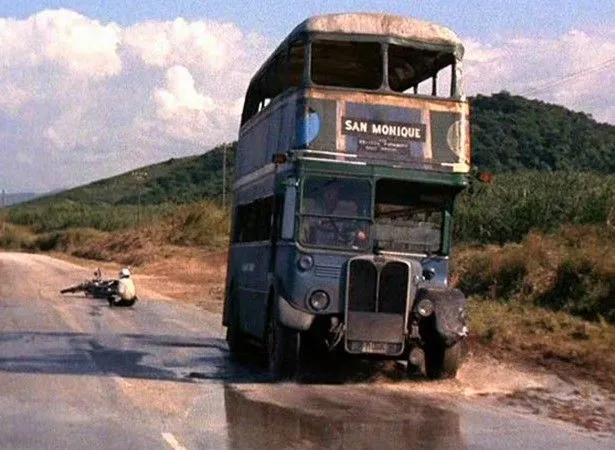
The vehicle is worth identifying correctly. Many sources, including the respected production history Some Kind of Hero, call it an AEC Routemaster, but Moore himself, writing in Bond on Bond, correctly names it an AEC Regent RT-type — the Routemaster’s older, more utilitarian predecessor, the workhorse of the postwar London fleet.
Bond and Solitaire, having discovered Dr Kananga’s illicit poppy fields, reach the village of Alligator Pond surrounded by police in cars and on motorbikes. As Moore described it in his diary: their only escape vehicle is the double-decker bus that Bond spies outside a café. The bus is an improvisation — an unlikely and often ungainly escape vehicle picked up on the fly — an idea which began with the moonbuggy sequence in Connery’s Diamonds Are Forever and which Moore would make his own throughout his run, from the yellow Citroën in For Your Eyes Only to the rickshaw in Octopussy to the fire engine in A View to a Kill.
On arrival, the art department resprayed it from London Transport red to a muddy grey-green — the colours decided upon for the fictitious San Monique transport authority. On screen, under Jamaican sunlight, it reads closer to blue. The repaint did more than establish a fictional bus company. It disguised the joke. Nothing about it announces that it is also a London double-decker until the shape of it, upright and unmistakeable in the Jamaican landscape, makes the incongruity land.
Maurice Patchett: From London Bus Instructor to London Bus Destroyer
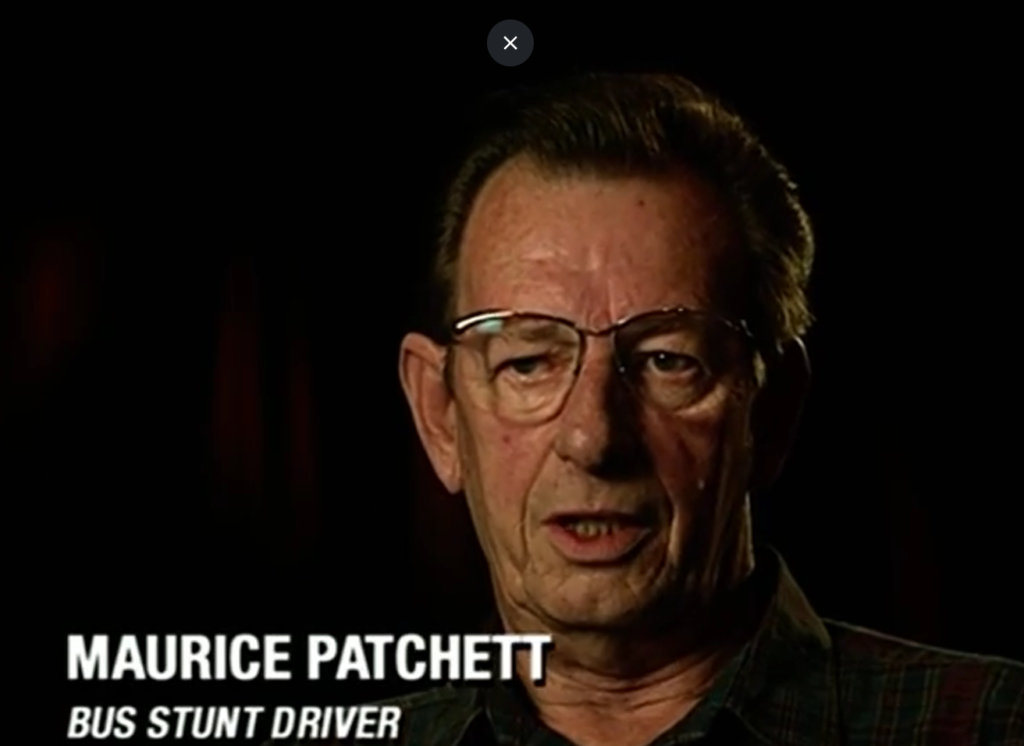
In charge of the vehicle was Maurice Patchett, a driving instructor from London Transport’s Chiswick depot, who spent three months preparing for the sequence. His role was twofold: train Moore to handle it convincingly on camera, then step in as Bond’s double for every shot that carried real risk — the 180-degree skid, and ultimately the bridge. Moore, in his diary, noted the irony of a London bus instructor hired to smash it — “one of the oddest jobs any driving instructor has been paid to do.”
Qualifying as a London bus driver takes ten days’ instruction. Patchett had rather less time than that to get Moore up to speed — a crash course, in every sense — walking him through the cab’s unfamiliar apparatus: a hook above the left ear that served as the starter, gear buttons in place of a conventional shift. Most critically, a small red emergency flag. When it drops, Patchett warned, put your foot on the brake and don’t lift it off, because you don’t get a second chance — it means your brakes have gone. Patchett was equally direct about what the stunt work itself would involve: “What we actually want you to do is skid a bus around on a 30-foot road.” Moore noted that the first time you do it, you feel certain it’s going to tip over. It doesn’t — but it feels like it will.
On Moore’s first real driving day (Day Forty), he was sent off at speed towards a mark where an electrician stood with sun reflector boards to get the proper lighting effect. He did it four times, each take a little faster. On the last, the flag dropped. Moore kept his foot hard down and hauled on the handbrake. If Maurice hadn’t told him about it, he wrote, “there would have been one electrician as flat as his reflector board under a fifty-five-ton London bus.”
Filming Starts, The Chase Begins
Shooting of the bus sequence began on 30 November 1972 and would stretch across five shooting days, with Hamilton taking over second unit directing duties. He preferred to shoot the action himself. The chase was filmed on the working road between Montego Bay and Lucca, with production assistants holding back real traffic between takes. One gentleman in a smart Mercedes-Benz, stopped and told he could not drive through, delivered the crushing response that it was his land they were standing on — and he could drive through whenever he pleased.
The road itself had been strewn with boulders and thick branches by the Property Department for a better bumpy effect. Patchett, taking the vehicle on a trial run the previous day, jolted over a bad bump and had the wheel whip around, injuring his wrist. Moore, not permitted a seatbelt as it just wasn’t very masculine in those days for a hero to wear one, hit his head on the cab roof repeatedly and held on like grim death when the wheel spun. Above his head, a walkie-talkie connected him to first assistant director Derek Cracknell and the posse of police motorcycles; the radio reception was terrible, and instructions arrived in fragments.
Skids and 180-Degree Turns
The 180-degree turn — shot on a water-drenched stretch at the bottom of a curving hill through sugar cane fields, with a pump spewing water across a six-hundred-foot square of road — required three stunt drivers on Harley Davidsons and two police Chevrolets. At the bottom, the double-decker braked and slewed in a tight wet arc: one car careered down a bank, the other scythed two hundred yards through eight-foot sugar cane. The motorcyclists, unable to stop, were dispatched in three directions — one sixty feet over the sea wall onto a coral reef.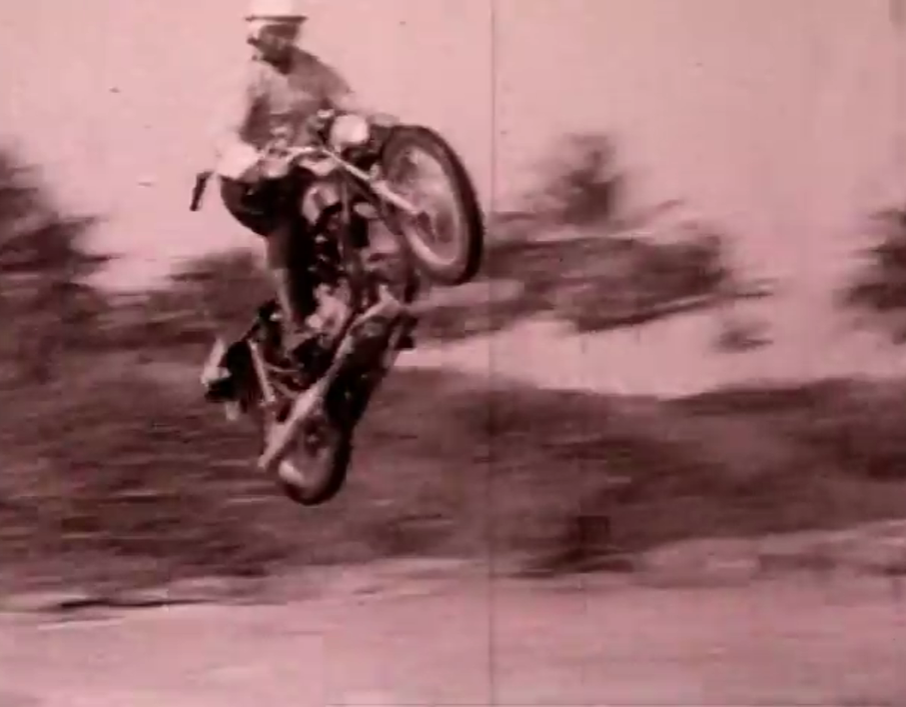
That last outcome had not gone quite according to plan. Co-art director Peter Lamont recalled in the documentary that the ramp on the parapet had gone slightly astray, and the stuntman landed on coral that hadn’t been cleared. He wasn’t badly hurt. They only did it the once. Sixty seconds of screen time. Three days to shoot.
Jane Seymour, as Solitaire, was bouncing around in the back throughout. Moore, with characteristic warmth, threatened to get her a clippie’s uniform and ticket punch — the clippie being the conductor who stood on the platform at the back of London’s double-deckers, collecting fares and clipping tickets.
“I was in that bus when it spun around,” she recalled, “and you know it could have been anyone.”
Elsewhere in the film, stuntmen had worn wigs to double as actors during the boat chase — but nobody appears to have told Seymour she didn’t need to be on the vehicle. She was there for the more dangerous stunts, including the moment the top deck was sheared off — a stunt that nobody knew would even work.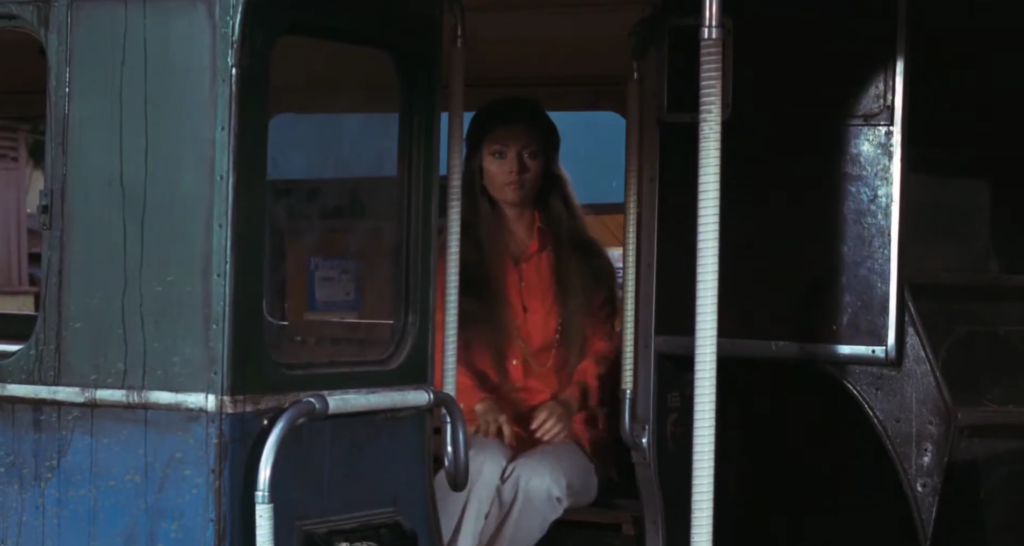
Knocking the Top Deck Off
Hamilton, watching the footage accumulate, arrived at the solution by looking at what he had and asking what else it could do. As he recalled in Inside Live and Let Die:
“What can we do with that? I know, knock the top off — it’s a low bridge.”
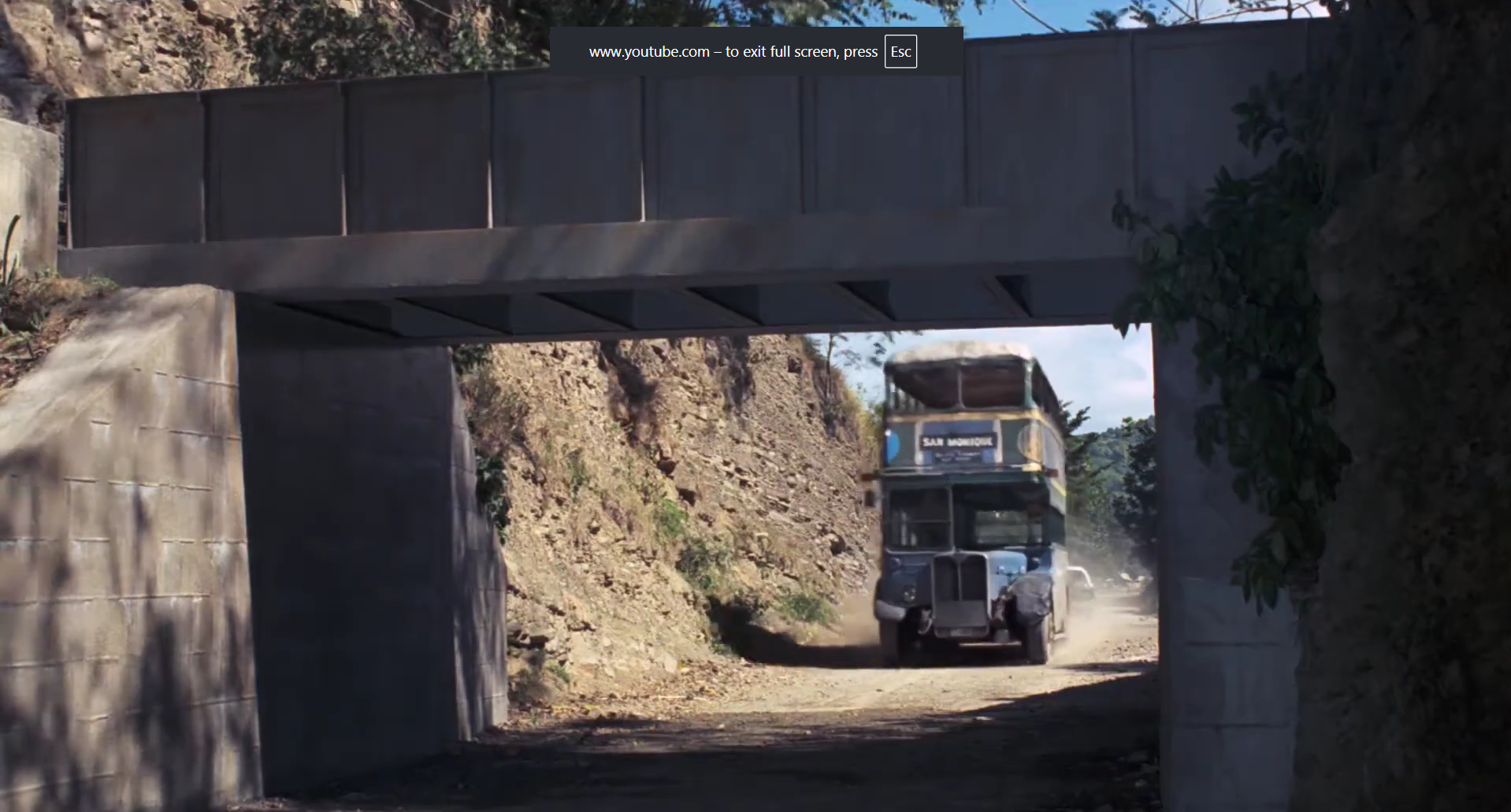
But the bridge didn’t exist. So the crew built it at the end of a palm-lined avenue on the main street of Lucca.
A crowd of around four hundred spectators proved nearly impossible to clear: just as the cameras began to turn, a face would appear from the palms and the first assistant would call “Cut”, and they would start again. Moore, who had encountered similar problems on episodes of The Saint, noted that crowd control in a working village on a public road was a task approaching the impossible. They got the road clear eventually and spent the morning covering all angles of the vehicle running to the bridge before moving to the shot itself.
Nobody was certain what would happen. Patchett, who took over the driving for the bridge shot itself, was openly sceptical:
“I’ve never actually seen a bus go under a bridge and take the roof completely off. It generally stops half way.”
But the special effects crew had pre-cut the upper deck and placed it on rollers, bolted temporarily to the lower deck for the chase sequences, designed to shoot spectacularly backwards on impact. The speed was a matter of some imprecision — Patchett recalled being told around 40 mph; Moore, in Bond on Bond, remembered 30. In the moments before the run, Seymour asked whether they had done this before. They said no. She asked if it was going to work.
“We don’t,” they told her.
The run-up was 300 to 400 yards. Three camera angles. Derek Cracknell called “Roll ’em”; Hamilton called “Action”; and the double-decker began its boulder-strewn run for the bridge. It hit spot on the front destination sign and the top crunched backwards, Moore wrote, as if sliced like some giant egg. The bottom half, carrying Seymour, belted underneath, barely an inch to spare.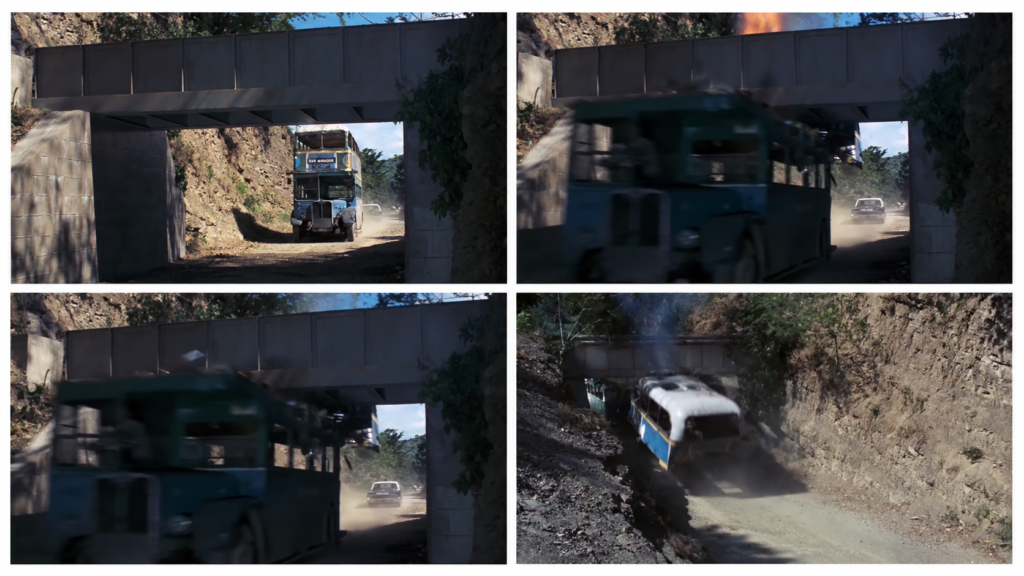 The ejected top deck landed in the road behind, and the pursuing police car crashed straight into it. There were seconds of silence — the sound recorders were still running — before everyone burst into a cheer. Moore suspected her eyes were tight shut. Her heart, she said, had been pumping. “And then of course,” she added, “I felt very proud to have been in that bus.”
Hamilton had bought the bus very very cheap. What the production spent instead was time and nerve: five shooting days, a wrist injury, a near-miss with a fifty-five-ton vehicle, a stuntman down on uncleared coral, a star driving without a seatbelt, an actress told “we don’t know” when she asked how the most dangerous shot of her career would work. And then, once, the double-decker hit the bridge at the right speed and the right angle, and the top came off cleanly, and everyone cheered.
Losing the top deck is a fun joke — and as Maurice Patchett said, a welcome reprieve from driving a bus through the streets of London.

- Why Robert Pattinson’s Batman Should Be DCU’s Caped Crusader - October 12, 2026
- California’s AG Loses to Paramount: Inside the Paramount / Warner Bros. Discovery Merger — And Why Ellison May Still Leave California - September 26, 2026
- Napoleon Solo Sold for £1: The Year Ian Fleming Stopped Owning Ian Fleming - July 25, 2026