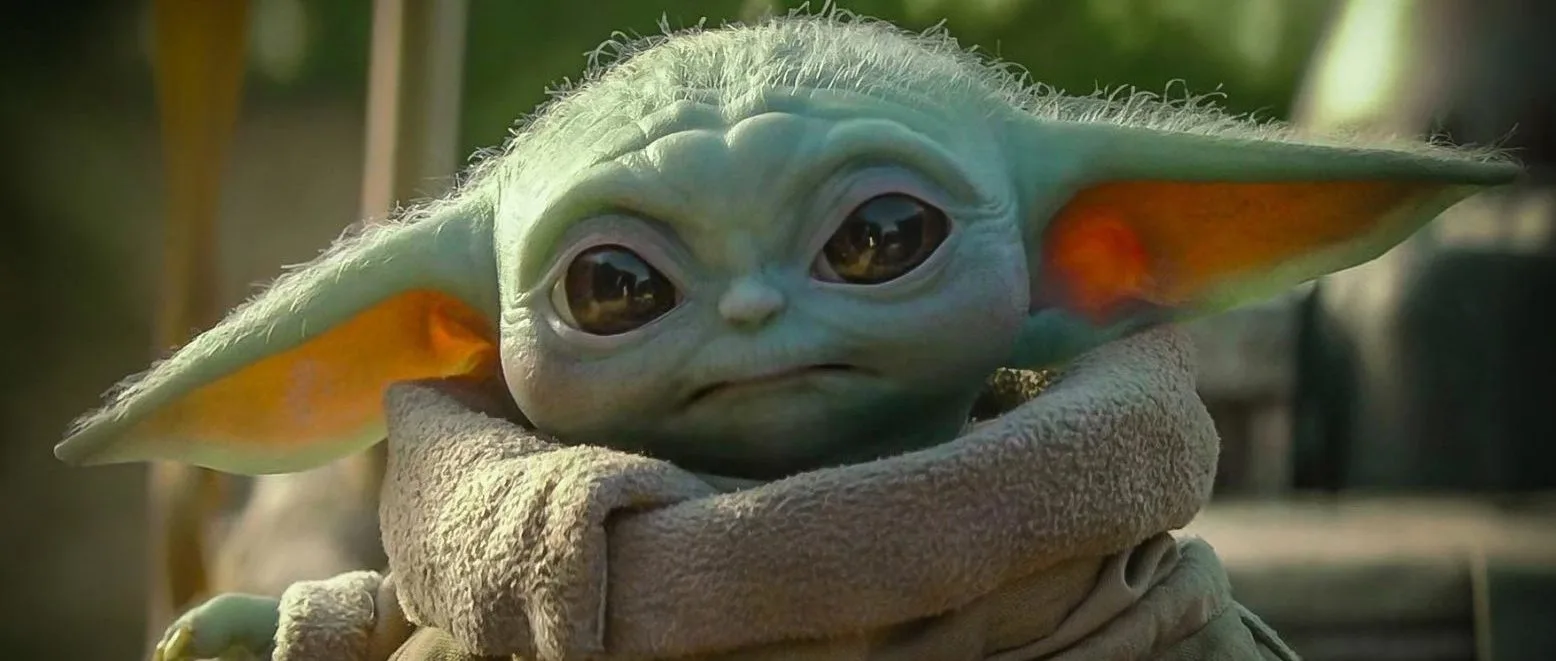
Creating “Baby Yoda”: As the Opposite of Yoda, Grogu Shouldn’t Work. Instead He’s the Face of The Mandalorian — In More Ways Than One
An Impossible Brief
Normally a screen performance runs on face and voice together. Here, each lead had only one of them. Din Djarin keeps his voice but loses his face to the helmet; Grogu keeps a face but has no voice, because the character cannot speak. Neither half is whole on its own. The relationship works only when Pascal’s voice responds to Grogu’s actions and expressions and vice versa. And because Pascal can’t reach for a raised eyebrow or a softening around the eyes, the expressive burden tilts hard onto Grogu.
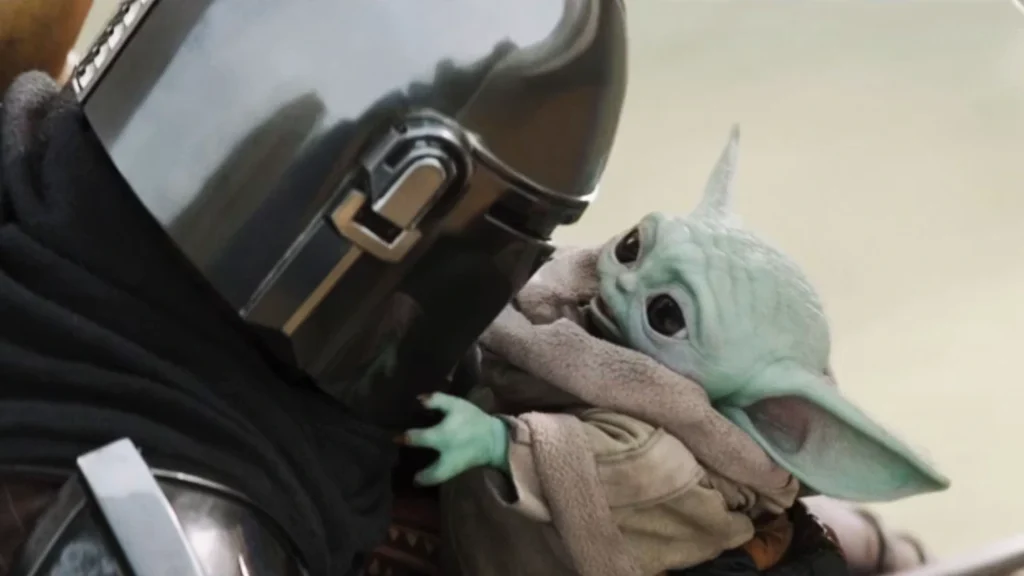
When the audience feels the bond between these two, they are largely feeling it through the puppet.
That is a heavy load for a creature effect, and cuteness alone doesn’t carry it.
To work as a co-lead rather than a background gag, Grogu had to convey curiosity, fear, mischief, hunger, and affection — through body language, the tilt of his head, the twitch and raising of an ear, the blink of an eye, and with its only vocabulary — a series of infant noises. That meant building something with enough range to genuinely act.
Youthening a Legend
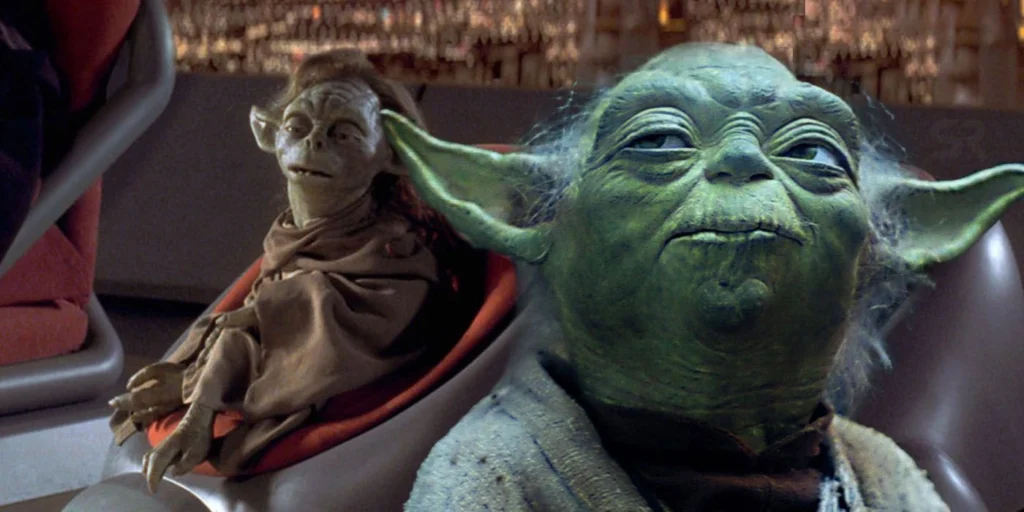
There was a second, sneakier challenge baked into the design, and it goes to the heart of why Grogu landed at all — Grogu’s comparison and contrast to Yoda.
Yoda is Star Wars’s wizard. He is the franchise’s Merlin: ancient, gnomic, the wise old teacher the hero seeks out for training and a little magic. For more than forty years, his species existed on screen only as that — an old mentor. Yoda’s role expanded in the Prequel era — sitting on the Prequel-era Jedi Council, and even delighting audiences with his prowess with a lightsaber. The series had built up to this moment, and even expanded the species to two — introducing us to the female member of the species, Yaddle, who had a voiceless background role on the Jedi Council. But both were still elderly sages. Grogu, by contrast and natural progression, is the first child of the species we have ever seen.
So the design team faced a problem no one in Star Wars had solved before: they had to youthen an icon. They needed a face instantly recognizable as Yoda’s kind — because that flash of recognition is the entire hook — while inverting everything that made the original memorable. Yoda is characterized by his wizened look, his command of the Force, and the back-to-front wisdom he dispenses. The Child is his opposite: a toddler, vulnerable, silent, never uttering any words of wisdom, and so drained by using the Force that it knocks him out. Same species, separated by centuries–but at opposite poles.
That contrast is a design brief here. What it means — that the vessel of Star Wars’s definitive mentor has been recast as a helpless hero at the very start of his own journey — his own Hero’s Journey — is a story for another piece. The point for the artists was narrower and harder: build a baby Merlin, and make audiences fall for him on sight.
Concept and Design
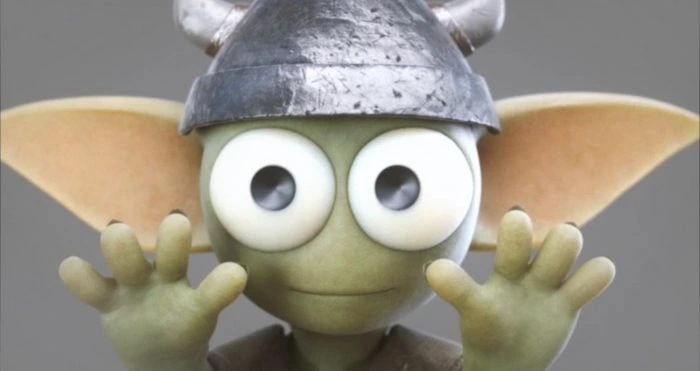
Curiously, basing him on Yoda wasn’t the first instinct. Showrunner Jon Favreau came in with his own ideas, drawn partly from creatures he’d developed for Gnomes & Goblins, a VR project he’d been working on. The character’s true starting point is a single line at the end of the pilot screenplay:
“It’s a baby. The same race as Yoda. And it’s smiling up at them.”
That line was enough for co-creator Dave Filoni, who sketched the scene — infant and hovering cradle — on a flight home.
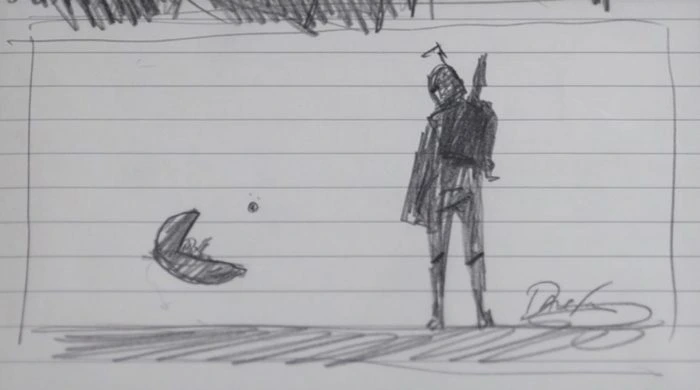
His drawing became the closing shot of the premiere. Filoni handed the sketch to veteran Star Wars artist Doug Chiang, who’d been imagining this universe since The Phantom Menace, and Chiang produced the first detailed art of the character and his floating cradle. From there Grogu passed through many hands and many variations.
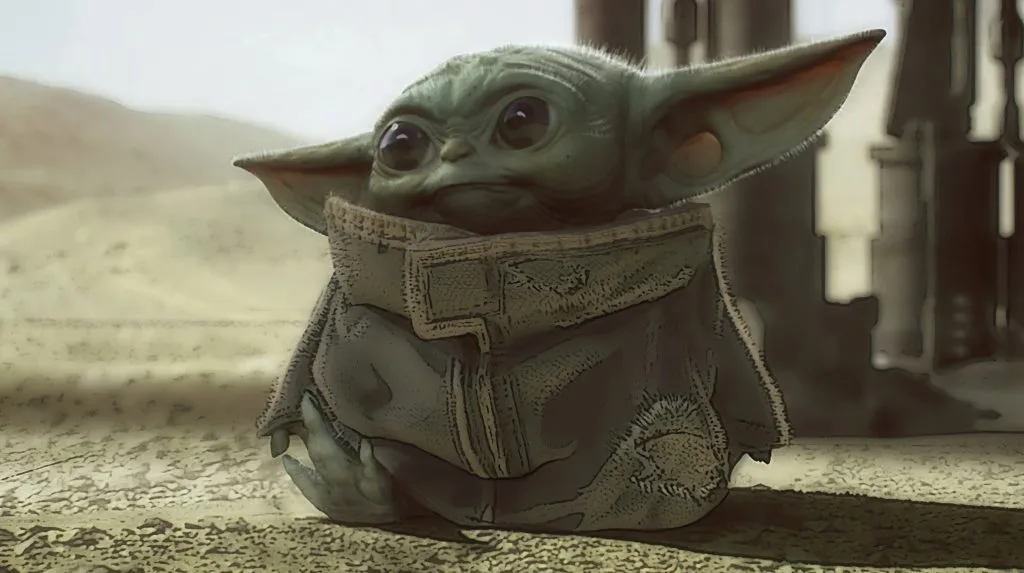
One instinct held across all of them: every designer pushed expression into the ears and eyes, far more than the rest of the head. In the documentary series Disney Gallery: The Mandalorian, Favreau described rejecting design after design for being too ugly, wrongly proportioned — or even too cute. It took roughly three months before he settled on a version by concept artist Christian Alzmann.
Puppet or Pixels?
With the look locked, the team had to decide how to physically build him — and at first, they bet on pixels.
The original plan leaned on CG. ILM would handle a digital Grogu for most shots, with a puppet from Legacy Effects used mainly in the background or as an on-set reference to be painted out and replaced in post. Two versions were developed in parallel, which is why the early puppet and the early CG model looked slightly different from each other. Favreau even floated capturing the character through performance capture so he could manipulate the baby in the edit and see how its reactions played against the actors, then pass that intent to the VFX houses. As ILM’s Richard Bluff recounted at Star Wars Celebration 2022, that proxy approach turned out to be unnecessary — Legacy’s practical work was simply too good.
The lineage helped. Master Yoda, performed by Frank Oz, had paved this road decades earlier, proving a puppet could share a frame with human actors without looking out of place. For the Prequels, Lucasfilm and ILM built a CG Yoda that pushed digital creature work forward; praised at the time, it now reads, in hindsight against more lifelike modern effects, as visibly animated. Grogu’s makers had all of that to stand on.
The turning point came early in season one. The puppet proved so lifelike and so charming on set that the production flipped its priorities and decided to lead with it. The catalyst was actor-director Werner Herzog, who played The Client — he found the puppet so convincing that he pushed the crew to ditch the CG version and commit to the practical one. That suited Favreau fine; he loves the in-camera puppetry of the original trilogy and prefers practical effects wherever they’ll hold.
Building the Baby
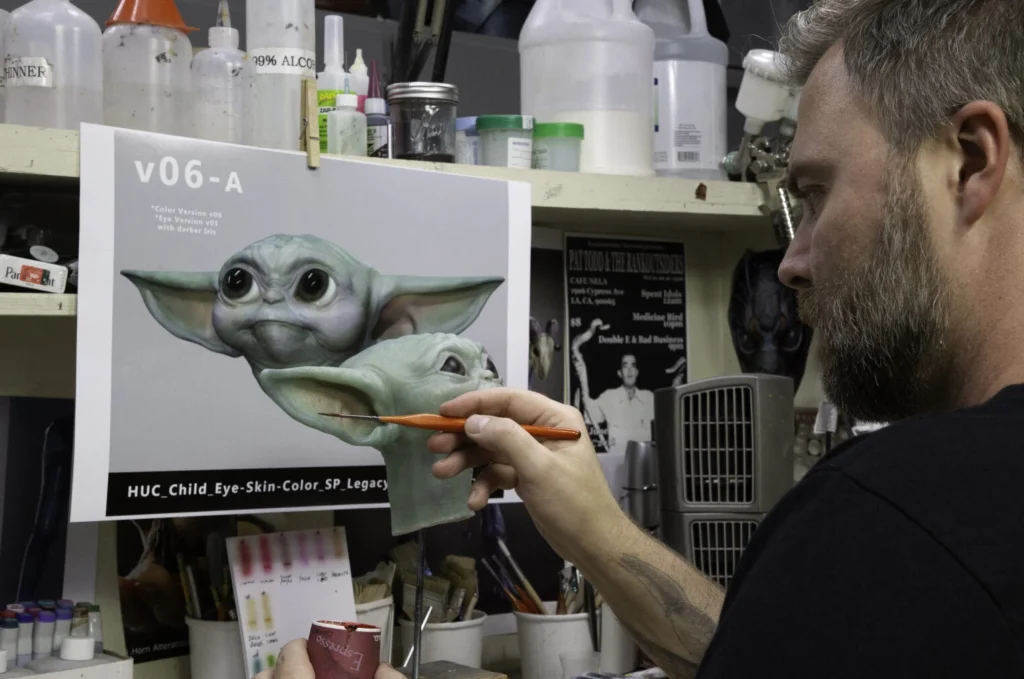
The craftsmanship that won Herzog over was substantial, and it began with a decision Legacy Effects had to make before a single shot was filmed: how many puppets to build. The answer was five, each for a different demand. Two hero puppets handled close-up expressive work; a stunt version took the physical punishment; a fully waterproof model covered water sequences; and a self-contained build gave the operators flexibility when they needed to stay further back. The internal mechanics powering all of them — incorporating brass, aluminum, steel, and 3D-printed nylon — have been kept a closely guarded secret since production began.
What was never secret was the skin. The puppet was built around a custom silicone blend engineered for exactly the right give and translucency, so it moved like flesh and could be lit from behind to make the ears glow.
“It’s very fleshy in how it feels,” John Rosengrant of Legacy Effects told the Celebration audience, and cast and crew agreed it looked and felt like real skin.
The eyes were hand-painted, set with silicone lids that blink on command, and surrounding sections of the face — read them as muscles — move in concert with the lids to sell a natural expression. It is a world beyond the original Yoda hand-puppet Frank Oz operated on The Empire Strikes Back and Return of the Jedi, whose eyes, if you watch closely, never blinked at all.
But it is the ears that are Grogu’s primary expressive instrument — the detail every designer from the earliest concept iterations prioritized above all else. They function the way eyebrows do on a human face: a tilt broadcasts curiosity, a flattening signals alarm, a slow pivot tracks a sound with a toddler’s particular concentration. That is not an accident of design. It is the whole architecture of how the puppet communicates mood without speech, and why every concept pushed expression into the ears and eyes far more than anywhere else on the head.
Running all of this required five Legacy Effects puppeteers working in precise coordination on every setup. Jason Matthews operated the eyes; Hiroshi “Kan” Ikeuchi controlled the ears and mouth — both via joystick, allowing the fine-grained, responsive micro-expression that carries the character’s emotional life. Trevor Hensley handled head movement and the central body; Mike Manzel worked the rods controlling the arms and broader body motion, with a separate set of leg controls beside him. Favreau directed the puppet on set like any other performer — name an emotion and five specialists coordinate their performance into one.
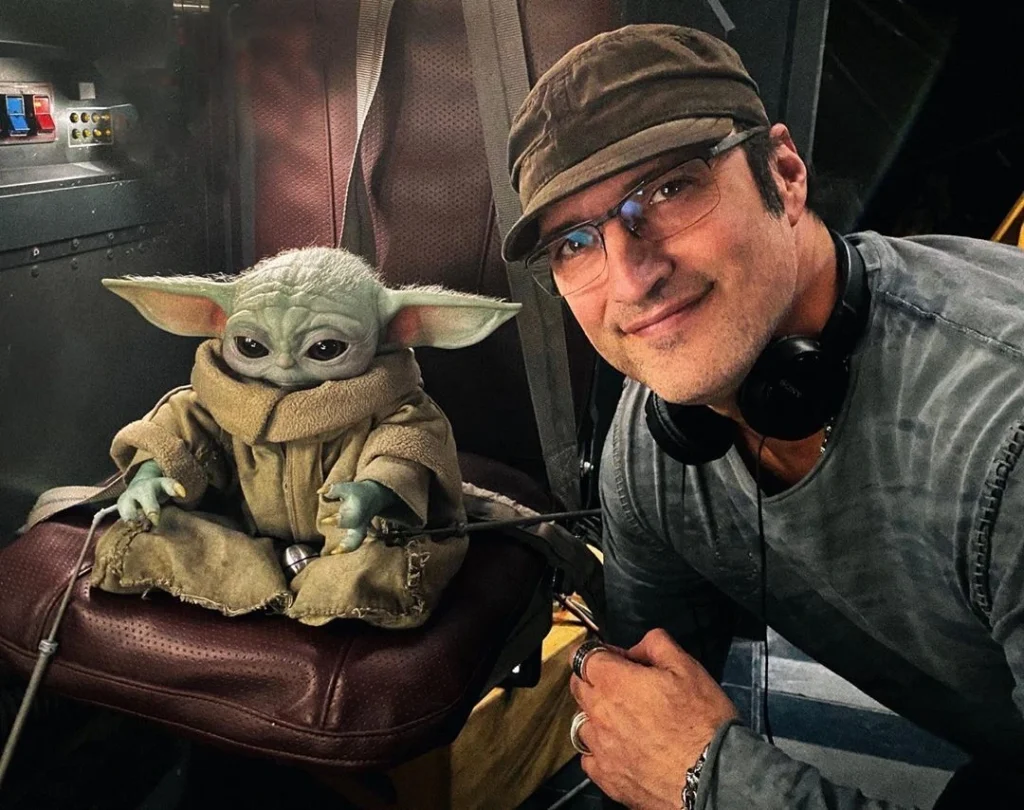
As Legacy Effects co-founder Alan Scott described it, the puppet is an instrument that had to be learned:
“It’s not one person because there’s so many different functionalities; ultimately four or five or sometimes more people are using their performance to create one singular performance. And the more that you work together, the more that you learn what the puppet is capable of, the more intuitive and natural those become.”
With each production the build was refined. By the time of the feature film the hero puppet had gained articulated fingers and more realistic blinking — a pattern VFX supervisor John Knoll summarized by noting Legacy “take some pride in over-delivering,” producing something with “a lot more ability to act and perform than I think what the original brief was.” Seven years in, the puppet keeps getting better.
Where the Puppet Stopped and CG Began
For all its range, the puppet had limits, and understanding exactly where CG entered reveals the precise geography of what silicone and joysticks can and cannot do.
The most significant Force moment in the first season — Grogu lifting the mudhorn to save Din in episode two, the scene that hooked the audience and confirmed the character’s potential — was CG. The shot demanded a face so concentrated, so intensely strained with effort, that the puppet couldn’t sustain it.
As Hickel explained:
“That particular shot was the hardest CG challenge of the season, because it was such a big performance moment, the face so focused, and the team was constantly trying to ensure they didn’t exceed what the puppet could do or break what was charming and perfect about it.”
The standing rule was consistent throughout: CG entered when the emotional intensity exceeded what the five-person team and a silicone face could deliver in camera.
Eating scenes presented different problems. The sequence of Grogu slurping down live frogs became one of the show’s most-shared images, but the mechanics of it — complex tongue movement, physics of swallowing, prey continuing to move — required digital work throughout. And when the show called for Grogu to at first swallow and then spit a frog back out, the solution was entirely CG: the puppet wasn’t going anywhere near that much slime. Protecting the hero puppet from damage was a routine production consideration; some of the most physical or fluid-heavy gags simply weren’t worth the risk to the build.
What surprised the production was how much the puppet could do that would seem to demand CG. The scene of Grogu perched on Din’s shoulder frantically tapping at his helmet was done entirely practically: two puppeteers stood just behind the pair, lifting the puppet into position and operating the arm that knocked against the beskar via rod. On the Razor Crest, animated sequences depicted Grogu crawling freely around the ship — something the puppet’s slow, rod-controlled gait never could — so CG took over there. But the instruction never changed.
“Anytime it couldn’t be a puppet,” ILM animation supervisor Hal Hickel told IndieWire, “the goal was that audiences still thought it was.”
Digital Grogu was deliberately held to the practical puppet’s vocabulary: he doesn’t suddenly scramble or dart, even when the software would allow it. The CG exists to extend the puppet, not to replace it.
Finding Grogu’s Voice
A speechless baby still has to be heard. Grogu can’t talk, so he has no Yoda-style aphorisms to fall back on — and building a believable infant vocabulary for a species we’ve only ever heard sound a bit like Kermit the Frog was its own puzzle. Skywalker Sound’s David Acord didn’t try to invent it from scratch. Instead, Grogu’s coos, squawks, and grumbles are a blend of human-infant recordings layered with two real animals: the bat-eared fox and the kinkajou, a tree-dwelling cousin of the raccoon. The mix turned out to be every bit as winning as the puppet looks.
Getting the emotional register right took deliberate calibration. Supervising sound editor Matthew Wood has explained that the team settled Grogu’s sonic “palette” early so it could live in the edit and start to feel native to the show, then kept refining it as his personality emerged — aiming for a voice that read neither too young nor fully grown, but always full of feeling. By season three, the brief got even harder: footage teased Grogu finally uttering his first words.
Acting Opposite a Puppet
The achievement is easier to appreciate when you understand how fragmented the central relationship actually was in production. On one side of every scene: five puppeteers coordinating via joysticks and rods to build one performance from five pairs of hands. On the other: an armored figure whose performance was itself split across three people.
Pedro Pascal provides Din Djarin’s voice — but it is often a voice on record, pre-recorded separately and dubbed over physical performance Pascal was not present for. The suit, 62 pounds of beskar armor, was worn across the seasons by Pascal and his two stunt doubles: Brendan Wayne, the grandson of John Wayne, and Lateef Crowder dos Santos.
Wayne logged thirteen-hour days in the full costume during seasons one and two, unable to take it off between setups; undressing took seven minutes, and an additional ten if the Grogu puppet was mounted on his shoulder. By season three, with the character never unmasked, Pascal provided only voiceover — none of the physical performance on set was him. He has described the earlier seasons honestly: the suit was physically punishing, his body not always up to four months of it, and once the production found a system that worked without requiring his presence, it gave him the freedom to go and do something else. Stunt doubles Brendan Wayne and Lateef Crowder were not officially credited for their contributions until season three.
So when Grogu gazes up at Din in one of those quiet two-shot moments and the audience feels the bond between them, what they are actually watching is a puppet operated by five people locking eyes with a costume worn by someone who may not be Pedro Pascal, in a scene the actual Pedro Pascal may not have been on set for at all. And it still works — which tells you how much weight is being carried by the puppet.
That capacity was the design brief from the beginning. As Rosengrant put it during development, the whole question was: if they could have the child be there and be real, with actors genuinely looking at it, just maybe they could make this thing work. It did. George Lucas visited the set during season one and instinctively cradled and bounced the puppet like a real infant before catching himself. If the architect of the galaxy can’t resist, the rest of us never stood a chance.
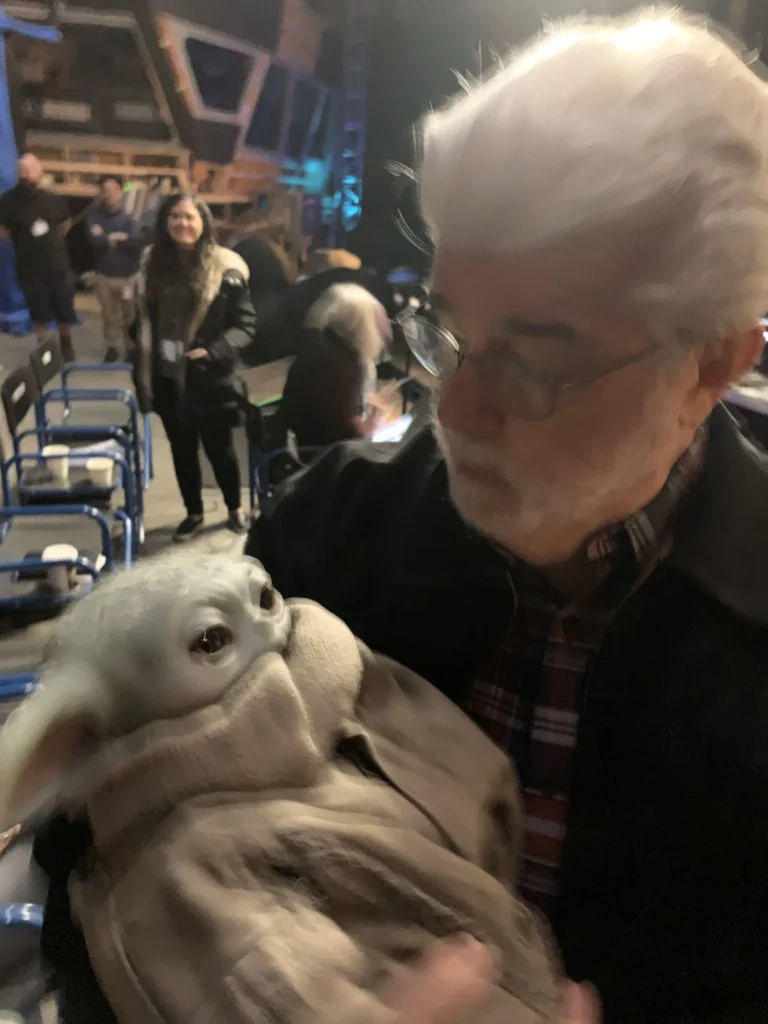
Favreau has called Grogu the conscience of the audience — the character the camera returns to whenever it needs to tell us how a scene feels. That is an enormous responsibility to place on silicone and joysticks and five people working in sync. Which is perhaps the most precise way to say what Legacy Effects and ILM actually built: not a puppet, but a performer. One that had to be, because–at times–there is no one else in the room with a face.
Which leaves the more interesting question, the one the design only set up: having built a baby version of Star Wars’s wisest mentor, what does the show do with him? That’s where Grogu stops being a marvel of engineering and becomes a hero — and that’s a story for another piece.

- Why Robert Pattinson’s Batman Should Be DCU’s Caped Crusader - October 12, 2026
- California’s AG Loses to Paramount: Inside the Paramount / Warner Bros. Discovery Merger — And Why Ellison May Still Leave California - September 26, 2026
- Napoleon Solo Sold for £1: The Year Ian Fleming Stopped Owning Ian Fleming - July 25, 2026