


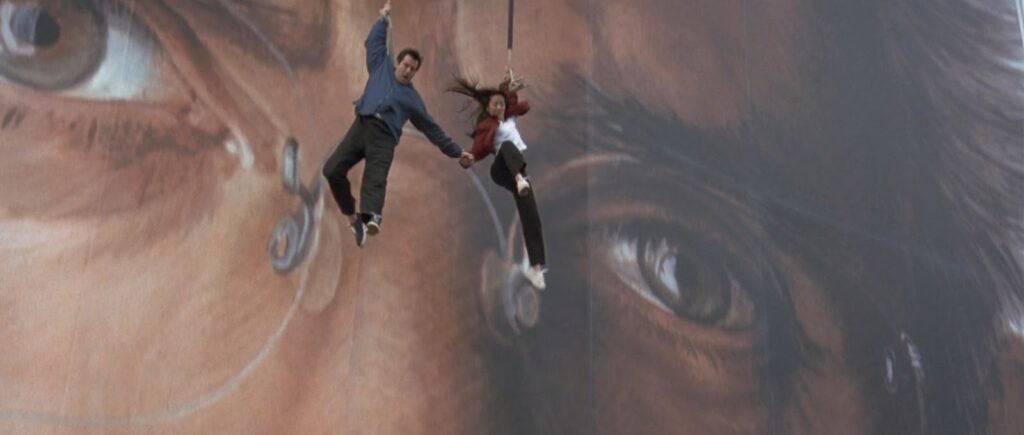
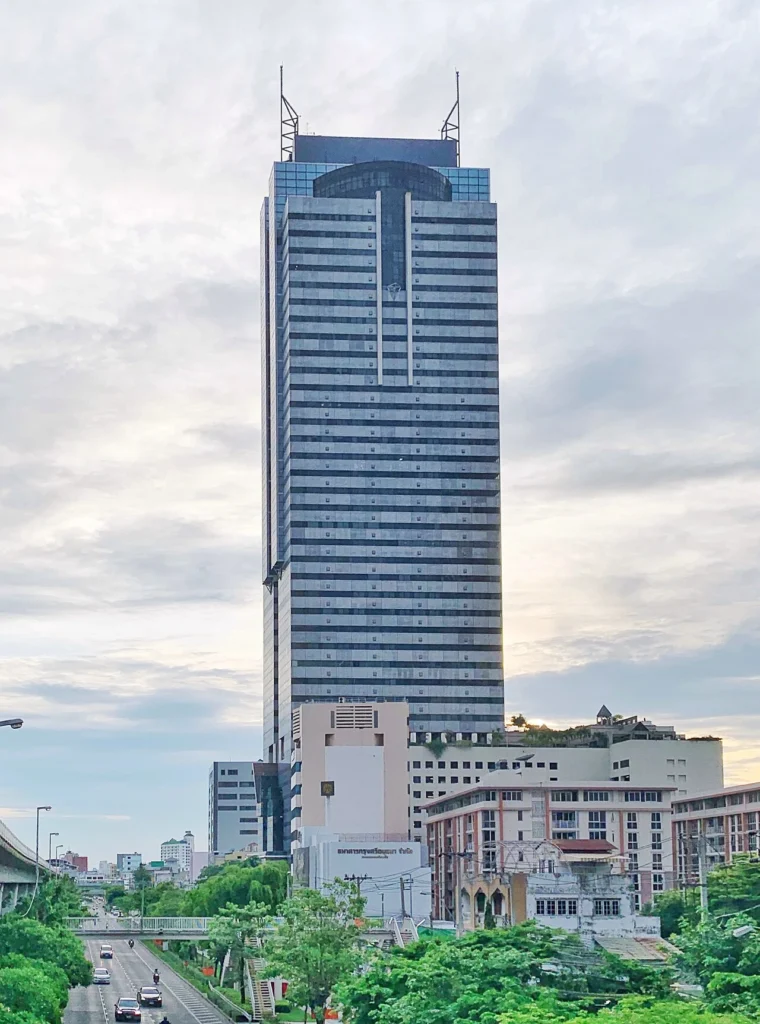
In Bangkok, on the morning of May 21, 1997, the temperature is already climbing toward 110 degrees Fahrenheit. Mark Southwell and Wendy Leech are about to step off the edge of the 44-storey Sinn Sathorn Tower and abseil down the side of a giant banner bearing the face of fictional media mogul Elliot Carver. The Thai rainy season is imminent. A sudden gust of wind, Southwell will later note, could have slammed them both into the side of the building.
Nobody said it was going to be easy.
The Idea
The banner sequence in Tomorrow Never Dies exists because of a flight from Kuala Lumpur to Hong Kong. Vic Armstrong, the film’s second unit director, had arrived in Malaysia planning to use the Petronas Towers — then the tallest buildings in the world — as the headquarters of villain Elliot Carver. When the Petronas company refused to allow their building to be portrayed as a villain’s HQ, the permits were denied and the production relocated to Bangkok. Armstrong flew on to Hong Kong.
Driving from the airport, he noticed something: the buildings under construction across the city were covered in scaffolding, and draped across the netting were enormous advertising banners. The image triggered a memory — a scene from Michael Curtiz’s 1935 swashbuckler Captain Blood, in which Errol Flynn drives a knife into a ship’s sail and rides it down to the deck below.
The banner would be the sail. The rope would be the knife.
Production designer Allan Cameron identified the Sinn Sathorn Tower in Bangkok’s Thonburi district as the ideal real-world stand-in for Carver’s Ho Chi Minh City headquarters. The tower’s facade was slightly modified with CGI for the finished film. Visual effects supervisor Mara Bryan, who worked on the film’s digital elements, confirmed her team’s involvement extended to the sequence itself:
“We worked on Bond and Wai Lin abseiling down the front of the building and ripping the banner.”
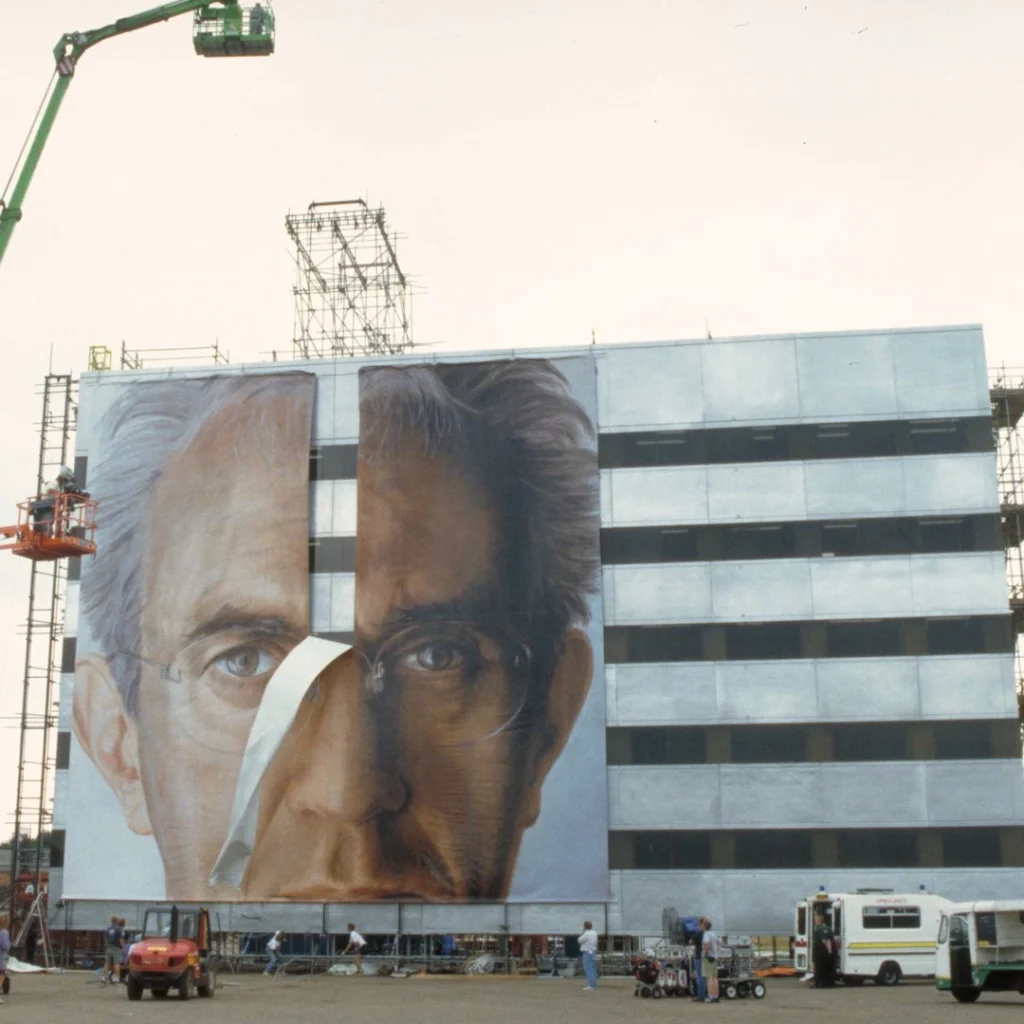
The CGI work sat on top of the practical stunt — augmenting it rather than replacing it. A giant banner of Carver’s face — 16 feet long and 70 feet wide — was constructed to hang from it. Armstrong devised the sequence, then asked Spanish stuntman Jordi Casares to supervise it on the day.
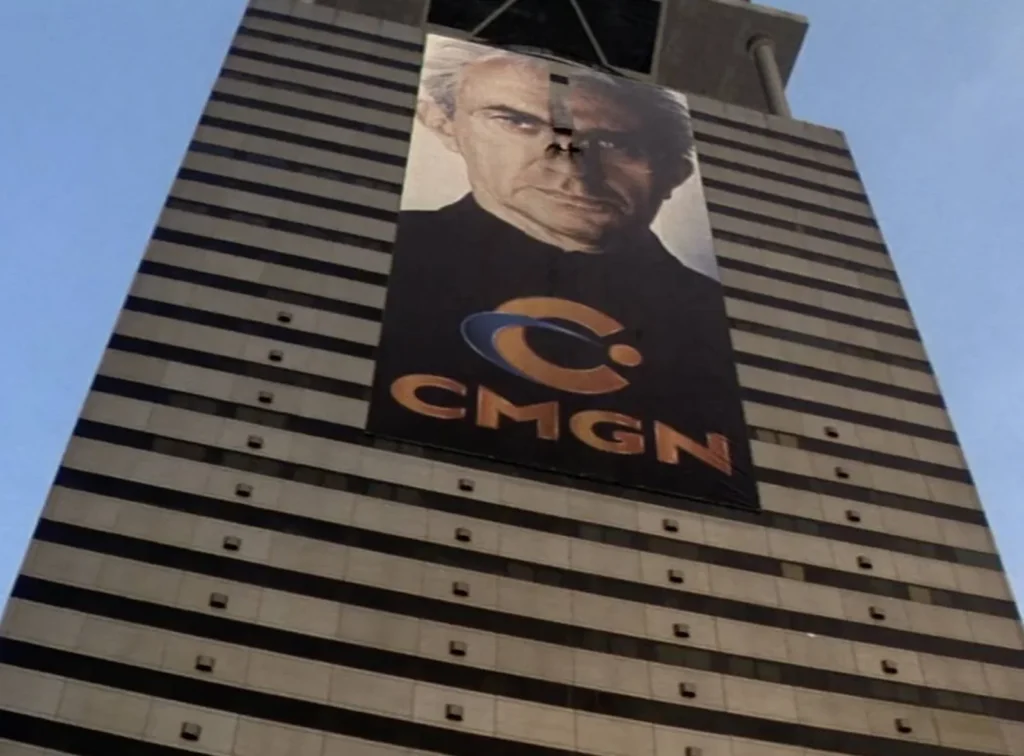

The Location
The scene as written has Bond and Wai Lin captured and brought to Carver’s high-rise headquarters. After Carver lays out his plan for engineering a global conflict, Bond and Wai Lin overpower their guards, jump from a balcony, and use ropes to tear their way down the full length of the banner — from Carver’s eyebrows, past his chin, to his chest — before reaching the street below.
Shooting on the real building happened on May 21, 1997. It was Southwell and Leech on those ropes, not Pierce Brosnan and Michelle Yeoh. They began their descent from the 43rd floor, falling the length of the banner before the stunt concluded between the 19th and 12th floors. In temperatures approaching 110 degrees Fahrenheit, with Bangkok’s rainy season closing in, the wind was the variable nobody could fully control.
As Southwell put it: “The wind was the unknown factor here. The rainy season would soon be with us and a gust of wind could have slammed us into the side of the building.”
Roger Spottiswoode, the film’s director, later said a lot of fingers were crossed that day.
Hidden from the camera was a platform below the stunt performers — a controlled landing point that gave the production the safety margin the height demanded. On screen it looks like a sheer uninterrupted descent. In practice, the sequence was engineered with the same invisible infrastructure that underpins every great practical stunt.

The Set
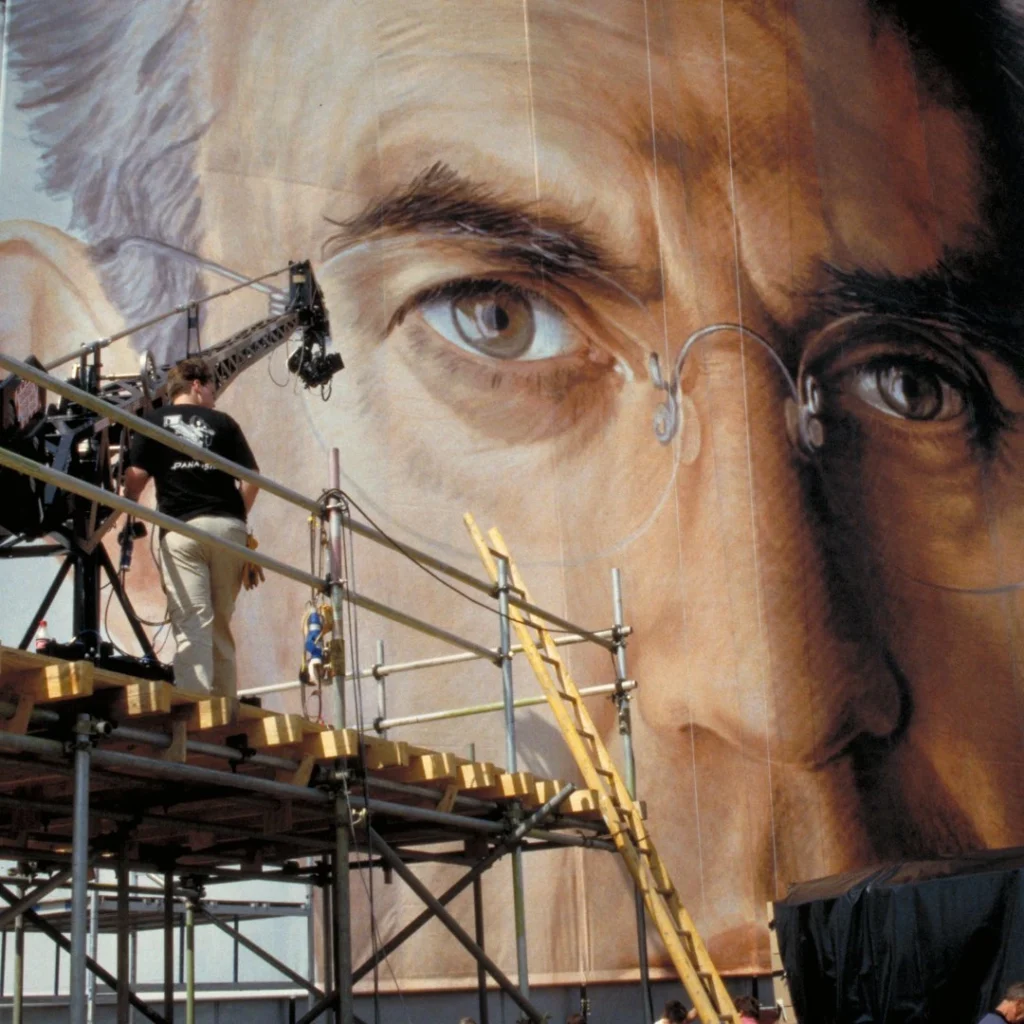
On the same day Southwell and Leech were on the real tower in Bangkok, Brosnan and Yeoh were thirty feet up on a set in England.
A 120-foot-high, one-third-scale section of the Sinn Sathorn Tower and its banner had been constructed at EON Studios in Frogmore, Hertfordshire — the former Radlett Aerodrome site that had been converted into a studio facility when both Pinewood and Leavesden were fully booked. It was here that the close-ups of the principals were filmed, with scaffolding erected in front of the set to carry the camera crews.
Both actors did meaningful portions of the work themselves. Spottiswoode was complimentary about their commitment in The Making of Tomorrow Never Dies documentary: “Both Pierce and Michelle are really good at this sort of stuff, and they kind of like doing it. They play it very well.”

Brosnan was characteristically breezy about it: “I just did it.”
Yeoh was more candid about the physical reality.
“If you’re frightened, you shouldn’t do it,” she said, “because obviously you’re not going to be able to handle the situation well. There are moments when you get hurt.”
She described the physical toll of the descent — being raised and lowered repeatedly so the sequence could be captured from every angle, the constant strain on the arms:
“You can’t make it look too easy, because when it looks too easy then it will show on the camera. One arm got like two inches longer than the other one by the time we finished. So we were both walking lopsided.”
Yeoh was also vivid on the scale of the banner itself — the strange experience of descending across the enormous printed face of Jonathan Pryce day after day:
“We were coming down, you know, the face of Jonathan Pryce, from his eyebrows down to his chin, and down to chest. And every day it’s like, ‘You mean we’re still travelling on his face?'”
The Sequence
The banner stunt is one of the more inventive action beats in the Brosnan era — a piece of filmmaking that draws a direct line from a 1935 swashbuckler to a 44-storey tower in Bangkok, by way of Hong Kong scaffolding and one stunt coordinator’s eye for a usable image.
It also left a thread unresolved. The original idea Armstrong had brought to Tomorrow Never Dies — Bond and Wai Lin swinging beneath the Petronas Towers — had been abandoned when the permits were denied. The banner sequence replaced it. But Armstrong never forgot the Petronas concept. He would use it on his next film.
That film was Entrapment. And it starred the original Bond.


- Why Robert Pattinson’s Batman Should Be DCU’s Caped Crusader - October 12, 2026
- California’s AG Loses to Paramount: Inside the Paramount / Warner Bros. Discovery Merger — And Why Ellison May Still Leave California - September 26, 2026
- Napoleon Solo Sold for £1: The Year Ian Fleming Stopped Owning Ian Fleming - July 25, 2026