Dead Reckoning’s Motorbike Jump: How 13,000 Jumps, 500 Skydives, Computer Simulation, and an Engineered Ramp Created Cinema’s “Biggest Stunt”
The motorbike BASE jump executed by Tom Cruise in Mission: Impossible – Dead Reckoning was promoted by both Paramount and the media as “the biggest stunt in cinema history.” The claim is contentious. James Bond had already driven a motorbike off a cliff in GoldenEye and BASE jumped into a pilotless plane.
What cannot be disputed, however, is that Cruise improved on the Bond template by doing the stunt himself and by changing how such action is filmed. GoldenEye captured Bond’s descent in a series of wide shots, emphasizing scale and danger while keeping the stunt performer at a distance. Partly this reflected the technology of the time, but it also served a practical purpose: disguising the fact that Pierce Brosnan was not the one making the jump.
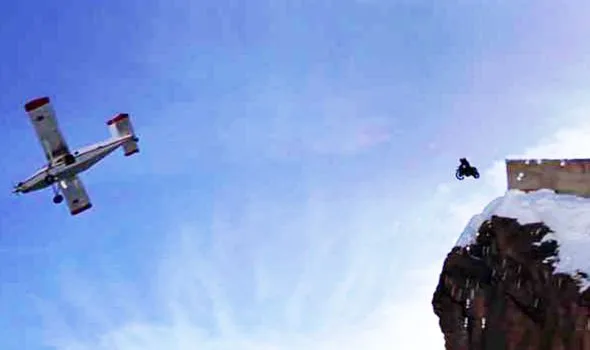
Dead Reckoning takes the opposite approach. By transitioning from wide shots to mid-shots and close-ups of Cruise, the film collapses the distance between viewer and stunt performer, immersing the audience in the stunt and erasing any doubt that Cruise is the one riding off that cliff and careering away from the mountainside in a parachute. In modern blockbuster cinema — where CG substitution is the norm — that immersion, seeing the expressions on Cruise’s face as he performs a dangerous, practical stunt, becomes the spectacle.
Cruise has brought back practical stunts in a big way, using advanced cameras, including drone photography, cutting-edge rigging, and sophisticated computer modelling that used data taken from a GPS tracker that recorded the trajectory of each of Cruise’s practice jumps.
Cruise deserves credit not only for performing the stunt himself, but for committing to weeks of training across multiple extreme-sports disciplines in order to make that intimacy possible.
Cruise’s feat involved riding a lightweight motocross bike off a cliff at Helsetkopen, transitioning instantly into freefall, and converting that drop into a BASE jump — all while avoiding the jagged cliff face mere meters behind him. A ramp was engineered for precision, then digitally replaced with rock in post-production. Safety harnesses were used only in early rehearsals, but the live-action stunt depended entirely on Cruise’s skill, training, and judgment. One wrong movement and Hollywood’s most bankable star could have been lost.
It was nerve-wracking enough that director Christopher McQuarrie insisted this be the very first scene shot on the first day of principal photography. “If something went wrong,” McQuarrie later admitted, “we had to know before we spent three months filming a movie that couldn’t be finished.”
It was a cold equation, but a necessary one.
Cruise survived — and delivered six full jumps. This is how one of cinema’s greatest stunts was conceived, trained, engineered, and executed.
The Birth of an Impossible Idea
The idea for a motorbike BASE jump had been forming in Cruise’s mind for years. “This was in the works for years, and the training was immense,” he told Men’s Journal. In many ways, the stunt is a culmination of skills Cruise had been deliberately building across the Mission: Impossible series.
Earlier films gave Cruise experience with parachuting and motorcycle performance — including a BASE jump out of a building in Mission: Impossible III, a HALO jump in Fallout, and extensive riding in Mission: Impossible 2, Rogue Nation, and Fallout. These skills formed a necessary foundation, but they were not sufficient on their own. The Dead Reckoning stunt required those abilities to be refined and executed back-to-back, without interruption: riding a motorcycle off a cliff, separating cleanly in mid-air, and deploying a parachute while clearing the surrounding terrain.
Before Norway entered the equation, Cruise began extensive additional training in the UK, focusing on motocross and advanced skydiving skills. Much of this preparation emphasized repetition — isolating individual components of the stunt and drilling them relentlessly before attempting to combine them.
Training for the Impossible
13,000 Motocross Jumps and Practicing Separation From the Bike

The stunt required coordination between two stunt disciplines: motocross and base jumping.
With motocross training, Cruise focused on repeatedly practicing long, controlled jumps on solid ground, so that when he finally faced the cliff in Norway, the mechanics of launch and separation carried him cleanly away from the cliff face.
A custom motocross track was constructed in the English countryside, where Cruise made over 13,000 motocross jumps, repeatedly clearing 70–80-foot dirt tabletops until precision became instinctive.
Stunt coordinator Wade Eastwood described the intensity of the process bluntly. Cruise, he said, was doing “over thirty jumps a day,” to the point where “he was just a machine.” Cruise himself framed the work without embellishment: “I had to get so good on the bike. There was no chance I was going to miss my mark. So you train and drill every little aspect, over and over again.”
The motorcycle itself was treated as part of that training, not as a separate prop. According to Esquire Middle East, the bike was a heavily modified Honda CRF250R, rebuilt by professional rider and technical advisor Kieran Clarke. The production selected a 250cc machine over a more powerful alternative for predictability rather than speed.
As Clarke explained, “a heavier bike doesn’t fall away the same way.” Once airborne, the bike needed to separate cleanly from Cruise without interfering with his body or parachute.
There was no speedometer fitted. Cruise judged take-off speed by consistency rather than instrumentation, a choice that placed absolute emphasis on repetition and control.
“The key was hitting the right speed up the ramp,” Cruise said. “There’s no speedometer on the bike, so I do it all by sound and feel. Then, as I launch off the bike, I create separation by cupping my arms and chest to give me lift into the jump.”
During training, Cruise used safety harnesses to isolate and practice specific elements of the stunt, particularly separation technique and body position, allowing repeated drills under controlled conditions.
No harness was used during the live motorbike BASE jump in Norway; once Cruise left the ramp at Helsetkopen, there was no physical safety system attached.
Motocross was only one half of the preparation.
A Year of BASE Training, including 500 Skydives
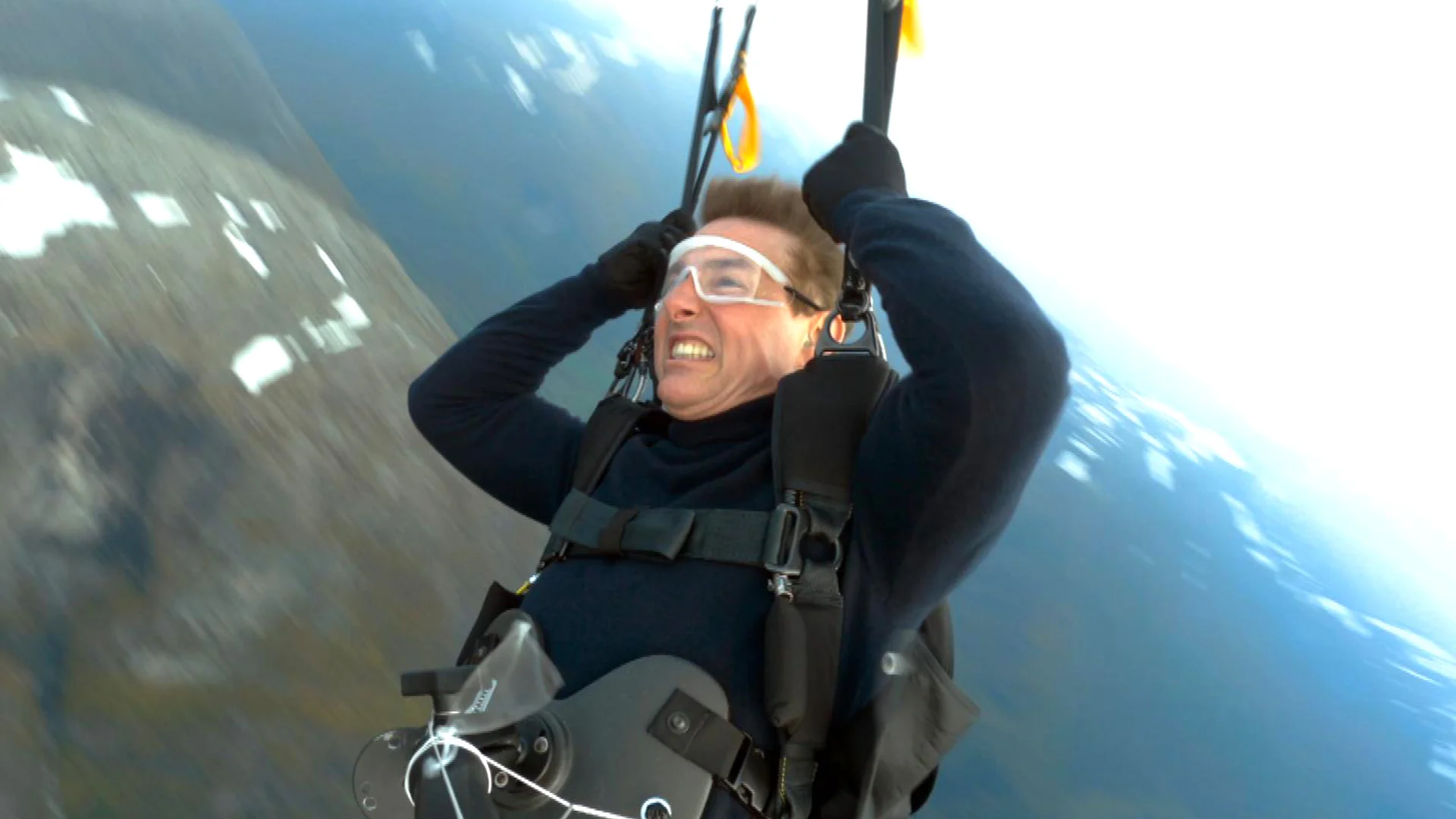
After separation from the bike, Cruise had to position himself into freefall to perform a safe BASE jump.
For this, Cruise undertook extensive skydiving and BASE-jump training with elite instructors, which involved “a year of BASE training, advanced skydive training, a lot of canopy skills, a lot of tracking.” Cruise completed more than 500 skydives during this period, with some days involving as many as thirty jumps.
This training addressed the most unforgiving part of the stunt: what happens after the bike leaves the ramp. Cruise needed to separate cleanly from the motorcycle, stabilize in freefall, and deploy his parachute while moving away from the cliff face. BASE-jumping coach Miles Daisher described the environment as a rock bowl, with walls on all sides and no margin for hesitation.
By the time filming began, Cruise had refined two highly specialized disciplines — motocross and BASE jumping — to a level that allowed them to be executed consecutively, without a stunt double.
Cruise’s performance — and the stunt’s success — relied on two additional elements: engineering the perfect ramp and using computer modelling to work in concert with drone cameras and a camera helicopter.
Engineering the Environment — and Certainty
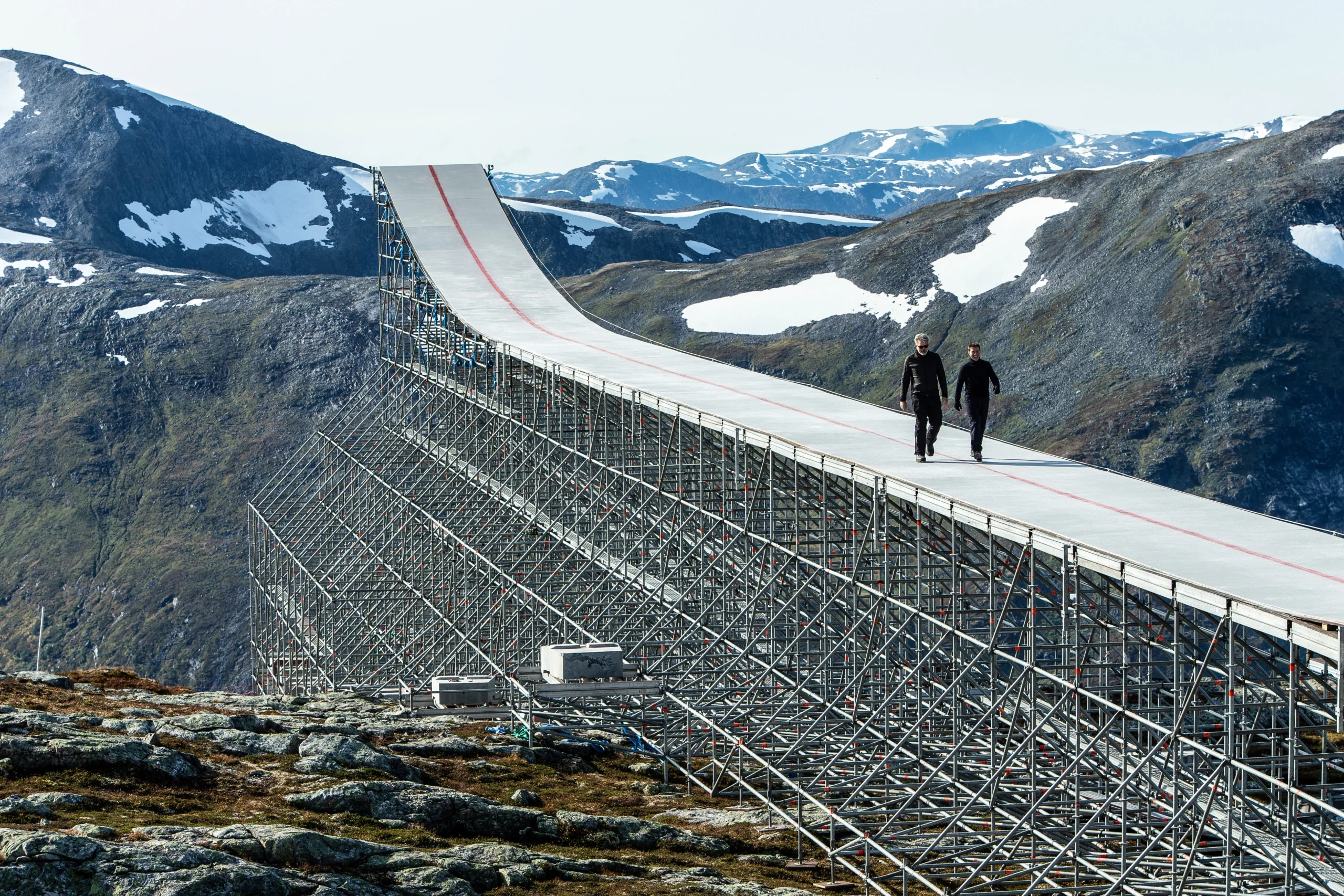
Once Cruise could perform the maneuver reliably, the next challenge was engineering the environment itself.
A custom steel ramp was engineered on top of Helsetkopen Mountain in Norway. With no road access, every component had to be flown in by helicopter. According to production reporting published by Film London, an extreme rigging team spent 27 days working on the mountain, with thirteen days devoted to assembling the 280-ton scaffold structure.
The ramp extended roughly 250 meters, including the run-up and rose to approximately 18 meters at its highest point at the cliff edge. Built from heavyweight staging scaffold and anchored against alpine winds, it functioned as a launch system rather than a simple jump, delivering Cruise at a precisely controlled speed and angle.
Ben Browning Firminger, Supervising Location Manager on Dead Reckoning, told Film London:
“It was also the largest aerial shoot in history, using a total of 13 helicopters each day to service and shoot the scene.”
The ramp was never meant to be seen. After filming, visual-effects artists digitally replaced it with rock, creating the illusion that Cruise simply rode off the natural lip of the mountain.
Once Cruise left the ramp and entered freefall, there was almost no margin for error. The official behind-the-scenes featurette makes clear that clean separation from the motorcycle and immediate movement away from the mountain were critical. Eastwood later explained to the Motion Picture Association that if Cruise failed to track correctly after leaving the bike, the consequences would be immediate:
“If he tracked the wrong way from the bike, he wouldn’t track away from the mountain. If he opened his parachute and had a small twist, he’s going to turn and slam straight into the mountain — and it’s game over.”
Mapping the Jump — Computer Modelling and Previsualization
Training and engineering solved only part of the problem. The production needed a way to predict Cruise’s movement through three-dimensional space before the jump was attempted. While safety was paramount — ensuring Cruise tracked cleanly away from the rock face — computer modelling also allowed the team to determine where cameras could be placed to capture the stunt at close range without colliding with him.
As Cruise joked: “Don’t hit the drone.”
According to Omelchak Multimedia, the motorbike BASE jump was first recreated as a previsualization using Unreal Engine to build a detailed digital version of the cliff, ramp, and jump, allowing the filmmakers to test trajectory, camera positions, and lighting before attempting the stunt on location.
This process is visible in Paramount’s official behind-the-scenes featurette, where three-dimensional grid overlays and wireframe models map Cruise’s predicted path through space. These visuals show how GPS data gathered during training — recording speed, height, and flight path — was translated into trajectory arcs away from the cliff and rockface.
Filming the Stunt — Camera Systems and Placement
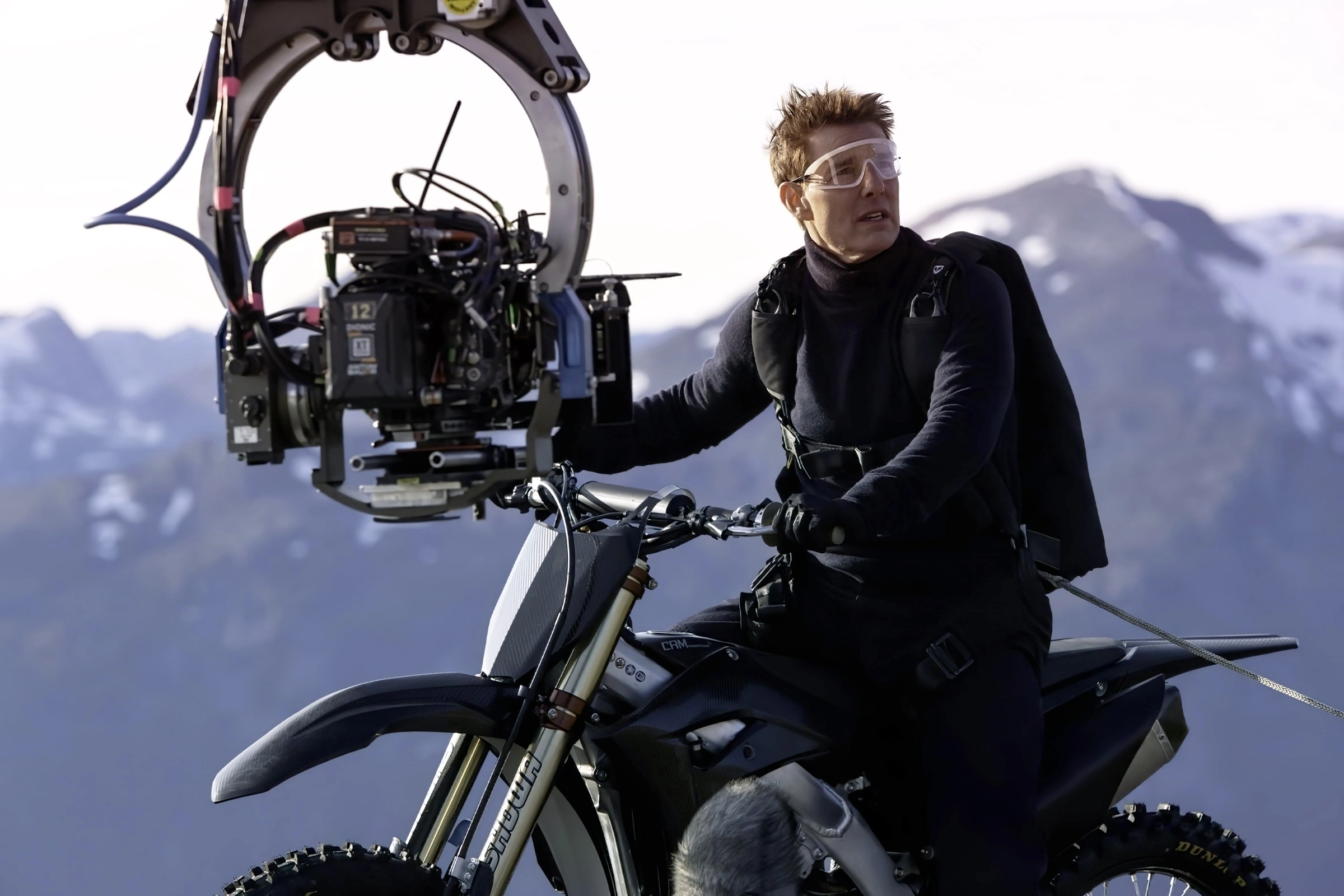
Filming the stunt required multiple camera systems operating simultaneously, each designed to solve a different problem of scale, proximity, and proof.
Aerial cinematography was coordinated by Australian specialist XM2, whose involvement is documented in Ausfilm and XM2’s own production case studies. XM2 deployed a combination of multiple heavy-lift drones and smaller UAV platforms to capture the jump in flight. These aerial units were choreographed during Cruise’s training jumps at the quarry in the UK.
XM2 also supplied a synchronized multi-camera array consisting of seven ARRI Alexa Mini LF cameras fitted with Zeiss CP3 lenses to capture ultra-wide, high-resolution environmental plates. These preserved scale, geography, and spatial continuity around the stunt, particularly for visual-effects integration.
XM2 also provided LIDAR and photogrammetry capture of environments and structures for the Visual Effects department.
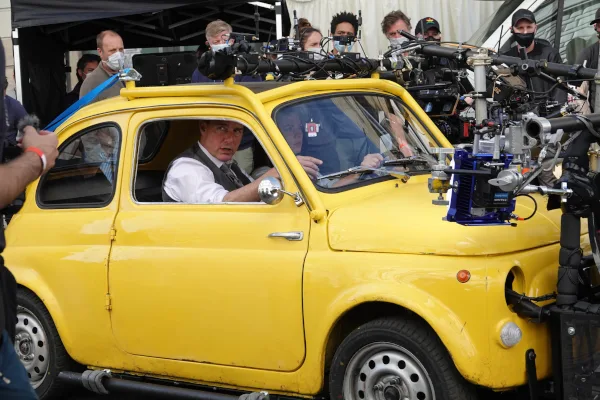
A camera helicopter tracked Cruise along the run-up to the ramp, followed him out over the edge, and continued to track the descent from above. Compact cameras mounted directly to Cruise’s motorcycle captured close-range views of his face, body position, and the precise instant of launch, collapsing the distance between performer and audience and eliminating doubt that Cruise himself was riding the bike off the cliff.
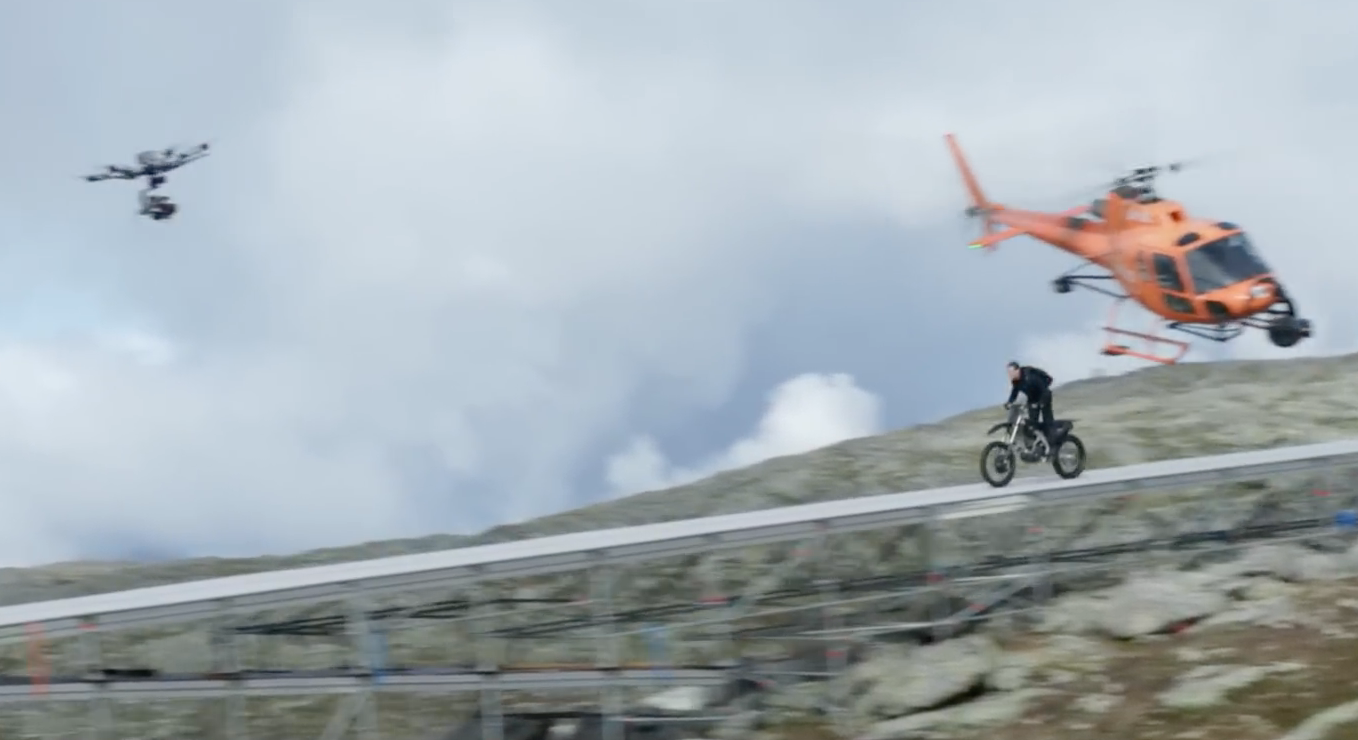
Making the Impossible, Possible — Execution Day
Once the exact configuration of cameras, ramp height, and computer modelling was determined, the jump was filmed in Norway, where they operated close enough to capture mid-shots and close-ups without intersecting his path.
This happened on the first day of principal photography. Director Chris McQuarrie and stunt coordinator Wade Eastwood waited with bated breath as Cruise careered along that ramp and off the Norwegian cliff into the abyss. Months of training ensured a clean dismount from the bike and a perfect BASE jump.
The production team cheered. Once again, their star had cheated death. And he would cheat death not once.
But a total of six times.
Each jump demanded absolute precision: speed judged by engine sound, launch angle by feel, clean separation from the bike, controlled movement away from the cliff, parachute deployment, and safe landing far below. Every time Cruise disappeared over the edge, communication stopped.
McQuarrie later described the experience as waiting in silence for the radio call confirming Cruise had landed safely.
He always did.
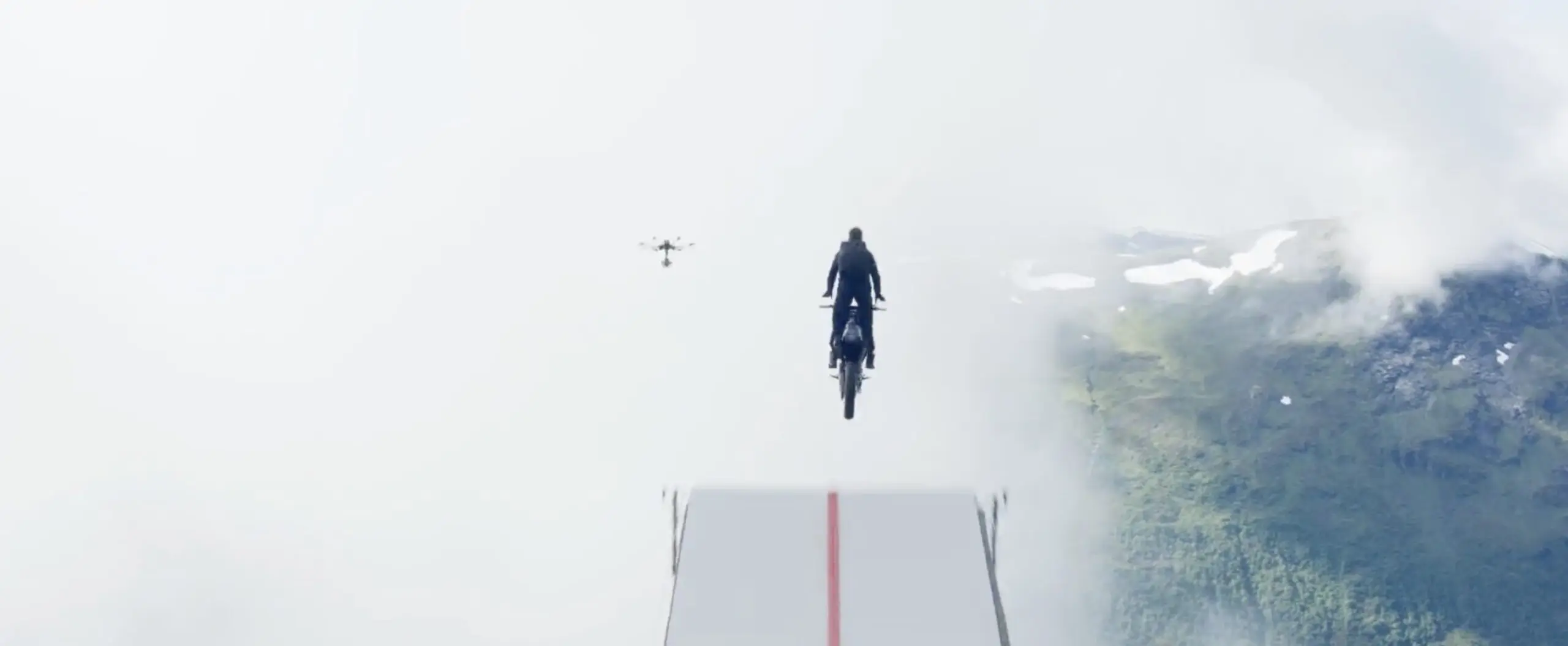
Culmination
Tom Cruise’s motorbike BASE jump is not simply a spectacular moment. It is the culmination of years of preparation, months of training, two extreme disciplines, precise engineering, and a filmmaking process built entirely around proof rather than illusion.
James Bond had already shown what such a jump could look like.
Cruise showed what it could feel like.
In an era dominated by digital spectacle, he proved there is still no substitute
for a man, a motorbike, a mountain— and the abyss.