How Goldfinger Predicted the Future of Laser Technology
The 1964 Bond scene that foresaw the laser’s role as a precision industrial and medical tool.
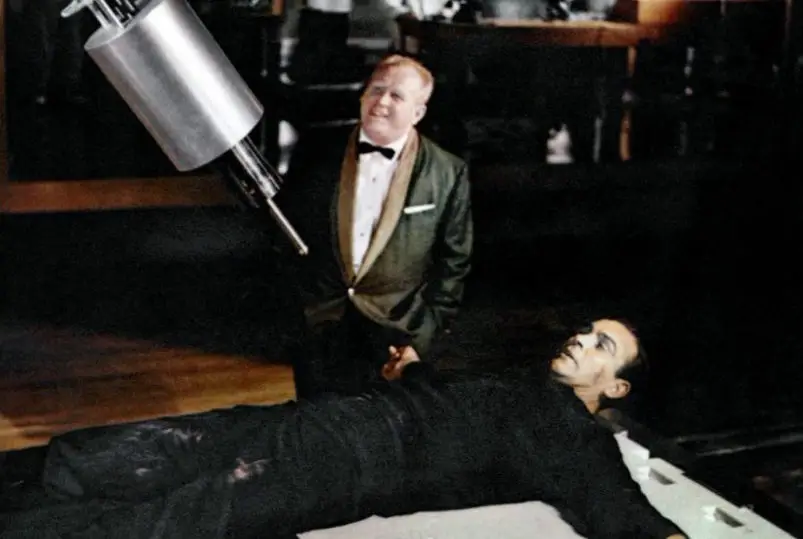
When Goldfinger hit cinemas in 1964, most people had never heard the word “laser,” let alone seen one; movie audiences were familiar with vague “ray guns” and “death rays,” but not with anything resembling an actual, scientifically credible laser. The word “LASER” itself — an acronym for Light Amplification by Stimulated Emission of Radiation — had only been coined in 1957 and was still largely unknown outside scientific circles during the early 1960s. Yet there on screen was an “industrial laser” calmly slicing its way toward James Bond’s crotch while Auric Goldfinger described its capabilities with the assurance of a man delivering a laboratory demonstration:
“You are looking at an industrial laser, which emits an extraordinary light not to be found in nature. It can project a spot on the moon or, at closer range, cut through solid metal. I will show you.”
In hindsight, the scene is astonishing. It didn’t merely invent a memorable Bond gadget — it accurately visualised the core principles of how lasers would evolve in the real world. Modern optics writers and industrial laser firms routinely cite the Goldfinger sequence as a rare example of popular cinema anticipating the future of a major technology. The film didn’t just predict laser cutting; it predicted the laser itself as a precision industrial and medical tool.
The Laser in 1964: A New Invention With No Clear Purpose
The first operational laser — Theodore Maiman’s synthetic ruby laser, built in May 1960 at Hughes Research Laboratories — was only four years old when Goldfinger was filmed. (Yes, this is Howard Hughes’ research division, later immortalised in Bond history through Diamonds Are Forever and the billionaire Willard Whyte, modelled on Hughes.)
Physicists at the time famously described lasers as “a solution looking for a problem.” Its industrial future was undefined. Indeed, the world’s first practical laser-processing machine — designed specifically to drill holes in diamond dies — was developed in 1965 at the Western Electric Engineering Research Center, a Bell System facility foundational to early laser research. This device is now recognised as the earliest true example of laser material processing.
Physics World later noted that by 1964 the laser had only barely entered public consciousness; most audiences would have encountered the word for the first time in Goldfinger.
So when Bond faces a precisely guided beam melting its way through steel, the film is portraying a scientific possibility that had not yet appeared in any factory on Earth. And audiences were captivated by this dazzling new technology, the stuff of science fiction made real.
Goldfinger Didn’t Just Predict Cutting — It Predicted Precision Laser Technology
The genius of the scene lies not in the beam cutting metal, but in how it behaves. Goldfinger’s laser operates exactly like the precision tools lasers would soon become. Its energy is concentrated into a tiny, controlled point, producing enough heat to remove material without any physical contact. The beam moves along a guided path with mechanical regularity, displaying the essential characteristic that would define laser engineering for decades: a coherent, controllable form of energy capable of modifying material with extraordinary accuracy.
This behaviour laid the foundation for every major industrial laser application that followed. Factories would use lasers for precision cutting, drilling, welding, engraving, and microfabrication, while the semiconductor industry would adapt laser systems for etching, wafer scribing, and micromachining. Medicine soon followed: surgical lasers capable of incision and cauterization, dermatological lasers for resurfacing, and early ophthalmic procedures all relied on exactly the kind of controlled, high-energy delivery dramatized in Goldfinger.
At this point, the natural question becomes: how did the production team know enough to depict a laser so convincingly before the technology had even entered industry?
The answer came from Ken Adam — and more specifically, the scientists he consulted.
How Ken Adam Designed the Laser Projector
Production designer Ken Adam crafted the laser device — essentially a laser projector — with scientific credibility in mind. To ground his design in real science, Adam consulted experts at AERE Harwell, the UK Atomic Energy Authority’s main research centre, where physicists worked on cutting-edge nuclear and optical technologies.
Adam later recalled in Ken Adam and the Art of Production Design:
“Harry [Saltzman] had a contact at Harwell in Oxfordshire, so two young scientists spent a couple of hours with me at Pinewood where they explained to me the principles of a nuclear water-reactor [for Dr. No.], and that was it. They helped me again with the laser in Goldfinger.”
Their guidance explains why Adam’s prop resembles early laboratory laser assemblies: a fixed emitter head mounted above a work surface, heavy cabling, and a downward-aimed beam path. Remarkably, its layout anticipates the structure of the first industrial laser cutters that appeared a year later in 1965.
With the design grounded in real scientific advice, the film was now ready to make bold claims about what lasers could do.
One of Cinema’s First Realistic Laser Beams — and Why It’s Red
Most sci-fi “lasers” of the 1950s were imaginative light effects with no basis in optics. Goldfinger, however, depicted a beam that resembled the real thing: a narrow, coherent line of ruby-red light. That colour choice wasn’t artistic; it reflected the scientific reality of the era.
The world’s first laser, built by Theodore Maiman at Hughes Research Laboratories, was a ruby laser, emitting deep-red light at 694.3 nm. Ruby was chosen because it stored optical energy efficiently, was durable and inexpensive, and its chromium-doped crystal structure naturally produced intense bursts of red coherent light. As a result, through the early 1960s, ruby lasers dominated scientific demonstrations, military experiments, and industrial trials. The public’s first visual association with the word “laser” was red.
That association quickly seeped into pop culture. Bond’s laser in Goldfinger was ruby-red because that was what a real laser looked like. In Diamonds Are Forever, Blofeld’s orbital laser also emits a red beam — a detail enhanced by the fact that Hughes Research Laboratories (founded by Howard Hughes, the inspiration for Willard Whyte) created the first ruby laser. Even the plot, involving stolen diamonds used to focus the beam, echoes early laser research using crystalline materials.
The red laser then permeated science fiction: the iconic bolts of Star Wars, and even the red heat vision of Superman, owe their colour to ruby’s dominance in the early laser age. For years, ruby-red simply was the cultural image of a laser.
This makes it even more surprising that Goldfinger adds a line that seems, at first, completely unbelievable.
“Project a Spot on the Moon”: The Claim That Sounds Impossible — But Isn’t
Goldfinger’s boast that his laser can “project a spot on the moon” seems like theatrical villainy, yet the basic physics is surprisingly accurate. Since 1969, NASA’s Lunar Laser Ranging program has fired laser pulses at retro-reflectors placed on the Moon during Apollo missions — a fact confirmed by NASA’s History Office.
Because of natural beam divergence, a laser widens from a few metres at launch to roughly 2–6 kilometres at lunar distance (as documented by the APOLLO project at Apache Point Observatory). Yet even with that spread, enough photons return that NASA’s Goddard Space Flight Center can now measure the Earth–Moon distance with millimetre-level precision thanks to modern upgrades.
So while Goldfinger exaggerates the tightness of the beam, the underlying idea — that a laser can reach the Moon — is unexpectedly grounded in real physics.
With these layers of realism established — design accuracy, optical accuracy, and physical plausibility — the final step is to explore how the special effects team made the illusion work.
The Special Effect Was Fake — But Technically Accurate
Although the visible beam in Goldfinger was added optically — real lasers are invisible under bright studio lighting — the production went surprisingly far in trying to use a real one. The crew initially tested a genuine ruby laser on set. In darkness it produced a dramatic, razor-thin red line, but under Pinewood’s studio lamps the beam disappeared entirely, a reminder that real lasers only become visible when interacting with smoke, dust, or low light. Special Effects Supervisor John Stears therefore used the real laser only as a guide and created the final beam through optical compositing in post-production.
But the cutting effect — the glowing, molten trail eating through the gold table as it inches toward Bond — was completely real. Sean Connery was strapped to the table for three days in March 1964, and the danger he faced was not theatrical. Beneath the table, an operator used an acetylene welding torch to melt a pre-cut channel in real time, working blind and moving upward toward Connery with each pass. If the torch overshot its mark or failed to stop on cue, Connery was directly in harm’s way.
Optical Effects Designer Cliff Culley explained the process in Inside Goldfinger:
“We had to pre-cut the area which is going to melt. Then, very carefully, fill the whole lot in with solder. And then make the top finish again look like gold. I was underneath that thing — that table. The gun was acetylene that was cutting the channel. Somebody had to go under there, of course, in case something went wrong at the last minute, and it didn’t stop when it should. It came awful close.”
Ken Adam’s gleaming E-Stage set completed the illusion, while Peter Hunt’s precise editing and John Barry’s escalating strings amplified the tension. The beam may have been optical, but the physics-inspired design — and Connery’s real danger — were entirely genuine.
Did Goldfinger Truly Predict the Future of Laser Technology?
Yes — in ways that can be precisely defined. Chronologically, the film depicted laser-based material processing before the world’s first industrial laser machine existed; Western Electric’s device appeared in 1965, a year after the film. Conceptually, the scene visualised the laser as a tool of concentrated, controllable energy capable of altering material with unprecedented precision — exactly the role lasers would come to play in manufacturing, medicine, and microelectronics.
Industrial laser manufacturer TRUMPF has described the Goldfinger sequence as “visionary,” noting how closely its fictional demonstration aligns with the principles of real laser-material processing used today.
The film didn’t cause these innovations — but it foresaw them with astonishing clarity.
Bond’s Most Famous Gadget Was a Glimpse of Tomorrow
Goldfinger’s laser is remembered as one of Bond’s great near-death moments — but it is far more than a cinematic milestone. It is one of the earliest public depictions of a technological principle that would reshape entire industries.
Long before lasers became tools for cutting steel, welding automobile frames, fabricating microchips, performing eye surgery, or measuring the Earth–Moon distance with millimetre-level precision… Goldfinger visualised the laser’s central truth: a coherent beam of extraordinary light capable of precision beyond human hands.
Bond’s laser didn’t just predict laser cutting — it predicted the laser’s destiny as one of the most versatile precision technologies of the modern age.