From Russia With Flames: The Making of the Boat Chase That Nearly Killed Its Director
The boat chase in From Russia with Love turned into one of the most dangerous shoots in early Bond history.
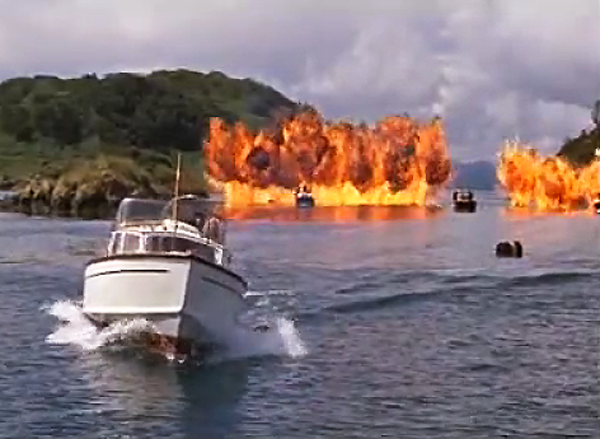
Real boats were blown apart. The sea was set ablaze with flaming fuel. Stuntmen performed full-body fire stunts, with one momentarily singed when he surfaced too soon. Daniela Bianchi was injured on her way to the location. One technical disaster after another culminated in a catastrophic reconnaissance flight in which director Terence Young nearly drowned when his helicopter plunged into the sea — and he became a real-life James Bond when he saved the pilot.
Young’s crash was so severe that producers briefly considered bringing in David Lean, director of Lawrence of Arabia, to finish the sequence.
What began as a straightforward escape sequence became a seven-week gauntlet of physical danger, improvisation, and wartime-inspired pyrotechnics — one that formed the first large-scale, high-speed, multi-boat, speedboat chase in cinema history.
A Climax Built for Cinema, Not From Fleming
Ian Fleming’s novel skips from the fight between Donovan “Red” Grant and Bond on the Orient Express to Venice, with Bond fighting Rosa Klebb and narrowly avoiding death from her poison-tipped shoe. On the page, this ending works. But on screen, the producers knew they needed something larger, more physical, and unmistakably cinematic.
Screenwriter Richard Maibaum, working closely with director Terence Young, constructed a new third act that didn’t exist in the source material: a helicopter chase inspired by North by Northwest, followed by an explosive boat pursuit that delivered a dramatic, visually driven payoff.
The second half of this invented climax—the line of drifting fuel barrels ignited by Bond—was not adapted from Fleming. It was Bond reimagined for film — and it would push the production to its breaking point.
How The Red Beret and a WWII Training Exercise Inspired the Boat Chase
The boat chase’s origins came from two sources deeply personal to the creative team. The first was The Red Beret (1953), a war film produced by Broccoli, written by Maibaum, and directed by Young.
In that film, Alan Ladd’s paratroopers find themselves trapped in a German minefield. Their only escape comes from improvisation: firing a bazooka low across the ground to detonate the mines in a rapid chain reaction: one projectile, one continuous line of explosions, and a desperate dash to freedom.
The structure of that moment—cornered heroes, improvisation under pressure, and a linear cascade of explosions from carefully aimed projectiles—was adapted for the sea in From Russia with Love.
Bond’s solution mirrors the one in The Red Beret, only now the mines become floating fuel barrels and the bazooka is replaced by a flare from a Webley gun. The fuel barrels indeed help the heroes escape just like the exploded mines in The Red Beret, but with a twist: they also become a deadly trap for the enemy as they float between the SPECTRE boats, waiting for that moment they’re set alight by Bond’s flare.
The second inspiration came from Young’s own wartime experience. In the Criterion LaserDisc commentary, he recalled a tank drill preparing for the Normandy landings where soldiers were warned the Germans planned to place oil drums beneath the surf so the sea itself could be set on fire as Allied tanks rolled ashore.
“We did a rehearsal,” said Young, “where we had to drive one of our tanks through the thing [the fire] — so that’s why we used that stunt later.”
From these two sources — a film they had already made, and a war they had already fought — the boat chase was born.
The sequence itself went through notable early revisions. Screenwriter Richard Maibaum originally conceived the boat chase as a nighttime operation, and storyboards confirm that the nocturnal setting survived well into pre-production. These storyboards show SPECTRE’s boats sweeping the water with searchlights as they hunt for Bond and Tatiana, with Bond shooting out one of the lights — a beat later dropped from the film.
Beyond the shift from night to daylight, most of the action remained remarkably close to what ended up on screen. But while the concept was solidified early, the actual shoot proved anything but simple.
Turkey: The Location That Fought Back
The initial plan was to shoot the entire boat chase in Turkey, near Pendik on the Sea of Marmara, to maintain geographic continuity with the Orient Express storyline. Instead, the location became one of the worst logistical nightmares of early Bond history.
When the crew arrived on 8 May 1963, The boats had not arrived — delayed by low water in the channel. When they finally did turn up, the camera boat was already leaking. Although repaired by late morning, the situation worsened: one SPECTRE boat struck a submerged buoy and sank, the camera boat proved too slow to keep pace with the action, and the weather was too dull for photography, forcing the day’s work to be abandoned.
The next day brought more setbacks. Several boats refused to start because local assistants had mistakenly filled the tanks with kerosene instead of petrol, resulting in repeated breakdowns. Filming again stalled while the crew waited for a change in the light. When they finally attempted another take, mechanical issues prevented the boats from achieving the required speed, rendering the footage unusable.
Conditions on the water remained rough, and Daniela Bianchi suffered violent seasickness, further complicating continuity.
At one point, the team attempted to pivot and film the helicopter sequence instead, only to stop when the helicopter malfunctioned on arrival.
Young sought faster, more reliable vessels from British boat maker Fairey Marine, but Turkey was trying to kill the sequence.
Young cut his losses and decided to rebuild the sequence off the west coast of Scotland.
Scotland: Calm Waters and a Second Attempt
The west coast of Scotland provided what Turkey never could: calm, predictable water and long open stretches ideal for high-speed photography.
Here, the production assembled a fleet of Fairey Marine powerboats that transformed the coastline into a Bond-sized nautical battlefield. At the center was Bond’s own vessel: a white-painted Fairey Huntress (Hull 32) fitted with an Interceptor V8 petrol engine, later raced in the 1963 Cowes–Torquay endurance event. Its cockpit was modified with a line of 50-gallon drums — the same barrels Bond releases and ignites in the climax.
Leading the enemy pursuit was a black-painted Fairey Huntsman 28 (Hull 34) appropriately named Here and Now, driven by aviation legend Peter Twiss, the former world air-speed record holder.
Supporting vessels included Cockatoo, a Huntress (Hull 48) powered by a 140hp Mermaid diesel engine, which handled close maneuvers and tracking passes, and Gay Dolphin, another Huntress (Hull 61) fitted with a Perkins S6M diesel, which provided further chase coverage and utility.
Even the camera unit used a Fairey — a separate Huntsman (Hull 12) converted into the production’s primary camera boat, allowing stable, high-speed filming across long, clean stretches of water.
The finishing touch came back at Pinewood Studios, where the production built mock-up boats and set them ablaze in the studio tank to create the final fireball sequence. For Fairey Marine, the film became an extraordinary piece of free publicity — their boats were cast as the technological stars of Bond’s newest adventure and paid handsomely for the privilege. Incredibly, for a sequence that runs under five minutes on screen, the entire operation — the boats, the stunt coordination, the explosions, the aerial plates — took seven weeks to organize and shoot.
Despite Scotland’s calmer waters, the worst accident of the production was still to come.
The Helicopter Crash: Terence Young’s Near-Death Experience
The most terrifying incident during the making of From Russia with Love happened to the director. Young detailed the account in vivid detail to Criterion.
On the morning of 6 July 1963, the unit gathered on the Scottish quayside — rain soaking the shoreline while an island across the water glowed in sunlight. Young decided to take a helicopter with assistant art director Michael White and a cameraman to scout the sunny location.
The pilot insisted he wear a Mae West life jacket to comply with Scottish Ministry of Aviation law. Young dismissed the warning with:
“Shit, I’m a good sailor. Don’t worry.”
According to John Stears, the helicopter had been worked on all night due to mechanical issues. Young, however, recalled an additional cause: the pilot was “showing off” — making what Young called “a very glamorous departure” by lifting off backwards. At about 100 feet, the engine failed.
Young described the sudden plunge:
“We were under water for about thirty seconds, still able to breathe because the canopy is slowly filling up … and this guy couldn’t swim. Nobody seemed to be able to swim in this bloody picture.”
Moments before the crash, the pilot had explained the emergency procedure: if a water crash seemed inevitable, he would roll the helicopter onto its side to prevent the rotor from killing them:
“Because,” as Young recalled, “if you’re underwater and you come up and the chopper is still going, it’ll take your head off.”
And the pilot did exactly that, rolling the helicopter into a 90-degree turn onto its side.
“As it hit the water, the blades blew off,” recalled Walter Gotell, who played Morzeny.
The pilot also had the presence of mind to tilt the aircraft so that the side with the camera mount — which blocked one exit — hit the water first, pinning that side to the seabed.
Stears and another crew member immediately stripped off and dove into the water, estimating the wreck lay 40 to 50 feet beneath the surface.
He remembered Young and White kicking at the Perspex canopy.
Young remembered it differently:
White escaped instantly “like a dose of salts.”
Only Young and the pilot remained trapped as water rose steadily inside. The panicking pilot kept repeating:
“I can’t swim. I can’t swim.”
The canopy finally “exploded with pressure,” sucking Young and the pilot free. Young grabbed the pilot and began ascending slowly, stopping every ten feet “so I didn’t get bubbles in the blood” to avoid the bends.
“My lungs were bursting,” Young said, “but I knew perfectly well I was going to survive.”
Both men reached the surface alive. And stuntmen swam out and towed them ashore. Young and the pilot were taken to hospital.
David Lean Asked To Finish the Scene
At the hospital, producer Harry Saltzman panicked and approached David Lean—editorially next door cutting Lawrence of Arabia—and asked if he could take over the film. Lean agreed to fill in for several days if necessary.
But Cubby Broccoli intervened:
“Did he walk to the ambulance?”, the producer asked.
“Yes.”
“Then he’ll be shooting after lunch.”
Remarkably, Young—with forty stitches below his knee—was directing again by 2 p.m.
“He shot all day long like nothing had ever happened,” Stears said. “Absolutely amazing.”
The Truth About the “Burned Stuntmen”
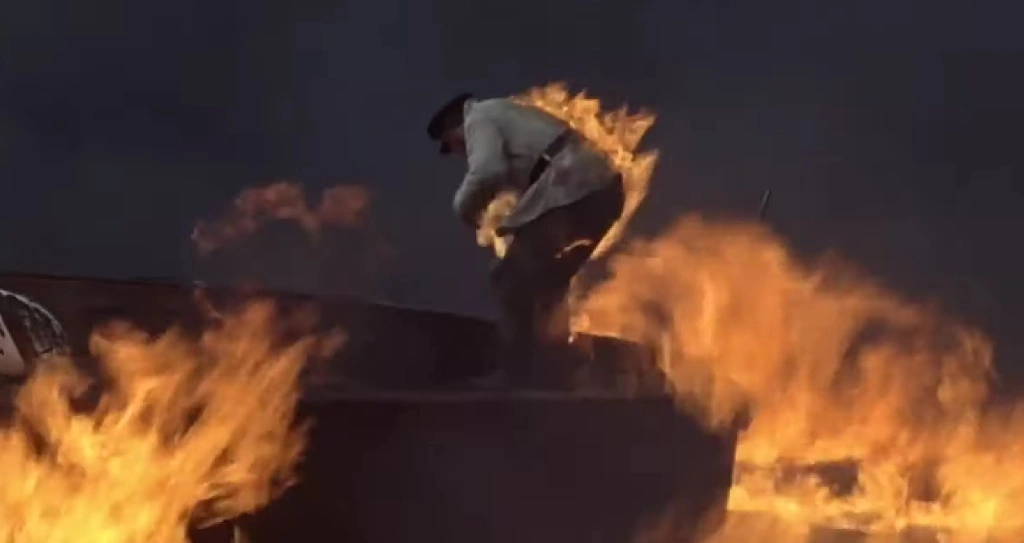
Some online sources claim several stuntmen were badly burned during the boat chase. No reputable Bond historian or documented production record supports this.
Special effects supervisor John Stears told 007 Magazine:
“Nothing has ever gotten out of hand on a Bond film I’ve done… nobody got burnt. The only time somebody got singed was Peter Perkins… but he was all right.”
Perkins surfaced early during a fire stunt and brushed the flames. But it was a minor incident.
Pinewood’s Fiery Climax
While Scotland provided the chase, the explosive finale required more control. Flames were ignited off the coast of Scotland, but the burning of the boats was created in Pinewood Studios’ outdoor water tank.
Here, Stears supervised full-scale boat mock-ups rigged with charges, gasoline poured across the tank surface, flame lanes sculpted for continuity, and stunt performers jumping through real fire.
Peter Hunt’s editing blended the tank footage seamlessly with the Scottish plates, creating a climax still effective sixty years later.
The First High-Speed Boat Chase in Cinema
Film history does offer earlier examples of boats in action scenes, including movie serials of the 1940s, but none approach the scale or stunt complexity of From Russia with Love. The Bond production was the first to feature a genuinely high-speed speedboat chase, the first in which speed itself becomes a dramatic factor, and the first to use multiple boats in coordinated pursuit — a template that action cinema had simply never attempted before 1963.
Connery Is Reunited with an Old Prop on The League of Extraordinary Gentlemen
Decades later, on the set of The League of Extraordinary Gentlemen, property department crew member Brenton Lane handed Sean Connery a flare gun for a scene. Connery studied it and said:
“I used one just like it on From Russia With Love.”
Lane answered:
“Yes — you used THAT one.”
Connery replied: “Yes, it was just like this one.”
“No,” Lane labored. “It WAS that one.”
Bapty & Co. had matched the serial number.
Forty years after igniting the burning sea–almost to the day–Bond’s flare gun found its way back into Connery’s hands — a fitting coda to one of the most dangerous sequences ever filmed in the franchise.

- Why Robert Pattinson’s Batman Should Be DCU’s Caped Crusader - October 12, 2026
- California’s AG Loses to Paramount: Inside the Paramount / Warner Bros. Discovery Merger — And Why Ellison May Still Leave California - September 26, 2026
- Napoleon Solo Sold for £1: The Year Ian Fleming Stopped Owning Ian Fleming - July 25, 2026