How Bond’s Lotus Esprit Submarine Inspired the Real-Life Rinspeed sQuba
When The Spy Who Loved Me hit theaters in 1977, the sight of a Lotus Esprit diving into the sea and transforming into a submarine was unforgettable. In reality, the car-to-sub transformation was done through special effects trickery involving full-size car shells and miniatures to show every stage of transformation. But, after transformation, that submersible you see is real: custom-built by Perry Oceanographic, tucked inside a Lotus Esprit shell. It required divers to wear scuba gear and was propelled by electric motors.
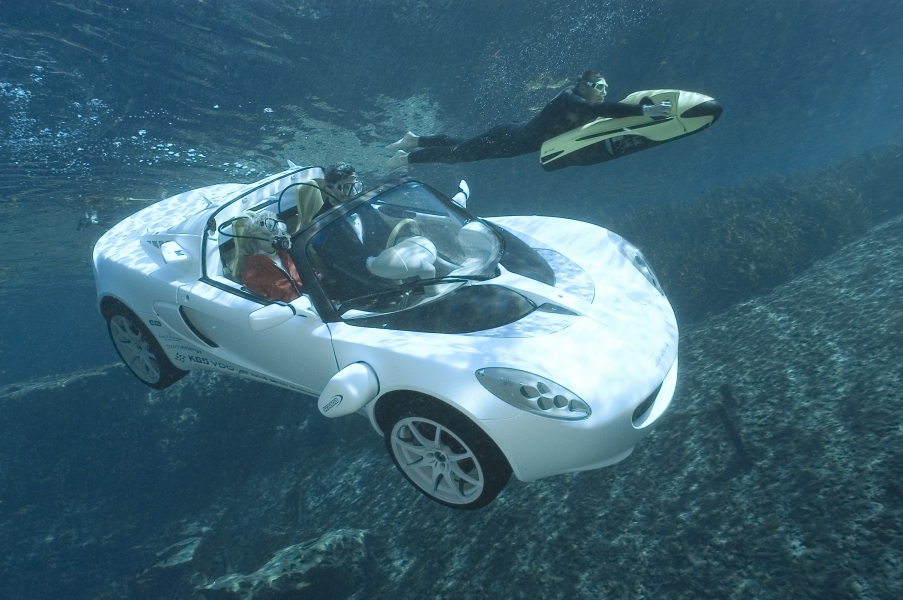
Fast forward about three decades: Swiss designer Frank Rinderknecht made the car-to-sub transformation a reality. At the 2008 Geneva Motor Show, he introduced the Rinspeed sQuba, a fully operational car capable of driving on land, floating on water, and descending underwater like a submersible.
As Rinderknecht, a self-proclaimed Bond enthusiast, put it:
“For three decades I have tried to imagine how it might be possible to build a car that can fly under water. Now we have made this dream come true.”
Building the sQuba: From Lotus Elise to Underwater Marvel
Base Vehicle and Chassis
One of the most significant choices in the entire project was the selection of the donor car. Rinderknecht didn’t choose a random chassis — he chose another Lotus, the Lotus Elise, as the foundation for the sQuba.
But choosing the Elise was more than just a nod to Bond. It has a bonded aluminum chassis is extremely light and rigid, and its composite body panels are easy to modify into hydrodynamic forms. In addition, the Elise has a mid-engine layout allowing excellent balance, and, in general, Lotus bodies are primarily composite, making them easier to reshape.
Lotus engineering—long known for prioritizing lightness and simplicity—gave the project the structural platform needed for a buoyancy-critical conversion. The Elise’s minimal mass reduced the amount of flotation required, while its corrosion-resistant aluminum backbone minimized long-term exposure issues when taken into water.
The choice of a Lotus Elise wasn’t just technical — it was symbolic. It preserved the connection to Bond’s original Lotus submarine.
As Rinderknecht explained, the goal was always to “make the Bond Lotus scene real—let a sports car drive into the water and then ‘fly’ underwater like a fish.”
Electric Powertrain Conversion
Swiss engineering firm Esoro stripped out the Elise’s conventional gasoline engine and replaced it with an all-electric powertrain, which includes a 54 kW electric motor driving the rear wheels, lithium-ion battery packs, and waterproofed control electronics.
Electric propulsion was essential because electric motors require no air intake, exhaust, or combustible fuel—all of which are incompatible with underwater operation.
Floating, Flooding, and Diving
On land, the sQuba uses a 54-kilowatt electric motor for the rear wheels. Once it drives into the water, it switches to two rear propellers and two front Seabob jet drives, allowing it to dive and “fly” underwater down to about 10 meters.
Open-Top Design and Buoyancy
Unlike the sealed, cinematic illusion of the Bond car, the sQuba is open-top underwater. The flooded-cabin approach avoids pressure differentials and eliminates the need for a heavy, submarine-style sealed hull. Occupants breathe through scuba regulators attached to onboard air tanks.
This mirrors the wet-sub approach to drive the real underwater prop in the Bond film.
Underwater Propulsion System
The sQuba uses a dual propulsion layout:
Two electric propellers mounted at the rear for forward thrust
Two Seabob jet drives mounted at the front to provide steering and vertical control
The propellers deliver constant forward movement, while the front-mounted jets allow the nose to pitch up or down and enable mid-water maneuvering.
Performance figures published by Rinspeed list:
approx. 6 km/h on the water surface
approx. 3 km/h underwater
a working depth of about 10 meters
Buoyancy Management and Interior Materials
The sQuba is designed with natural positive buoyancy. This means the vehicle always floats unless downward thrust is applied—an important safety measure for a wet submersible.
To resist corrosion, interior components were redesigned using marine-grade fabrics, waterproof switches, and salt-resistant materials. CNET reported that the entire dashboard and instrument cluster were engineered to remain functional while submerged.
Safety and Construction
As noted in Motor1’s retrospective, the sQuba automatically surfaces when unoccupied due to its positive buoyancy profile. The seats incorporate quick-release dive-style restraints to make underwater egress simple. All electronics are isolated and sealed to prevent shorting.
Development Timeline and Testing
According to MotorTrend, the complete land-to-sea conversion took approximately six months. The engineering firm Esoro, Rinspeed’s longtime technical partner, executed the modification work. While Rinspeed did not release a full engineering log, demonstrations for the press showed successful transitions from road to water and controlled underwater operation.
The Amphicar Influence: The First Production Amphibious Car
Before the sQuba or Bond’s Esprit submarine, the world had already seen a road-going amphibious vehicle: the Amphicar Model 770, produced in West Germany from 1961 to 1968.
While Rinderknecht never explicitly stated that the Amphicar influenced the sQuba, the lineage is unmistakable. The Amphicar demonstrated long before sQuba that a car could be engineered to:
Drive on land like a conventional automobile
Transition into water under its own power
Propel itself using dual rear-mounted propellers
Float using a sealed steel body
The Amphicar used a Triumph engine to drive the wheels on land, and twin propellers for water propulsion, making it one of the earliest commercially available amphibious vehicles. Its top speed of “7 knots on water, 70 mph on land” gave it the “770” designation.
Compared with the Amphicar’s amphibious abilities, the sQuba took the concept a major step further by adding true underwater capability, not just surface flotation. Where the Amphicar could travel on the water, the sQuba could travel under it. The connection between the two is clear: both vehicles occupy the same engineering lineage of dual-environment automobiles. The sQuba simply extends that lineage into the realm of submersibles.
Bond’s Legacy and sQuba’s Achievement
While the Lotus Esprit submarine car in The Spy Who Loved Me relied on props for its car-to-sub transformation, Perry Oceanographic did create a real working submersible hidden inside a Lotus car shell. Rinspeed, however, made the transformation possible — not with such a dramatic transformation as diving off a pier and folding its wheels away — but by taking the concept of an amphibious car like the Amphicar and adding the ability to fully submerge and operate underwater like the Perry Oceanographic Lotus submersible.
The Rinspeed sQuba remains the only publicly demonstrated car capable of underwater operation. Built on a Lotus Elise chassis, powered by electric motors, and engineered as a practical wet submersible, it stands as the closest real-world analog to James Bond’s legendary Lotus Esprit submarine.
Its existence proves that while cinema often bends physics for spectacle, sometimes the real world is willing to try—and succeed—at building the impossible.