Calculated Chaos: The Mechanics and Practical Stunts of the Live and Let Die Boat Chase
In the history of cinematic aquatic action, the boat chase in Live and Let Die (1973) stands as a massive mechanical upgrade to the daylight speedboat template established a decade earlier in From Russia with Love (1963). While the earlier sequence was a landmark spectacle of flame and fiery stuntwork that redefined how speedboats were filmed to show fast movement, the 1973 pursuit pushed these boundaries even further.
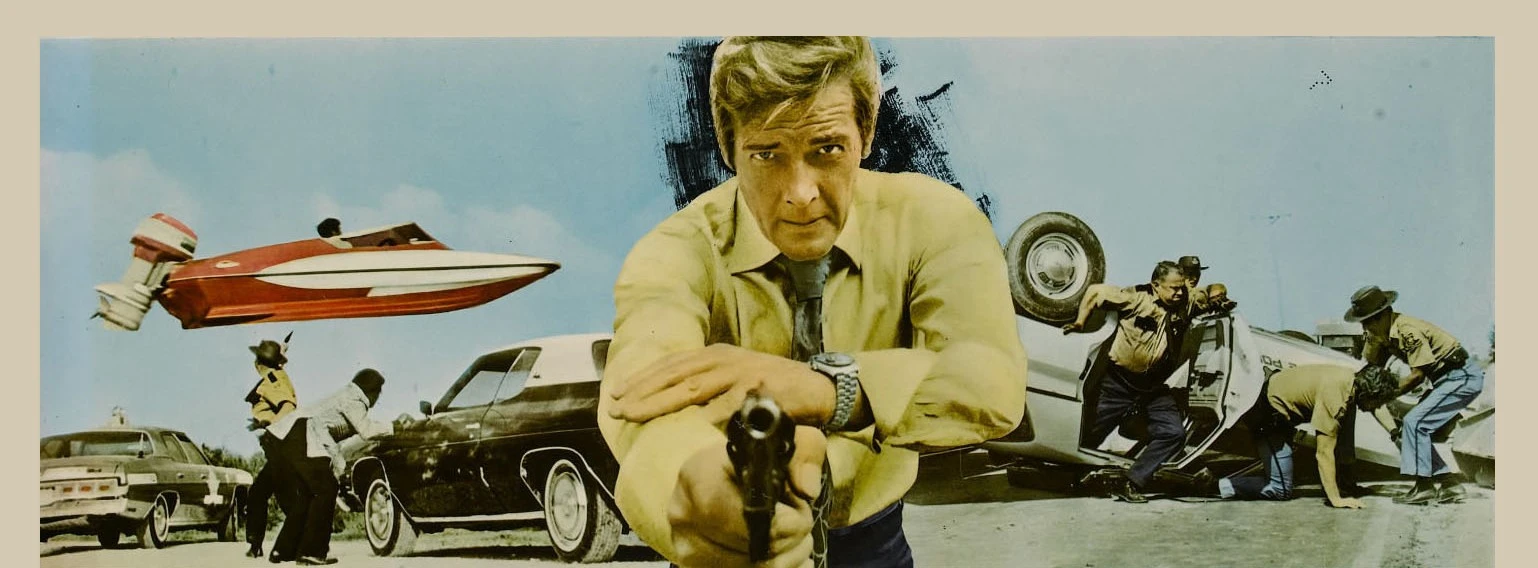
Director Guy Hamilton significantly increased the complexity by incorporating the aquatic pursuit with a simultaneous car chase involving police cruisers along the parallel bayou levees. It was a sequence defined by high-speed physical obstacles—skidding across lawns, jumping over roads, and punching through blockades—culminating in a fiery conclusion that saw Bond once again use his ingenuity to devise an escape. This marked the franchise’s full transition into the era of the high-concept, practical “stunt-piece” blockbuster.
The Creative Vacuum: A Script Born in the Swamp
The genesis of the Live and Let Die boat chase was famously born from a creative vacuum that illustrates the “wing-it” philosophy of 1970s blockbuster production. For a significant portion of pre-production, the script was essentially a placeholder. In his memoir, My Life as a Mankiewicz, screenwriter Tom Mankiewicz recalled that for months, the screenplay simply read: “And then follows the most amazing boat chase you ever saw.”
This was not merely a result of writer’s block, but a strategic hesitation. The production knew they wanted a boat chase, but the topography of the Louisiana bayous was so unpredictable that committing to specific action beats on paper felt premature. It wasn’t until ten days before principal photography was scheduled to begin that United Artists formally requested that the sequence be scripted.
This prompted Guy Hamilton to send Mankiewicz to his hotel room in New Orleans with a strict deadline: he was not to emerge until the “most amazing boat chase” was a reality. Mankiewicz spent the next 48 hours crafting the logic of the chase, integrating the comedic presence of Sheriff J.W. Pepper and the logistical reality of the bayou’s “interlocking” water and land paths.
The Twenty-Four Day Marathon: A Baptism of Fire
The production schedule for Live and Let Die was as unconventional as its script. Eschewing the traditional “dialogue-first” approach, principal photography for Roger Moore’s debut began with the roar of a two-stroke engine. The boat chase was the very first sequence filmed, starting on October 13, 1972.
The shoot was a grueling, twenty-four-day marathon that took the crew deep into the humid, mosquito-infested wetlands of Slidell and the Irish Bayou. For Moore it would be a stretch of 13 days, before he got to shoot anything else.
Moore remembered the stench of the muddied water as the Glastron came to life and its outboard motor churned up the water, revealing black snakes slithering just beneath the surface. This period was marked by the constant noise of the high-performance outboards and the logistical nightmare of moving heavy camera equipment across unstable marshes.
In his book, 007 Diaries: Filming Live and Let Die, Roger Moore recalled being thrown straight into the deep end, positioned behind the wheel of a Glastron GT-150 capable of speeds up to 75 mph. It was fourteen days into the shoot before Moore even uttered his first line of dialogue as James Bond. For the first two weeks of his tenure, the world’s most famous secret agent was essentially a stunt driver.
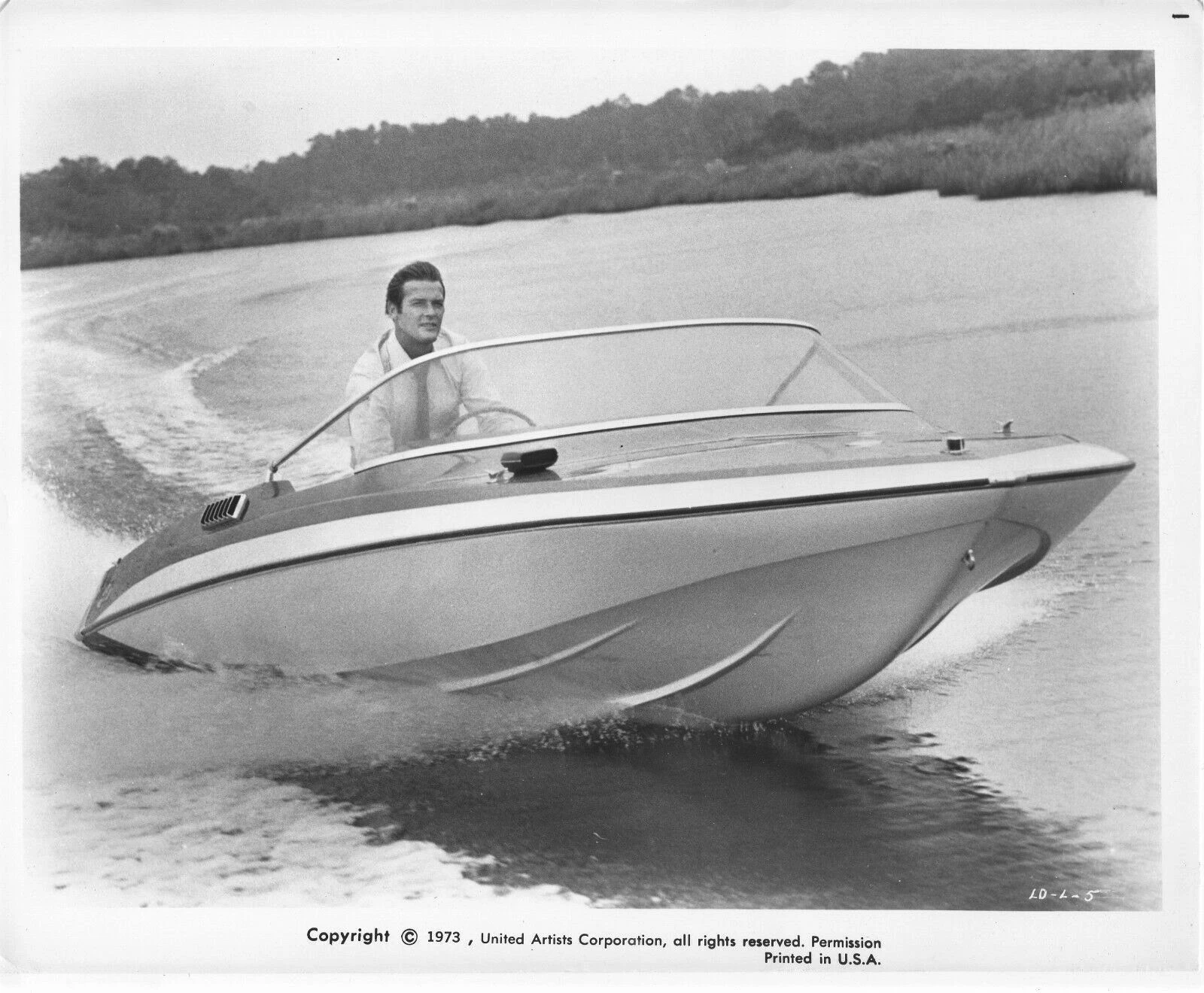
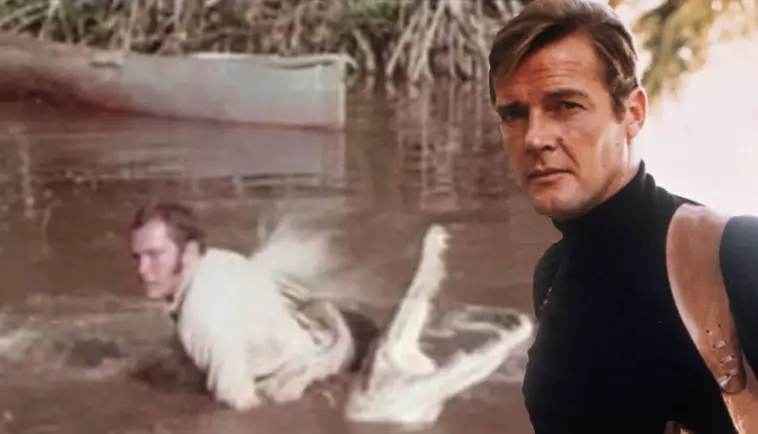
This “silent” period was nearly Moore’s last. During high-speed training, the day before principal photography began, the steering on Moore’s Glastron jammed. The boat veered sharply off course, crashing into a boathouse.
“The only thing flashing before my eyes was a large, corrugated iron shed sticking up out of the Louisiana bayou, which I was approaching at a fair old 60mph in an out-of-control boat,” Roger Moore recalled in 007 Diaries: Filming Live and Let Die. “I knew I was going to hit it – and there was nothing I could do about it. I wound up in a heap on the floor, clutching my mouth, my knee throbbing, my shoulder numb, and what felt like fifty-four thousand teeth in my mouth all at once being slowly mangled up into little bits of gravel. Here I was, just about to start playing James Bond, with no teeth.”
He still had his teeth — but the impact chipped a front tooth and twisted a knee. As Moore noted in his recollections, he continued to film despite the pain–and the use of a cane–performing his own driving while his knee was heavily bandaged and hidden under his wardrobe.
The Dual Pursuit
The technical success of the sequence rested on a dual pursuit where the speed of the boats in the channel had to be perfectly synchronized with the speed of the Chevrolet Novas on the asphalt levees.
To capture this, the camera department faced extreme physical risks. Camera operator Bob Kindred later described how he and Director Guy Hamilton often had themselves literally tied to the front of chase boats, traveling at speeds exceeding 60 mph to secure steady close-up POV shots. The technical setup utilized Panavision Super PSR R-200 and Arriflex 35 IIC units, which had to be heavily secured to withstand the “porpoising” (heavy bouncing) of the boats in the choppy bayou water.
From behind the wheel, Moore reached a wry conclusion about why they’d been so insistent he learn to drive the boats first:
“The director, Guy, and Bob Kindred, the camera operator, tied themselves on the front of a boat today tearing at 60mph up and down the bayou, photographing close-up reactions of me. That takes a lot of guts. It was then I knew why they wanted me to practice with the boats before commencement of principal photography; not so much for my safety, but more for theirs!”
The Engineering of the Glastron Fleet: Speed and Survival
The backbone of the sequence was a massive logistical partnership with the Glastron Boat Company. Peter Lamont oversaw the preparation of twenty-six boats for the sequence, a staggering number for a single action scene. Out of these twenty-six, five specific GT-150s were custom-fitted to double Bond’s primary vessel, known as the “Bond Five.” These were stripped down and rebuilt specifically for the rigors of high-impact stunt work.
Each boat was powered by an Evinrude Starflite 135hp outboard motor. These engines were pushed to their 75-mph limit, providing the “spectacle of speed” Hamilton demanded for the sequence. To prevent the brittle fiberglass hulls from shattering upon impact with the shore, Derek Meddings and Peter Lamont attached specialized sacrificial mahogany runners to the undersides, allowing the boats to “hydroplane” over the damp grass.
For high-velocity jumps over roads and levees, the SFX team constructed timber-framed ramps lifted in place by cranes and anchored into the swamp bed. Because a boat has no tires for lateral grip, the hulls were modified with two small black metal rails. Meddings remembers these rails acting like train wheels, slotting into guides on the wooden ramps to lock the boat into a perfectly straight trajectory during takeoff.
These ramps featured a central “relief” gap which allowed the propeller to continue spinning in clear air or shallow water while the hull’s rails took the weight on the outer tracks. Without this gap, the spinning propeller would have struck the wood at 70 mph, causing the boat to pole-vault uncontrollably. To further ensure the boats didn’t roll or torque mid-air, the steering and the single bucket seat were moved to the exact longitudinal center of the hull.
The Jet-Drive Pursuit: Adam and the “Billy Bob” Boat
One of the most technically distinct vessels in the fleet was the Glastron-Carlson CV-21, driven in the film by the villainous henchman Adam (played by Tommy Lane). Known on-set as the “Billy Bob” boat, the CV-21 was the heavyweight of the pursuit.
Unlike Bond’s outboard GT-150, Adam’s CV-21 was a jet boat powered by a massive 455 cubic inch Oldsmobile V8 engine paired with a Berkeley jet unit. Because the boat relied on an internal jet impeller rather than an external propeller, it was the ideal vehicle for the sequence’s high-speed land jumps. Adam’s boat could launch over asphalt and skid across levees without the mechanical “pole-vaulting” risk inherent in outboard engines.
While the jet drive protected the engine, it offered zero directional control once the hull left the water. Stunt drivers had to rely on sheer momentum to guide the heavy V8-powered hull across the Louisiana grass, often battling the boat’s tendency to spin uncontrollably.
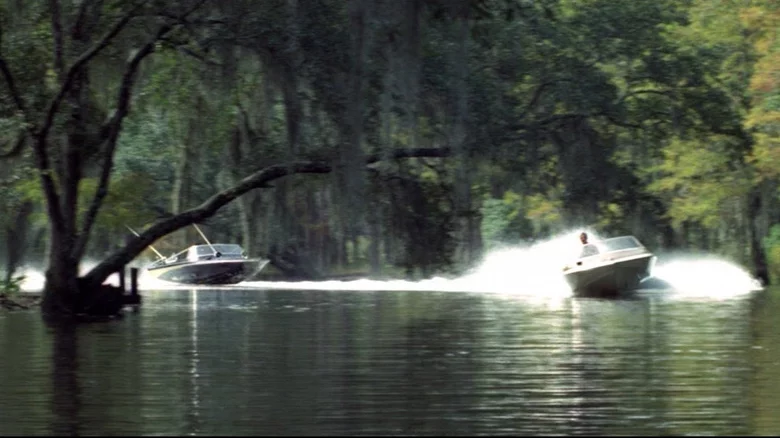
Outboard vs. Jet-Drive: The Technical Divide
In a clever piece of editing, the audience often sees Bond and Adam performing similar maneuvers, but the technical reality was split between two engineering philosophies. In his DVD commentary for the Ultimate Edition, Peter Lamont explained the necessity of using different boats for different terrains.
The GT-150 faced a potential “catastrophic stop” on every land jump. It relied entirely on the “Relief Channel” ramps to ensure the spinning propeller never touched asphalt or wood. It was chosen for the “flying” stunts because its lighter weight allowed for the record-breaking trajectory. In contrast, Adam’s jet boat functioned like a giant jet ski, capable of “hopping” across a road or levee without a specialized relief ramp because the bottom of the hull was nearly flush. However, the heavy V8 engine made it a “lawn-dart” in the air, making it too rear-heavy for the 120-foot jump attempt.
After the GT-150 is “shot” and abandoned in the swamp, Bond actually steals a white and gold CV-19 Jet Boat. This allowed the production to film more aggressive land-skids in the latter half of the chase, as the jet boat was far more durable for “off-road” use than the delicate outboard GT-150.
Practical Stunts:
The “Car-Boat” and Miller’s Bridge
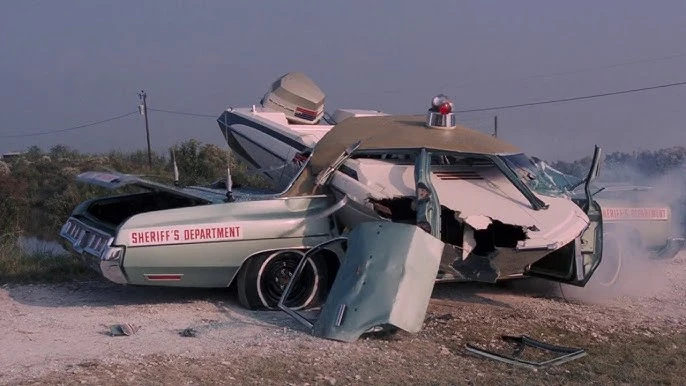
In his book, Not Forgetting James Bond, Art Director Syd Cain detailed the “hands-on” nature of the stunts, which would be deemed impossible by modern safety standards. One of the most iconic visual gags involves a pursuing speedboat launching over a bank and ploughing directly into a police vehicle — what a “smart-ass” cop watching the incident calls “one of those new car-boats”.
This was a 100% practical effect; Meddings’ team had to physically weld a boat hull to the roof of a police cruiser to create the wreckage, with wires used to tie it in place.
But on Day Four of filming, disaster struck. A wire snapped and a piece of wire broke off and got lodged in boat driver John Kerner’s eye. He was rushed to hospital, where a surgeon operated on his eye.
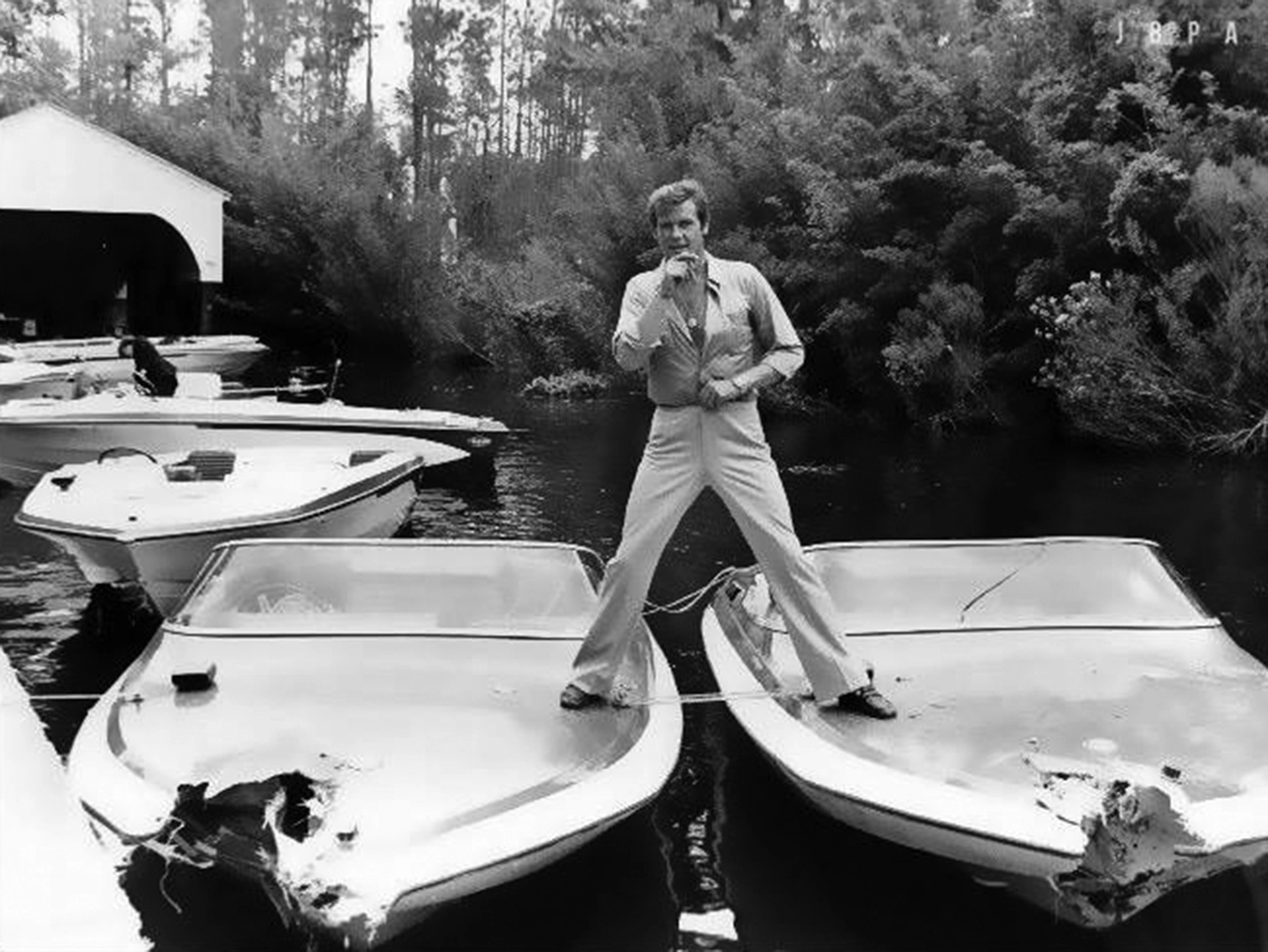
At Miller’s Bridge in Phoenix, Louisiana, the authorities attempt to end the pursuit with a floating “riverblock.” The crew tied a series of small, decommissioned boats together across the channel. To ensure Bond’s boat could punch through without flipping, the SFX team used chainsaws to “pre-score” and weaken the hulls of the stationary boats before impact.
The Physics of the 120-Foot Jump: The Tulane Equations
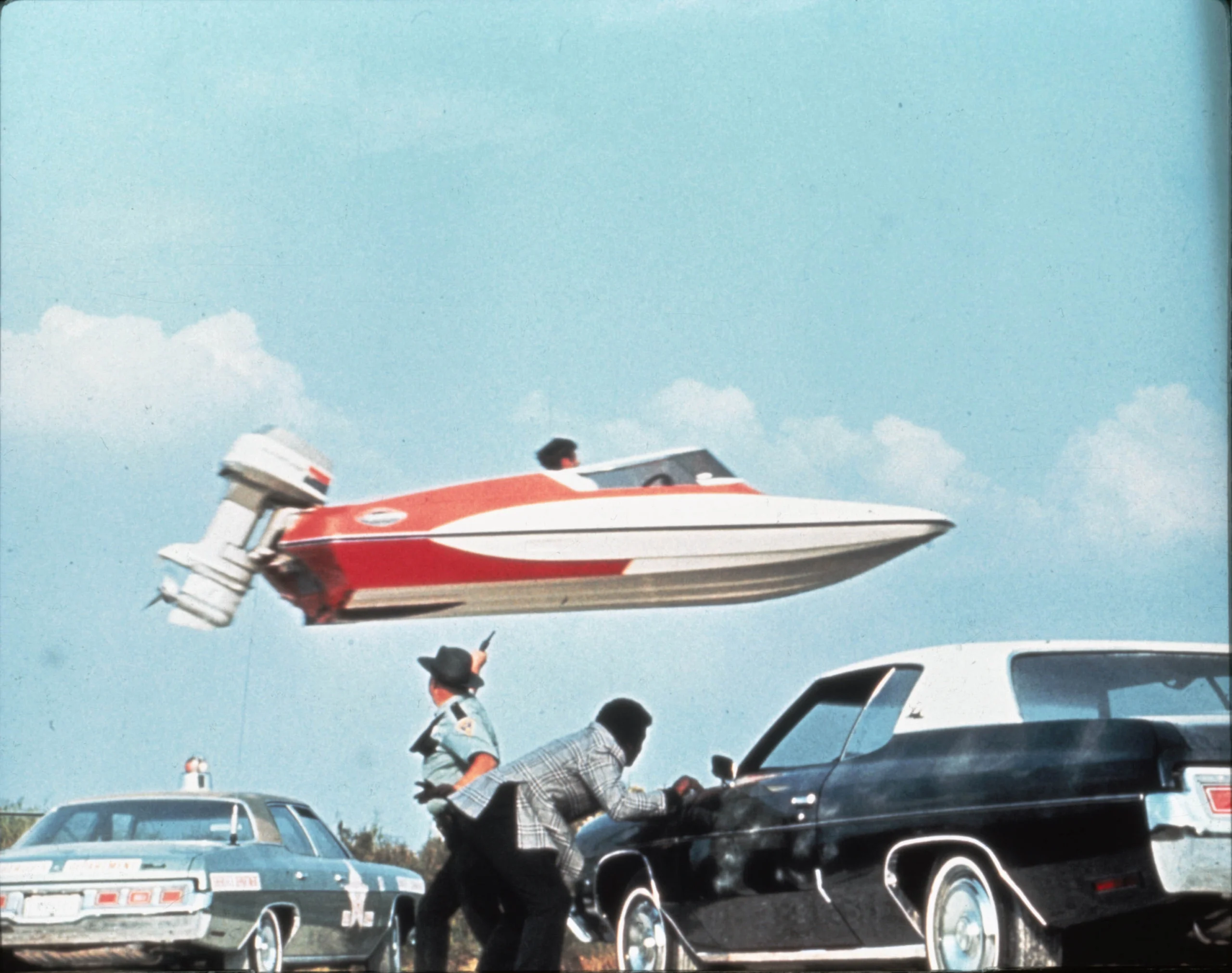
The jump over Crawdad Bridge remains the technical crown jewel of the film. Stuntman Jerry Comeaux spent six weeks preparing for this single leap, yet initial practice jumps were plagued by crashes. To ensure the jump was successful—and that Comeaux survived—the production consulted with the Mathematics Department at Tulane University.
The physics were daunting: because a speedboat is a hollow shell, it acts as an airfoil at high speeds. If the nose lifted too much, the air pressure under the hull would flip the boat backward. Tulane’s professors calculated the exact angle for the ramp and the precise speed—72 mph—required to clear the road and the cars parked beneath the bridge. The stakes were absolute; if the math was off by even 2-3 mph, the boat would have likely cartwheeled into the bridge pilings.
A perfect take was achieved on the third attempt. The crew measured roughly 120 feet from take-off to re-entry — though when the leap entered the Guinness Book of World Records, it was officially logged at 110.
Comeaux’s luck ran out when he doubled one of the henchmen — a role that, in 1972, meant performing in blackface and a wig, a stunt-doubling practice now recognized as racist. The second of his two jumps that day nearly killed him. Moore saw it happen:
“On the second jump he took off on a forty-foot leap, hit the water, skidded in the wake of another boat, and flipped up to the bank… Happily, Jerry was all in one piece; his wig must have saved him.”
Skidding onto the Lawn: The Pool and the Wedding
On Day Seven and Eight, the crew shot two scenes — one per day — involving boats skidding across lawns. The first tore up the lawns of the Baldwin estate, where Bond’s GT-150 vaulted out of the bayou and onto the grass with a pursuer hard behind — a pursuer who overshot and came to rest in the middle of a kidney-shaped swimming pool, a 135-hp Evinrude idling in somebody’s backyard. Moore called it a ludicrous sight, like “an ad for the man who has everything.”
Getting the reverse angle nearly stood the boat on its tail. To shoot Bond from behind, Hamilton and camera operator Bob Kindred climbed into the rear seat — and the weight aft sent the nose rearing to ninety degrees the instant Moore opened the throttle, dunking everyone’s backside in the bayou. The fix was crude: sandbag the bows until the hull sat level.
The wedding was harder. On the rolling lawns of the Treadway estate — a former Indian reservation thirty miles out of New Orleans — the crew dressed an outdoor altar for a marriage, which exists for the chase to ruin. Four cameras and a bank of stills men waited as the jet boats charged the bank at sixty-five.
It went wrong three times before it went right. The lead boat, driven by Murray Cleveland, skidded out of control and hit a giant oak head-on — the loudest thud Moore said he’d ever heard. Within ten minutes Comeaux’s boat lost power into a second tree; a third engine cut and careered into a third. Three wrecks in under an hour, casualties laid out behind the collapsed marquee like a field hospital, some £30,000 of boats gone in an afternoon.
The shot that survived belonged to the man running the carnage. After a forty-five-minute delay, stunt coordinator Eddie Smith aimed his own boat at the reception, hit the lawn at over sixty, and slid clean through the three-tiered cake before ripping into the marquee — tables, presents and champagne glasses going up with a rigged charge.
Smith was the only Black stunt coordinator on the picture, and far more than that. In 1967 he had founded the Black Stuntmen’s Association, fighting to break the colour barrier and get Black performers into stunt work that had been closed to them for decades. The biggest practical gag in the chase was driven, and overseen, by him.
The wedding still wasn’t finished. At dawn the next day the unit convoyed back to the Treadway lawns to shoot the rest of the party — and found nothing to shoot. Overnight, winds across the 630-square-mile Lake Pontchartrain had pushed the lake into the bayous, and three feet of water now sat over the grass; you couldn’t tell where the lawn ended and the bayou began. With the production burning roughly £28,000 a day, a wash-out was no trivial loss. Bond’s most chaotic afternoon on land had been topped, the next morning, by the bayou quietly reclaiming the set.
The Esther Williams Influence and the Producer’s Conflict
As the sequence grew in scope, Director Guy Hamilton originally envisioned an “aqua-musical” detour inspired by Esther Williams, the 1940s MGM superstar. Hamilton’s vision would have seen the chase detour through a public “Southern Water Show” in front of a cheering audience.
In the centerpiece of the stunt, Bond would swerve through a “triangle of men on skis.” This human pyramid featured the men carrying pretty girls on their shoulders, who held little banners. Bond’s boat was intended to pass by the formation without disturbing a single skier, while a pursuing enemy boat would cause the entire pyramid to collapse.
However, producer Cubby Broccoli wasn’t happy telling co-producer Harry Saltzman: “This f*ing boat chase just goes on and on.” Broccoli put a hard stop to any further action, killing the Esther Williams sequence and a planned Slidell boatyard finale that would have featured Bond using a decommissioned ferry as a massive ramp.
A Glass of Port and Two Hundred Pounds of Explosive
Because of Broccoli’s intervention, the planned “Ferry Jump” finale was significantly condensed into the Slidell Harbor conclusion seen in the final film.
Rather than a spectacular leap, the pursuit ends with Adam’s jet-powered CV-21 ploughing into the wreckage of a decommissioned ferry and exploding. The collision was a 100% practical effect; the speed of the jet boat meant that when it struck the ferry’s rusted metal hull, the impact was severe. The production used carefully placed explosives to ensure the Oldsmobile engine’s fuel load “ignited” on cue, providing the fiery punctuation Broccoli demanded.
The film’s most famous still from the chase isn’t a stunt at all. It’s Roger Moore, seated, a glass of chilled white port in his hand, oblivious as Adam’s death erupts in flame behind him — the picture of unbothered cool. The cool was manufactured. The danger wasn’t.
By the time the unit reached the Slidell boatyard for the finale, the target was a 325-foot decommissioned tank landing craft — a WWII relic of the kind so often sold off as a ferry that the vessel gets described half a dozen ways. Bond’s last move is to douse Adam in petrol and steer his boat up the craft’s ramp to its detonation; the production packed the hull with explosives to turn the collision into the fireball Broccoli wanted. Nobody would tell Moore how much was in there.
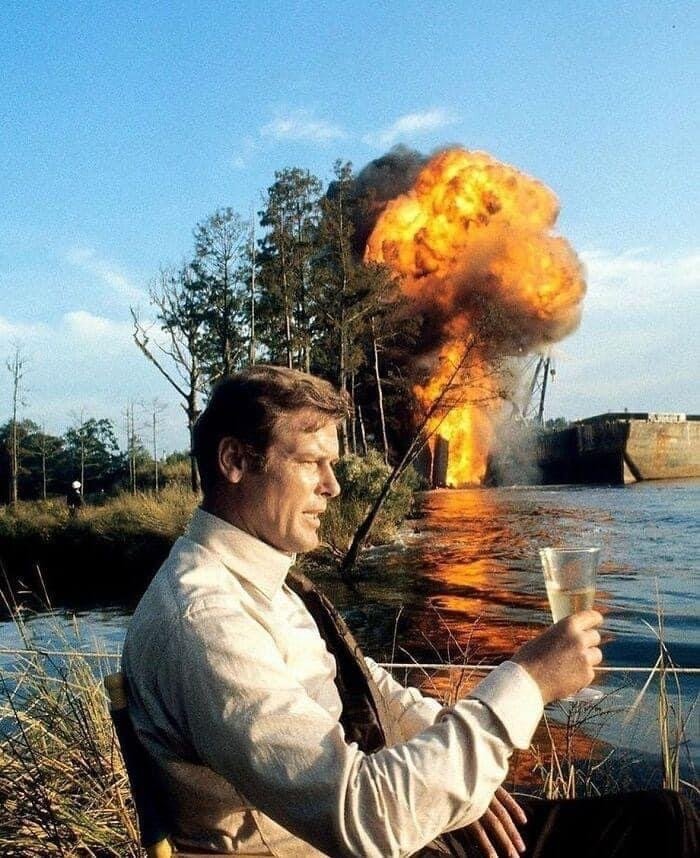
The photograph was the publicist’s idea. With Moore not needed for the explosion shot itself, British publicist Dan Slater sat him in front of the press cameras, glass in hand, facing away from a blast some three hundred yards off — the unflappable 007 incarnate. Moore agreed. Then he noticed the film crew building a blast hide.
“Why are you hiding behind there, fellows?” he asked. “Well, Rarge,” came the reply — the American crew’s version of “Roger” — “they say there’s gonna be a little blast.”
He then learned he was insured for five million dollars. The stills setup was moved off the barge to the far bank, nominally safer, though it actually put everyone thirty yards closer to the charge. Moore sat through the countdown anyway, on the logic that chickening out wouldn’t suit the Bond image. When it went, by his own account, “I don’t know if it blew me or if I jumped four feet in the air, but somehow I didn’t spill one drop of wine.” Most of the photographers, he noted, leapt a good deal higher than he did.
A Swedish photographer suggested they all stroll closer for a better frame, the bang being, in theory, over. They got as far as the retreating fireboat before someone bellowed through a loud hailer that there were another two hundred pounds of explosives still live on deck. The photographers pressed for one more shot anyway.
So the most composed image in the entire production was a man holding his nerve — and his glass — while a charge nobody had finished detonating went up a few hundred yards to his left. Which is about as Bond as it gets.
Scoring the Chase: George Martin’s Invisible Hand
For the first time in a decade, a Bond film arrived without composer John Barry. After six consecutive Barry scores, it fell to George Martin to provide the music. He’d landed the job almost by accident: Saltzman and Broccoli, impressed by his orchestration on Paul McCartney title song, considered him for the score, and flew him out to Jamaica to meet Saltzman on location, as Martin recounts in All You Need Is Ears.
Following Barry was a tall order, and Martin has tended to get overlooked for it — drowned out, as one Bond commentary puts it, by the sheer popularity of the Wings single. But the score does quiet, deliberate work. Hamilton briefed him scene by scene on what each moment should convey and asked for only minor changes once it was written. Through the chase, Martin threads the McCartney theme into the action, bending the rock melody to fit the Barry/Bond template — so the tune you can’t shake becomes the engine of a sequence you’re too busy watching to notice it powering.
That invisibility was the point. In All You Need Is Ears, Martin uses the film’s own chase to make the case: ask anyone leaving the cinema what the music was during the sequence and they’ll swear there wasn’t any — yet pull the score out and most of the excitement drains away with it. The cue itself is listed, with no ceremony, as “Boat Chase” on Martin’s score. It isn’t there to be admired. It’s there for suspense and buildup.
The Blueprint for the Stunt-Piece Blockbuster
The sequence’s legacy is defined by the standard it set. It demonstrated that the sight of a real boat flying 120 feet through the air provided a visceral thrill that miniatures or rear-projection simply could not match. By integrating a car pursuit into the aquatic action and utilizing rigorous mathematical planning, the production established a blueprint for the “stunt-piece” blockbuster that would influence directors for decades — including multiple Bond boat chases to come.

- California’s AG Loses to Paramount: Inside the Paramount / Warner Bros. Discovery Merger — And Why Ellison May Still Leave California - September 26, 2026
- Napoleon Solo Sold for £1: The Year Ian Fleming Stopped Owning Ian Fleming - July 25, 2026
- The Untold Story of The Persuaders!: Cars, Glamour, Conflict and James Bond - July 20, 2026