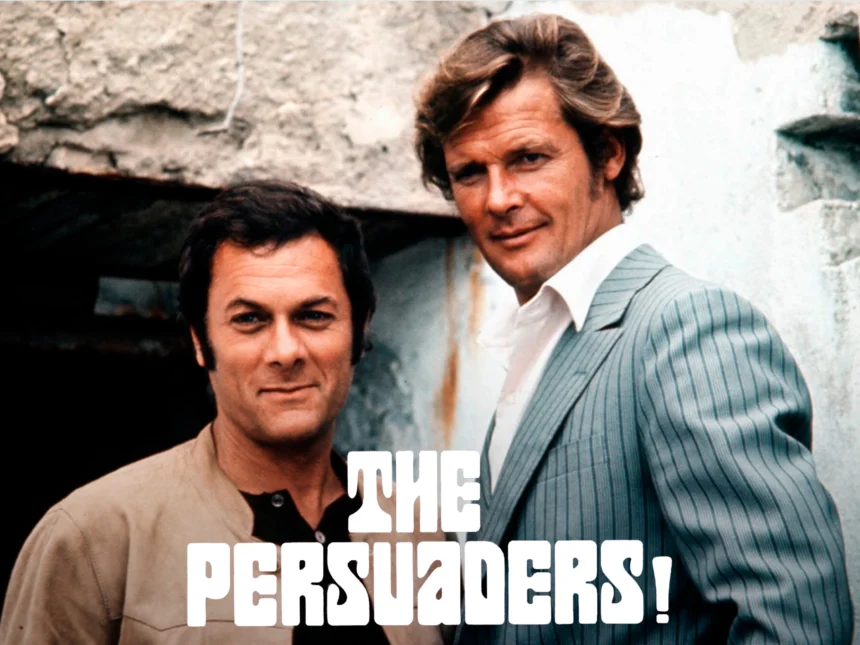
The Untold Story of The Persuaders!: Cars, Glamour, Conflict and James Bond
Robert S. Baker had wanted to make a buddy picture for years. While producing The Saint, he tested the idea in “The Ex-King of Diamonds,” an episode that paired Roger Moore’s Simon Templar with Rod Huston, a wealthy Texan played by Stuart Damon.
“I always wanted to make a buddy picture,” Baker recalled. “I was doing The Saint at the time, so I thought, ‘Why don’t I do one episode that has a kind of a connotation of two guys working together.’”
Production executive Johnny Goodman later described the episode as the basic template for The Persuaders!, while Damon regarded it as an unofficial pilot. The experiment established the essential formula: two rich, glamorous men from opposite sides of the Atlantic, competitive by nature but effective when forced to work together.
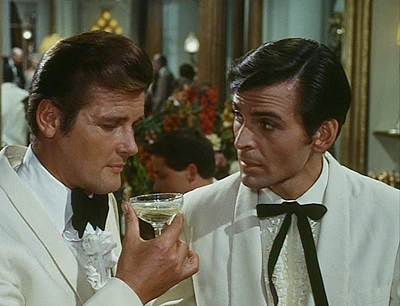
The series was initially going to be called Friendly Persuaders, until the title was judged too close to the 1956 film Friendly Persuasion. The title was changed to The Persuaders!, a stronger, direct title.
“Friendly Persuaders told you they were going to be chums,” Baker said. “Persuaders didn’t tell you anything, so it was a better hook.”
Finding the Two Persuaders Took Some Persuading
Roger Moore was the obvious choice for Lord Brett Sinclair. After nearly a decade playing Simon Templar in The Saint, he was one of television’s most recognisable international stars, bringing elegance, humour and an established audience.
But the new series would be expensive, and Lew Grade — the UK’s cigar-chewing super producer — needed an American network sale. Stuart Damon had helped prove the format, but he was not yet a sufficiently large name to secure the role. Moore could bring the international television audience; his co-star had to bring American audiences.
Moore was initially reluctant to commit to another lengthy television production. Grade attempted to appeal to his patriotism after receiving the Queen’s Award for Industry.
“The country needs the money,” Grade told him. “Just think of your Queen.”
“You have to say more than that to persuade me, Lew,” Moore replied.
Grade did, and the search for Moore’s American partner began. Rock Hudson was an early choice, followed by Glenn Ford, who did not want to leave the United States for the extended shoot. The American network supplied a list of possible stars, and Tony Curtis was on it.
Baker and story editor Terry Nation met Curtis in Beverly Hills, where he agreed to make the series. He later summarised the casting requirements in characteristically immodest fashion.
“He wanted an American and an Englishman, two men approximately the same age, two very wealthy, charming men. But he didn’t get that with Roger—he got it with me.”
That joke already contained the series — a continual rivalry between the characters for women and the satisfaction of one-upmanship.
It also foreshadowed Curtis’s often difficult relationship with the production.
Tony Curtis Arrives—and Is Stopped at Customs
Curtis arrived in Britain in April 1970 carrying a small box of cannabis and a pistol, both promptly discovered by customs officers. Before being searched, he pressed a wad of cotton wool containing pills into Goodman’s hand.
Goodman, whose father-in-law was then a commander in the Criminal Investigation Department, suddenly found himself walking through customs with what he described as “a pocket full of substance which could have been very embarrassing for me.”
Outside, he approached an American who was staying with Curtis.
“Did they find shit on him?” the man asked.
“Not only did they find shit on him,” Goodman replied, “but I’ve got some too.”
Goodman transferred the contraband during a staged handshake in the car park. Curtis appeared before a magistrate the following morning, apologised and explained that he had brought the drugs because he was nervous about entering a new country. He was fined £50.
Goodman paid the fine because Curtis had no money with him.
“Rich actors never carry any money,” he observed.
Tony Curtis had arrived.
Brian Clemens Shapes the Series
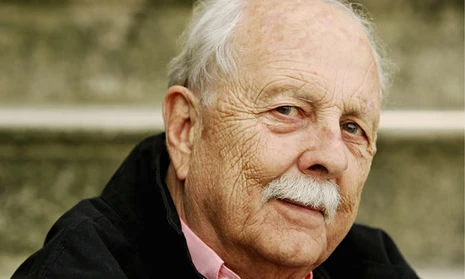
Baker selected Brian Clemens to establish the characters and tone. Through The Avengers, Clemens had already shown an instinct for combining wit, danger, glamour and eccentricity, and he shaped the two leads around the actors themselves.
“I knew Roger had a good sense of humour and looked like a lord anyway,” Clemens said. “He dressed well and was a clothes horse. I knew that Tony Curtis was a kind of get-rich-quick New York guy, so that’s the way I wrote him.”
Moore became Brett Sinclair, an English aristocrat whose wealth and confidence appeared inherited. Curtis became Danny Wilde, a self-made American millionaire who wore success as proof that he had escaped the world into which he was born.
Built into that contrast was an exploration of class: one man had inherited his station, while the other had created his own. Neither belonged to ordinary society, and that distance supplied much of the show’s escapism for viewers who did. Wilde remained marked by the world he had escaped, while Sinclair’s inherited privilege placed him at a distance from it.
Judge Fulton, played by Laurence Naismith, manipulated the pair into investigating crimes overlooked by the authorities. The conceit was that two men who both saw themselves as operating outside society’s usual constraints were uniquely suited to pursue cases beyond the reach of conventional law enforcement. Naismith also appeared that same year as diamond-syndicate chairman Sir Donald Munger in Diamonds Are Forever.
Fulton described the partnership through a chemical metaphor:
“Take two relatively harmless compounds, say nitro and glycerine. Mix them both together and you have a very potent combination.”
The chemistry may have been scientifically questionable, but dramatically it was exact.
“With The Persuaders!, we were determined to shoot on location as much as we could,” he said.
The production established an initial base in the south of France, gathering location material for several episodes during a seven- or eight-week stay in Nice. The Riviera’s villas, hotels, harbours, casinos and mountain roads became inseparable from the show’s identity—a luxurious European playground for the rich, but also a place where kidnappers, counterfeiters and crime syndicates operated behind the glamour.
It was unmistakably Bond-adjacent, born from the 1960s spy craze, which had been enmeshed with European style and glamour from the get-go.
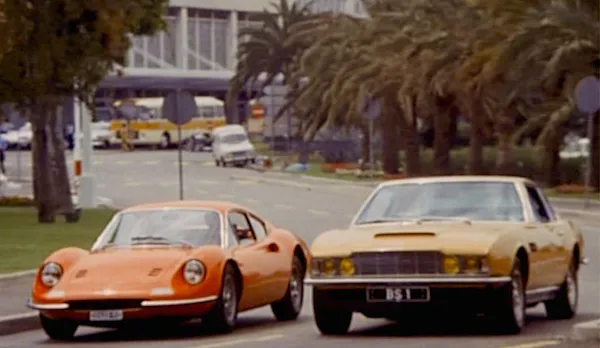
The clearest expression of its style came in the opening episode, “Overture,” in which Wilde’s red Ferrari Dino 246 GT encounters Sinclair’s Bahama Yellow Aston Martin DBS on the roads above Monte Carlo.
Curtis chose the Ferrari, knowing Moore would naturally receive the English car. Moore preferred the roomier Aston Martin, finding the Dino cramped and awkward.
“We had an Aston Martin and we had a Ferrari Dino,” Clemens recalled. “And once I knew we had those cars, it was just simple nature that you were going to have them race each other.”
The sequence worked because the competition was not entirely manufactured. Curtis was already measuring himself against Moore, and that instinct carried naturally into the characters. The cars established their rivalry in a fun, playful way against a glamorous backdrop.
Creating Europe at Pinewood
The production could not take its stars to every country named in the scripts. Small second units gathered footage in places such as Paris and Copenhagen, while the bulk of the series was filmed at Pinewood Studios, Black Park and nearby locations.
Pinewood’s gardens, standing sets and backlot could be redressed to represent different parts of Europe. Genuine Riviera footage provided scale and credibility; Pinewood supplied control. The international world of The Persuaders! was built through the same combination of location filmmaking, studio craft and carefully chosen British landscapes that had long sustained large-scale adventure cinema.
By the 1970s, Pinewood had long been established as one of Britain’s principal production centres, providing stages and facilities for major films including the James Bond series. The Saint had been made at Elstree, but The Persuaders! moved Baker and Moore into Pinewood’s larger production environment. Many of the interiors seen throughout the series were built specifically for the programme on its soundstages.
The Glamour: Moore’s Designer Credit and Curtis’s Refusal to Be Outdone
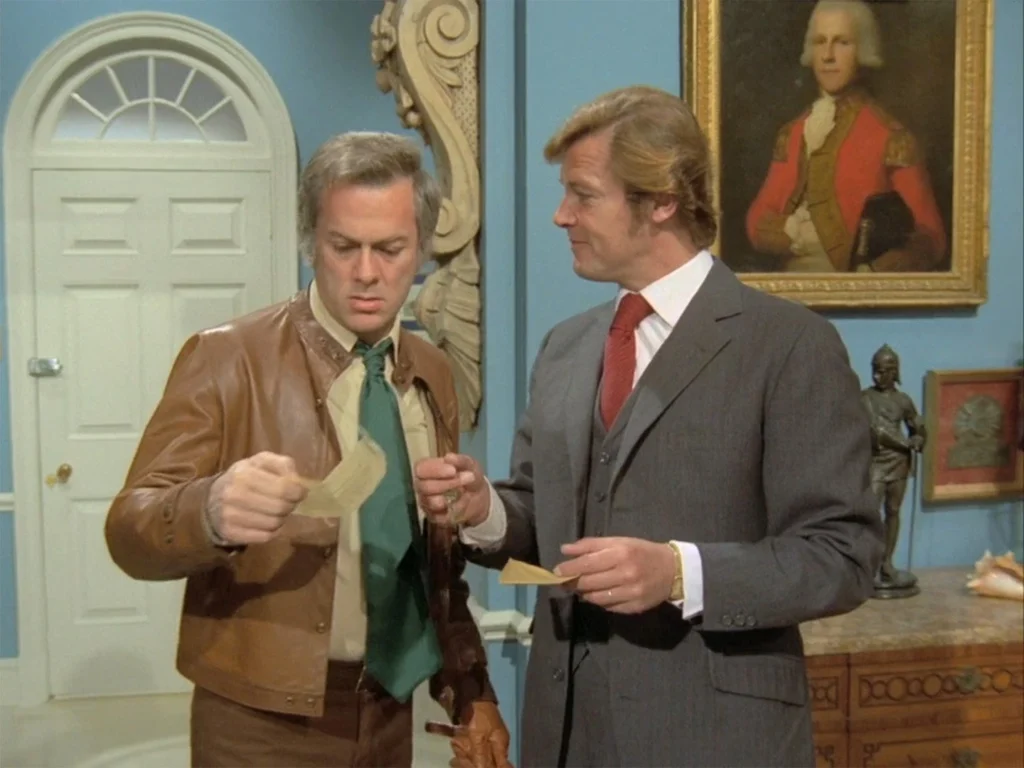
Baker openly described The Persuaders! as a glamorous show. Its expensive cars, elegant hotels, beautiful women and elaborate wardrobes were not merely decoration; they defined its heroes.
Curtis wanted Wilde to appear in different clothes from scene to scene. Sartorial interest aside, given Curtis’s competitiveness with Moore, the constant wardrobe changes were likely driven partly by ego—a determination not to be visually outdone by his impeccably dressed co-star. Across the series, Wilde wore a succession of suits, mixed jackets and trousers, open shirts, T-shirts and gloves. His wardrobe displayed wealth because he had earned it — and the character’s flamboyance.
Moore’s clothes involved a more unusual arrangement. He was then connected with the British textile firm Pearson and Foster, which supplied material and clothing for the series, and he received the memorable credit, “Lord Sinclair’s clothes designed by Roger Moore,” with his large signature underneath.
The credit made Moore’s role sound more comprehensive than it was. He helped establish Sinclair’s look and facilitated the commercial arrangement, while specialists including his longtime tailor Cyril Castle and shirtmaker Frank Foster turned that image into an actual wardrobe.
Sinclair’s clothes expressed inherited privilege: elegant and assured, but still with that need to impress, particularly in the vivid colours he wore on the Riviera. There was often a contrast between his vibrant, modern European wardrobe and the more traditional clothes he adopted when playing his part within the English establishment.
Danny Wilde dressed like a man who wanted the world to see how far he had risen. Brett Sinclair dressed like a man who had never needed to prove he belonged, but the flamboyance of his Riviera wardrobe revealed an important overlap between them. Beneath their different backgrounds, both men enjoyed spectacle, competition and making an entrance.
That shared quality helps explain Fulton’s chemical metaphor. Nitro and glycerine are not simply opposites forced together; they are volatile elements that combine readily and become more powerful in partnership. The same was true of Wilde and Sinclair.
Predictable in His Unpredictability
Goodman remembered Curtis as almost predictable in his unpredictability. When summoned to his dressing room, he might find the actor naked or wearing only a jockstrap, with “granny glasses” balanced on the end of his nose, drawing cubes or constructing strange arrangements from cigar boxes, earth and twigs.
That eccentricity carried onto the set. Curtis could resist direction simply for the sake of resisting it. Baker recalled a director asking him to enter through a door, only for Curtis to demand to know why he could not use the French window instead. Half an hour was then spent explaining why using the door was more appropriate.
Curtis also insisted upon performing dangerous stunts. Director Roy Ward Baker remembered him unexpectedly climbing up a drainpipe onto a rooftop approximately 60 feet high. The cameras were hurriedly turned over before he reached the roof.
Assistant director Ken Baker said Curtis “never said the same thing twice” and drove the continuity staff “nuts.” Curtis called himself an ad-libber, but his improvisation could alter scenes, dialogue and movement in ways that neither helped or strained the production.
Moore also improvised, but appears by all recollections to have possessed the better instinct for working within the script’s constraints, offering concise jokes and verbal “cracks” that added to a scene rather than rewriting it.
“Roger is the great ad-libber,” Goodman said. “Roger can come up with the cracks. But Tony, when he’s got the right lines, is obviously a great actor.”
When Curtis refused to say a line, Goodman recalled, Moore would often offer to take it himself.
“Roger always smoothed the path.”
Was There a Feud?
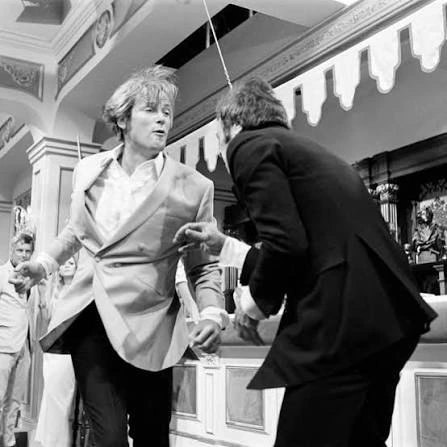
The reported feud between Moore and Curtis appears to have been exaggerated. There was genuine friction, largely caused by their different temperaments and working methods, but Baker said they generally worked well together and had no major personal arguments.
Goodman described Moore as “one of the most decent human beings out there in the world,” saying that this quality shone through in his performances. Moore was also self-aware enough to ask cinematographer Tony Spratling and camera operator Jimmy Devis to warn him when his famous raised eyebrow was becoming “a little bit over the top.”
Robert S. Baker reduced the contrast between the two leads to one provocative distinction.
“Tony is an actor. Roger is a star. That is the difference. But the combination of an actor and a star worked perfectly.”
Curtis brought intensity, technique and restless invention. Moore brought comic instinct, composure and the audience connection of a natural leading man. Whatever tensions existed, Moore later described their relationship as good both on and off screen, while Curtis insisted:
“We got along famously. What you saw on the screen is what we were like.”
The friction was genuine, but so was the friendship.
Success Everywhere Except America — Where It Mattered Most
The Persuaders! was first broadcast in Australia, where Baker said it became a “smash hit” and remained at the top throughout its run. In Britain, it ranked as the second- or third-most-watched programme, and it also became enormously popular across continental Europe.
“We expected to make the big time in America,” Goodman recalled, “but sadly we didn’t.”
The series faced Mission: Impossible and the movie of the week, while Moore believed ABC’s weak Saturday-night line-up gave it little support. It was later moved to Wednesday, where it again faced established competition.
Yet disappointing American ratings did not immediately kill the series.
Why There Was No Second Series
“Even if we hadn’t made the big success we thought we were in America, Lew was prepared to finance another series of The Persuaders!,” Goodman said. “But by that time Roger had been grabbed by the scruff of the neck to be the next James Bond.”
Grade initially considered recasting Sinclair, with Noel Harrison discussed as a possible replacement. Baker argued that Moore could not simply be substituted without fundamentally changing the programme.
“You alter the chemistry, you alter the show,” he said. “It’s not the same.”
Baker suggested they stop. They had made a very good show and should leave it there.
Grade agreed.
That was the end of The Persuaders!.