Tom Sims, Apocalypse Snow — and the James Bond Stunt That Transformed Snowboarding
Before 1985, few people had heard of snowboarding. Then out came A View To A Kill, featuring James Bond shredding down a mountainside in Siberia. The worldwide exposure of snowboarding in that one scene sent thousands out looking for their “skateboard in the snow.” Nobody sells a new sport better than James Bond—not even snowboarding legends Tom Sims and Steve Link, who doubled Bond in the sequence.
The snowboarding scene in A View To A Kill helped popularise snowboarding worldwide, and this is usually where the story ends. But the impact went deeper: the Bond film helped shape how snowboarding was received on snowfields in the United States and abroad, and helped determine which style of snowboarding would dominate.
Apocalypse Snow: The Snowboarding Short Film Inspired By Bond Ski Stunts
Before we get into that, the story of James Bond’s influence on snowboarding begins two years earlier with the French short film Apocalypse Snow (1983) by Régis Rolland. His short—first in a trilogy released from 1983 to 1986—re-did earlier Bond ski stunts, but with a snowboard. The Bond-style action almost singlehandedly launched snowboarding in Europe. The connection between James Bond and the Apocalypse Snow trilogy cannot be understated.
Rolland, an outstanding snowboarder, was fully conscious of the Bond influence:
“I think the idea came because they thought ‘Oh we’ll put some James Bond in there’… The snowboarder — which was me because we only had one — he would be the one who had the genius of the slide.”
— Rolland, White Lines, 2007
The first Apocalypse Snow film had a simple set-up: a team of “evil” monoskiers trying to capture the lone snowboarder for his sliding secrets — an excuse to stage jaw-dropping ski stunts reminiscent of On Her Majesty’s Secret Service, The Spy Who Loved Me, and For Your Eyes Only – but this time with a snowboard.
Many of those Bond stunts were created and filmed by Willy Bogner Jr., the “fastest cinematographer alive,” whose handheld skiing work revolutionised action ski sequences.
Bogner, of course, filmed the ski sequences in On Her Majesty’s Secret Service, The Spy Who Loved Me, and For Your Eyes Only.
Rolland mirrored Bogner in another way. Bogner’s short Skifaszination (1966) introduced skiing to the world long before he filmed Bond. Apocalypse Snow did the same for snowboarding in Europe. After the film, snowboarders were no longer pariahs — at least not in Europe.
But those views would be harder to shift in the United States, where snowboarding wasn’t even allowed on most snowfields.
Snowboarding in America still fought for legitimacy. Resorts banned snowboarders outright, viewing them as unruly outsiders rather than athletes. This resistance shaped the sport’s early identity and placed enormous weight on the few pioneers trying to push snowboarding forward in the U.S.
In 1985, the year A View To A Kill was released, only about 7 percent of U.S. ski resorts allowed snowboarders — roughly 40 mountains nationwide during the 1984–85 season. By 1989, that number had surged to around 75 percent.
The mid-1980s marked a pivotal shift: France and much of Europe had already embraced snowboarding, thanks in large part to the cultural impact of Apocalypse Snow, but in the United States the sport was only just beginning to be permitted on mainstream slopes.
Before this shift, many American riders had to sneak onto mountains after hours, hike up closed ski runs, or ride the higher, ungroomed sections of terrain just to get a few turns in. But the public interest in snowboarding — and the willingness of U.S. ski fields to capitalize on that interest — exploded after A View To A Kill, which introduced millions of people to the sport overnight.
This doesn’t take anything away from the pioneers of the sport, such as Jake Burton Carpenter and others who lobbied hard with ski areas to open their lifts to snowboarders. But it was the worldwide exposure of a specific kind of snowboarding in the Bond sequence — freestyle — that helped cement the style riders would adopt worldwide. And that style can be largely attributed to snowboarding legend Tom Sims — a master of all boards: skateboards, surfboards, wakeboards, and, of course, snowboards.
Enter Tom Sims
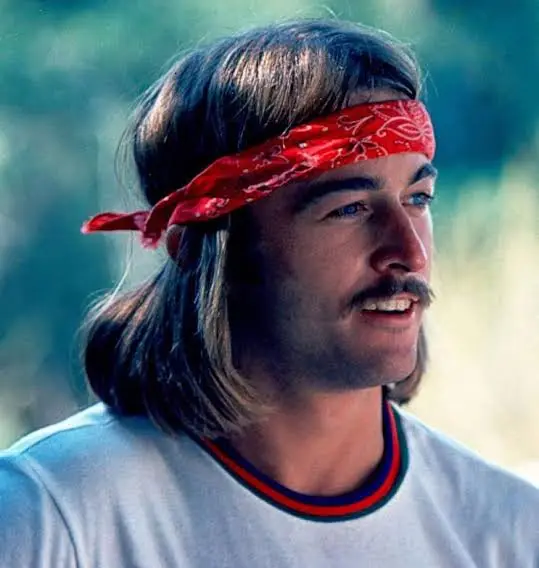
In this environment, no figure was more central to America’s early snowboarding story than Tom Sims. The origins of snowboarding are complicated, and Sims had his own version of how it began. The story goes that in 1963, at age thirteen, Sims was in wood class when he looked at the scoop on the front of a wooden boat and imagined a board that could glide across snow. He built his “skiboard,” as he called it, and shredded down local hills — only to have the “jocks” laugh at him. Whether or not this truly marks the birth of the modern snowboard, it forms one of the earliest rider-driven origin stories.
Two years later, Sherman Poppen invented the Snurfer — two skis bound together and a rope at the nose for guidance— bringing the idea to a mass audience. By the early 1970s, Dimitrije Milovich developed boards inspired by sliding on cafeteria trays, and Jake Burton Carpenter bought an early “skiboard” design from Bob Webber and refined it into the earliest Burton boards. Burton’s business and marketing infrastructure helped establish snowboarding commercially; Sims’s strength was riding — and innovating.
Sims brought a surf and skate sensibility to snowboarding, progressing the sport with equipment and ideas: the first metal-edged snowboard in 1983, the first women-specific board, improved high-back bindings (still standard worldwide), and the first halfpipe, followed by the first freestyle competitions. His riding style — expressive, fluid, airborne — made him one of snowboarding’s defining pioneers.
But despite all this, snowboarding remained marginalised in the United States. Resorts continued to view riders as dangerous and undisciplined; many refused to let them on lifts at all. In that climate, Sims’s freestyle — unconventional, skate-inspired, radical — was often seen as too far ahead of its time. And even within filmmaking, his abilities weren’t fully recognised: Willy Bogner, who had defined ski cinematography on three Bond films, noticed another rider first — Steve Link.
Ironically, the very style America resisted — Sims’s surf-skate freestyle — was about to become the style James Bond would showcase to the world.
A View To A Kill: How Sims and Link Entered the Bond Universe
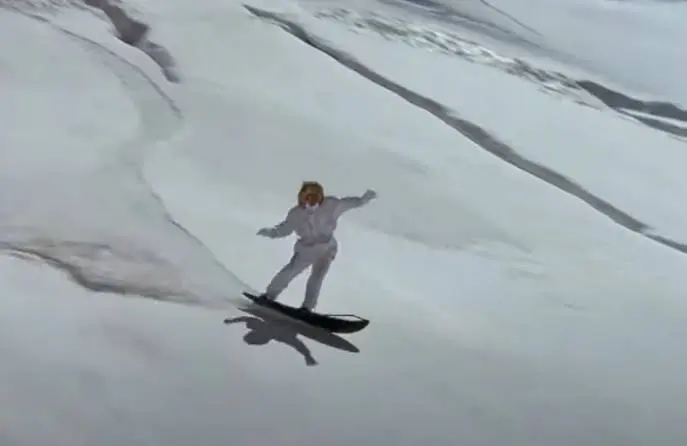
For A View To A Kill, Bogner wanted to combine ski and snowboard stunts to create the film’s pre-title sequence. The snowboarding footage featured Tom Sims and Steve Link doubling Roger Moore, disguised in a fur-lined white hoodie and white ski suit that blended into the Arctic environment.
The film opens with Bond behind enemy lines in Siberia. After a harrowing ski escape, a helicopter’s Gatling gun blows apart one of Bond’s skis. He commandeers a snowmobile, which is also destroyed. The only surviving piece — the snowmobile’s front runner — becomes Bond’s makeshift snowboard as he escapes to the Beach Boys’ “California Girls.”
But Sims wasn’t initially invited. While working on Bogner’s film Fire and Ice, he overheard crew members talking about Bogner’s next project — a James Bond movie. Sims later told White Lines (2010):
“So, I said, ‘Oh, can you get me in there?’ And they said, ‘What could you do?’ I was like, ‘What the fuck? You’ve just seen me ride!’ So anyway, I said I’d go down a mountain and go across a lake. Basically I made it up so he’d be interested.”
Bogner had already spotted Steve Link snowboarding in Colorado and hired him for Fire and Ice. He showed Link’s outtakes to producer Albert R. Broccoli, who approved including a snowboard sequence in A View To A Kill. Link was in; Sims had to lobby his way in — a continuation of the pattern that had defined his early career.
But, according to Sims, once he was on board with Bond, he devised the whole snowboarding sequence.
Filming the Sequence: Six Weeks on the Glacier
Production began on June 23, 1984, in Iceland with shots of Bond’s iceberg boat and an exploding helicopter model. The snowboard scenes were filmed on the Pers Glacier at the foot of Piz Palü in the Alps of eastern Switzerland. Starting in July, the sequence was directed by Leonhard Gmür and Bogner.
Sims and Link doubled Moore in the snowboarding scenes, which took six weeks to complete. Link told MI6-HQ in 2015:
“After the van ride up from the hotel in St. Moritz… we would be at the base of the mountain at the Diavolezza ski area with a helicopter waiting to bring us up to the base camp… a big tent, warm food, a chef, make-up people, the camera crew, ten skiers… a three-course catered lunch every day.”
Link’s “big air” shot — the low-angle leap off the snow cornice — remains one of the standout moments. Most of the snowboarding, however, was performed by Sims, including Bond’s surf across the glacial lake. The documentary Inside A View to a Kill incorrectly credited this stunt to “Steven Lincoln,” a misspelling of Link’s name, but the glide across the lake was unmistakably Sims.
When it came time to perform Bond shredding down a mountain slope and then surfing over the glacial lake, Sims encountered some anti-shred resistance from the Bond crew–including Bogner.
“Basically he told me to stop [at the edge of the lake] on a 40 degree pitch of solid ice. I said to Willy, ‘I’ll just go across.’ He said, ‘No, because there are no scuba diving guys and you’ll drown.’ Everybody is hearing this conversation and saying that the guy is gonna drown. So I bet everyone that I’d make it across. Haha! And I won thousands of dollars and got the shots as well.”
To create Bond’s improvised snowboard, Sims modified a board to resemble the snowmobile’s front runner. It looked similar to the Sims 1500FE boards of the time. The board was painted black and mounted with copper pipes.
“It looked like a fat water ski,” Link recalled. “Try snowboarding with spray paint and a heavy set of copper pipes mounted on the board! It was a drag — literally.”
Bond’s Global Impact — and the Victory of Freestyle
What Apocalypse Snow did for Europe, A View To A Kill did globally. But Bond did something more specific: it showcased Sims’s freestyle riding — playful, skate-inspired, expressive — at the precise moment snowboarding was struggling to define itself.
Burton championed alpine carving. Sims championed freestyle. Bond showed freestyle to millions.
The sport followed.
Snowboarding’s explosive growth in the mid-1980s and early 1990s aligned with the very style Sims brought to the screen. Bond didn’t invent snowboarding. He didn’t even pick sides. But by choosing Sims — and by choosing that style — Bond helped determine which version of the sport would become the global template.
Sims once said people laughed at him on the sledding hill in 1963. Twenty-two years later, that same style carried James Bond across a glacial lake and into cinemas worldwide.
The world wasn’t laughing anymore.