How Frank Rinderknecht’s iChange Brought Bond’s Remote-Controlled Car into the Real World
Frank M. Rinderknecht has built a career out of transforming cinematic fantasy into physical engineering. Few designers have embraced the playful, futuristic spirit of James Bond gadgets as wholeheartedly—or as credibly—as the founder of Rinspeed. His creations have long hovered at the boundary of science fiction, and none illustrate that better than two of his most famous concept cars: the sQuba and the iChange.
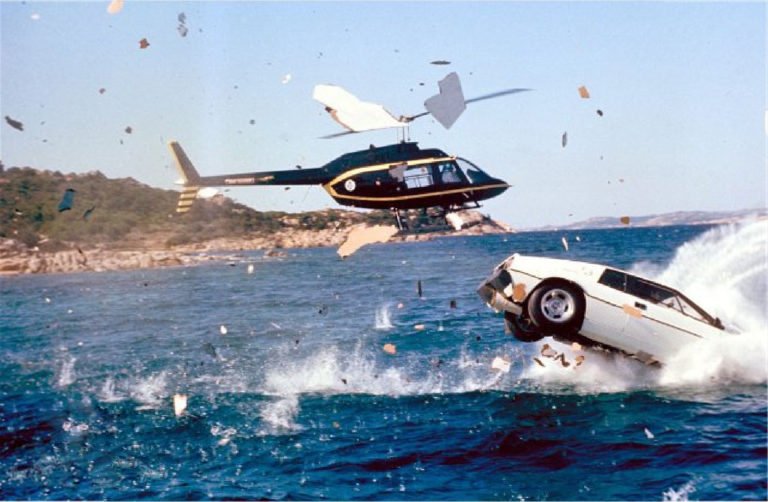
Rinderknecht first made headlines in 2008 with the sQuba, a fully functional submersible car directly inspired by the Lotus Esprit submarine from The Spy Who Loved Me. While Bond’s Esprit appeared to be elegantly sealed, the real-world sQuba operated as an open-top “wet sub,” its cabin intentionally flooding while occupants breathed through scuba regulators. It was a bold, audacious attempt to recreate one of the most iconic Bond sequences ever filmed. And it worked. The sQuba remains the world’s only true underwater car.
But after proving that one of Bond’s most impossible vehicles could exist in the real world, Rinderknecht set his sights on another piece of 007 lore—this time, from Tomorrow Never Dies.
In that 1997 film, Bond pilots his BMW 750iL through a crowded parking garage using nothing but an Ericsson cellphone. At the time, remote controlling your car via cellphone seemed like playful sci-fi flourish. But over a decade later, Rinderknecht unveiled a concept that made the idea startlingly real.
A Shape-Shifting Electric Car Controlled by a Phone

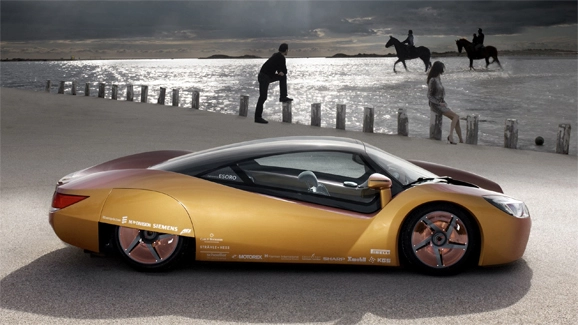
In 2009, Rinspeed introduced the iChange, one of the most forward-thinking electric concept cars ever created. At first glance it looked like a sleek, minimalist sports coupé—low, narrow, and aerodynamically compressed to a razor’s edge. But the illusion changed the moment the car was activated.
The iChange’s most striking trait was its ability to physically transform its shape. In its single-seat “driver only” configuration, the roofline lay impossibly low to reduce aerodynamic drag. But with a tap on the interface, the rear section of the roof lifted upward, expanding the cabin and creating room for two additional passengers. With its servo-actuated roof module rising or lowering on demand, the iChange became a rare example of a genuine shape-shifting road-going vehicle—technology straight out of Q Branch, executed with Swiss precision.
But the car’s control system is equally impressive.
The iChange was designed to be operated, configured, and even driven via an Apple iPhone. This was not a gimmick. The iPhone served as the primary key and command interface, communicating directly with the car’s digital nervous system. Through a custom app, the driver could unlock the car, start it, adjust its cabin configuration, manipulate the shape-shifting roof, and—most impressively—drive the car remotely at low speeds.
In 2009, long before Tesla’s Summon or BMW’s remote parking existed, the iChange showed the world the first credible vision of a smartphone-operated vehicle.
How the iPhone Control System Worked
The iChange’s smartphone interface functioned because the car was engineered from the ground up around drive-by-wire technology. There were no traditional mechanical linkages connecting the steering wheel, throttle, or brakes. Instead, every control input existed as a digital signal.
The iPhone communicated with the vehicle using a secure wireless protocol—industry commentators at the time described a Wi-Fi or RF-based system. The car’s electronic control unit translated touchscreen swipes and virtual button presses into physical actions:
- steering motors adjusted wheel angles
- brake actuators engaged electronically
- the power controller modulated torque delivery
- the roof module lifted or lowered via servo rails
To ensure safety, remote-driving mode was limited to low speeds, and the system included redundancies: if the wireless connection failed or if the user released the interface, the car halted immediately.
It was a fully realized teleoperation platform and it predated the current remote control landscape by nearly a decade.
Real-World Remote Summon: Bond Predicted the Future

While Tomorrow Never Dies showcased Bond steering his BMW with a phone, The World Is Not Enough featured a different kind of remote control: Bond presses a button on his keyfob and his BMW Z8 drives itself out of a tight parking space straight to him.
At the time, it looked like a fun movie convenience. Today, it’s a real automotive feature.
Several modern carmakers now offer remote summon systems that mirror that exact Bond moment:
Tesla
- Smart Summon lets the car navigate a car park and drive to its owner
- Controlled through the Tesla smartphone app
BMW
- Remote Control Parking (on the 7 Series)
- Uses the keyfob to move the car forward or backward—almost identical to Bond’s Z8 scene
Mercedes-Benz
- Remote Parking Pilot
- Allows the car to manoeuvre out of tight spaces via a phone app
Hyundai / Kia / Genesis
- Remote Smart Parking Assist
- Press buttons on the keyfob and the car drives to you
Bond predicted it.
The iChange helped prototype it.
The parallels are unavoidable:
- Bond drove a car with a cellphone → The iChange could be driven with an iPhone.
- Bond summoned a car with a keyfob → Tesla, BMW, Genesis, and others now offer identical features.
- Bond movies imagined it → Rinderknecht engineered it.
In a sense, the iChange is the missing link between cinematic fantasy and the technology now sitting in millions of driveways.
Public Reaction and Media Coverage
When the iChange debuted at the 2009 Geneva Motor Show, it was met with equal parts astonishment and admiration. Journalists immediately drew the connection to Bond, calling it “a real-life Q Branch experiment” and “the car you can drive with your phone.” Its shape-shifting ability further cemented its reputation as something out of the future.
Technology outlets praised its forward-thinking digital ecosystem; environmental writers appreciated its clean, electric powertrain; automotive purists respected its engineering audacity even if they questioned its practicality.
And while no major manufacturer rushed to copy Rinspeed’s design, the automotive world has since moved decisively in the direction the iChange pointed:
- Smartphone-based vehicle control
- Remote summon functionality
- Software-defined cars
- Adaptive bodywork in high-efficiency EVs
The iChange wasn’t just a concept car. It was a concept of where the automotive world was going–at least in part.
But fantasy elements still remain. Unfortunately, there seems to be no demand for underwater cars or cars that can shape-shift. At least not yet.
Nonetheless, what Bond films dreamed, Rinderknecht engineered into reality.