New Bond, New Aston Martin: The Making of the V8 Chase in The Living Daylights
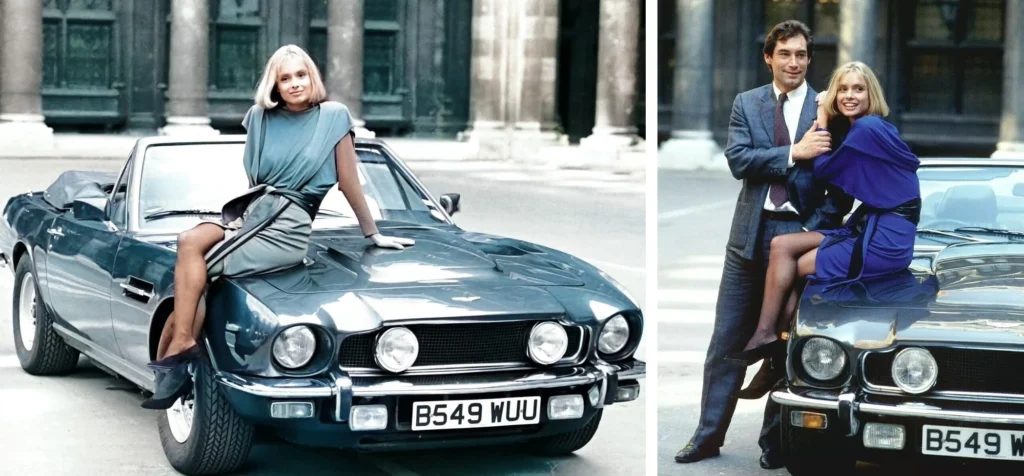
On 5 October 1986, in Vienna, Timothy Dalton was introduced to the world as James Bond. He stood alongside Maryam d’Abo — his Bond girl, Kara Milovy — and answered journalists’ questions at an international press conference, the day before filming began on The Living Daylights. Also present, parked beside them for the cameras, was Bond’s new car: the Aston Martin V8.
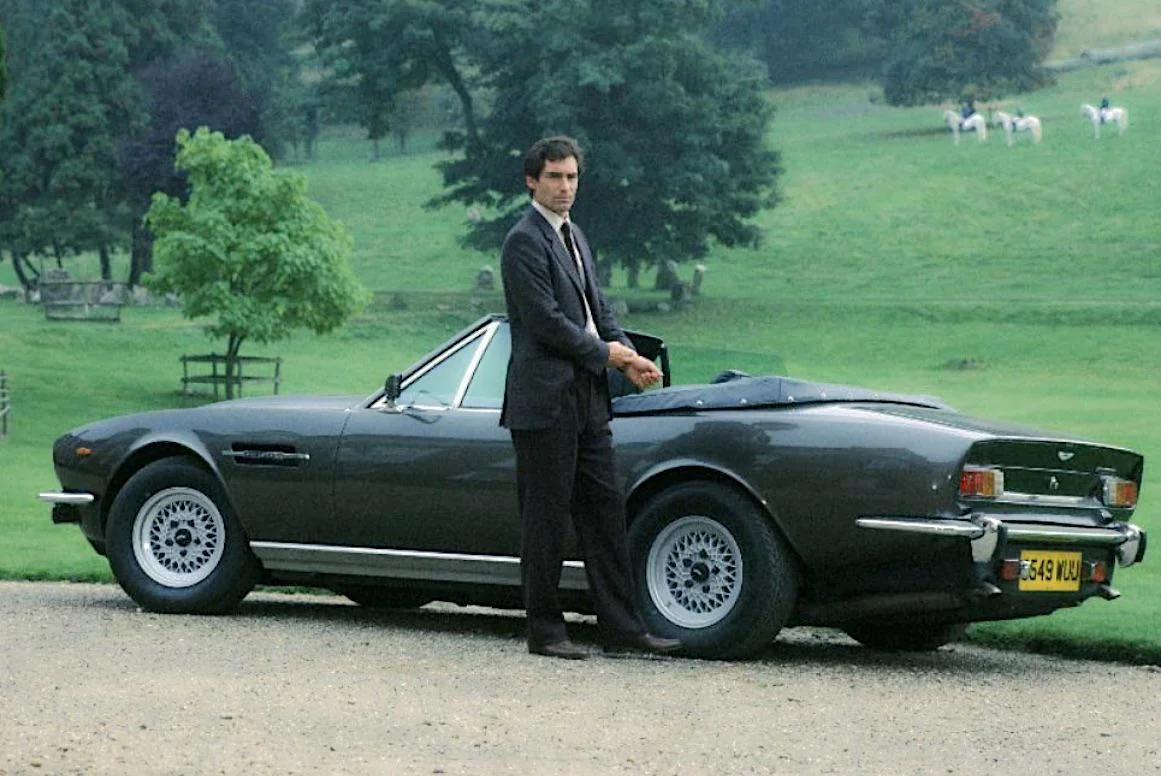
The car was the personal V8 Volante of Victor Gauntlett — chairman of Aston Martin Lagonda — who had driven it out to Vienna himself for the production. That Gauntlett drove his own car to Austria for a Bond film was not vanity. It was necessity. By the 1980s, Aston Martin was fighting for survival. Recession had nearly finished the company off entirely, and it was Gauntlett — a charismatic businessman, car enthusiast and aviator whose success in the petrochemical industry had led him to invest in the brand at its lowest point — who kept it alive. There is little doubt that Aston Martin might have disappeared altogether were it not for his commitment, and the deal he later brokered with Ford in 1987. Getting the brand back into Bond was part of that fight, and Gauntlett dealt with Cubby Broccoli directly to make it happen.
The stakes were significant. Aston Martin had been absent from the Bond series for 18 years — since George Lazenby’s one-shot appearance in On Her Majesty’s Secret Service in 1969. Eight films had come and gone without an Aston Martin in sight. The association between the brand and 007 — forged so indelibly by the DB5 in Goldfinger — had faded. Gauntlett understood that a Bond film was the most powerful advertisement Aston Martin could buy. As it had done for the DB5 after Goldfinger, the exposure could transform the brand’s fortunes overnight. He was right. In the film, both the V8 Volante and the V8 Vantage appear — and only eagle-eyed fans and Aston Martin enthusiasts will notice the two different models doubling as the same car throughout. The V8 Volante is a convertible, while the V8 Vantage is a hard-top, connected by a bit of Q Branch trickery when a faux hard top is lowered onto the convertible. “Winterizing” is what Q calls it — a neat sleight of hand that transfers the action seamlessly from Volante to Vantage.
Introducing a new Bond with his new car is no accident. It’s not just about introducing the latest Aston Martin model to audiences — which is important — but also about introducing the right car for the new Bond. In the Bond series, a new Bond has always meant a new car — and the two are never introduced separately, because they are never really separate. The car, whatever make and model, is itself a symbol of whatever iteration of the character the actor brings.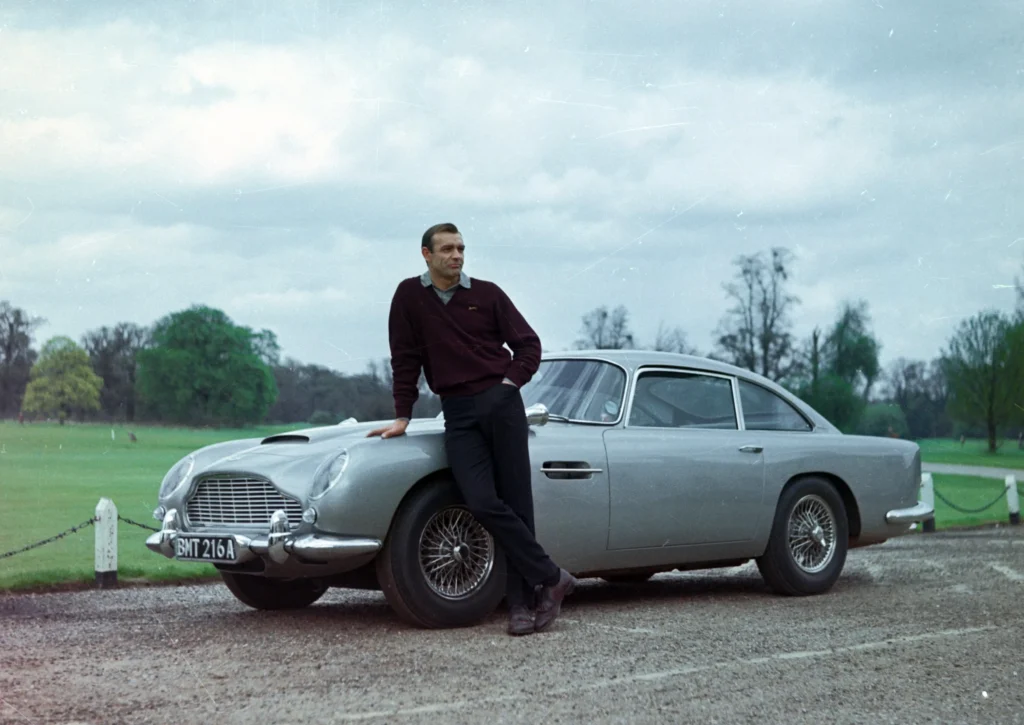
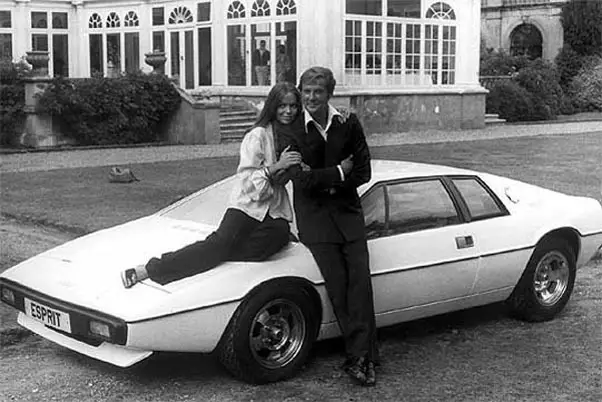
Connery’s Aston Martin DB5 embodied his Bond perfectly: weaponized elegance, violence concealed beneath a gentleman’s grand tourer. When Roger Moore took over, Lotus replaced Aston Martin entirely. The Esprit S1 was — at the time — modern, futuristic, and almost playfully transformative — a car that could become a submarine, driven by a Bond who treated espionage as an extended international holiday. Moore’s Bond needed a car that distinguished him from Connery entirely, and the sleeker Lotus delivered.
Dalton’s Bond had a natural conundrum. Should his Bond embrace an entirely different British car — a Jaguar or even a Bentley, like the literary 007 whom Dalton’s Bond emulated? Continuity mattered. Aston Martin came back into the frame — its models were more sporty than the statesman-like Bentleys anyway. And with George Lazenby having already accepted the Aston Martin baton from Connery, the choice for Dalton seemed obvious, though it would need to be suited to his persona. When The Living Daylights arrived in 1987, it came with a deliberate course correction — away from Moore’s lightness and back toward Ian Fleming’s literary 007: dangerous, psychologically complex, capable of genuine violence. Dalton’s Aston Martin became a statement distinct from Connery’s DB5. It doesn’t arrive in Silver Birch — that pale, gleaming color inseparable from the DB5 and everything it represents. It arrives in Cumberland Grey: darker, heavier, more matte in its presence. A color closer in spirit to George Lazenby’s DBS in On Her Majesty’s Secret Service — the darkest Bond film, the most Fleming-faithful, the one where Bond experiences personal loss. The shade is almost a statement of intent. This is not a return to Goldfinger. This is a return to something more serious than that — the producers admitted they wanted something closer to From Russia With Love.
The V8 Vantage makes that argument in metal and paint. It is still an Aston Martin — still sophisticated, still unmistakably British, still a grand tourer in its bones. But where the DB5’s sophistication was the point, the elegance concealing the violence beneath it like a gentleman’s secret, the V8 wears its danger closer to the surface. It is muscular where the DB5 was refined — more blunt instrument than gentleman’s weapon, like Dalton himself.
Dalton operates the same way. The suits are there. The champagne and martinis are there. The opera houses and hotel suites are there. But the danger is always visible on the surface — in the eyes, in his brooding, in the way he holds himself throughout the film. It never quite retreats. The car and the man are the same proposition. And on that October morning in Vienna, standing beside it for the cameras, Dalton and the V8 were introduced to the world together — as they should have been. Crucially, the car chase that follows would be driven by Dalton like a battering ram — forward-facing, bracing for impact, a blunt instrument in motion.
Aston Martin Returns
EON Productions made a deal with Aston Martin Lagonda to showcase their V580 models, specifically the V8 Vantage and V8 Volante. Art Director Terry Ackland-Snow remembered how it came together: “Cubby Broccoli and Michael Wilson were deciding what car to use. I got Aston Martin to come down to Pinewood with a Volante. Cubby Broccoli sat in it and Michael Wilson drove it. They said, ‘Can we take it for a spin?’ They went to Slough and back. Cubby loved it. The waiting list was two years. Cubby asked them to deliver them in six weeks.”
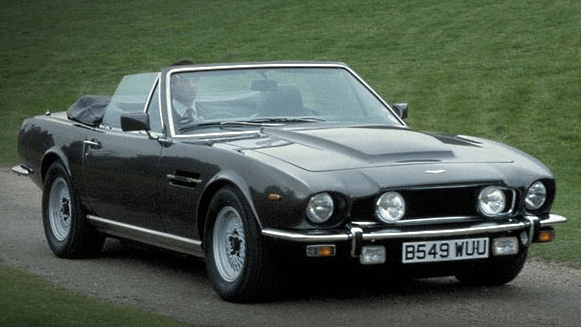
Peter Lamont was amused at the dedication that followed. “Tom Pevsner and I had to go up to Newport Pagnell to see Victor Gauntlett who ran Aston Martin at the time. They were all hard tops. The open top in the film was Gauntlett’s car. When we wanted his Aston in Vienna he said, ‘I’ll bring it out!’ — and he drove it out there for us.” It is Gauntlett’s personal V8 Volante — fitted with a Vantage engine — that we see Bond driving as he arrives at the fictional Blayden House MI6 stronghold, filmed at Stoner Park near Henley-on-Thames in Oxfordshire. “It was a great positive,” Michael G. Wilson observed of Aston Martin’s return. The positivity worked both ways — as it had after Goldfinger, the brand’s association with Bond would prove as valuable to Aston Martin as the car was to the film.
The V8 Volante makes its first appearance at Blayden House. It then reappears in Q’s lab, where a fake hardtop is lowered onto the convertible to “winterize” it for the Czechoslovakia mission — the sleight of hand that transitions the production seamlessly from the Volante to the hard-top Vantage used in the car chase itself.
“A Few Optional Extras”: The Design and Conception of the Gadgets
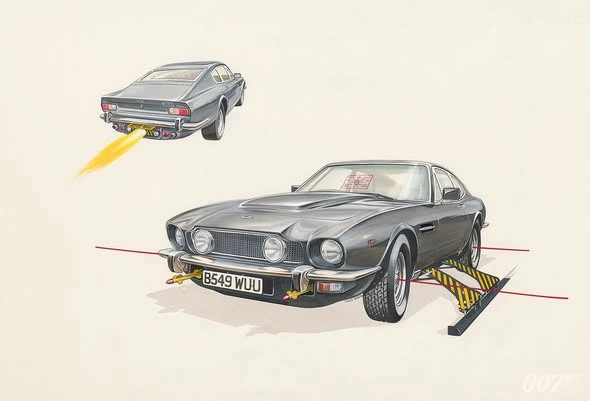
The V8 Vantage featured an array of gadgets. Like past vehicles, this car took some inspiration from the Aston Martin DB5 in Goldfinger. But the Aston Martin V8 holds the distinction of being the first gadget-laden Aston Martin since the iconic DB5 — and it didn’t merely update the formula. It escalated it.
Dalton’s trick car modernized and weaponized many of the DB5’s gadgets. The scythe-like tire slashers became laser beams firing from the hub caps. The bullet-proof shield was replaced by bullet-proof body armor and “modern safety glass”. And the front left and right machine guns hidden behind the DB5’s headlights were replaced by two missiles hidden behind the Vantage’s fog lights. Most significantly, those missiles are targeted via a heads-up display projected onto the inside of the windscreen — a technology borrowed directly from military aviation, where jet pilots had been using HUD targeting systems for years. Transposing it to the interior of a road car was genuinely novel for 1987, and it does more than any other gadget to establish the V8 as a weapons platform rather than a trick car. It also does the dramatic heavy lifting in the trailer sequence — without the two sights converging on screen, there is no build-up, no held breath, no moment of genuine uncertainty before Bond fires. The HUD is the gadget that creates tension rather than resolving it.
Other optional extras installed by Q Branch included a scanning digital radio picking up all police and military radio bands, a jet engine booster propelling the car at breakneck speeds so it can launch off a ramp, tires with studs so it can drive on the ice, retractable outrigger skis hidden underneath the doors to allow the car to steer on the ice, and a self-destruct mechanism Bond uses to escape after the car is ditched in the snow.
The outriggers had an unexpected origin. Director John Glen had originally gone to Weissensee to incorporate the local sport of ice sailing into the film, developing a big action sequence with boats on skis whizzing around the lake. The idea was adapted and the skis were given to the Aston Martin instead — meaning the car’s most distinctive gadget on the ice was essentially transplanted from a scrapped set piece.
Some have observed that the gadget-laden V8 was Bond’s way of taking back the concept from a host of TV imitators — most visibly KITT, the talking supercar from NBC’s Knight Rider, which had spent four seasons in the mid-1980s doing what Bond cars did, but weekly. The turbo boost, the onboard computer, the arsenal of defensive systems — the comparison is superficially plausible. But the V8 Vantage is a fundamentally different proposition to KITT. Where KITT is a companion — witty, protective, almost domestic — the V8 is a siege machine. Goldfinger’s DB5 provided the base, but it also incorporates one gadget from the Batmobile — its rocket booster. The idea would be escalated considerably by Anton Furst two years later in 1989’s Batman.
Building the Cars
Sources vary on the exact number of cars used in the film production. Using the Aston Martin chairman’s car for the action sequences was never going to fly. But with an 18-month waiting list on new V8s, the production crew sourced second-hand V8s and brought them up to spec with a fresh coat of Cumberland Grey paint, refurbished black upholstered interiors, and fitted Webasto-style sunroofs, used to create appropriate lighting for interior shots.
The producers bought three V8 saloons, all of which were prepared for filming by Aston Martin, and seven fiberglass mock-ups were also constructed for the more brutal parts of the sequence. At least ten cars were used specifically for the ice-bound car chase in Czechoslovakia.
Details behind four of those ten cars exist, each labeled by a number during production. Number 1 was used for close-up scenes, including Bond driving. Number 2 and Number 10 were stunt cars and Number 3 was refitted for special effects. Number 10 — equipped with a jet-powered rocket booster and ski-type outriggers — was fully restored, re-fitted with a Vantage specification engine and five-speed gear box and retained by EON Productions until 1995.
Filming the Sequence
The final sequence was shot around and on Lake Weissensee in southern Austria, doubling for Czechoslovakia. The Austria location work — encompassing both the road sequences and the ice lake — was shot in January 1987 as part of a nineteen-week production schedule that wrapped at Pinewood Studios on 13 February 1987. The road stunts and the ice lake sequence were the domain of second unit director Arthur Wooster, who handled all the stunt work throughout the film. Glen joined Wooster on location for three days to shoot close-ups with Dalton and D’Abo, but the sequence as seen on screen is overwhelmingly Wooster’s work. It was perilously cold — temperatures dropping to 30 degrees below zero — and that cold would prove to be as much an adversary as any Czech policeman.
The crew had to drive across the lake each morning to reach the filming location, and Richardson could still hear the noise of the ice cracking beneath them as they moved over it. The danger was not hypothetical. One evening, a safety crewman clearing fresh snowfall off the ice with a bulldozer dropped straight through it — fortunately into a shallow area. He admitted the water was rather cold.
Every gadget in the car had been scripted and storyboarded long before the vehicles came into Richardson’s workshop. The sequence was planned shot by shot, gadget by gadget, in chronological order — and it unfolds that way on screen.
The Laser Hubcaps
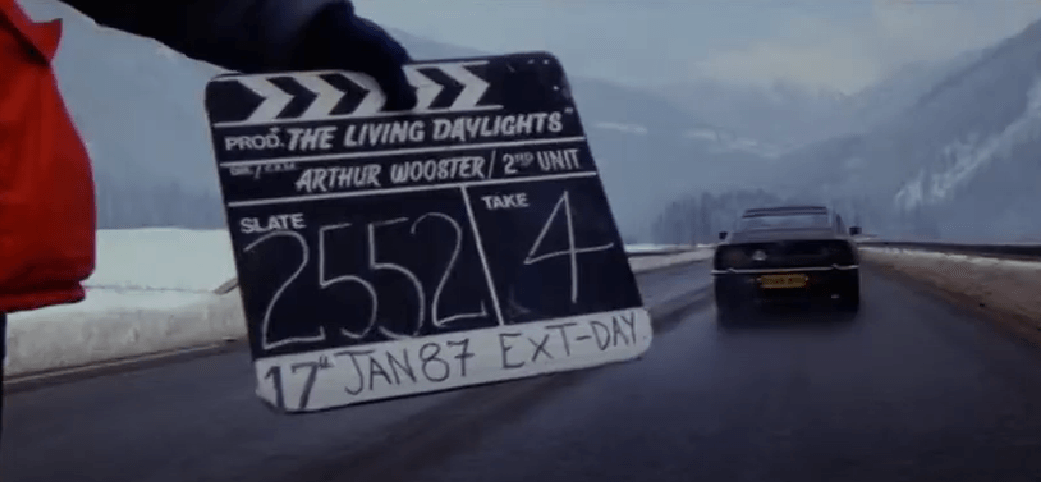
The sequence begins on the roads leading to Lake Weissensee, filmed from 17th to 20th January 1987. Bond and Kara Milovy encounter a police car alongside them — and Bond uses the laser beams firing from the wheel hubs to sever the police car’s body clean from its chassis, slicing it in half at speed on the road. Building a car that could come apart that convincingly, with two people still inside it, was one of the sequence’s most demanding practical challenges.
“Building a car to come apart was a fairly difficult job,” Richardson noted, “because we had to have two people in it. We had to make a compact body shell for them to sit in; but when the car came apart, they still had to get past the wheels and over the chassis — I was worried about it, but I thought it cut in very well.”
Several different techniques were employed to suggest the actual cutting. The wide shot used a pyrotechnic effect — burning away a thin lead sheet. For the very close-up shot, Richardson used an oxyacetylene torch burning through from the inside, giving a slightly bluish effect. For that gag, the car was on a rolling road on the stage with an effects man inside operating the torch. The car was held together and towed for the shot, and at the right moment the two pieces were released. The laser beams themselves were animated in post-production.
The Missiles and the Semitrailer
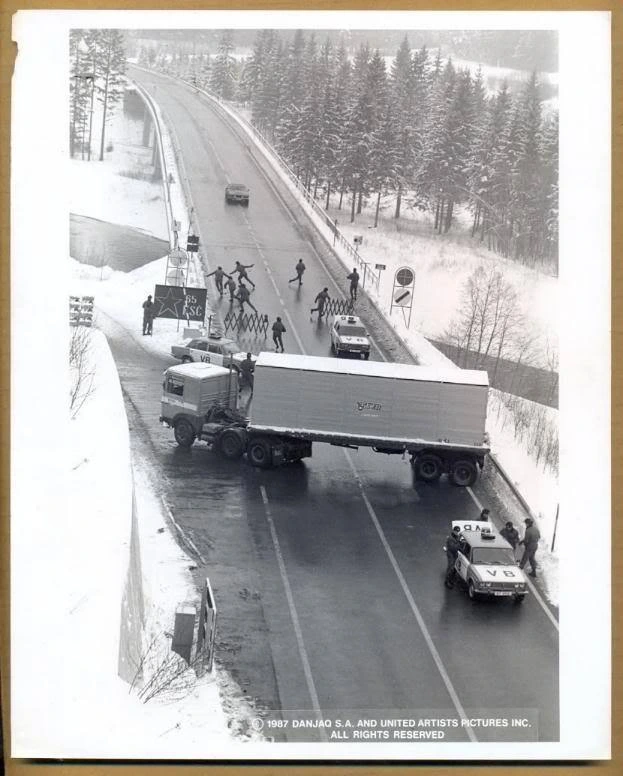
A helicopter shot establishes Bond’s approach to a truck and semitrailer blocking the road — a roadblock designed to stop him dead. What follows is one of the most carefully constructed beats in the sequence, and one that signals immediately that this chase is operating in a different tone from anything that came before it in the Bond series.
Richardson was especially proud of how the shot was engineered.
“From inside the car, you see the two targets come together on the windscreen. Then we cut to a moving POV outside where we see two missiles fire toward the truck and blow up — all in one shot! It’s so quick that only an aficionado would appreciate it.”
Two wires ran along the road, with the missiles sitting on them ready to fire. A camera tracked along at car height on an outrigged arm, so that when it drew level with the ends of the wires it was at exactly the right height for the bumper of the car. With the camera still tracking forward, they fired the two missiles. They came out from under the camera, went straight down the wires, hit the truck — and Richardson blew it up on a visual cue. No opticals.
Explosives had already blown up a life-size semitrailer for the approach shot. But the special effects department could not guarantee that the blast would blow a clean hole in the trailer for an Aston Martin to drive through. So they separated a second semitrailer into two parts and did a controlled explosion to capture the Aston Martin driving through the inferno.
The Vantage “Wears” A Fishing Hut
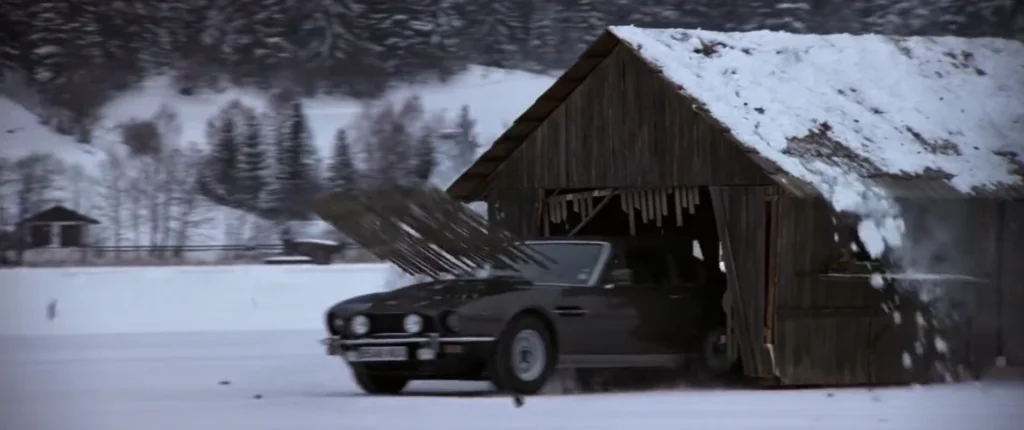
The ice on Lake Weissensee was around 12 inches thick — enough to support the cars, but only just, as the production would discover. The Aston Martin was fitted with skis, and one front nearside wheel was stripped of its tire entirely, leaving just the bare rim — the instrument that would be used to cut a circle in the ice beneath a pursuing police car.
At one point in the chase, Bond drives the Aston Martin straight into a fishing hut, briefly wearing it as an unlikely disguise before bursting through the other side. Later, the car mounts a ramp and smashes through a guard house, reducing it to pieces. Two structures were built for these sequences: one of balsa wood that the car could drive straight through, and one on a frame that the Aston could effectively “wear” — driven onto it so the structure sat over the car for the shot.
Richardson observed the cumulative toll the sequence took on the vehicles:
“Unless you’ve got an unlimited supply of action vehicles, which you rarely do, they have to be nurtured and caressed, as they suffer constant abuse.”
The Outrigger Skis and the Ice
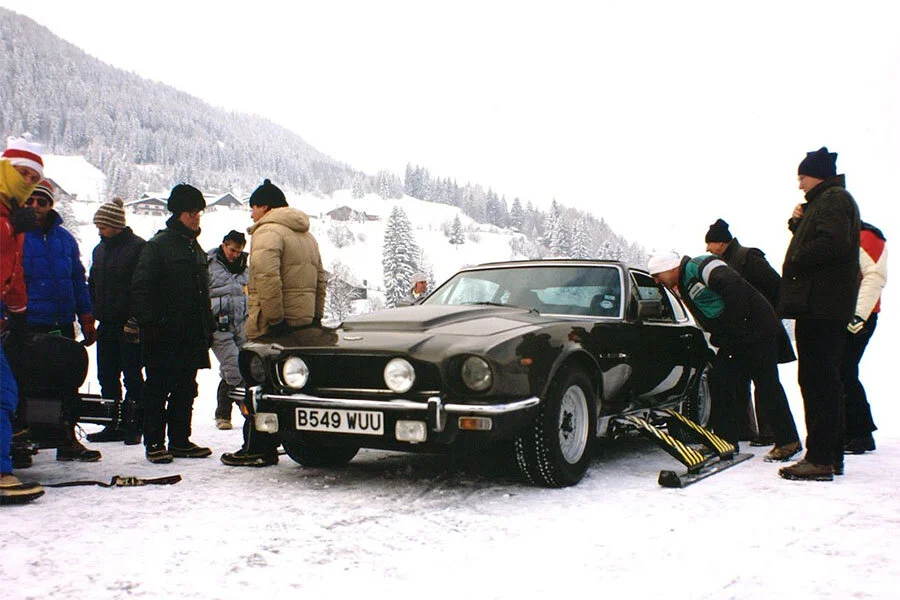
Bond activates the retractable outrigger skis hidden beneath the doors of the Aston Martin to stabilize the car across the frozen lake. The sequence was storyboarded by Ackland-Snow in detail before filming — a rarely seen board survives showing the Aston Martin sprouting its skis as it pursues Czech police across the ice.
The skis were made practical on one of the dummy cars so that they actually came out and folded down. Other sets were then fitted to the real cars so they could be driven out on the ice. Richardson was also careful about the tires. One car was rigged with studs that would pop out for the gag shot. The real cars were then outfitted with standard studded tires — a necessity for driving on ice at speeds of up to 80 miles per hour. Without them and the skis, the vehicles would have had no traction. Remy Julienne and his stunt team were enlisted to do the driving.
Beyond the outriggers, there was an earlier stunt in which Bond uses the spinning wheel rim — after a tire is shot out — to slice a hole in the ice into which his pursuers fall. The tireless rim cuts a huge hole, and the pursuing cars plunge through. Though the chase was shot on location in the Austrian Alps, the sinking car sequence was not. It was photographed at the studio, in an outdoor tank equipped with a hydraulic rig for submerging the vehicle. The icy lake top was constructed from fiberglass and covered with marble dust snow. Real trees and a painted backdrop completed the illusion.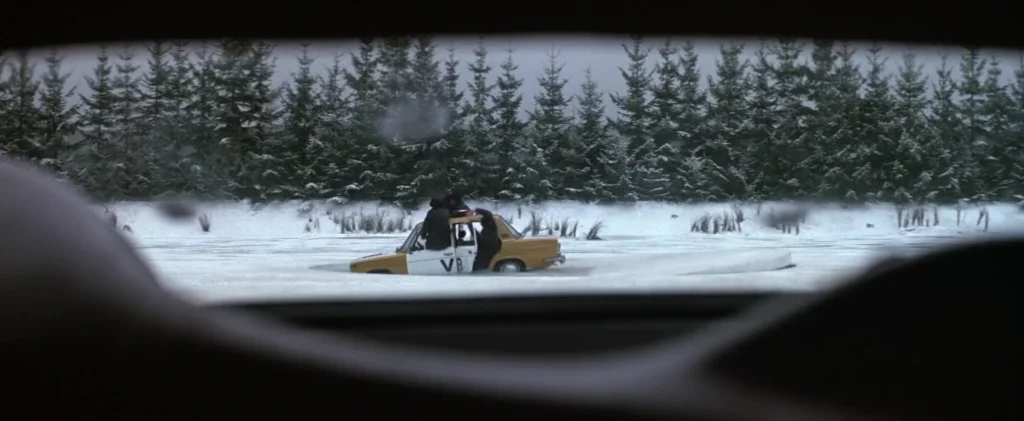
Before any of this could be filmed cleanly on location, however, the production nearly lost its principal car. During take one on the actual lake, the weight of the Aston Martin broke through the surface ice and the car began to sink. The crew rescued it and relocated to the other end of Lake Weissensee, where the ice was sturdier. It was the first of two near-disasters on the frozen lake. The second would come from the cold itself.
The Car Jump off a 50-foot-long Ramp
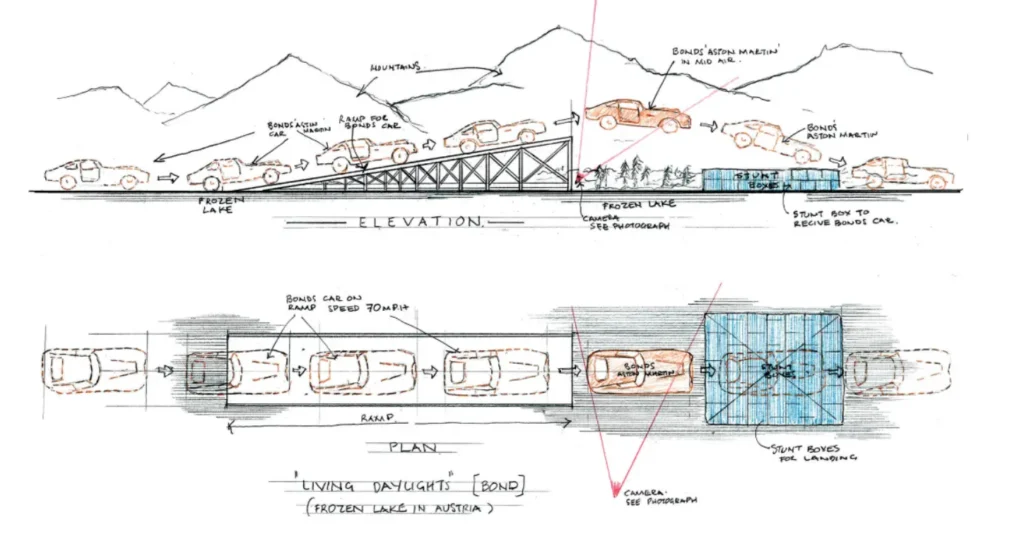
Bond activates the jet-powered rocket motor and launches the Aston Martin over a guard house and down a slope into its final resting place buried in snow. Director Glen wanted to see the car flying through the air — and Ackland-Snow designed a ramp to make it happen. A 50-foot-long by 12-foot-high ramp was fixed to the frozen lake, with a gap of 45 feet separating it from the stunt boxes positioned for the landing. The car had to travel at exactly 70 mph to ensure the right height and accuracy. The stuntman got somewhat carried away. He hit the ramp at 90 mph — twenty miles per hour over the target speed — and only just made contact with the stunt boxes. As Ackland-Snow noted: “He was a lucky man.”
Finding the right location for the crash landing required its own adventure. Ackland-Snow, Richardson, and Barbara Broccoli set out on a Snowcat to find a suitable spot in the snowy woods where the car could hit a tree and blow up. They found what looked like a promising location, and Ackland-Snow jumped down to check it over properly, ignoring the driver’s warning. He sank into the snow almost up to his neck. When they stopped laughing and pulled him out, the driver pointed out that although the trees looked full size, they were only seeing the tops. The rest was buried by the snow.
This was where Chris Corbould ran into the shoot’s most costly technical disaster. At 30 degrees below zero, the compressed air system that would fire the car up the ramp became the problem.
“It was like 30 below out there and we fired the car with compressed air,” Corbould recalled. “Because of the extreme cold, the valves instead of opening ever so quickly, the valves had contracted and it opened ever so slowly.”
Richardson remembered the chaos that followed:
“We were running around with blowtorches and heaters and trying to warm everything up. [It wasn’t enough.] And the car instead of firing off like mad, just went ‘bloop’ and went straight into the hut,” Corbould continued. “Total disaster. I went over to Cubby and said, ‘I’m terribly sorry Cubby.’ He said, ‘Don’t worry. We’ll come back tomorrow and we do it again.'”
Cubby had already quietly paid for everyone’s drinks at the hotel bar by the time the crew got back that night. The next day they regrouped on the lake.
“We went back next day. Cubby sat down in the same seat. We fired it and it flew like a dream and looked great. And I went up to him and said, ‘Was that better Cubby?’ He said, ‘Yeah. That’s exactly what I knew would happen.'”
Ackland-Snow had prepared detailed elevation and plan diagrams predicting the arc of the car as it cleared the ramp — showing the 70 mph approach speed, the car in mid-air, the 45-foot gap to the stunt boxes, and the camera position on the far side of the lake. In the final film, the jump and the crash down the slope were shot in two different — though nearby — locations.
The Self-Destruct and the Cello Case
After the car is cornered and Bond triggers the self-destruct, the Aston Martin is ditched in the snow. The gadget-laden car is gone — but the chase isn’t over. The car that explodes is one of the seven fiberglass replicas built for the production — none of the three real V8s were destroyed. John Glen had suggested a novel escape: Bond and Kara fleeing the mountain in her cello case, used as a makeshift toboggan. Cubby was unconvinced. It was only when Glen demonstrated it was physically viable — after they both visited an MGM sound stage in Los Angeles to try one out — that it was approved. Richardson’s team adapted a strengthened case fitted with custom skis and a steering mechanism. Dalton threw the cello into the air himself for real as they passed beneath the security barrier.
D’Abo remembered the filming:
“We spent two or three days doing scenes where Bond and Kara escape down the mountain in the cello case. They had placed little explosives under the snow so it looked like they were shooting at us. I have a phobia of big bangs, guns and explosions — I would be wearing a Walkman with loud music to block out the noise. I was terrified.”
Premiere, Forward-Facing Action, and Its Impact on the Series
On 29 June 1987, the royal world charity première of The Living Daylights was staged at the Odeon Leicester Square — renamed James Bond Square for the day in honor of the series’ Silver Jubilee. Prince Charles and Princess Diana attended and examined the tricked-out Aston Martin Volante parked in front of the cinema. The square was packed with a-ha fans who witnessed a stuntman abseil down the front of the theater to coincide with Timothy Dalton making his entrance in the televised broadcast later that evening.
Dalton arrived with D’Abo, but the police had shut Leicester Square and wouldn’t let their car through. D’Abo recalled the chaos: “The bobby just didn’t believe Timothy was James Bond! Timothy took me by the hand and we had to fight through the crowds. I was tip-toeing in my tightly fitted Ungaro dress. When we arrived at the main entrance, the crowds suddenly parted when they realized we were the two unknown new leads.”
The new direction and the new Bond were a creative shot in the arm for EON, as worldwide grosses bounced up to $192 million. But the ice lake sequence had done something more significant than its box office suggested. By 1987, the Bond series had produced three standout gadget car chases — the Aston Martin DB5 on the tarmac roads of Switzerland in Goldfinger, the Lotus Esprit beneath the Mediterranean in The Spy Who Loved Me, and now the V8 Vantage on the ice and snow of Weissensee. Three Bond actors, three cars, three environments: dry land, ocean, snow. Each one defining its era, and each environment as precisely suited to its Bond as the car itself. The DB5 belongs to the sun-lit roads of Europe — elegant, controlled, civilized. The Lotus belongs to the deep — sleek, transformative, fantastical. The V8 belongs to the ice — hard, cold, and unforgiving. Dalton’s environment, like his Bond, offers nowhere to hide.
It is worth noting what kind of sequence this is within the broader film. The Living Daylights is otherwise a serious spy thriller — defectors, arms deals, the KGB, Afghanistan — played in a harder, more Fleming-faithful tone than anything the Moore era produced. The gadgets in the V8 are as fantastical as the DB5’s arsenal in Goldfinger — laser hubcaps, fog light missiles, a jet-powered rocket booster — and the sequence is the one passage in the film where the production leans most consciously into Bond’s gadget car heritage. The slapstick moments — the police car skidding off its own chassis, the tireless wheel rim cutting a perfect circle in the ice, the cello toboggan ride — are hangovers from Moore, the kind of comedy his Bond was known for. In a film that has otherwise moved on from that tone, the ice lake sequence allows itself one moment of unabashed Goldfinger-style fun. It is not a criticism. It is the production saying: we know what a Bond car chase is supposed to feel like, and we are going to give you one — even here, even now, even with this Bond. What the chase ultimately delivers is a hybrid — part inherited wit, part new aggression — and the balance between the two is the document of a series in mid-transition.
Dalton faces forward. Sure, there’s police and the military giving chase, but overwhelmingly the stunts require Bond to use his car as a battering ram. After the laser hubcaps, every obstacle in the chase is in front of him — a truck trailer roadblock destroyed with missiles, a hut driven through without hesitation, a tank firing projectiles, a ramp taken at 70 mph with a rocket booster, armed police firing directly at him as he launches the car from the ramp into the air and crash-lands it into the snow. He doesn’t go around obstacles. He goes through them.
Connery and Moore’s gadget cars were framed defensively, with a predominantly rear-mounted arsenal from oil slicks, smoke screens, and concrete sprayers fired on pursuing enemy cars. Even when Connery deploys his machine guns, its out of confusion, because oncoming headlights appear to be an approaching car, but turn out to be a reflection of his own, forcing him off the road and into a wall. And while Connery and Moore might crash their car — as in Goldfinger — or destroy it as a gag, like the burglar alarm in For Your Eyes Only, Dalton sets the self-destruct to unbalance machine-gun toting, ski-bound soldiers.
Fleming described Bond as a blunt instrument. Here, Dalton is using his car as exactly that. The closest Moore comes to this forward-facing aggression is Live and Let Die‘s boat chase, with the police tying together boats at Miller’s bridge. But Bond doesn’t even slow down. It’s played for laughs, showing how inept the inept police, with a sheriff ending up in the water. Unlike the obstacle in front of Dalton’s Bond — the semitrailer — in which he is shown taking a deep breath and a steely resolve forming on his face as he activates the heads-up display on his windscreen to target the missiles, there is no tense build-up, no close-up of Moore’s face. Not even a raised eyebrow. The whole scene is shot in wide as Bond doesn’t even slow down his boat and just sails through the obstacle. The humor is the point.
The brute force would only deepen in Licence to Kill, where the truck chase strips away the gags entirely — no laser hubcaps, no comedic cops, just Dalton wrestling a fuel tanker down a mountain road. But the forward-facing, bracing for impact, crashing through obstacles template didn’t die with Dalton’s Bond. It was inherited. Brosnan’s GoldenEye tank chase, the remote-controlled BMW in Tomorrow Never Dies, the Vanquish in Die Another Day — all of them operate in the same mode, using the car as an instrument of forward aggression rather than just a defensive toolkit. Daniel Craig’s films pushed it further still, most memorably in the Aston Martin chase in Quantum of Solace and the brutal Land Rover pursuit in No Time to Die. The idea that Bond uses his car to force outcomes rather than avoid them — that the vehicle is a weapon pointed forward rather than a shield facing back — begins here, with seriousness, in the ice and snow of Weissensee in January 1987.
The V8 Vantage returned for Licence to Kill before Aston Martin’s association with the series was again interrupted — not until Die Another Day in 2002 would the brand return, this time to stay. As a thank you for loaning the cars, EON offered Gauntlett a cameo as a KGB Colonel — but he couldn’t make time to film the scene. The car got its close-up. He didn’t. But the brand he fought to keep alive got something more valuable: a place back at Bond’s side, and a chase sequence that quietly changed the direction of every Bond car that followed.