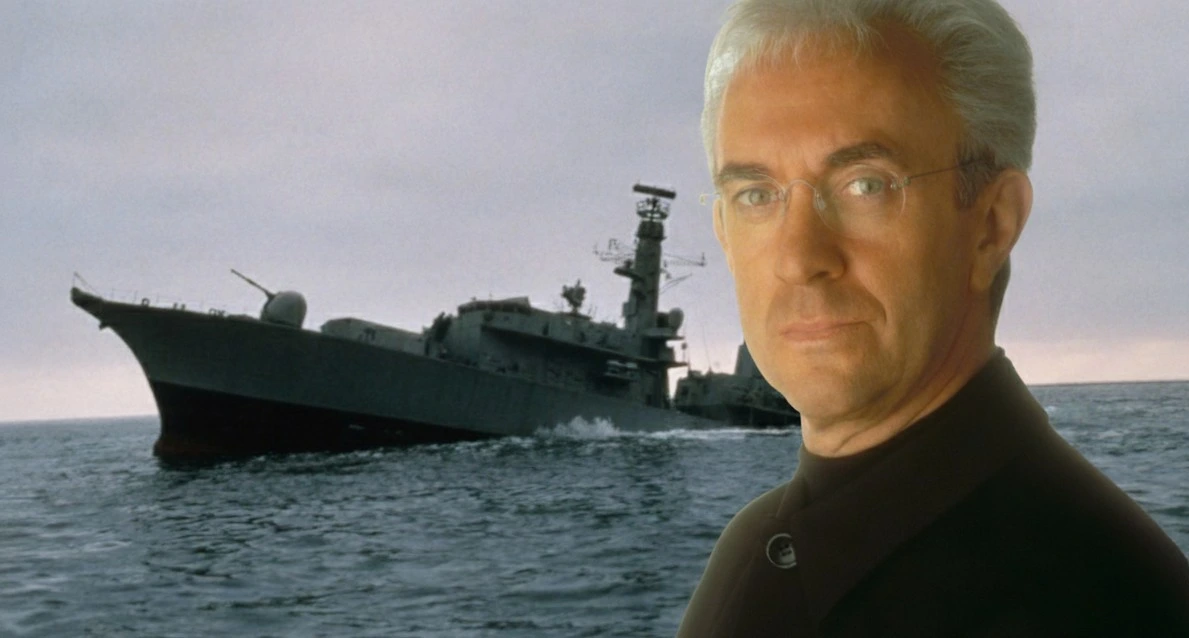
Stealth Boat Blunder: Why Elliot Carver’s Master Plan in Tomorrow Never Dies Sinks Faster Than the HMS Devonshire
Ah, James Bond films—the pinnacle of espionage entertainment, filled with ingenious gadgets, and villains who monologue like they’re auditioning for Shakespeare as they outline their outlandish world-dominating schemes to the world’s most recognizable secret agent.
We’re not supposed to look too closely at the villain’s scheme. Suspension of disbelief is key. But few villain schemes crumble under scrutiny quite like Elliot Carver’s opening gambit in Tomorrow Never Dies (1997). Played with gleeful menace by Jonathan Pryce, Carver is a media mogul hell-bent on starting World War III between Britain and China, all to boost his cable news ratings. Sounds diabolical, right? Well, hold onto your martini shaker, because the scene is so ridiculous, you’ll wonder why you didn’t catch it on your first watch.
After an astounding pre-credits sequence and some sultry vocals from Sheryl Crowe over Daniel Kleinman’s evocative opening credits, the film introduces us to the latest villain’s scheme for world domination.
In the South China Sea, a tense standoff is brewing. The HMS Devonshire, a proud Royal Navy frigate, is patrolling what it believes are international waters. But Carver, the Rupert Murdoch-esque tycoon, has rigged the game. Using a stolen GPS encoder, he’s messed with the ship’s navigation, luring it into Chinese territory. China has scrambled two MiGs to intercept, and the HMS Devonshire holds steadfast, believing they’re in international waters.
Enter Carver’s massive stealth boat: a giant metallic catamaran invisible to radar.
The plan? Sink the Devonshire with a “sea drill”—a gigantic underwater buzzsaw that appears as a torpedo on the Devonshire’s radar. And then blame the attack on the Chinese.
The plan involves releasing the sea drill when the Chinese MiG fighters next fly overhead, making it look like Beijing pulled the trigger. The sea drill rips into the Devonshire’s hull, and soon the ship sinks. And the survivors are mowed down with Chinese bullets for that extra framing flair.
Escalating tensions, the promise of world war, and all of it reported by the Carver Media Network. Instant headlines. Tomorrow’s news today.
But here’s the problem. While the stealth boat is invisible to radar, it isn’t invisible to human eyesight. The attack unfolds at dusk, with the sun dipping low but still casting plenty of light across the waves. In the film, we see the stealth boat lurking in plain sight just a hundred or few hundred yards from the Royal Navy ship. I’m probably being generous with that estimate. We’re talking about a hulking vessel the size of a small destroyer, bobbing on the surface like a metallic whale. The crew on the frigate’s deck, binoculars in hand and alarms blaring, should’ve spotted it faster than Bond spots a femme fatale.
Let’s zoom in on the absurdity. The sea drill isn’t some long-range missile. The stealth boat has to be close enough to the Devonshire to release the sea drill, because, as Carver’s minions say: the sea drill will show up immediately on radar as soon as it is deployed.
Not only that, but the sea drill is attached to a retractable arm. You have to watch clearly to spot it. The graphics of the sea drill on the stealth boat’s computer monitor don’t match up with shots of the actual sea drill. The graphic looks like it is a remotely operated drill. But the sight of the drill traveling in the water reveals otherwise. A retractable arm guarantees the stealth boat is within a hundred yards or less of the Devonshire.
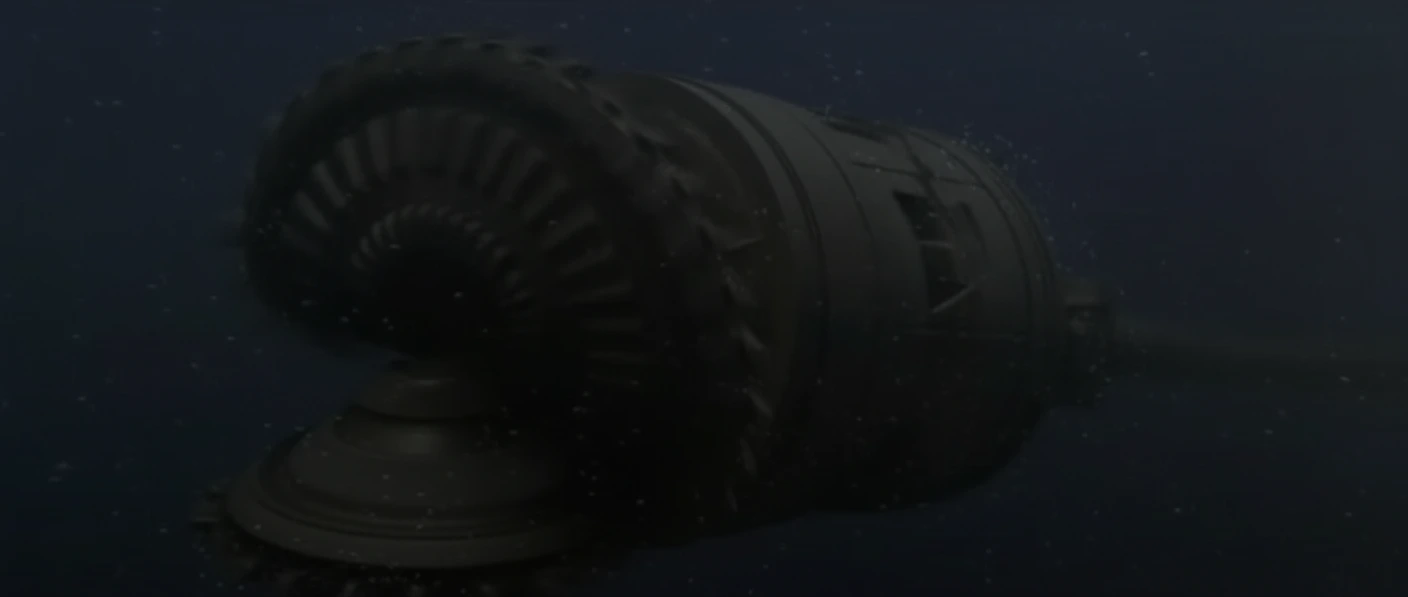
Yet, no one on the Devonshire seems to be on deck to see. It’s as if Carver’s tech includes a “plot convenience field” that blinds everyone to the elephant—or stealth boat—in the room. In real life, naval vessels have lookouts and even basic eyeballs trained for visual threats. Radar stealth is cool for evading distant sensors, but up close in broad (dusk) light? Not a chance.
And then there are the Chinese MiG pilots, soaring overhead like confused seagulls. Their altitude gives them a greater field of vision than the crew on the deck of the Devonshire. These jets scream by at low altitude, close enough to rattle the Devonshire’s teacups. From the cockpit, with dusk’s lingering light illuminating the sea, spotting a giant boat should’ve been child’s play.
Carver and the stealth boat crew are stupid for thinking they could sail so close to a naval vessel. Luckily, they’re met by an even dumber crew onboard the Devonshire and two practically blind Chinese pilots, courtesy of screenwriter Bruce Feirstein. No wonder Bond bailed from the Royal Navy.
Carver’s plan hinges on perfect timing: Launch the drill as the MiGs pass, fooling the Brits into thinking it’s an aerial torpedo. But if just one pilot glances down and thinks, “Hey, that’s not our torpedo—that’s a boat with a buzzsaw!” the jig is up. Beijing could radio back, “Uh, that’s not us,” and Carver’s war evaporates faster than his broadcast rights in China.
This flaw isn’t just a nitpick; it’s a torpedo to the film’s logic. Bond movies thrive on suspension of disbelief—lasers from space, irradiating gold at Fort Knox, or a midair heist of two nukes—but Tomorrow Never Dies pushes it into parody. Why not attack at midnight, under cover of true darkness? A stealth plane may have worked better, dropping a remote-controlled sea drill from air, mimicking a torpedo dropped by a Chinese MiG. (In fact, the stealth boat is revised from an unused stealth plane planned for Timothy Dalton’s unfilmed third Bond film, Property of a Lady).
This waterlogged scheme sheds light on the limits of the James Bond formula: the narrative structure, or recipe, that so many Bond films (before Daniel Craig) follow, almost slavishly.
Carver’s scheme is a mishmash of Emile Largo and Karl Stromberg’s plots from Thunderball and The Spy Who Loved Me, respectively.
The screenwriters borrowed the idea of a villain igniting World War Three from The Spy Who Loved Me. Karl Stromberg, an aquatically-obsessed shipping magnate, uses a specially-designed supertanker to swallow American and Soviet nuclear submarines. He then plans to launch nuclear missiles from each captured sub to destroy both Moscow and New York. Each side will blame the other, triggering nuclear Armageddon.
In Tomorrow Never Dies, Carver also uses a tricked-out boat to trigger a war.
Just like Stromberg, Carver also plans on launching a missile, this time recovered from the shipwrecked Devonshire. The missile will be launched into Beijing, thereby triggering his manufactured conflict.
This recovery of the missile also mirrors Largo’s recovery of two nukes from a sunken Vulcan bomber in Thunderball. And Largo also has a boat that stores stolen bombs. Bond films repeatedly reuse ideas. It helps give these films familiarity by making the plot Bond-esque.
The problem is the writers in their desire to give Tomorrow Never Dies a familiar Bond film feel, discarded the logic of carrying out such a plan successfully. And sometimes–as is often the case in Pierce Brosnan’s Bond films–the focus on developing a familiar villain scheme results in sacrificing the more interesting relationship between villain and hero and the villain’s actual motives.
In Goldeneye and Die Another Day, the villains threaten nations with a satellite weapon, first used in Diamonds Are Forever. And in The World Is Not Enough, Elektra King plans on using a stolen nuke to blow up Istanbul, destroying competing oil pipelines, so the West is reliant on her oil supply for the next century. Replace gold with oil, and Fort Knox with Istanbul, and you have the same basic plot as Goldfinger.
Updating a classic Bond scheme for a modern audience is fine if it makes sense and doesn’t ignore the potential of the characters. No Brosnan Bond film commits this faux pas more than Goldeneye, a film beloved by Bond fans.
Brosnan’s inaugural Bond adventure, Goldeneye, pitted 007 against his old ally, 006. The film’s trailer promised a cat-and-mouse game between the two. Alec Trevelyan (006) is the “man who knows him [Bond] best”, someone who worked with him on missions and knows his every move. But we never really get to see that apart from Trevelyan deactivating the mines Bond has placed in his base by pressing a button on Bond’s watch, and the standout hand-to-hand fight between the two at the end. Otherwise, we never see the two Double-0s match skills and guile, and play a game of one-upmanship that you might expect, filled with reversals, countermoves, and matching spycraft.
Instead, Trevelyan devolves quickly into a generic Bond villain with another satellite weapon.
We’d have to wait until Daniel Craig’s Bond tenure–specifically Skyfall–to see a cat-and-mouse hunt between Bond and a former MI6 agent. Skyfall, like many of Craig’s Bond films, focused on the characters and story over the Bond formula, crafting more logical stories and focusing on what is really interesting: the relationship between hero and villain.
Yet, Bond films like Goldeneye and Tomorrow Never Dies are still enjoyable to watch. We forgive them because they’re escapism. For many fans, Bond films are nostalgia. Pierce Brosnan’s suave 007, Michelle Yeoh’s kickass Wai Lin, and that BMW motorcycle chase make up for Carver’s ridiculous plan.
It is safe to say that Tomorrow Never Dies has some of the best action sequences in the Bond series’ prestigious history.
In addition, Carver’s scheme echoes real threats—fake news, geopolitical hacks—but amps them to cartoonish heights. In today’s world of deepfakes and disinformation, Tomorrow Never Dies is almost prescient. Still, next time you watch, chuckle at that stealth boat, gleaming in the dusk like a bad disguise at a spy convention.
In the end, the real villain isn’t Carver; it’s lazy writing and nostalgia for the type of Bond film that is on life support after the Craig era.