The Living Daylights Cargo Net Fight: How Bond’s Wildest Aerial Stunt Was Filmed
At 6,500 feet above the Mojave Desert, clinging to a cargo net at 100 knots, BJ Worth gave a signal. The signal was simple. But the situation was dangerous. He couldn’t move after swinging from the bottom to the top of the cargo net containing hundreds of bags of heroin. Worth needed to get back in the plane. At that height, holding onto a net being dragged out the back of Hercules cargo plane meant he couldn’t use his voice. No one could hear him. Instead the men inside the plane were waiting for another signal, when Worth opened his mouth. The wind load on the front of the opium bag he had been fighting on had spent every last reserve of energy he had, and all he could do was hold on until the winch cables hauled the net back in and two people on the cargo plane’s tailgate physically dragged him aboard. Then they would reset and the stunt guys would do it again.
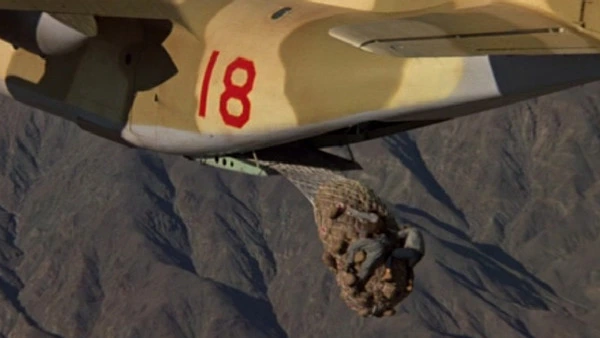
This is the scene in The Living Daylights (1987) in which James Bond (Timothy Dalton) engages Necros (Andreas Wisniewski) in a brutal, wind-swept fistfight on a heavy net holding bags of heroin, dangling outside the rear cargo door of a military cargo plane by a supply rope — a celebrated stunt in the Bond canon, that is also one of the most physically punishing set-pieces in the entire Bond series.
The fight finishes in characteristic Bond style with a visual metaphor set up for the usual quip. Necros plummets to his death after Bond cuts the laces to his boot — the same boot Necros is hanging onto for dear life. A minute later, Bond back in the plane tells Kara, who is piloting, or trying to pilot, the aircraft:
“He got the boot.”
It was an original idea – hanging on a net filled with bags of heroin dangling outside the rear of a cargo plane. It almost sounds absurd. But on film it is a genuine nail-biting moment. You know those are real stuntmen up there. There was nothing safe about it, but the Bond crew are always well-prepared in what was a meticulously engineered sequence using two veteran Bond stunt parachutists.
The Problem of the Net
The sequence presents a deceptively simple premise. Bond and Necros fight on a net full of heroin hanging out the back of a Hercules C-130 transport plane. In practice, getting that bag to behave required an engineering solution the audience would never see.
A 1500-pound sack (or 900 lbs according to stuntman Jake Lombard) at 100 knots is not a stable platform. Without intervention, it would have pitched and rolled unpredictably, making co-ordinated stunt work impossible and the camera angles unusable. Worth’s solution was structural: a large fibreglass keel built inside the bag, hidden beneath the outer layer of sacks. The airflow would hit the keel, stabilise the whole mass, and give the two performers something they could actually work on. From outside the aircraft, it looked like a bag of drugs. From inside the engineering, it was a purpose-built aerial stunt rig.
“This cargo net was being buffeted by winds and they continually being slammed against the fuselage,” Glen explained in the documentary, Inside The Living Daylights.
Getting that 1500-pound construction in and out of the aircraft was its own challenge. Stuntman Jake Lombard, who doubled Necros, was matter-of-fact about it: a couple of winches, pulleys, and good rigging worked out well. The bag also had a rip cord system built into the net itself. Both performers had to position their hands and feet on either side before someone in the plane could pull the cord, releasing the net, so the back opened outward. Once those bags went “out the door”, as Lombard put it, it got real breezy — the sacks hitting at 120 miles an hour while you still had to hold on.
Return of Skydiving Duo B.J. Worth and Jake Lombard
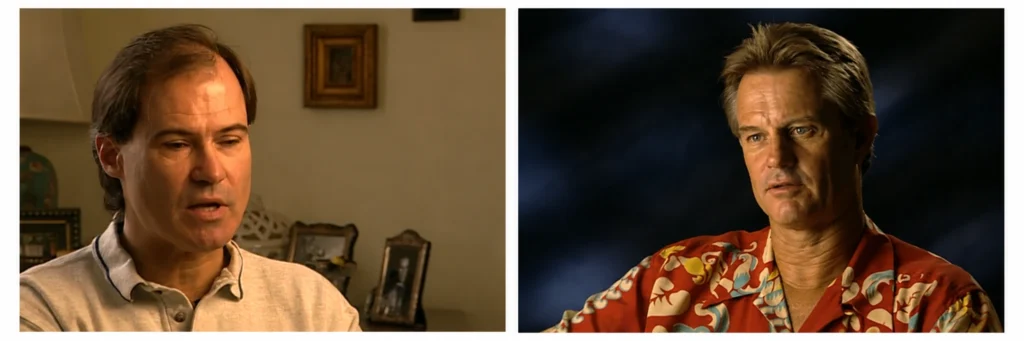
The choice of Worth and Lombard was not incidental. The two had worked together — on and off– for nearly a decade beginning with Moonraker (1979) and then Octopussy (1983). The pre-title freefall no parachute sequence in Moonraker, in which Bond and a pilot fight over a parachute is their signature stunt — a sequence that won the Best Stunt award for 1979. Lombard bore a strong enough resemblance to Roger Moore to allow relatively close facial shots in freefall and doubled Bond; Worth played the pilot he fought against. Then they returned for Octopussy in the astounding climax on top of a plane, with both Worth and Lombard clambering on the outside at 10,000 feet. Lombard went uncredited, doubling once again as Moore, and Worth as henchman Gobinda.
Poor B.J. had to double as the villains, but he finally got his chance to double new Bond parachuting in this cargo plane scene in The Living Daylights. It’s funny how a change in actor can suddenly find this pair in reverse roles. Lombard, who is blonde, was more reminiscent of Necros.
The Living Daylights was a reunion of a proven pairing, and the physical trust that comes from shared experience under those conditions is not something that can be improvised.
The aerial unit was organised by Sparky Greene, who handled logistics, while Worth assembled and led the stunt team.
The Shoot: Glen is Concerned With the Lackluster Footage
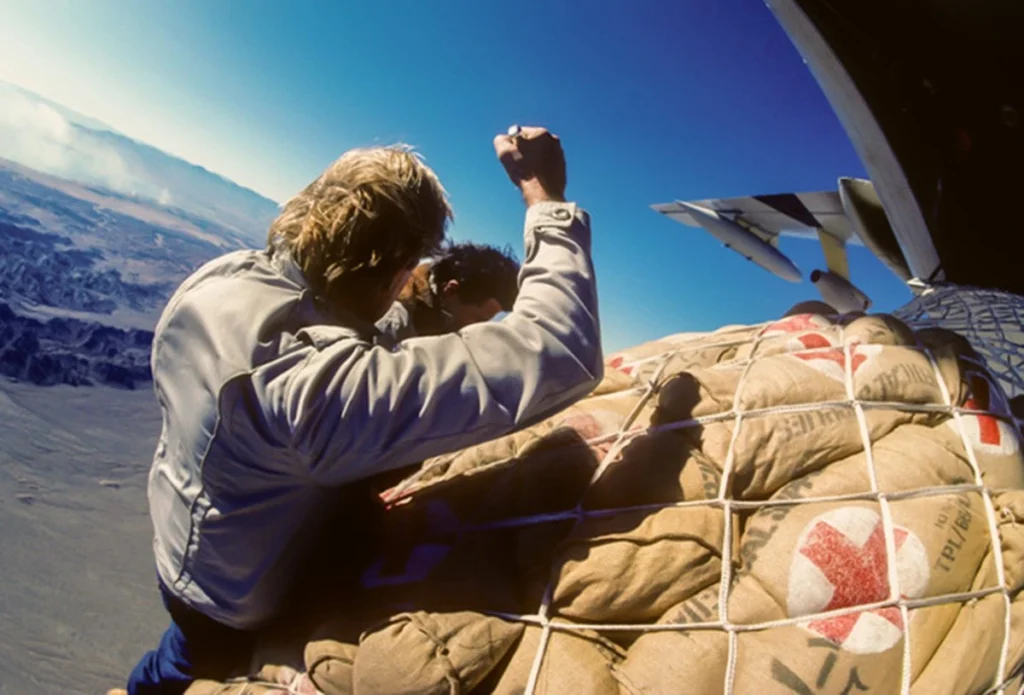
The shoot took place over the Mojave Desert, with the Hercules, the bag, a camera-helicopter, Lombard and Worth, and a bunch of camera crew and rescue skydivers. Executive producer and co-screenwriter Michael G. Wilson also hitched a ride.
The fight on the bag is shot both with the two stuntmen duking it out on the net in mid-air, and back on the 007 Stage with Dalton and Wisniewski fighting to the death just inches from the ground on a set.
The mid-air fight is divided into three main stunts: grabbing the net as it exits the rear of the plane and hanging on until it stops. Then the primary stunt work–the maneuvers on top, under and to the side of the net as they fight, and Worth and Lombard riding the net as it empties its contents — the heroin bags — after Bond cuts the netting with his knife, using the bags as an arsenal, bombarding Necros — Lombard — as they exit.
There’s a camera in the cargo bay that captures the duo grabbing onto the net as it exits, and the camera helicopter flying in parallel formation to the Hercules capturing the footage from the side. The camera inside the cargo bay captures additional footage of the two stuntmen fighting on the bag, all of which is later intercut with the footage captured of Dalton and Wisniewski back at Pinewood.
Veteran helicopter pilot and helicopter camera operator, Marc Wolff, himself responsible for wild aerial shots in multiple Bond films, and piloting the helicopter chasing Bond’s Lotus Esprit in The Spy Who Loved Me and a red Soviet helicopter in A View to a Kill’s pretitles, coordinated the aerial sequence from inside the Moroccan Air Force Hercules, able to move between the flight deck and the cargo area to observe the stunt work and communicate with the director and camera crew by radio.
“[The director and camera crew] could cue me when they wanted certain things to happen,” he told Bond Locations, “which I would then relay to the Hercules pilots and the stunt crew. “
But in the sequence Wolff describes Kara tries other buttons and levers trying to work out how to close the door.
Instead of closing the ramp door, first she shut one of the engines down by mistake, then she made the flaps go down, then the landing gear, Bond was getting more and more frustrated, eventually she found the right lever to close the door at the back. It was quite humorous in the cockpit.
In the final film, Bond closes the rear door himself when he climbs back onboard.
Unlike the 88 jumps made in Moonraker, there’s no information on the number of attempts on the bag–and resultant freefalls to gather enough shots to cobble — or edit — together a fully legible sequence. This is how these aerial fight scenes are typically completed — piecemeal and through patience and a lot of courage.
“I got tossed off [the net] a couple of times,” admitted Worth.
“We had safety guys that would chase us. But for them to go out and catch you didn’t do much good in freefall. Be really lucky if they could help you out,” added Lombard.
Director John Glen initially thought the footage looked lackluster. The keel system worked too well. The net was just hanging there — but as Worth relayed “it got real un-dull real fast.”
The final sequence shows what happened next — and it all relates to the net releasing the heroin bags.
“We built a ripcord system in the net,” said Lombard, “and you had to hang on to get your feet and hands on both sides of it so the guy in the plane could pull the rip cord and then you just sort of let go and open the net up.”
Worth noted it was an adrenaline-fueled “wild ride”. Those bags, Lombard explained, would hit them at 120 miles per hour — “and you have to still hang on.”
But the “un-dull” moment came after Bond kicks Necros off — literally — by giving him his boot. Wild gyrations picked up the slack left by the empty net and flung it around with Worth holding on:
“I thought I was going to hit my head so I tucked my head down and the third one, I thought I was going to hit it and so I dropped my head to have my backpack hit it. I don’t know how close I came and I never did touch it but I thought surely it would.”
Executive producer Michael G. Wilson watched the whole thing unfold, but Worth let go and fell out into freefall. It was obvious that if he stayed on any longer, his head was going to hit it.
The wind had given Glen what he wanted. Glen, of course, never wants the stunt team to be in danger, but danger is part of the brief — with planning and safeguards made meticulously to avoid loss of life.
When something went wrong, Worth and Lombard would let go.
“We had safety guys chase us,” said Lombard. “But for them to go out and catch you and do much good in freefall. You’d be really lucky if they could help you out.”
The Pinewood Half
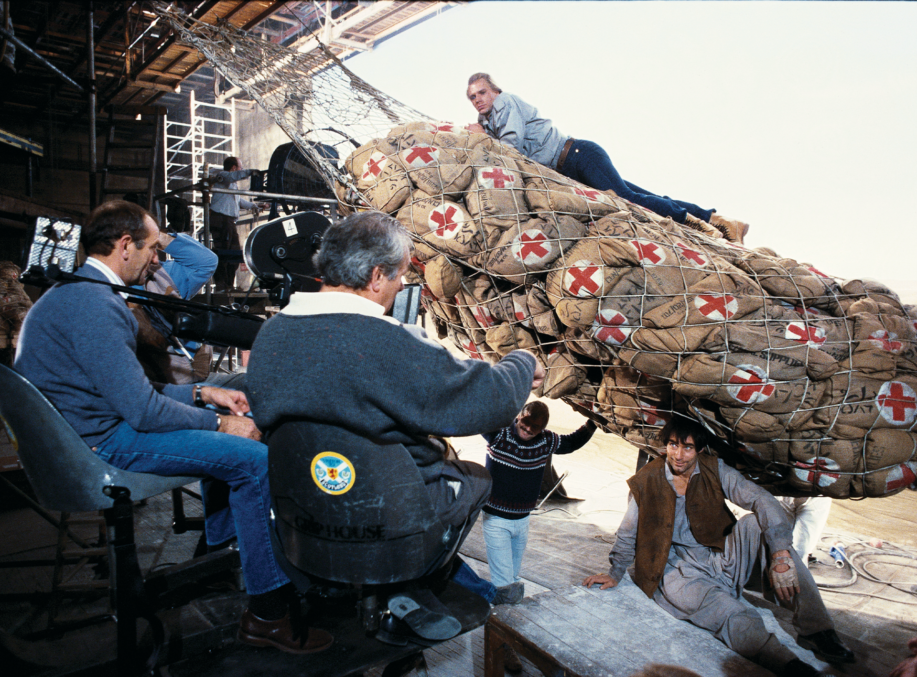
The aerial unit’s footage was shot first. Then, back at Pinewood, Glen sat at a Steenbeck editing machine and worked out how to shoot the close-ups to match what Worth’s team had done over California. In those days before non-linear editing, this was a slow, methodical process of frame-matching.
Production designer Peter Lamont’s team built a complete Hercules interior on A Stage — cockpit, cargo bay, and a working cargo door — and created terrain for the fight using a Vickers rostrum covered in plaster, painted carefully to match the mountains visible in the distance in the American aerial footage. Half an airplane on a soundstage, with the horizon painted and a gypsum landscape built around it.
Into that half-airplane, Timothy Dalton and Andreas Wisniewski climbed into the net and hung there for hours at a time over three days. Wisniewski, who had watched the aerial unit’s footage and been quietly relieved he hadn’t been asked to participate, described the Pinewood work as the hardest of the entire film — not dangerous in the same way, but relentless.
“The fight wasn’t hard work,” he said of the kitchen sequence earlier in the film. “You get a kick and then you get a break. That is no sweat. We were hanging in that net for an hour… waiting for the next take was not even comparable to the fight.”
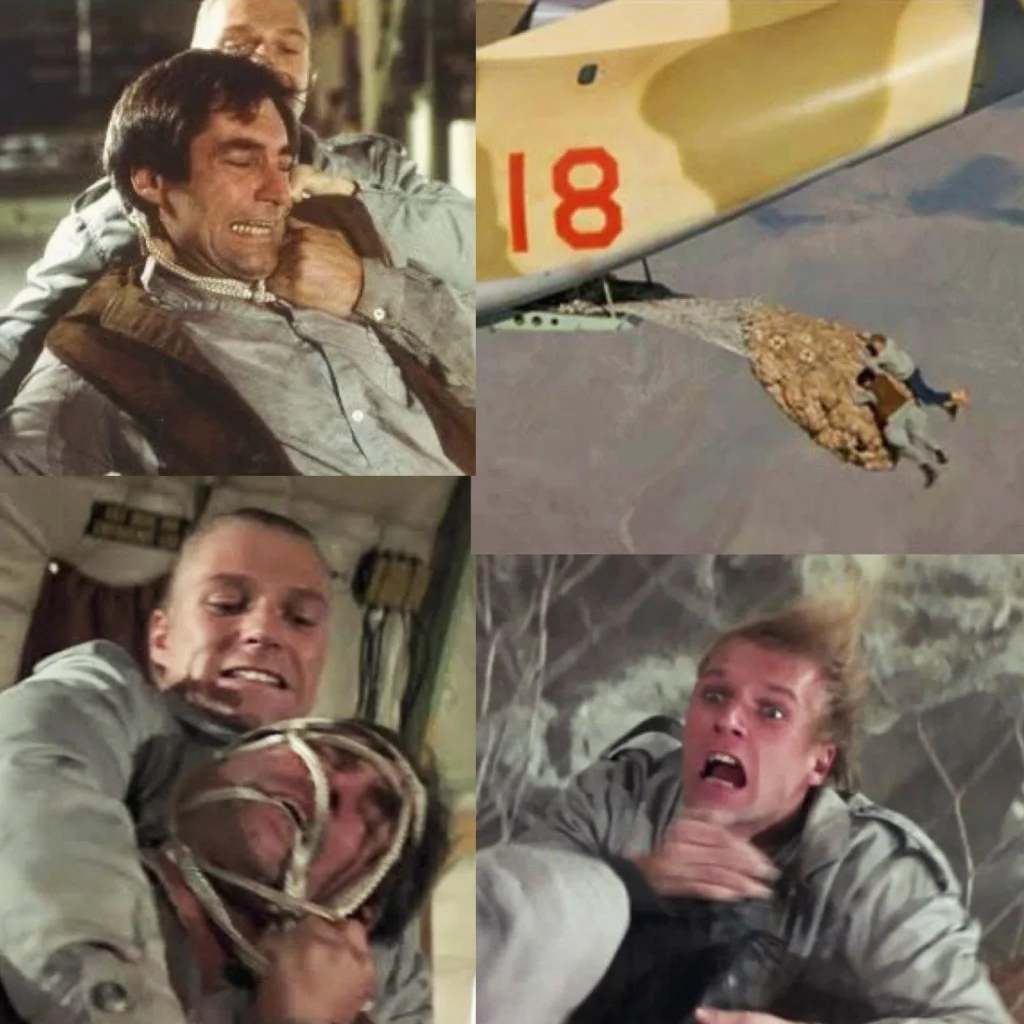
After about an hour in the net on the first day, Dalton turned to Wisniewski and said: “Dude, I’m wrecked already” — neither of them yet knowing they had three days of it ahead. Scaffolding suspended the cargo netting over the set; a camera crane swung to create the impression of movement. In the finished film, it reads as seamless.
The Plane Itself
The Moroccan Air Force made a Hercules available to the production for location work, and Peter Lamont’s production design team applied Russian military decals to it. For the American aerial unit, however, a different aircraft was used — a twin-engine plane rather than the four-engine C-130. The budget for two or three weeks in the Mojave with an actual C-130 would have been too expensive.
Glen acknowledged it as a calculated gamble: the discrepancy between shot-to-shot would be visible to anyone who counted the engines, and he knew it. They got hold of a cheaper aircraft and hoped that no one would notice the lack of engines. Apparently, most didn’t.
There was also the matter of the Red Cross. The opium sacks in the sequence carry the Red Cross insignia — a choice that prompted protests from the organisation’s branches in the United States, the United Kingdom, and Canada, who maintained that the use of the emblem was both inappropriate and unauthorised. Production designer Lamont’s account is blunt: the Red Cross sued them, because you are not allowed to use the insignia without permission. Producer Cubby Broccoli made a financial contribution to resolve the matter.
The Red Cross-branded heroin sacks stayed in the film.
He Got the Boot
Most of the extended Hercules sequence is achieved in miniatures, including blowing a bridge sky-high, the initial take-off avoiding another aircraft coming into land on the same runway, and the Hercules final moments as Bond and Kara exit the rear in a miniature jeep attached to a miniature parachute exiting a miniature Hercules, which then plows into a miniature mountain range.
The entire sequence is remarkable. The miniature work seamlessly blends with the live-action footage, like this entire live-action stunt that marks the center of the sequence.
The sequence is an escalation of troubles. After desperately trying to stay on the net, Bond now has to get himself and Kara out the rear of it in that jeep before it hits the mountain range.
One threat is replaced by another. It’s just another day for James Bond.

- Why Robert Pattinson’s Batman Should Be DCU’s Caped Crusader - October 12, 2026
- California’s AG Loses to Paramount: Inside the Paramount / Warner Bros. Discovery Merger — And Why Ellison May Still Leave California - September 26, 2026
- Napoleon Solo Sold for £1: The Year Ian Fleming Stopped Owning Ian Fleming - July 25, 2026