James Bond’s Bobsled Chase: How an Abandoned, Repurposed Bob Run & Stunt Accidents Rewrote OHMSS’s Finale
In Ian Fleming’s 1963 novel, the bobsleigh chase that closes On Her Majesty’s Secret Service is over almost as soon as it begins. As Piz Gloria falls under attack from the Corsican mafia — the Unione Corse — Blofeld flees down the mountain’s bob run. Bond pursues; Blofeld lobs a grenade; the explosion throws Bond clear of the track. The bobsled chase itself is a few paragraphs, no more, before Bond is on his way to his wedding and the tragic death of his bride, Countess Teresa di Vicenzo.
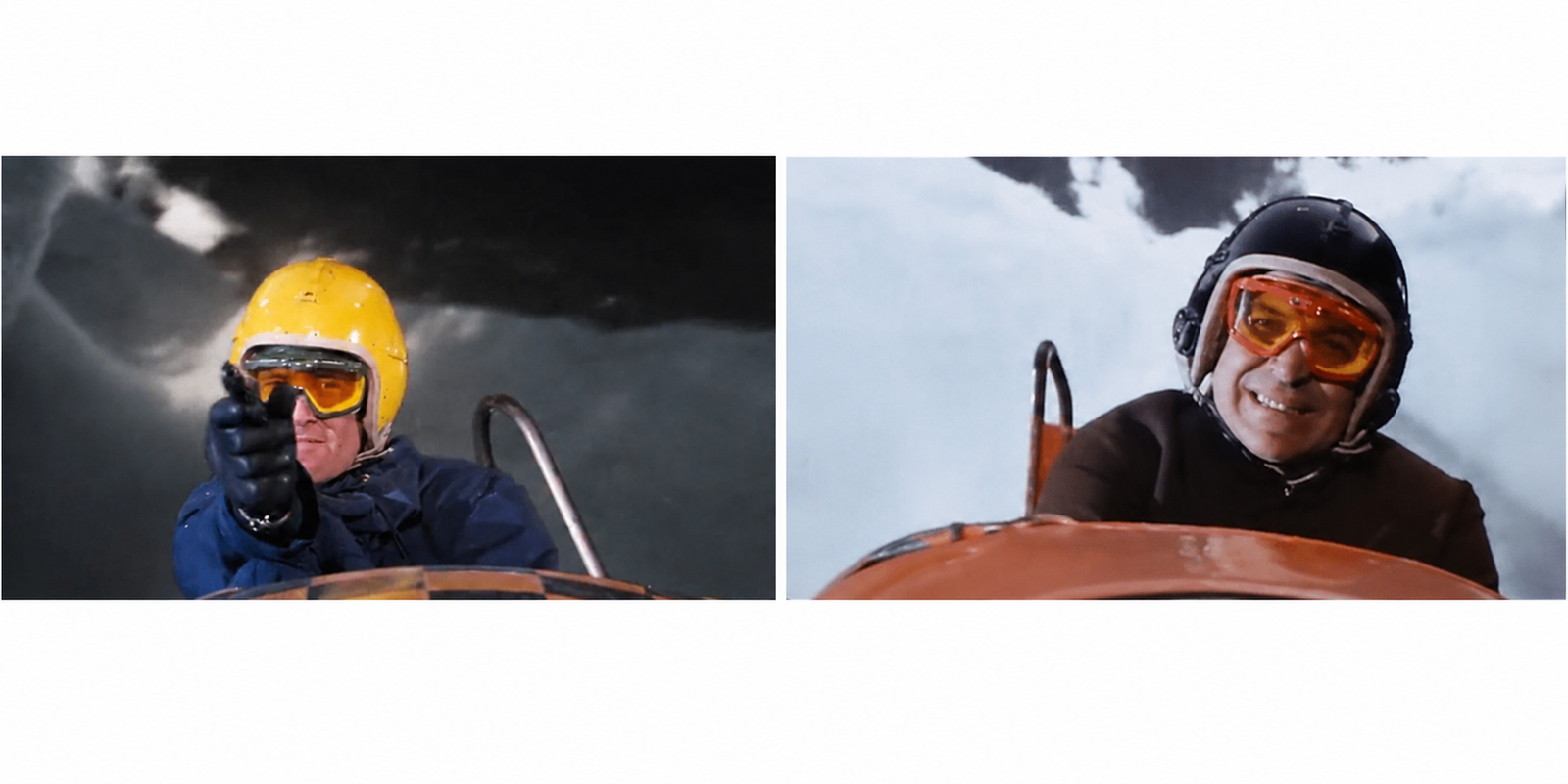
What ended up on screen in 1969 isn’t really an adaptation of that. In the novel, most of the attack on Piz Gloria happens offpage while Bond is already chasing Blofeld down the bob run. In the film, the chase only begins once Piz Gloria’s destruction is complete. The one moment that survives intact between the two is the grenade: Blofeld lobs it at Bond, the explosion throws him clear of his bob — and in the novel, that’s how Blofeld gets away. Not in the film. There, the grenade is just the opening move in a desperate, escalating fight between the two men that ends with Blofeld clotheslined by a branch overhanging the track.
Thanks to some brave stuntmen, the film turns those few paragraphs into something else entirely: a knuckle-clenching, immersive chase, fast-paced and fast-cut, escalating in stages — Bond’s bob gaining on Blofeld’s, gunfire between them, colliding bobsleds, an explosion that sends a stuntman flying clear of his bob, a sprint ahead of the run to latch onto the back of Blofeld’s sled and be dragged down the track, a climb into the bob itself, a desperate fistfight, heads scraping the ice wall, and finally the branch that catches Blofeld.
Willy Bogner’s own company would later call the result simply “one of the most famous scenes in film history.”
What makes that claim defensible rather than just marketing is the absence of anything to copy. Ski action on screen had forty years of precedent by 1969 — a whole genre, a whole technique, traceable back to Arnold Fanck’s mountain films of the 1920s. The bobsleigh chase had nothing. Nobody had built a sustained action sequence around competitive bobsledding before. Action filmmaking already had its own grammar by 1969 — established ways of conveying speed, danger, geography, impact — much of it pioneered by the Bond series’ own rapid-cut editing, principally under Peter Hunt, now promoted to director of On Her Majesty’s Secret Service. What the production now needed was to apply that grammar to an entirely new environment: a two-mile tube of ice, with no clear sightlines and barely enough room for a man, let alone a camera. That demanded new rigs and new approaches to filming, on a melting Alpine track, with the clock running out and almost no usable footage in the can.
You’d expect the answer to be pure engineering, and a lot of it was. But the strangest part of how they solved a problem with no precedent wasn’t a camera rig or a piece of hardware. It’s that some of the chase’s most dangerous beats weren’t scripted in advance or designed at all. Parts of it were written by accident — by the stuntmen, whose real accidents added a visceral danger no design could match, and around which the sequence was then rewritten and built. And the man who made that call, organically and on the fly, was newly in charge of the second unit.
That man was John Glen.
The Man Who Was Handed the Bobsled Sequence
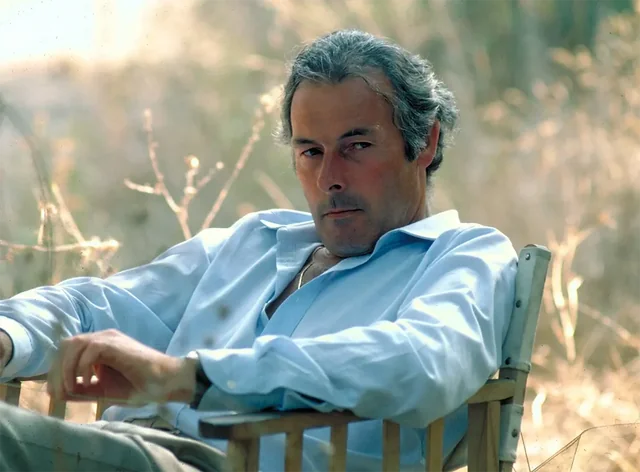
When Peter Hunt phoned John Glen in early 1969, Glen was dubbing The Italian Job and hadn’t heard from him in years. Hunt had just made the leap from editor — he’d cut the first five Bond films — to director of On Her Majesty’s Secret Service, and he needed help on the second unit. Glen told the story of how it happened more than once over the years, and the tellings agree on the essentials.
“He thrust a script in my hand and said, ‘Read this sequence,'” Glen remembered, in an interview recorded for EON’s own documentary Inside On Her Majesty’s Secret Service. “And I read it and he said, ‘Would you like to direct it?’ And I said, ‘Lead me to it. This is the most wonderful opportunity.'”
Robin Browne, the 2nd unit cinematographer who’d work alongside him through the whole shoot, remembered meeting him for the first time:
“He was just like a schoolboy… so enthusiastic. He wanted to film everything.”
By the following Monday, Glen was on a plane to Switzerland.
He arrived to a production in serious trouble. The crew had been shooting around Mürren since October 1968, but the mildest winter in twenty years — Glen, writing from memory decades later, would recall it as forty — had yielded almost nothing. The second unit had roughly ten seconds of usable footage in the can. Part of the problem was weather. Part was that the existing second-unit director, Anthony Squire, and his three assistants couldn’t ski, which made them of limited use on the mountain. Stuntman Vic Armstrong, on the mountain that winter, remembered the production’s logic from the other side: they blamed Squire for the weather itself — “it must be someone’s fault,” as Armstrong put it — sacked him, brought in Glen, and the snow promptly behaved. Armstrong called it fate.
Glen’s brief was narrow and urgent: shoot the bob run, and claw back the lost time. What he built over the following two weeks is one of the most physically committed action sequences in the series. The through-line is improvisation forced by constraint.
A Two-Mile Track With a Deadly History
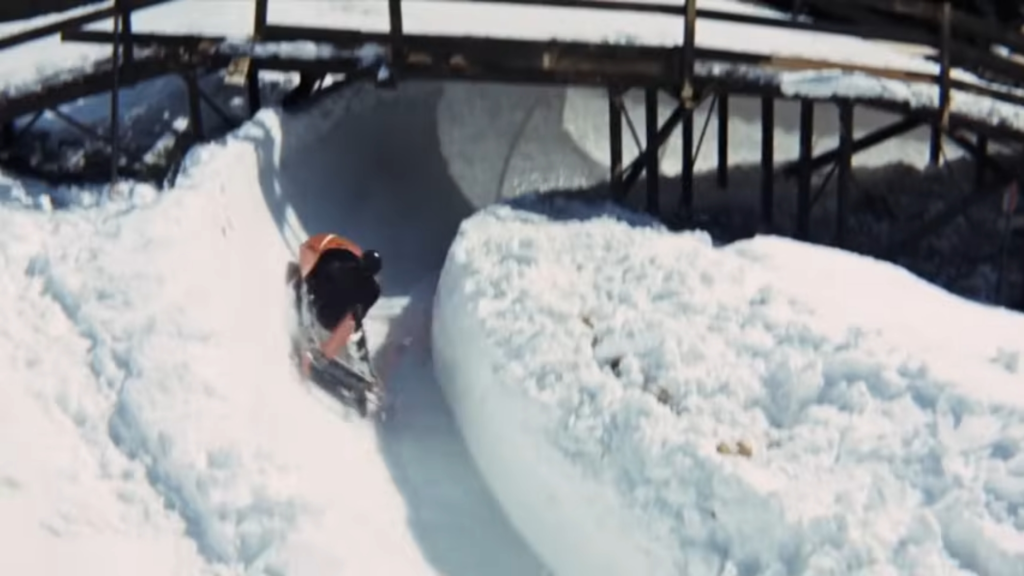
The track wasn’t new. It was modified from an existing, abandoned one — a run cut into the mountainside near Mürren that had been closed in 1937 after a string of fatal accidents, and left unused for more than thirty years. Robin Browne remembered the story as it was passed around the crew at the time: three or four English lords killed on the same stretch of ice, enough to see it shut for good. Peter Hunt, hearing the history, was apparently delighted rather than deterred. His reaction, by all accounts, was simply to ask whether they could have it again — and they did. Franz Capose, a former bobsleigh champion who trained the Swiss national team, was brought in to rebuild it with an Italian crew, reinforcing the old structure with ice blocks trucked in overnight from Bern.
The steepest curve had a name: Stone Curve. The track fought them daily — by midday the sun melted the ice on the corners, so Capose’s team rigged sun sails at strategic points to protect them. Glen put the danger plainly, in his own words:
“The corners where you corner it at 60, 70 miles an hour were melting and becoming very dangerous.” Shooting ran from roughly 9am to 2pm, when Capose called a halt on safety grounds.
The single cleverest piece of production logistics was how they fed the track. A world-championship bob team might manage one run a day. Glen’s unit used a helicopter — Alouettes, piloted by Bruno Bagnaud — to hoist the bobs back to the top after each descent, achieving eight or nine runs daily. On their longest day they shot for two and a half hours continuously and completed eighteen separate runs.
The Skier at the End of a Tether
The footage that gives the sequence its inside-the-run intimacy came from a cameraman the British crew openly dismissed. Willy Bogner Jr. was a former Olympic skier, and Cubby Broccoli had recruited him specifically off the back of his 1966 documentary Skifaszination, which had put the camera inside the action at speed. Glen rated him from the first day. Others told Glen to his face that the rushes were unusable rubbish.
The original plan used a camera bob running behind the action bob. It didn’t work — the heavier camera bob kept catching the one ahead and causing collisions. Bogner’s solution was to ski inside the track behind the bobs with a hand-held camera — an Arriflex built into a box, with a Hasselblad mounted on top that he could look straight down through.
He cut a small ramp into the track wall so he could steer his skis up and out at the end of each run, coming off at around fifty miles an hour and still stopping safely. The problem was keeping pace, since he was far lighter than the bobs. So they tethered him to the back bob with a twenty-foot cable, quick-released by knocking out a stick jammed in his belt. The tether did something unplanned and valuable: the fixed distance kept his focus perfect, and he could pull over-the-shoulder shots. From that point they abandoned the camera bob entirely and shot the interior of the run on Bogner’s skis.
His nerve ran ahead of his brief. He argued that he could stand inside a curve as a bob came through, because centrifugal force would throw it to the outside wall — and he was standing inside Stone Curve, the steepest on the track, when the worst crash of the shoot happened directly in front of him.
The One-Legged Man in the Front Bob
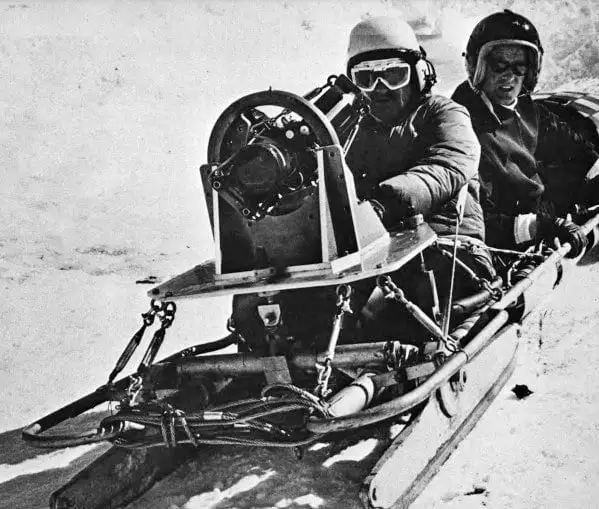
Johnny Jordan was an aerial cameraman who had lost a leg during You Only Live Twice in 1966, when a chasing helicopter clipped his during the Little Nellie sequence and it was later amputated. The metal in his prosthetic froze at altitude, so for the OHMSS mountain work he removed it, covered the stump with a mountaineering sock, and climbed into a front bob to shoot plates at up to seventy miles an hour.
Not every collision on that mountain made it into the finished film. While Jordan rode his bob shooting these front-projection plates — background footage that would later be screened behind the actors at Pinewood — former bobsleigh champion Franz Capose came hurtling toward him on the track. The two bobs tried to avoid each other and failed; Capose took a glancing blow, badly bruised, and was taken to hospital. Jordan, characteristically, made something out of it: he built a flicker book from his own footage of the near-miss and gave it to Capose while he recovered.
“Franz would sit in the bar showing people his flicker book,” 2nd unit cinematographer Robin Browne remembered, “which illustrated just how lucky he was.”
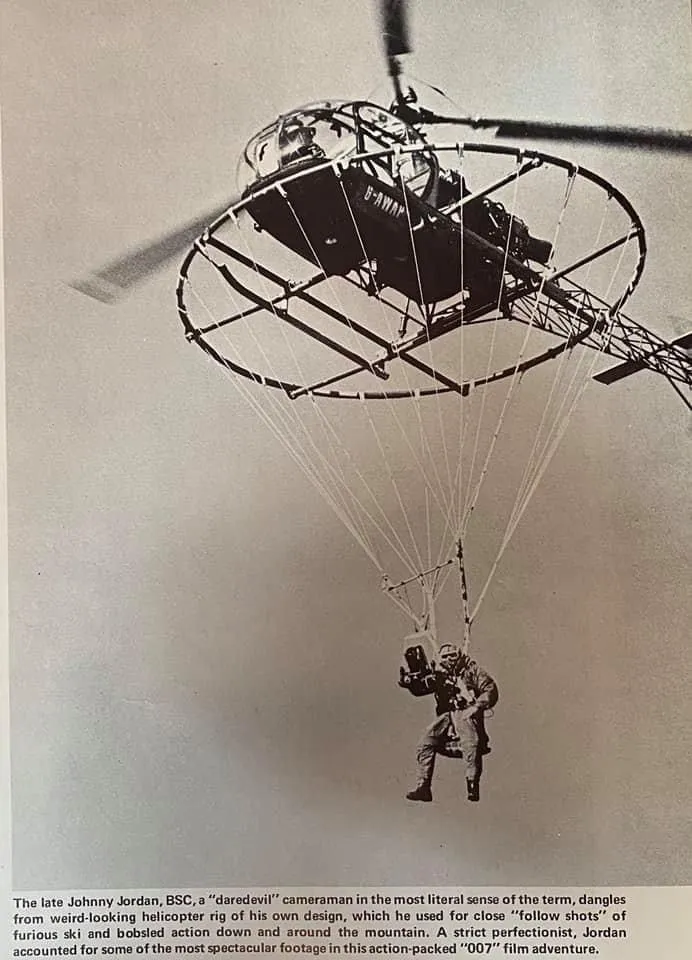
Impressed by what Jordan had already delivered on the ski material, Glen called him back specifically for the bob run.
“We laid on a couple of sessions where he came over the bob run,” Glen remembered, “and filmed some beautiful aerial shots for us of some of the action.”
With camera mechanic Ted Warringham, Jordan also built a turnover mount, milled overnight in the local blacksmith’s shop, to rotate the image for the avalanche tumbles Glen would shoot later in the year. To keep ground crews invisible in those aerial shots, Glen had them wear white boiler suits and hide behind portable fir trees.
Jordan’s bravery reads differently knowing the chapter ends. Months after the OHMSS shoot, while filming Catch-22 over the Gulf of Mexico, he fell from a B-29 after taking off his harness for greater freedom of movement. Robin Browne — the 2nd unit cinematographer who worked alongside Jordan in Switzerland — later told Glen what happened: a near-miss, the pilot banking hard to avoid a collision, Jordan going weightless and drifting out of the open door. Glen’s epitaph was grimly affectionate: knowing Jordan, he probably filmed his own descent.
Real Champions, Real Crashes
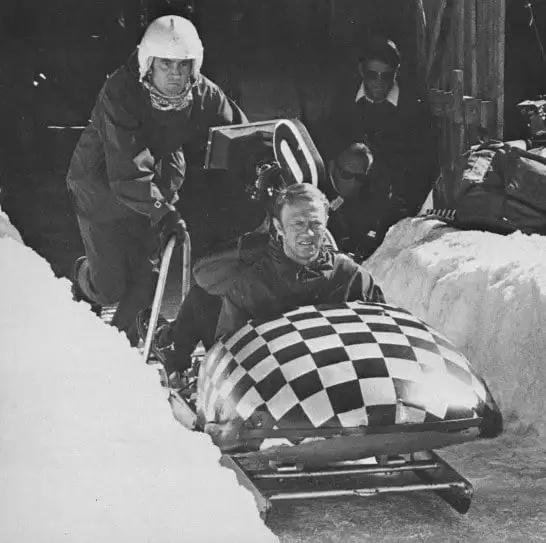
Coordinating the stunt crew throughout was George Leech, who’d stepped in as stunt arranger when Bob Simmons — the series’ regular arranger since Dr. No — was unavailable for this production. Leech had been Simmons’ assistant on all five previous Bond films and knew the job from the inside.
Glen worked almost entirely with doubles for the bob run itself, and they were genuine bobsleigh men rather than stunt performers — which is why the crashes look the way they do. Heinz Leu, a Zurich businessman and champion bob driver, doubled Bond. Robert Zimmerman, a brakeman for the Swiss national team and an Olympic skier, doubled Blofeld. Eddie Stacey — also seen elsewhere in the film as one of Blofeld’s anonymous henchmen, alongside fellow stuntmen George Cooper, Reg Harding, and Vic Armstrong — fell off a bob, clung to the back, and was dragged.
It wasn’t only the doubles who found it frightening. Robin Browne, operating camera at the end of the run, remembered the particular dread of the job:
“Nobody got really badly hurt, as far as I can remember. But it was always terrifying to stand at the end. You never really knew when you were operating the camera whether they would come flying up towards you.”
A small, telling detail: Bond’s Walther PPK prop never fired properly throughout the shoot. Glen told the doubles to carry on regardless. Every muzzle flash and report in the finished sequence was added in post.
Head Against the Wall
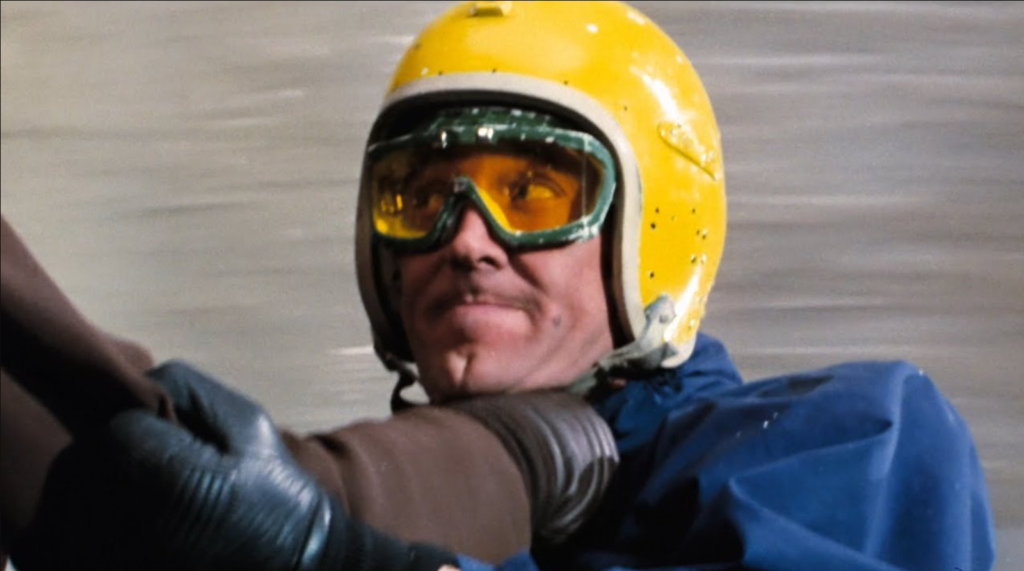
Glen, by his own account, simply asked stuntman Joe Powell whether he’d take a hit against the bob run’s ice wall for the camera.
“I was talking to Joe one day and said, ‘It would be wonderful if we could see your head smashing into the wall.’ He said, ‘Oh yeah, fine, I’ll do that.’ He was such a tough guy.”
For the close-ups — Lazenby’s own head appearing to strike the wall — the production didn’t risk the actors on the ice at all. Director of photography Michael Reed built a rolling drum, a practical technique that let the wall appear to rush past a stationary actor rather than the other way round.
The Grenade, and the Bob Bond Loses
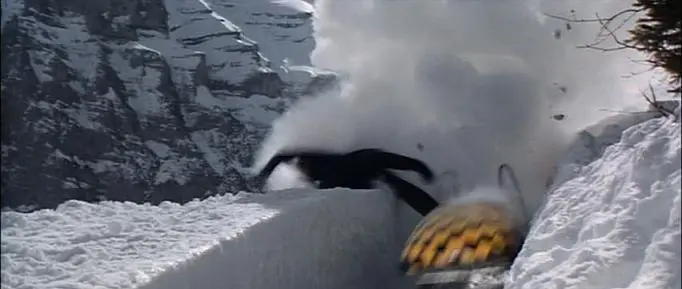
The chase escalates in stages, each stunt more dangerous than the last. It opens with a collision: Bond’s pursuing bob catches Blofeld’s, the two sleds clipping together at speed. Blofeld’s answer is a grenade. The explosion blows Bond clear of his own bob — Heinz, doubling Bond, had inspected the run in advance and marked exactly where he intended to jump, and a wall of snow further down the track was built to stop the now-empty, runaway sled. Glen had four cameras ready to cover the moment. The only thing that nearly went wrong was a last-minute lighting fix: cameraman Alex Barbey, finding the grenade wasn’t reading well on film, positioned a reflector to throw more light onto it — and the reflector dazzled Heinz as he came round the curve hunting for his mark. He jumped blind, at the exact instant Glen pressed the detonator, and skidded along the parapet before finishing up, in Glen’s words, “between Hubert’s legs” — unhurt. Heinz told him afterward it was lucky Glen had pressed the button when he did, because he’d had no idea where he was. Glen took a rule from the moment that he carried for the rest of his career: never change anything on a stunt after you’ve briefed the performer without calling him back and telling him exactly what’s changed, no matter how small.
Glen recorded one more detail from that morning, almost in passing: around the same time, word reached the unit that the avalanche they’d spent weeks rigging had come down entirely on its own, with no cameras running.
The Leap, the Latch-On, and the Fight in One Sled
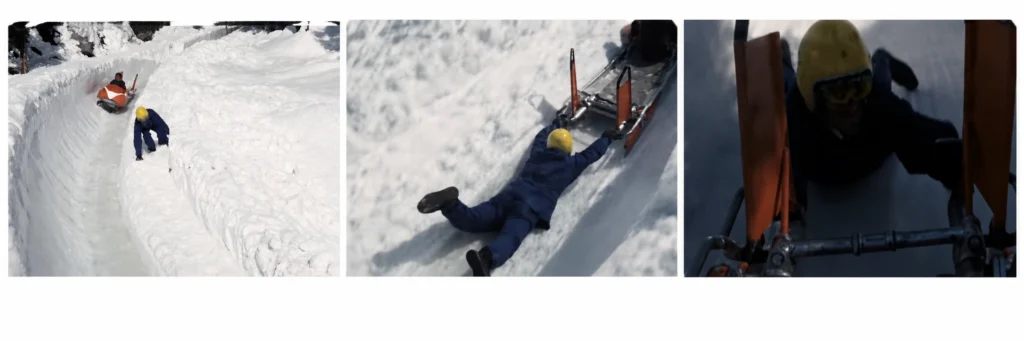
The track itself does the next piece of plotting. Because the run curves back on itself, Bond — now without a bob of his own — ends up ahead of Blofeld rather than behind him. Heinz makes the leap that gives the sequence its best single image: up onto a ledge cut into the side of the run, the kind of feature no working bob track would ever need, built purely so a stuntman would have somewhere to stand. As Blofeld’s bob comes round beneath him, Heinz grabs the back of it, is dragged for a stretch, then hauls himself in.
What follows is the fight Glen describes in his own account — Bond and Blofeld, doubled by Heinz and Robert, trading punches inside a single moving bob at speed. Glen, by his own admission, hadn’t appreciated how hard this would be to stage:
“If I had known a little more about bobsleighs I would have realized the difficulty of negotiating Stone Curve while having a punch-up at the same time.”
He asked the two men to be more animated. They obliged. Halfway through the curve, the front runner went out of the track and an arc of splintered ice came off the top of the wall as the bob swerved sideways. Heinz was thrown clear and slid along the run on his backside, still travelling at the speed the bob had been going when he fell — Robert, meanwhile, fought to keep the bob from coming down on top of him. When it finally dropped back into the run, Heinz got up without a scratch. Robert didn’t: caught in the bob’s machinery, his face injured, he was flown out for stitches inside his mouth. He was back at work two hours later.
Willy Bogner had caught the whole thing on his hand-held camera from inside the run. That evening, Glen rewrote the script to use it.
“I wasn’t looking for accidents,” he said of the habit this became, “but when they happened, they were so spectacular that they had to be incorporated in the story.”
Blofeld in the Branch, and Bond’s Exit From the Run
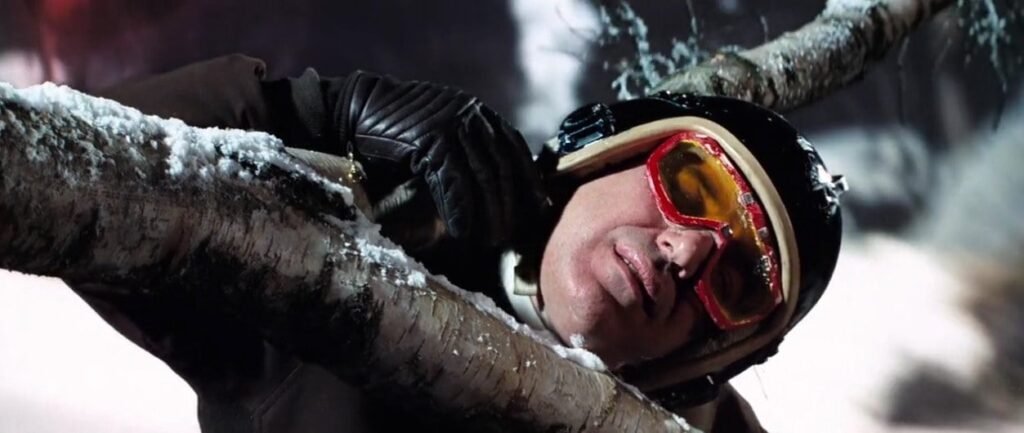
The scene’s last image — Blofeld’s head caught in a forked branch overhanging the run, torn from the sled — proved the hardest thing on the schedule to land. The plan put faith in a cable attached to Joe Powell’s back by harness, with a shock absorber anchored to the tree itself. Glen didn’t like the look of it from the start:
“It looked terribly dangerous to me and much too complicated.”
On the take, the cable broke from the harness; Powell hit the tree with what Glen called “a terrible bang” and fell on his back into the run. Nobody wanted to try it again.
Hunt solved it differently, back at Pinewood. Shooting with the camera reversed, he had Telly Savalas lowered down past the branch in front of one of the moving plates Bogner had shot on the mountain, and cut the frame at exactly the right moment. The brutal snap of the moment — Blofeld torn off his bob mid-flight — reliably gets a laugh in cinemas, Glen noted, because by that point the tension has built to a pitch the audience is grateful to have released.
The most dangerous stunt left on Glen’s list was saved for last on purpose: Bond.left in a bob, out of control, finally leaving the run. Franz Capose marked the bend with red flags to show Heinz exactly where to steer — hit the bank at full speed, ride it down and back up, then let the bob’s own momentum carry it off the track while Heinz jumped clear. The first attempt went wrong in the most ordinary way: Heinz lost his nerve and jumped early, and the empty bob skated along the parapet for a long stretch before finally leaving the run, missing a camera by a margin Glen didn’t enjoy. On the next good-weather morning they tried a revised plan — Robert steering so Heinz could concentrate purely on the jump, with Robert dropping clear at the last moment. This time the bob left the track exactly where Capose had marked it, but Robert was visible in two of the cameras. Glen took one final pass with an empty bob, no riders at all, and got a clean slow-motion shot of the sled itself leaving the ground. Heinz volunteered to go again. By then, Glen had what he called “a nasty feeling about this stunt,” and decided to wait for the rushes before deciding. He never got the chance to choose. The weather closed in, and that was the last attempt anyone made.
What the Constraints Built
The bob run works because it is organic — built around a succession of real-life accidents that add an element of visceral danger that no staged stunt matches.
Where it matters, everything is real. Where it is fake, it is there to augment — through cinematic language — the realism. Even the texture was hand-built — on bad-weather days they tented the track and shot inserts, faking movement by sweeping snow through with a broom while jiggling the camera. Sound editor Rydal Love dragged a piece of plastic across a scrubbing brush to build the blade-on-ice hiss.
Cubby Broccoli’s investment in the crew went beyond the cheque book. According to Glen’s memoir, he asked to ride the run himself while Glen was shooting it — first run of the morning, therefore the fastest, Leu driving and Zimmerman braking. Glen said a silent prayer and watched him go. It wasn’t a one-off gesture: Vic Armstrong remembered Broccoli seeing the crew off in person every morning at five o’clock, riding the cable car up to the Schilthorn with them before the day’s work began, purely to keep spirits up.
Glen’s own verdict on the finished sequence is worth stating plainly: he felt the bob run was cut “a bit too harshly” and ended up “a little too tight.”
As for the man Peter Hunt wanted to make into a director: Glen would go on to direct five consecutive James Bond films through the 1980s — For Your Eyes Only, Octopussy, A View to a Kill, The Living Daylights, and Licence to Kill — a record, as Vic Armstrong later put it, unlikely ever to be broken. The foundation was poured on a two-mile bob run below the Schilthorn, where a second unit had ten seconds of usable footage and the clock was running.

- Why Robert Pattinson’s Batman Should Be DCU’s Caped Crusader - October 12, 2026
- California’s AG Loses to Paramount: Inside the Paramount / Warner Bros. Discovery Merger — And Why Ellison May Still Leave California - September 26, 2026
- Napoleon Solo Sold for £1: The Year Ian Fleming Stopped Owning Ian Fleming - July 25, 2026