“Let’s Go Fishing”: The Mid-Air Plane Heist That Launched Licence to Kill — and the Star Who Wouldn’t Stay on the Ground
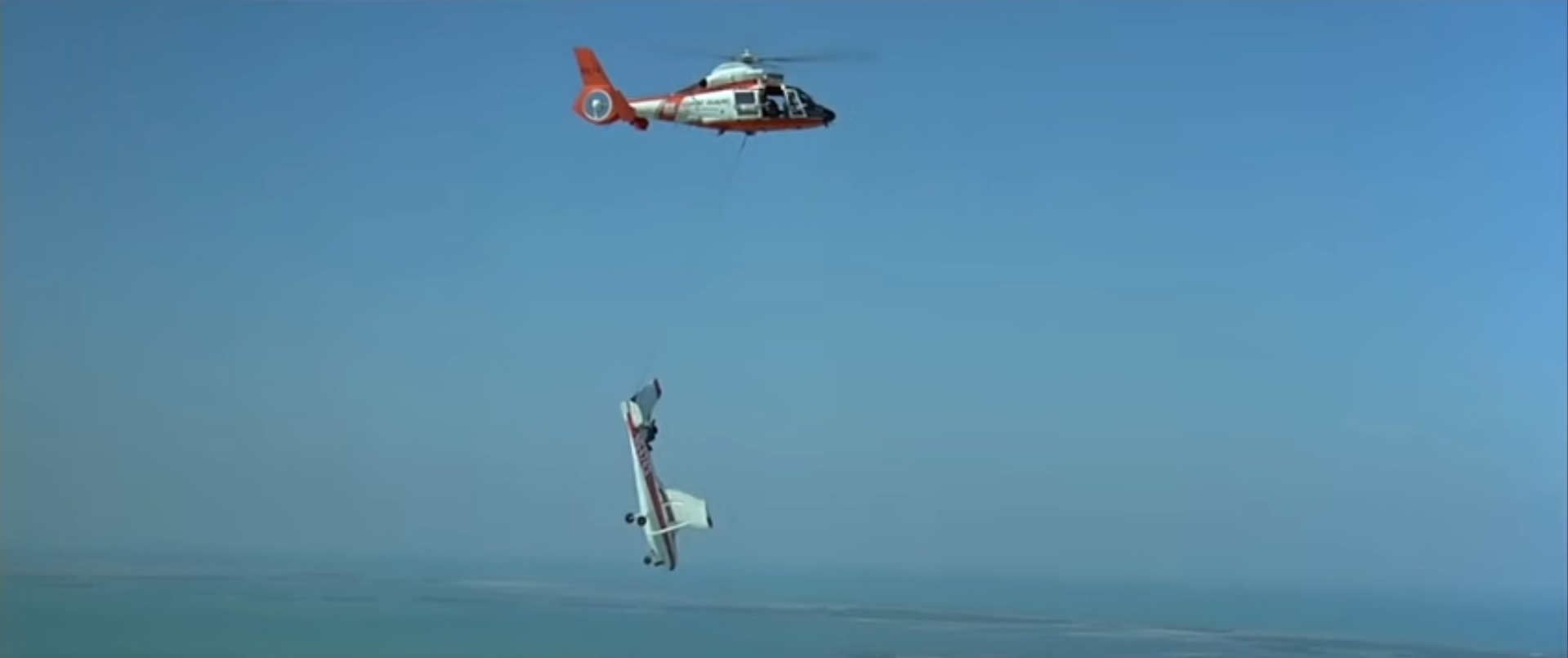
In Licence to Kill, James Bond’s best friend and DEA agent Felix Leiter is about to get married. But on the way to the church, Leiter receives a tip: drug baron Franz Sanchez is in the Florida Keys, and if they don’t move now, he’ll escape. Bond, Leiter’s best man, is allowed to come along, but strictly as an “observer.” But soon Bond is caught up in the action: a gun fight that leads to Sanchez’s escape in a Cessna 172 Skyhawk. Leiter and Bond give chase in a U.S. Coast Guard helicopter. Sanchez will be in “Cuban airspace in 15 minutes” — beyond an extradition treaty. The high-powered helicopter closes in, but now what? How do they get Sanchez out of that plane?
Bond has an idea. He looks at the helicopter’s winch cable, thinks of Leiter’s favourite pastime, and as he lowers the cable, he says: “Let’s go fishing.”
What follows is an elaborate and ingenious stunt — a mid-air plane heist — and one that would, 23 years later, be directly echoed in the opening of Christopher Nolan’s The Dark Knight Rises.
The stunt had its dangers: the man on the wire had no parachute. If anything went wrong he’d fall to his death. Potentially worse, at one point, the film’s star Timothy Dalton asked to take over — this time above a mockup, but no less dangerous. Dalton did what Tom Cruise would begin seven years later — albeit on a smaller scale — and do some of his own stunts.
A Stunt Years in the Making
The pre-title sequence of Licence to Kill (1989) began with a question from producer Albert “Cubby” Broccoli. According to Some Kind of Hero, the definitive behind-the-scenes history of the Bond franchise by Matthew Field and Ajay Chowdhury, Broccoli asked aerial stunt coordinator J.W. “Corkey” Fornof whether it was possible to take an airplane out of the air. Fornof’s answer was immediate.
“Yes, we can. I’ve got a stunt I’ve been working on for years.”
Fornof was not new to Bond. He flew his Acrostar BD-5J — the world’s smallest jet — in the now-famous pre-title sequence for Octopussy (1983). By Licence to Kill, Fornof had logged over 17,000 hours across more than 300 aircraft types.
He held an FAA Zero Level Aerobatic card and operated under an FAA-approved Motion Picture and Television Operations Manual — the safety plan required for aerial filming that would otherwise breach standard flight rules, including FAR 91.119, the minimum safe altitude regulation. Without that approval, the stunt over Key West could not legally have taken place. His screen credit — Aerial Stunt Supervisor — almost understates his role. He designed the sequence, obtained the permissions, and was responsible for safety from the moment aircraft were in use.
The plane snare stunt had been in his head for years.
It took three weeks to prepare over the skies of Miami. Fornof met with US Coast Guard chiefs in Washington DC to obtain the necessary permissions. The helicopter used in the sequence was a real Coast Guard Aerospatiale HH-65A Dauphin, not a production hire. Alongside Fornof, parachute stunt coordinator B.J. Worth oversaw the skydiving elements of the sequence. Worth was no stranger to Bond stunts without a safety net — he had done the Moonraker pre-title sequence, in which Bond is thrown from a plane with no parachute at all. By Licence to Kill, Worth had captained the team that won the World Sky-Diving Championship on three consecutive occasions. When the time came to test the stunt, the potential was not lost on the intelligence community. Members of the CIA showed up to film it.
Three Problems, Three Solutions
The concept sounds simple. A helicopter intercepts a slow-moving Cessna. A man drops from the helicopter on a wire, lassoes the tail of the plane, and the helicopter carries it off. But executing it required solving three distinct engineering problems, each discovered by a different member of the crew.
The first was the engine. For the sequence to work, the Cessna had to hang vertically beneath the helicopter with its propeller still turning. A standard aircraft engine won’t run inverted. Special effects supervisor John Richardson stripped the airframe completely and installed a microlight engine — the only powerplant light enough and capable of running at any angle, including upside down. There was a secondary constraint: Richardson noted in his memoir Making Movie Magic that the helicopter couldn’t fly too fast, or the dangling plane would feather, its propeller spinning uselessly in the airflow rather than under power.
The second problem was what happened when the winch engaged. Director John Glen described in his memoir For My Eyes Only what the rig taught them in testing: once the aircraft was winched up to the helicopter, it went from nose-down to horizontal — and then began climbing toward the helicopter. The nose had to be weighted to arrest the climb before the Cessna rose up and struck the helicopter above it.
The third problem was the transfer itself. The Cessna was travelling at just 50 to 60 mph — slow enough for a man on a wire to make contact. But any weight landing on the tail, a point far behind the plane’s centre of gravity, would immediately push the nose up and stall the engine. The window for contact was seconds.
Richardson’s effects department also built a separate rig for the ground unit: one that could tilt the Cessna from horizontal to vertical to simulate a nose-dive on cue. A wind machine stood in for the air currents the plane would experience at altitude, and one of camera technician Ken Atherfold’s rigs let the camera ‘float’ to suggest the shot was being taken from the air. By Atherfold’s usual standards the rig was simple — built largely from wood and stretchable bungee cords — but it is a fair example of the improvisation running through the unit’s work on this sequence.
No Parachute on the Wire
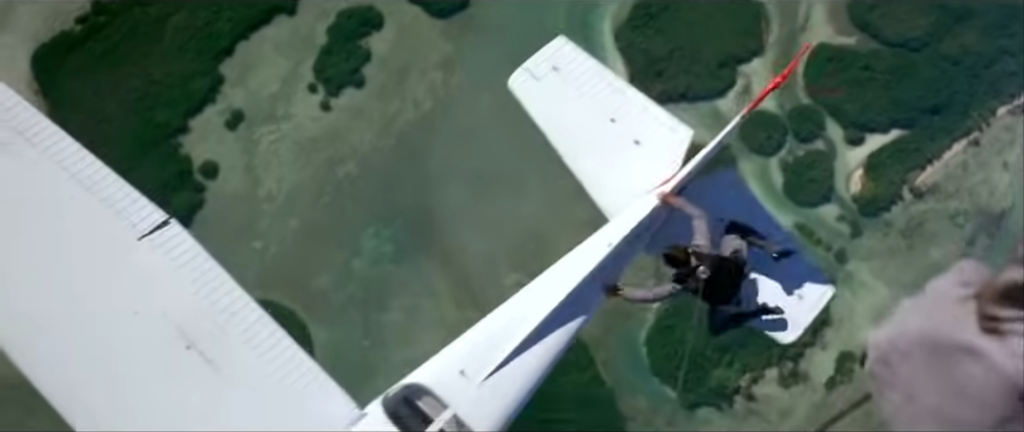
Jake Lombard was Dalton’s aerial stunt double on Licence to Kill. He had previously doubled Roger Moore on midair fight scenes in Moonraker and Octopussy. For the wire transfer, his credit in the film reads Stunt Rigger. His job was to descend from the Coast Guard helicopter onto the tail of the actual Cessna at altitude — and get off it immediately to avoid stalling.
In the EON Productions documentary Inside Licence to Kill, Lombard was characteristically understated about what the job involved: “What I was doing under the helicopter was pretty simple. You’re just basically a passenger until you have to grab a hold of the thing.”
Field and Chowdhury’s account makes the risk explicit. Fornof wrote a test program using skydiving skills to lower the stuntman onto the plane’s tail on a wire. A safety measure was developed for the man and the helicopter. “The most dangerous part? There was no ‘chute on the wire.”
Lombard wears what appears to be a parachute pack in the footage — it’s required by the scene. But Fornof’s account makes clear it wasn’t functional. Given that Richardson had stripped the Cessna to bare bones and replaced its engine to save weight, putting a live parachute on the man making tail contact would have worked against everything the production had spent weeks engineering.
Second unit director Arthur Wooster, watching from a second helicopter, was direct about what he’d witnessed: “That was for real. We were shooting it from another chopper and I mean dear old Jake — he actually came down and he got on that tail of that aircraft, which is, you know, that was good stuff.”
Ten Feet Off the Ground
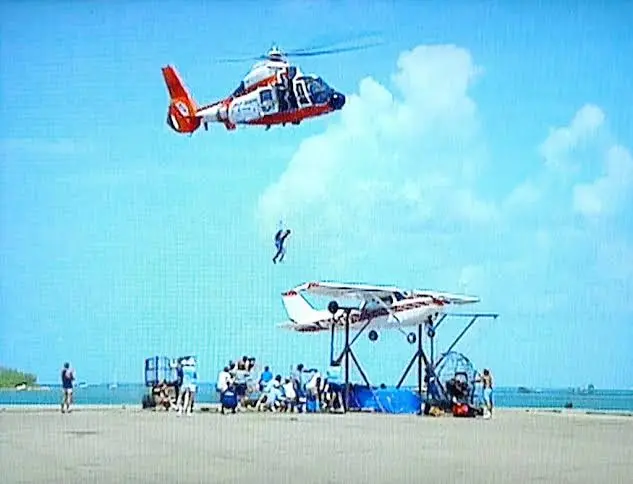
The aerial transfer at altitude was only part of what the audience sees — wide shots of Lombard descending and a bird’s eye view of him touching the Cessna’s tail. The actual snaring of the Cessna by Bond is shot with Dalton, and just feet off the ground.
On August 18, 1988, the second unit relocated to Key West, Florida. Richardson’s effects crew had built a full-scale replica Cessna on a gimbal rig, ten feet off the ground, that could tilt from horizontal to vertical to simulate a nose-dive on cue. A real helicopter hovered above it. Wind machines simulated the air currents the plane would experience at altitude, and one of camera technician Ken Atherfold’s rigs let the camera ‘float’ to suggest the shot was being taken from the air. This was where Lombard was supposed to continue through the close work — Bond lassoing the tail, riding the fuselage, subduing the pilot.
Watching the footage being filmed, Dalton grew concerned that the stunt double was not making the action look convincingly dangerous. According to Sally Hibbin’s contemporaneous production account The Making of Licence to Kill, Dalton explained what he felt was missing:
“I want to believe that there’s a battle going on. It should also have the feel of someone going fishing — you have to catch the plane on a hook.”
Then, Dalton took over and did the stunt himself.
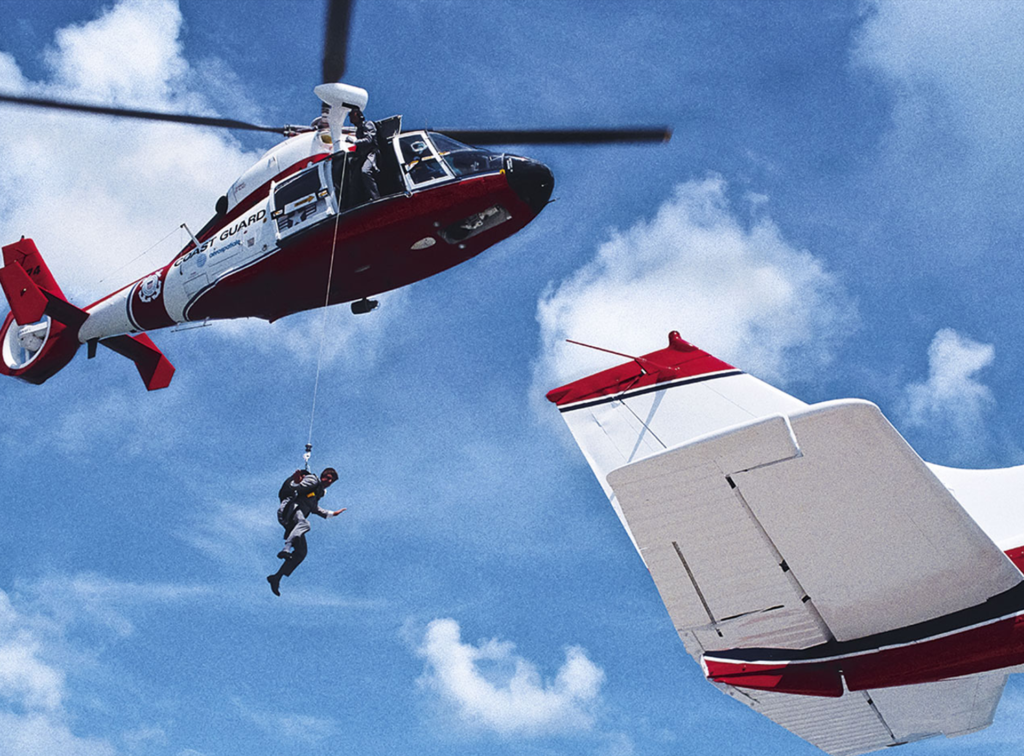
Dalton described the experience afterwards, recovering from having been lowered from a helicopter on the end of a rope:
“It was fun. It was just like flying. I was more worried when the plane was at full tilt. There was nothing to hold on to and the plane was moving around a lot when the helicopter was flying above it.”
It was at this point, in Lombard’s recollection of events, that Broccoli intervened.
“He’s flying into the tail of the plane. He’s not far off the ground. And Cubby drove up in his limousine and got out with a big thick cigar and looks over and looked at me and looked at Timothy flying in and realized that Timothy was flying in in this helicopter and goes, ‘What the hell are you doing here? I’m paying you to be up there. Get him down here. He can’t get hurt!'”
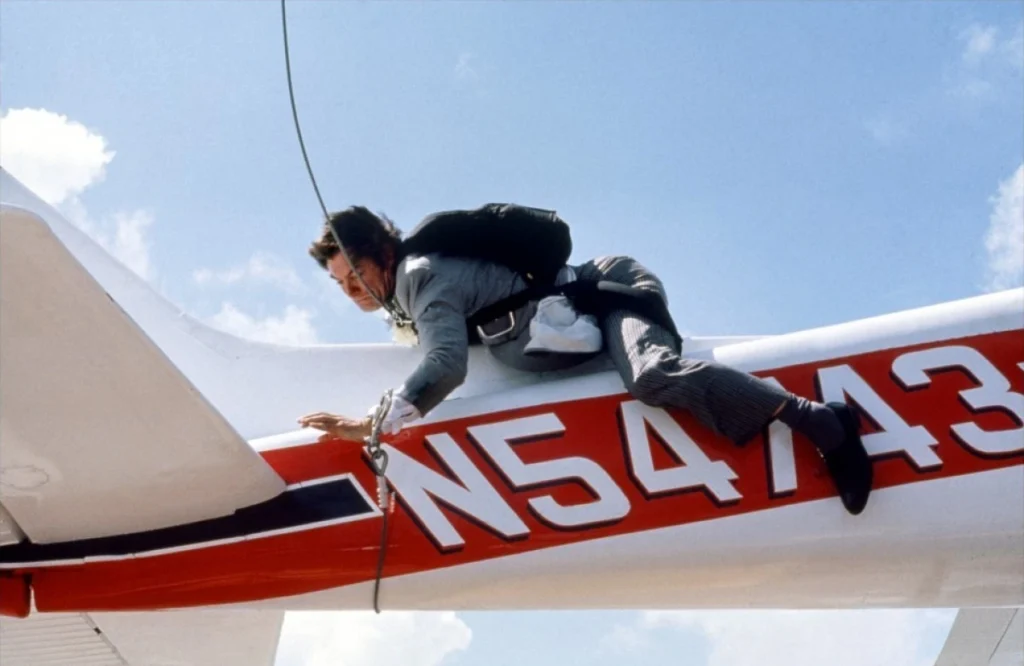
Dalton’s footage was too good to cut. It remained in the finished film.
Richardson’s gimbal-rigged fake plane also handled the suspension illusion — the shot of the Cessna dangling nose-down beneath the helicopter that gives the sequence its most memorable image. A cable release on the nose created the effect of the plane tipping vertical. The completed sequence is a composite of three separate elements: Lombard at altitude for the real wire transfer, Dalton ten feet off the ground for the close work, and Richardson’s rig for the suspension shots.
“If You Believe It’s Me — It’s Me”
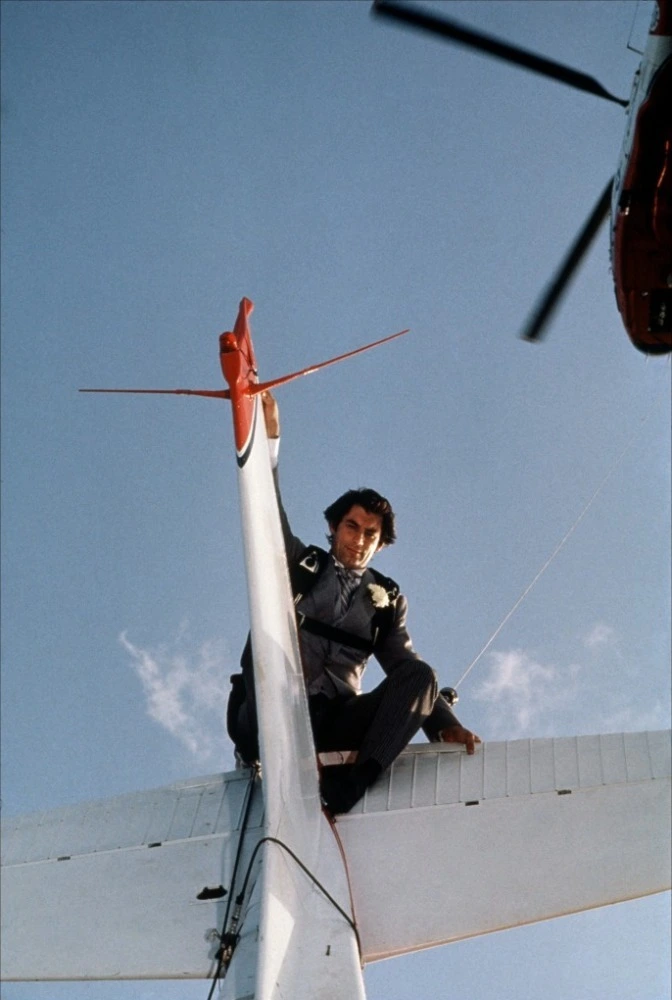
Stunt double Simon Crane, who handled ground doubling duties for Dalton on the film, articulated the standard position in the documentary:
“There’s a big difference between doing action and stunts. A stunt by definition, you don’t really see who it is. You just get a glimpse of what’s happening and it’s normally the guy flying through the air. There’s no point having an actor do it. You never see him.”
Dalton disagreed:
“If you believe it’s me, it’s me. If you can see it’s me, it’s me. The audience should just quite simply believe that the man, the character that they’re watching, James Bond, does them.”
Dalton’s presence in the sequence allows for camera angles and coverage that would have been impossible with a double — close-ups that put Bond’s face in the frame against a real helicopter and real sky. Without them, the production would likely have fallen back on rear projection, which in 1989 was still visibly unconvincing. The intercutting of Dalton’s work on the ground set with Lombard’s real aerial transfer is seamless, even today.
It was not the first time Dalton had pushed the boundary. In The Living Daylights (1987), he contributed realistic fight work on a cargo net set, with the close work intercutting against the real exterior stunt. The helicopter sequence in Licence to Kill was the next evolution — an actor insisting on being present not for vanity but because his being there made the scene better. Daniel Craig would later take this further, performing increasingly demanding stunt work on safety cables across his Bond run. But the instinct began with Dalton.
The Bond Stunt Nolan Couldn’t Forget
The sequence’s afterlife is worth noting. When Christopher Nolan opened The Dark Knight Rises (2012) with Bane’s mercenaries dropping from a larger aircraft onto a CIA plane, lashing cables to its fuselage and carrying it off vertically, the structural grammar was identical to what Fornof had designed in 1989. Nolan has never been coy about the debt. Asked by Rolling Stone whether the TDKR opening was an attempt to out-Bond the Bond films, he replied:
“Well, that’s always the attempt. I grew up watching those films obsessively… I don’t think I’ve been too subtle about the ways in which I’m ripping off those movies.”
For the sequence, he hired special effects supervisor Chris Corbould, whose Bond credits stretched back to The Spy Who Loved Me — and included Licence to Kill. Fornof’s stunt, designed in a Miami airfield and tested under CIA observation, had become the template.
After the Jump
The sequence ends with Bond and Felix Leiter parachuting to the steps of a Key West church for Leiter’s wedding. The wide shots were performed by Worth and Lombard. For the full body shots of Leiter landing, actor David Hedison was suspended from a crane and lowered to his mark. Glen asked the crane operator to bring him down a little faster. Hedison hit the concrete hard. Nothing was broken. He limped through the rest of the film. Glen still considers it his fault.
The character Hedison was playing had a worse afternoon ahead of him. Sanchez, carried off in the Cessna above the church, would escape DEA custody within the hour, feed Leiter to a shark, and murder his new wife. Leiter would survive, minus a leg bitten off below the knee.
The pre-title sequence is the last moment before everything unravels.