The Eurocopter Tiger in GoldenEye: Disentangling Reality from Fiction
In GoldenEye, a rogue Russian general and former Soviet fighter pilot steal Eurocopter’s answer to the electronic battlefield — the Tiger helicopter. The sleek, black, wasp-like aircraft was real. But the film made it iconic by granting it capabilities it never possessed: immunity to electromagnetic pulse and a fully ejectable cockpit.
No helicopter — or any aircraft, for that matter — can be impervious to a nuclear-generated electromagnetic pulse detonated in the upper atmosphere. Yet the idea is not pure fantasy. Modern military aircraft are designed with electromagnetic protection intended to minimise disruption to their electrical systems. And one helicopter has been equipped with an ejection system — just not as cinematic as the Tiger presented in GoldenEye.
So join me as we disentangle reality from fiction, and explore the real-world Tiger helicopter, electromagnetic hardening, and the truth behind ejectable cockpits.
The Tiger helicopter functions as the central MacGuffin in the first act of GoldenEye. After James Bond crosses paths with Xenia Onatopp, a former Soviet fighter pilot, his suspicions are confirmed when he fails to prevent her from stealing the Tiger during a demonstration aboard a French naval frigate. Later, MI6 tracks the helicopter to Severnaya, where Bond watches via satellite feed as Onatopp and rogue Russian General Ouromov seize the GoldenEye satellite weapon. They detonate an electromagnetic pulse to erase evidence of the theft, destroying the Severnaya facility and escaping in the supposedly EMP-immune Tiger while nearby Russian MiGs lose control and crash.
The structure of this theft echoes Thunderball. In that earlier Cold War entry, a SPECTRE agent impersonates a NATO pilot and hijacks a real Avro Vulcan bomber carrying nuclear weapons. The aircraft vanishes, the warheads are stolen, and the world is thrown into crisis. GoldenEye mirrors this architecture almost beat for beat — pilots murdered, identities assumed, nuclear hardware seized — but transposes it into a post-Soviet landscape of fragmentation rather than superpower rivalry. The Tiger becomes the 1990s equivalent of the Vulcan: a real military platform repurposed as the vehicle of nuclear theft.
These sequences elevate the Tiger beyond mere hardware. The film blends its real-world technical credibility with the fictional addition of total EMP immunity, presenting it as the most advanced helicopter in Europe. But its presence carries symbolic weight as well.
Four years after the collapse of the Soviet Union in 1991 and two years after the formal establishment of the European Union in 1993, Europe was consolidating politically and industrially. Eurocopter itself — formed in 1992 through the merger of France’s Aérospatiale and Germany’s MBB helicopter divisions — reflected that same Franco-German integration as the dominant political drivers of early European Union consolidation. While not an EU military institution, the company emerged from the broader atmosphere of cross-border cooperation that characterized early post–Cold War Europe. The Tiger, as its flagship program, became a visible expression of that new European industrial alignment.
GoldenEye captures this moment without explicitly announcing it. The Tiger is introduced as “Europe’s answer to the electronic battlefield,” staged aboard a French naval vessel and framed within a NATO context. The hardware is multinational, modern, cooperative — emblematic of Western consolidation.
At the same time, the threat no longer comes from a centralized Soviet superpower, but from a state in disarray filled with old Soviets and new Russian crime syndicates. The Janus Syndicate represents, in the hyperrealism of the Bond universe, a destabilized Russia, where old Soviet weapons–including nukes–were considered a threat if sold on the black market to rogue groups.
The Cold War chessboard had been cleared. A new game was beginning — and Bond’s first post–Cold War mission required new hardware.
The Real Eurocopter Tiger
Unlike many fictional Bond machines, the Tiger was not invented for the screen.
Executive producer Tom Pevsner explained during production:
“The helicopter which you see from here which is on the aft deck is the next generation of battlefield helicopter being produced by Eurocopter. And that actually won’t be in service with the German and the French governments until the year 2005. They have four prototypes that they’re in the process of testing at the moment, and we have prototype number one which has completed its test program and so they lent that to us.”
In 1995, the Tiger was still in development. Four prototypes were undergoing testing. GoldenEye secured access to prototype number one — years before the aircraft would formally enter operational service with France and Germany.
The Tiger would enter French service in 2005 and later see operational deployment in Afghanistan, Libya, and Mali. Germany fielded its own variants shortly thereafter. Australia selected the ARH Tiger in 2001 as part of its defence modernization program. In real-world operations, the helicopter proved agile and effective in reconnaissance and close-support roles — but it never possessed the cinematic invulnerability depicted in the film.
Europe’s Answer to the Electronic Battlefield?
During the Monte Carlo briefing, the helicopter is introduced as:
“Europe’s answer to the electronic battlefield… uniquely manoeuvrable… armed against all forms of electronic interference, radio jamming, and electromagnetic radiation.”
The demonstration conflates reality with spectacle.
By the early 1990s, modern attack helicopters were being designed to operate on the electronic battlefield — where radar surveillance, signal disruption, and radio-frequency interference were expected threats. The Tiger incorporated advanced avionics, secure communications, digital battlefield management systems, infrared suppression, and reduced radar signature characteristics.
But these capabilities were not unique to the Tiger. Comparable helicopters of the period — including the AH-64D Apache Longbow — were built with similar electronic resilience.
And none were immune to a high-altitude nuclear electromagnetic pulse.
What the Severnaya EMP Strike Shows
The Severnaya sequence is the film’s clearest visual demonstration of the GoldenEye weapon — and the Tiger’s EMP immunity.
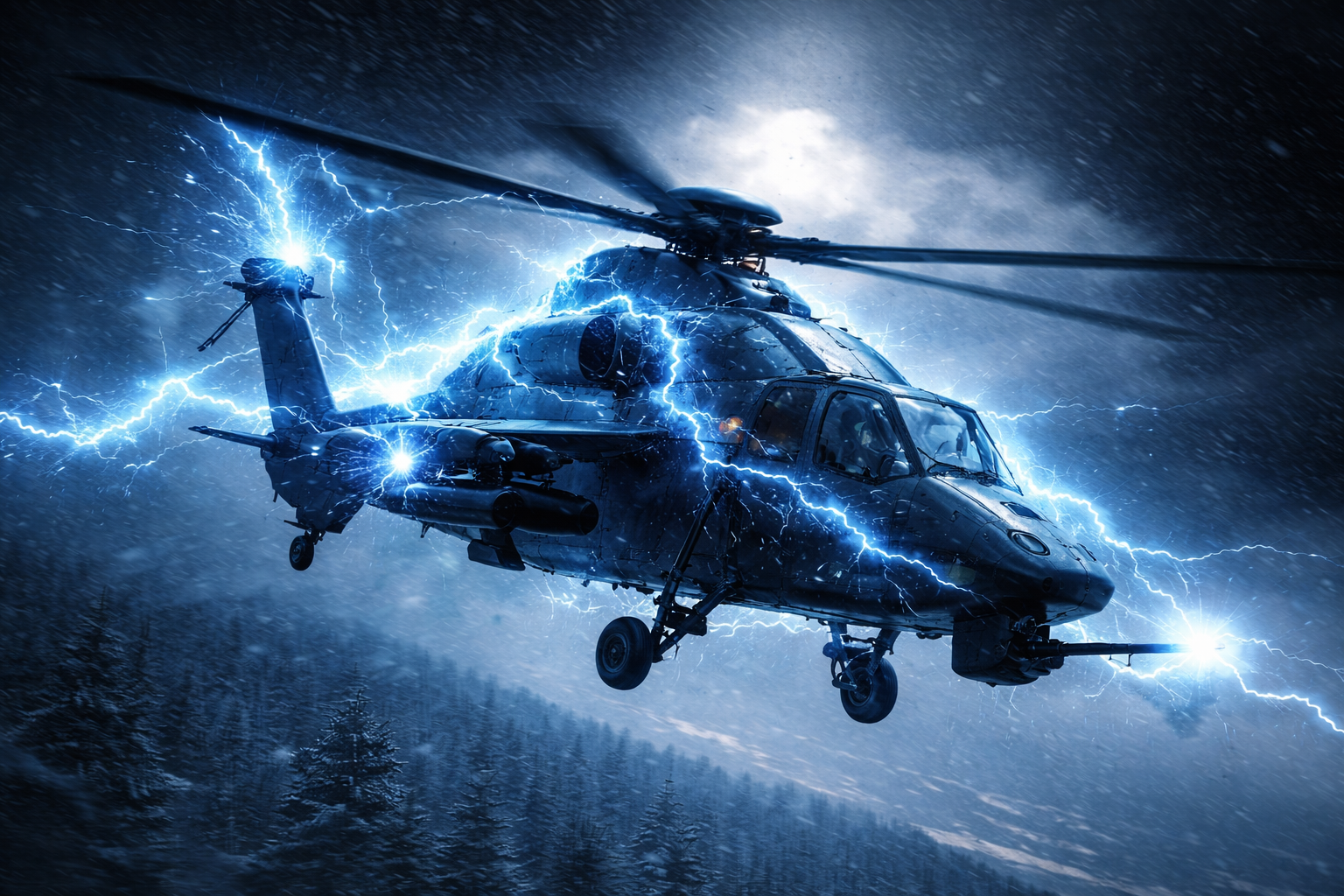
From orbit, the GoldenEye satellite fires. A pulse streaks toward Siberia. Moments later, blue electrical energy crawls across the vast satellite dish, the surrounding structures, and the aircraft on the runway.
Russian MiG fighters attempting to intercept the fleeing Tiger lose power and spiral from the sky. The Severnaya facility’s electronics overload and fail. The base is destroyed.
The Tiger experiences the same visible surge — the blue energy crawls across its fuselage — but it continues flying unscathed.
The Severnaya sequence does not depict electromagnetic hardening of the Tiger helicopter. It depicts total immunity.
The Severnaya sequence translates invisible physics into visible spectacle. You’ll never see blue electricity crawling on structures. Aircraft will crash and a ground base’s electronics will short out and go dark.
Nonetheless, the effects and miniature work are beautifully conceived, and for viewers unfamiliar with the realities of electromagnetic pulse, the Severnaya sequence remains highly effective even today. Watched in a darkened theatre, it becomes a striking light display that pulls the audience directly into the moment. It is a sequence that signals a clear evolution in Bond cinematography — a visual confidence that had been less pronounced in the last few entries.
What EMP Hardening Actually Means — and Why It Is Not Immunity
Modern military aircraft are not oblivious to electromagnetic threats. Since the Cold War, aviation engineers have developed methods to reduce vulnerability to electromagnetic pulse and electronic warfare.
EMP hardening typically involves:
Shielded and grounded wiring
Surge suppressors protecting sensitive components
Filtered power lines
Redundant avionics pathways
Segregated electronic systems
Reinforced circuit protection
Strategic aircraft built to function during nuclear conflict — such as airborne command posts — have incorporated extensive electromagnetic shielding and protected avionics compartments. Systems are tested against simulated pulse environments and designed to degrade rather than fail instantly.
But hardening is mitigation, not magic.
It reduces susceptibility.
It does not eliminate it.
An attack helicopter like the Tiger was built to operate on the electronic battlefield — where radar jamming, signal disruption, and radio-frequency interference are expected. Its avionics were designed to be resilient against interference. But resilience against interference is not the same as surviving a high-altitude nuclear EMP without consequence.
The distinction is critical. GoldenEye collapses it for dramatic effect. Real aerospace engineering does not.
How the Severnaya Sequence Was Filmed
The illusion of EMP immunity was achieved not through engineering, but through filmmaking.
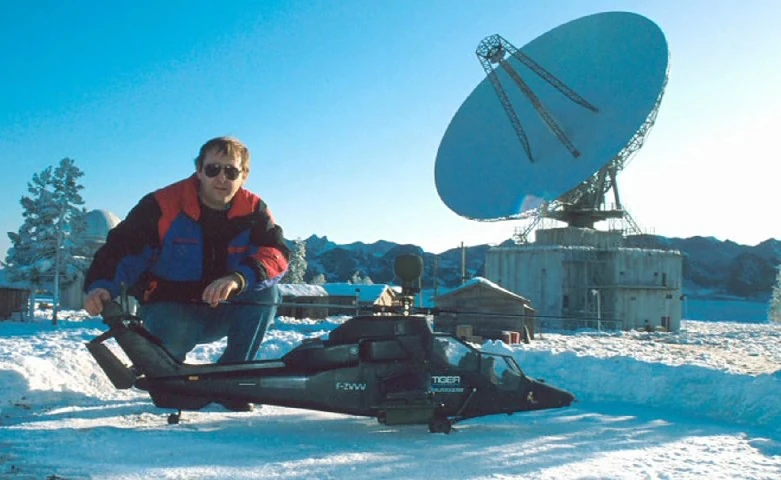
The Severnaya satellite facility and its Siberian surroundings were constructed as large outdoor miniatures by Derek Meddings’ model unit at Leavesden Studios in England. Further miniatures of the Russian MiG fighter planes and a remote-controlled Tiger were also made for the scene. To complete the frozen landscape effect, dendritic salt was used to simulate snow at scale.
Unexpected real snowfall complicated filming. Model maker Nigel Blake later recalled:
“The day we were due to shoot on it, it snowed overnight. And it actually overdid the whole thing. You couldn’t see anything for real snow. And we had a big problem with the fly model because it was about eight foot rotor span, I would imagine. It was fairly big chunk. It was so cold and frosty that the salt was melting but kicking up enough dust and all the paper snow that was on the set that it was forming a crust on the rotor blades and we could only fly it so far before they became so unaerodynamic and out of balance that we had to land the model again. But I mean we got that shot and it looks fantastic.”
The realistic shot of the radio-controlled miniature rising within the miniature landscape was intercut with full-scale photography for the actors, who were either filmed inside or alongside the full-size Tiger helicopter, or staged before the miniature environment positioned at sufficient distance to achieve convincing forced perspective.
The blue electrical arcs were added through visual effects layered over practical miniature photography by Cinesite. The arcs themselves were not present during miniature filming, but were created later through digital compositing and layered over the photographed models to simulate electromagnetic energy interacting with the structures and aircraft.
By the mid-1990s, visual effects artists were combining practical miniature photography with computer-generated enhancement. The result in GoldenEye is a hybrid effect: physically real aircraft and landscapes augmented by digitally created electrical phenomena.
The Tiger’s survival is therefore not mechanical — it is cinematic. The immunity exists in compositing software, not in aerospace engineering.
The Soviet Statue Park Cockpit Escape
If Severnaya establishes the Tiger’s fictional EMP immunity, the Statue Park climax delivers its second impossible feature: the detachable escape cockpit.
Bond regains consciousness inside the helicopter. The missiles fire. They arc away — then reverse course toward the aircraft.
The missiles are identified as Mistral systems — real infrared-guided weapons compatible with the Tiger. But real Mistrals do not reverse course and re-target their launching platform. That behaviour is cinematic invention.
Bond slams his head into the ejector button. The rotors detach. The cockpit rockets upward before descending via twin parachutes.
No production Tiger ever possessed such a system.
The concept of helicopter ejection is not entirely fictional. The Russian Kamov Ka-50 features a genuine ejection seat, with rotor blades explosively detached before the pilot is fired clear. But that system ejects the pilot, not the entire cockpit. The Tiger’s capsule is a cinematic escalation.
Practical destruction was photographed using large-scale miniatures. CGI enhancement completed the illusion.
The detachable cockpit belongs to cinema.
Was There Ever an Ejectable Helicopter?
While the Tiger’s escape system is fictional, the concept of helicopter crew ejection is not entirely imaginary.
The most notable example is the Russian Kamov Ka-50 “Black Shark.” Unlike conventional helicopters, the Ka-50 features a genuine ejection system. Before the pilot is propelled upward, explosive charges detach the rotor blades to clear a safe escape path. A rocket-assisted ejection seat then fires the pilot clear of the aircraft.
Even this system differs fundamentally from what GoldenEye depicts:
The Ka-50 ejects only the pilot, not the entire cockpit.
Rotor blade separation is part of the system.
There is no detachable crew capsule.
It is designed as a last-resort survivability mechanism — not a cinematic mid-air escape pod.
The Tiger’s system is therefore an escalation of a real concept. It takes rotor jettison and pilot ejection and magnifies them into a fully detachable command module — closer to spacecraft escape systems than helicopter engineering.
How the Statue Park Escape Was Filmed
The statue park sequence — in which the Tiger is struck by missiles, its rotors detach, and the cockpit pod rockets clear before descending via two parachutes — was created through a combination of miniatures and CGI.
Nigel Blake constructed a 1/4-scale Tiger model for the destruction sequence. Built from 4mm black ABS plastic sheet, the model incorporated explosively ejected rotor blades and a detachable cockpit pod mounted on counterweighted wires. Smoke and rocket pyrotechnics were fitted beneath the pod, and a radio-controlled release system allowed the miniature cockpit to separate mid-shot and deploy two working parachutes manufactured by Irvine Parachutes in Hertfordshire.
The sequence unfolds in layered practical stages:
Rotor separation
Explosive breakup
Rocket-assisted cockpit ascent
Parachute deployment
Full-scale fireball
Digital enhancements were later integrated to blend the miniature explosion with the surrounding environment and intensify the spectacle.
On GoldenEye, practical and digital techniques were deliberately fused together — a transitional moment in mid-1990s effects work when miniatures still carried physical weight and CGI was used to augment rather than replace them.
The destruction feels real because it was photographed. The escape feels plausible because it borrows fragments of real aerospace ideas. But the detachable cockpit itself belongs entirely to cinema.
Eurocopter Tiger – Technical Specifications
| Specification | Eurocopter Tiger (Early Production Variants) |
|---|---|
| Manufacturer | Eurocopter (France / Germany) |
| First Flight | 1991 |
| Operational Introduction | 2005 (France) |
| Crew | 2 (tandem cockpit) |
| Length | ~14.1 m |
| Rotor Diameter | 13 m |
| Height | ~4 m |
| Empty Weight | ~3,060 kg |
| Max Takeoff Weight | ~6,000 kg |
| Engines | 2 × MTR390 turboshaft |
| Max Speed | ~290 km/h |
| Range | ~800 km (with external tanks) |
| Armament | 30mm cannon, rockets, Mistral AAM, Hellfire/Spike ATGM |
| Avionics | Digital glass cockpit, HMD, laser designator, thermal imaging |
| Survivability | Reduced IR signature, ballistic protection, self-sealing tanks, redundant systems |
None of these specifications include EMP immunity or a detachable cockpit escape system.
Did GoldenEye Influence Tiger Sales?
Although GoldenEye brought the Eurocopter Tiger to global cinema audiences in 1995, there is no public evidence that the film influenced military procurement decisions. Attack helicopter acquisitions are the result of long-term governmental planning, strategic doctrine, and defence budgets — not cinematic exposure.
The Tiger’s real-world adoption followed defence policy rather than box-office momentum.
Did GoldenEye Influence Tiger Sales?
Although GoldenEye brought the Eurocopter Tiger to global cinema audiences in 1995, there is no public evidence that the film influenced military procurement decisions. Attack helicopter acquisitions are the result of long-term governmental planning, strategic doctrine, and defence budgets — not cinematic exposure.
The Tiger’s real-world adoption followed defence policy rather than box-office momentum.