Tesla “Flying” Roadster is Built on Real James Bond Tech
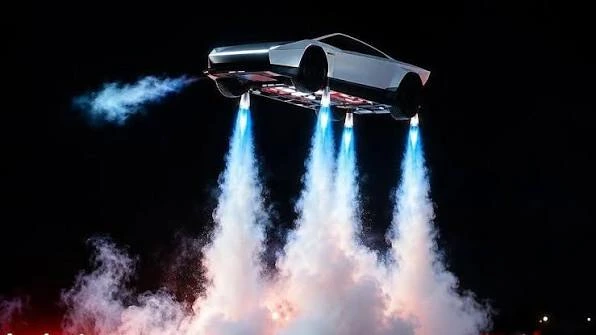
If Q demonstrated the new Tesla Roadster to James Bond, he might say it is packed with all the “usual refinements” but also has “some new tricks up its sleeve”. A fan suction system lets the car drive and hang upside down, but its primary feature, the one you’d expect 007 to showcase in the signature car chase of his latest big screen adventure, is its ability to fly. And the trick that gets it airborne traces straight back to Thunderball.
The franchise has toyed with a flying car before, in The Man With the Golden Gun. Villain Francisco Scaramanga’s own car had airplane wings mounted so it could take flight, leaving Bond on the ground just to watch it fly away. Q said they were working on a flying car of their own, but curiously it is the one gadget Bond is yet to have. Now Tesla has beaten him to it.
Launched, quite literally, at SpaceX’s McGregor Test site on 15 October 2026, the Tesla Roadster used its rear-mounted rockets to travel from 0 to 60 mph in 0.81 seconds. It isn’t the first Roadster SpaceX has launched (in 2018 the original was fired into space aboard Falcon Heavy), but it is the first to leave the ground under its own power.
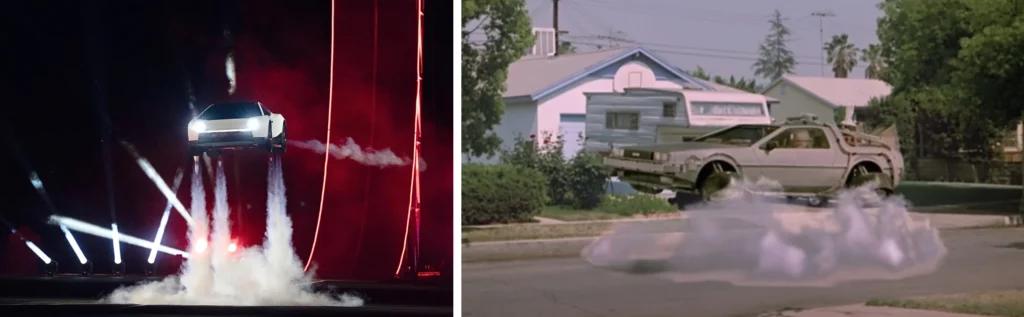
Sure, the sight of the car flying in the air recalls the DeLorean from Back to the Future, but Musk’s eye has always been on 007. He introduced it as much stating the Tesla Roadster is “better than any James Bond car”. That isn’t in dispute: it can do for real what many of Bond’s cars could only do with the help of movie magic. That magic has long been Musk’s brief to his engineers. In 2013 he bought the Lotus Esprit submarine car from The Spy Who Loved Me, intending to make it transform for real.
But that isn’t the whole story: the Tesla’s cold gas technology that kick the Roadster into the air, and also cushion its landing, work on the same principle as the real-life jetpack that had its most famous outing Thunderball: thrust from gas forced through nozzles, not lift from wings.
The Lotus Esprit on Screen
During the presentation, a photograph of James Bond’s Lotus Esprit submarine car appeared on screen.
Chief designer Franz von Holzhausen said the Blackbird SR-17 providing some design inspiration, but the wedge shape, the colour and the placement of gadgets recalled the tricked-out Lotus Esprit S1, that the engineers would soon put on screen. They made vague reference to transformation cars serving as inspiration for the Tesla Roadster. But only Bond’s Lotus Esprit submarine car made an appearance, partly because Musk owns it himself. Musk’s plan to make the full-size workable submersible’s compartment water and airtight and no doubt furnish it with gadgets has yet to come to pass. Maybe the next Roadster will swim, but it will be hard to compete with one that can fly. Nonetheless, many gadgets given this new Roadster are inspired in part from the Lotus Esprit S1.
But first let’s start with its look.
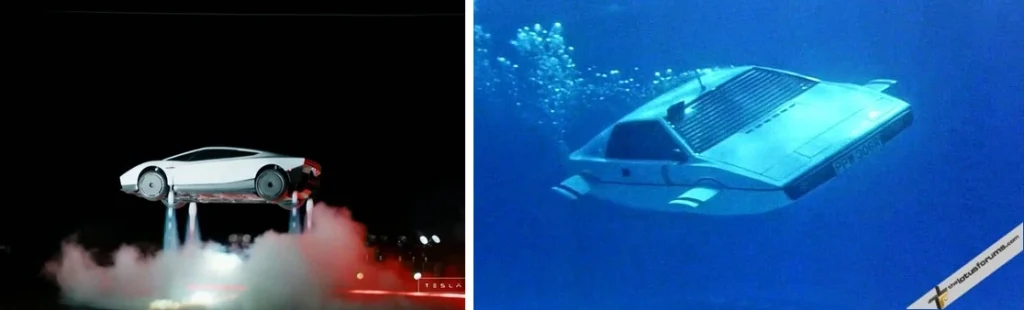
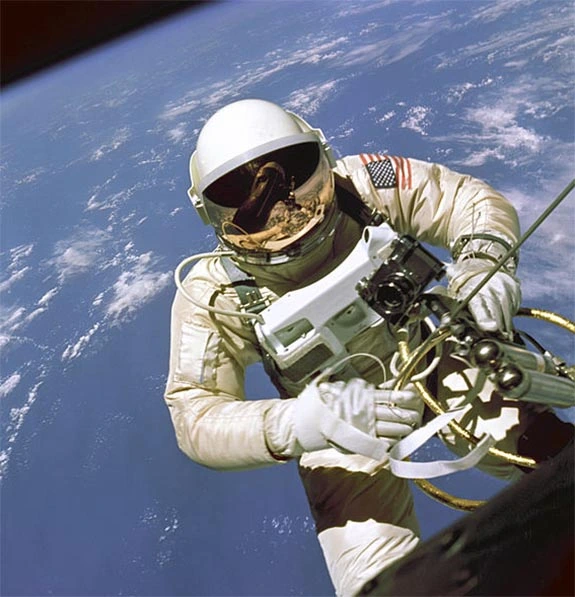
The white colour scheme, alongside the Roadster’s wedge shape recalls the Lotus Esprit S1, drawn by Giorgetto Giugiaro. In 2019, Musk credited the shape as a partial influence on the Cybertruck. But, specifically, it is meant to recall an astronaut’s space suit rather than Bond’s car, though, both can be true at once, as other specifics make clear.
The new Tesla Roadster is painted Ano White, a unique exterior paint derived from rocket protective coatings. The gold-tinted windows, inspired by Apollo spacesuit visors, and the rear-placed rockets and the undercarriage rockets that both propel the car off the ground and cushion its landing round out the space rocket inspiration.
At a casual glance the amalgamation of luxury sports car with rocket tech is the same configuration as Bond’s fleet of gadget cars.
Behind the number plate
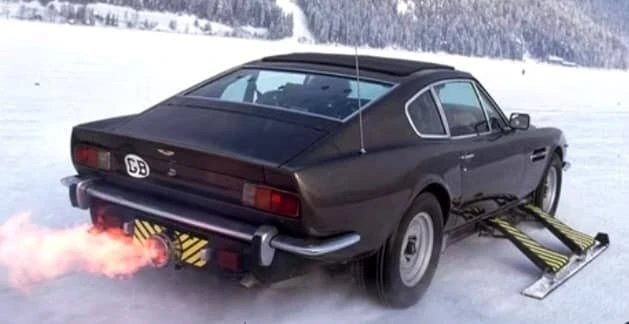
Musk, a lifelong fan of the James Bond series, stated in a 2020 preview of the first Roadster in Jay Leno’s Garage that the next generation Roadster would go “full-on James Bond” with its main thruster hidden behind a retractable rear licence plate. That trick, used to conceal concrete spray guns on the Lotus Esprit S1 in The Spy Who Loved Me and a rocket booster on the Aston Martin V6 Volante in The Living Daylights, didn’t make it into the final Tesla Roadster after all.
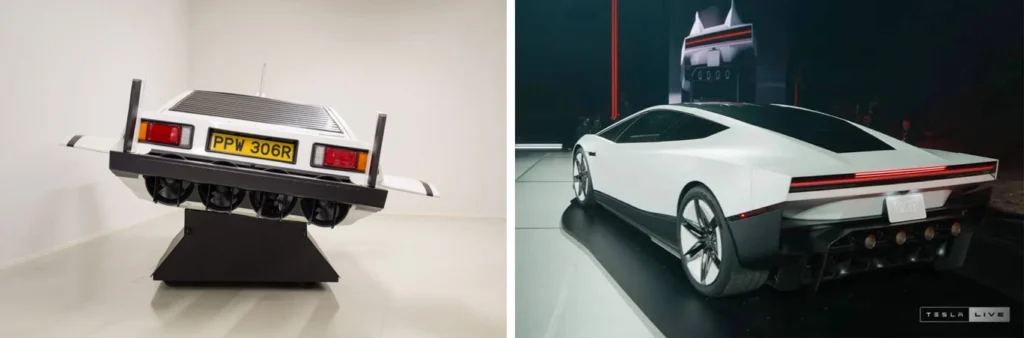
Instead, the four rockets sit in a straight line underneath the number plate. But the James Bond framing remained as once the Lotus Esprit S1 transforms into a submersible it sprouts four turbines below the number plate that propel it through the water.
That leaves us with the car’s piece de resistance: the technology that makes it airborne.
The Thrusters: The connection no one is talking about
The Bond connection — the compressed gas thrusters that give it flight — is the one connection no one has noticed.
When the Tesla Roadster launched over a lineup of Tesla vehicles, many viewers assumed they were watching similar technology to what SpaceX rockets use to launch into space. But they weren’t. Instead, they were watching a car fly in the same way a jet pack does. The Roadster drove up to the vehicles, no ramp needed. The undercar thrusters activated and launched the car upwards, flipping it over the vehicles, and the same thrusters cushioned its landing back on the tarmac.
Surprisingly, there is a clear lineage from the Bell Rocket Belt, designed by aeronautical engineer Wendell Moore, to Tesla’s new Roadster. The Roadster uses the same basic thruster technology as the Bell Rocket Belt that Bond used to escape a bunch of SPECTRE goons in Thunderball. Both also have the same limitation, which we’ll get to.
Jet pack is a colloquial term for any backpack device mounted with rockets or jets to fly a man. But, just like the Tesla Roadster, the Bell Rocket Belt fired pressurised gas through directional nozzles to launch it into the air.
The technology itself is not entirely new. Humans have used compressed gas fired through directional nozzles to launch a solo man into the air since the late 1950s. Some, like 1958’s Jump Belt, propelled a man up and across distance, like a supercharged pogo stick. But the first real jet pack, one that actually did what sci-fi comics and novels had been describing for decades, was the Bell Rocket Belt.
Moore’s belt could fly, rather than leap. Think of the development from the Jump Belt to the Bell Rocket Belt like Superman’s development from leaping tall buildings in a single bound to flight in the comics. Though, ultimately, both belts were a tad less impressive in reality. The Bell Rocket Belt could only fly for 21 seconds, and if the pilot wasn’t careful, he could have a sudden drop and a very bad day.
Moore first tried cold gas to propel the Rocket Belt in 1958, but it was too weak, producing only modest lift on a tether. Switching to hot gas gave two to three times the push, and the belt first flew freely in 1961. The Rocket Belt was funded by the U.S. military, but the results looked impressive for less than 30 seconds. Its limitations were too impractical for combat. It was hard to fly, had a short flight time, and its noise precluded a surprise attack. So, the military ceased funding. The hot gas also made the exhaust and pipes so hot the pilot had to wear insulated clothing.
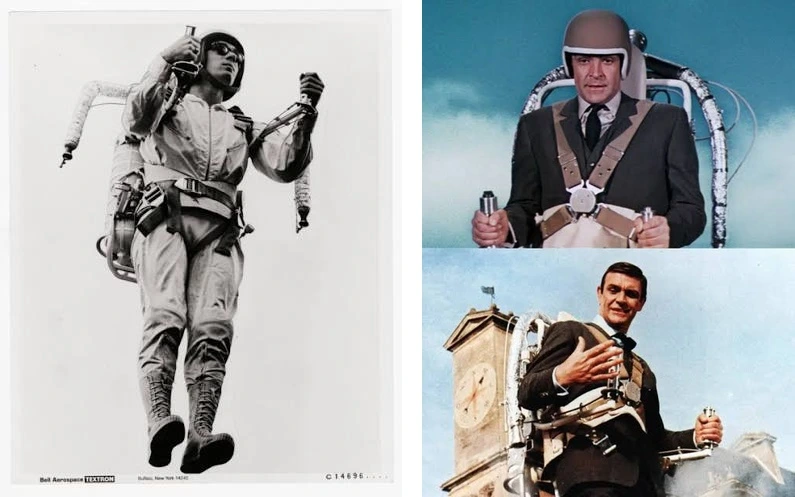
But it was too cool not to use in a James Bond film. In 1965’s Thunderball, Bill Suitor doubled as Bond and used the rocket belt to escape a French château. The Bond connection helped the rocket belt live on in imaginations long after its cancellation. It appeared in a Michael Jackson concert and in the opening ceremony of the 1984 Los Angeles Olympics.
While the Bell Rocket Belt stalled in development, the technology lived on in outer space.
NASA developed their own jet packs for maneuvering outside spacecraft. Cold gas already worked in space, powering Ed White’s handheld zip gun in 1965, which propelled astronauts through space. NASA did deploy a hot peroxide backpack on Gemini 9 in 1966, but it never got used. In the end, NASA stayed with cold gas, using it to power their backpacks, which were the same idea Moore had already developed with the Bell Rocket Belt. Cold gas suited astronaut backpacks better than hot gas because it was safer and simpler to use. Gravity, which limited its ability to keep a man airborne on the Jump Belt and the earliest iteration of the Rocket Belt, was absent from the equation in space.
In 1973, Skylab tested new backpacks, including the Manned Maneuvering Unit on the Space Shuttle, which flew in 1984, and is the subject of some of the most iconic NASA images. It ran on cold nitrogen at about 3,000 psi, but with a hefty 12 kg of cold gas. Ten years later came SAFER, a smaller emergency backpack still worn outside the International Space Station today. The amount of stored cold nitrogen decreased to 1.4 kg but with a far more powerful 3,250 psi. This is important. No gravity environments could run on less cold gas, while conversely increasing psi gave more pressure, more propelling force. For decades, that was enough. With no gravity to fight, NASA never needed more.
But the Tesla Roadster needed more. A lot more. To lift a car off the ground, Tesla packs about 250 kg of compressed air into tanks rated up to 10,000 psi: more than three times the pressure of NASA’s backpacks, and roughly twenty times the gas an MMU carried. That is the fix Moore could not make work. Cold gas was always strong enough for space. To make it work against gravity again, Tesla had to squeeze far more of it, far harder.
This brings us back to the new Tesla Roadster, and brings the argument full circle. Cold gas couldn’t keep a man airborne in Moore’s earliest Rocket Belt tests. Tesla proved that more nozzles, far more gas and a massive increase in psi can make it work in gravity. Basically, the Tesla and SpaceX collaboration gives the Roadster the same type of elevation and descent expected of a jet pack, specifically the Bell Rocket Belt, but with a safer and simpler type of compressed gas: cold gas. It is the type of gas Moore could not make work on his Rocket Belt, because he couldn’t carry enough of it at high enough pressure. NASA’s backpacks raised that pressure, and SpaceX and Tesla have shown it can be raised considerably further, enough to make a car airborne.
The one final addition to the technology Wendell Moore first made work is the use of nozzles that fire sideways. They helped flip the car upright after it drove off the underside of the Hot Wheels ramp, so it could make its safe descent on the underside thrusters. That idea came from flying at the edge of space, where the air is too thin for wings or rudders to steer, so the only way to turn a craft is to fire gas out of its side. In 1958, a Bell rocket plane, the X-1B, became one of the first aircraft to do it, and NACA test pilot Neil Armstrong, later the first man on the Moon, flew the first successful trial. Its thrusters ran on the same hot peroxide as Moore’s belt, and Bell, Moore’s employer, made the nozzles. NASA’s cold-gas backpacks used the same trick: the MMU’s 24 nozzles could turn an astronaut as well as push him. And SpaceX uses it on every Falcon 9 booster. After the booster separates at the edge of space, cold-gas nitrogen thrusters near its top flip it tail first so its engines can bring it home. The Roadster’s flip over the parked Teslas is the same manoeuvre, done in gravity, on a car.

- Tesla “Flying” Roadster is Built on Real James Bond Tech - October 28, 2026
- Why Robert Pattinson’s Batman Should Be DCU’s Caped Crusader - October 12, 2026
- California’s AG Loses to Paramount: Inside the Paramount / Warner Bros. Discovery Merger — And Why Ellison May Still Leave California - September 26, 2026